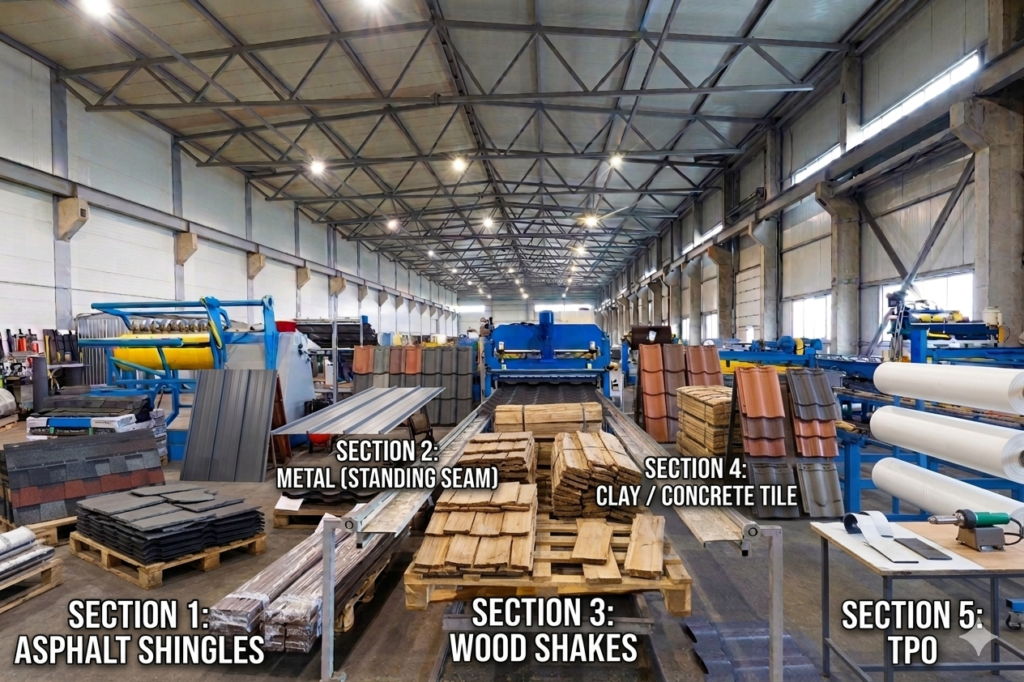
If you’re standing in a home improvement store staring at a dozen different roofing samples — or getting three wildly different quotes from contractors — you’re not alone. Picking a roofing material is one of the biggest decisions a homeowner can make, and there’s no universal right answer. It depends on where you live, how long you plan to stay in the house, what your budget looks like, and honestly, what kind of headaches you’re willing to tolerate over the next 20 to 50 years.
This guide breaks down every major roofing material available in the US market in 2026 — not just a generic list, but real comparisons with actual cost ranges, lifespan data, and the situations where each one makes sense. We’ll also flag where competitors like IKO, Owens Corning, and Sheffield Metals have strong content so you understand exactly what you’re up against in the search results.
Quick note: Costs listed below are installed costs per square foot, including labor. Material-only prices will be significantly lower — but material-only numbers are misleading for any real buying decision.
Quick Comparison: All Roofing Materials at a Glance
Before diving into each material in detail, here’s the full picture side by side. Use this table to quickly narrow down your options based on budget and priorities.
| Material | Cost/Sq Ft | Lifespan | KD Rating | Best For |
| Asphalt Shingles | $3 – $7 | 20–30 yrs | 50 | Most homes, budgets |
| Metal (Standing Seam) | $10 – $18 | 50–70 yrs | 20 | Long-term value |
| Wood Shakes | $6 – $12 | 20–25 yrs | 25 | Aesthetics, dry climates |
| Slate | $15 – $30 | 75–150 yrs | 35 | Premium, historic homes |
| Clay / Concrete Tile | $8 – $20 | 50+ yrs | 30 | Southwest, Spanish-style |
| EPDM (Rubber) | $4 – $8 | 15–25 yrs | 22 | Flat roofs, commercial |
| TPO | $5 – $10 | 15–20 yrs | 28 | Commercial flat roofs |
| Flat Built-Up (BUR) | $4 – $7 | 20–30 yrs | 30 | Commercial, industrial |
Note: Costs vary significantly by region, roof complexity, and labor rates. Texas, Florida, and California typically run 10–20% higher than the national average due to demand. Always get at least three local quotes.
1. Asphalt Shingles — The Most Common Choice in America
There’s a reason asphalt shingles cover roughly 75% of American homes. They’re affordable, easy to install, available everywhere, and most roofing contractors can work with them in their sleep. If you need a roof done fast and within a tight budget, asphalt is almost always going to be the starting point.
There are three main types worth knowing: 3-tab shingles, architectural (or dimensional) shingles, and luxury shingles. Three-tab shingles are the cheapest and thinnest — they look flat and uniform. Architectural shingles have a layered, dimensional look and last longer. Luxury shingles (like Presidential shingles from Certainteed) mimic slate or wood and offer the best performance within the asphalt category.
Cost breakdown
- 3-tab: $3.00 – $4.50 per sq ft installed
- Architectural: $4.00 – $6.00 per sq ft installed
- Luxury/Presidential: $5.50 – $8.00 per sq ft installed
- Average 2,000 sq ft home: $8,000 – $16,000 total
| Pros | Cons |
| ✓ Lowest upfront cost of any material | ✗ Shortest lifespan (20–30 yrs vs 50+ for metal/slate) |
| ✓ Available from every contractor | ✗ Vulnerable to high winds and hail |
| ✓ Wide variety of colors and styles | ✗ Petroleum-based — not the greenest option |
| ✓ DIY-friendly for experienced homeowners | ✗ Can develop algae growth in humid climates |
| ✓ Recyclable through some programs | ✗ Granule loss accelerates in extreme heat |
One thing competitors like IKO and Owens Corning don’t always make clear: their warranty claims assume proper installation and regular maintenance. A 30-year architectural shingle that gets improperly nailed or sits without attic ventilation might fail in 15 years. The material quality matters, but so does everything around it.
Best for: Homeowners who plan to sell within 10–15 years, tight budgets, or anyone replacing a roof quickly after storm damage. Not ideal for areas with frequent hail, high winds, or extreme temperature swings.
2. Metal Roofing — The Long-Game Choice
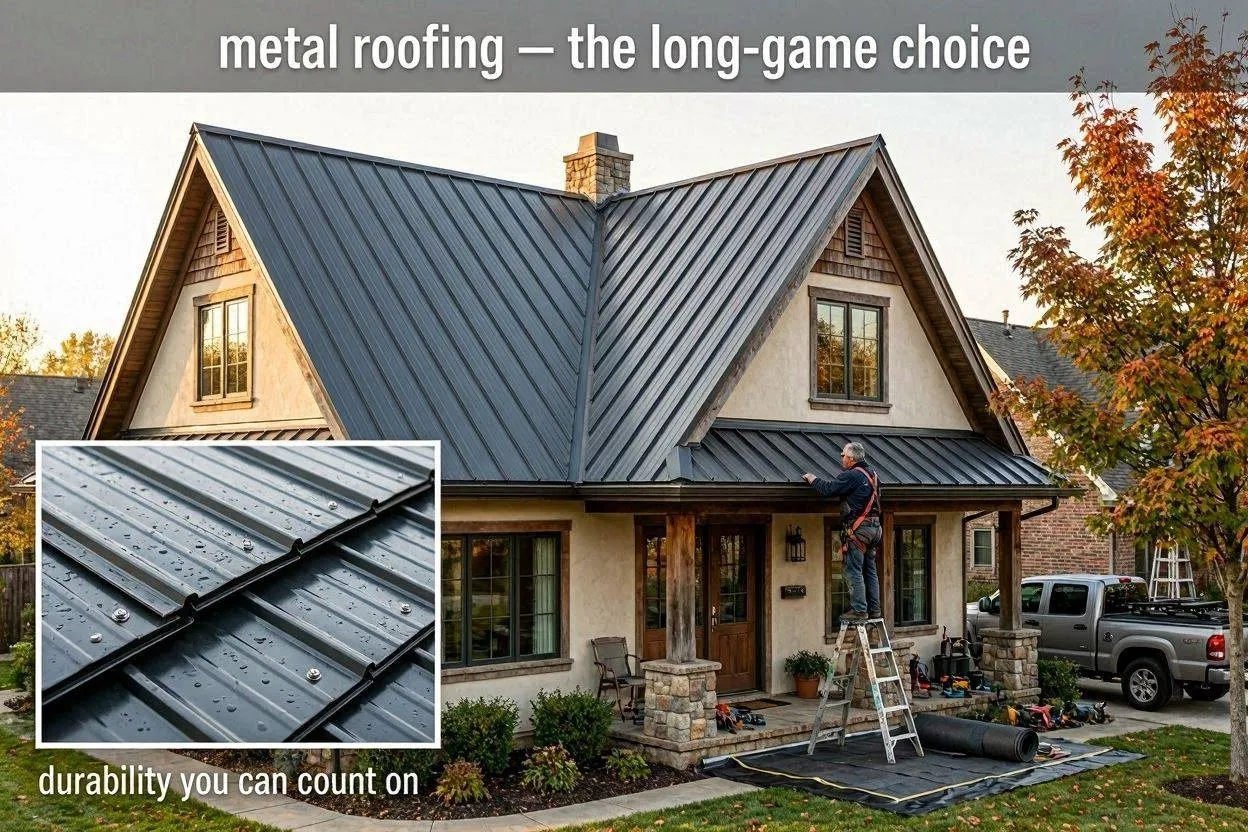
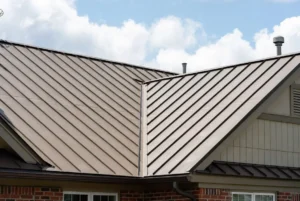
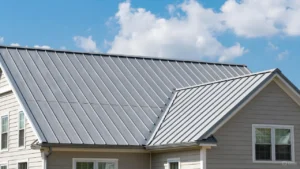
Metal roofing has completely shed its old reputation as something you’d only see on a barn or a factory. Standing seam metal roofs are now one of the fastest-growing residential roofing choices in the US, and for good reason — they last 50 to 70 years with minimal maintenance, shed snow and rain naturally, and can actually lower your cooling bills because they reflect solar heat.
The two main types in residential applications are standing seam and exposed fastener (also called R-panel or metal shingles). Standing seam is the premium option — the metal panels interlock and the fasteners are hidden, which means no screw holes that could leak over time. Exposed fastener systems are cheaper but more prone to eventual fastener failure.
Cost breakdown
- Exposed fastener / R-panel: $6 – $10 per sq ft installed
- Standing seam: $10 – $18 per sq ft installed
- Metal shingles (Kynar-coated): $8 – $14 per sq ft installed
- Average 2,000 sq ft home: $20,000 – $40,000 for standing seam
| Pros | Cons |
| ✓ 50–70 year lifespan — likely the last roof you’ll ever put on | ✗ Highest upfront cost of common residential options |
| ✓ Excellent in high-wind and hail-prone areas | ✗ Dents from large hail (though smaller hail bounces off) |
| ✓ Energy efficient — reflects solar heat | ✗ Noise during rain if not properly insulated |
| ✓ Minimal maintenance required | ✗ Fewer contractors have deep installation expertise |
| ✓ Great resale value addition | ✗ Expansion/contraction can cause issues if not installed correctly |
Sheffield Metals dominates the information space around metal roofing — they have 500+ technical articles and rank for most metal roofing keywords. But their gap is local service intent. They’re a manufacturer. They can tell you everything about standing seam profiles but they can’t come to your house in Houston and install one. That’s exactly where a service-focused page wins.
Best for: Homeowners planning to stay 20+ years, properties in hail or hurricane zones, anyone who wants to stop thinking about their roof for decades. The math on ROI gets very favorable over a 40-year timeframe even with the high upfront cost.
3. Wood Shakes and Shingles — Natural Beauty With Maintenance Demands
Wood roofing has a look that nothing else quite replicates — that warm, textured, organic appearance that makes a house look like it belongs on a magazine cover. Cedar is the most common species used, though pine and redwood also appear regionally. The difference between shakes and shingles is in the cut: shingles are sawn smooth on both sides, while shakes are split (at least on one side), giving a rougher, more rustic texture.
The appeal is real, but so are the demands. Wood needs periodic treatment, it’s susceptible to moisture and rot in humid climates, and it’s a significant fire risk unless treated with fire retardants. Several California counties have outright banned untreated wood shakes after wildfire seasons made the risks undeniable.
Cost breakdown
- Wood shingles: $6 – $9 per sq ft installed
- Hand-split cedar shakes: $8 – $13 per sq ft installed
- Average 2,000 sq ft home: $14,000 – $26,000
| Pros | Cons |
| ✓ Distinctive, premium natural aesthetic | ✗ Requires maintenance every 3–5 years (cleaning, sealing) |
| ✓ Good insulation properties | ✗ Not suitable for high-humidity climates without treatment |
| ✓ Environmentally renewable (if sustainably sourced) | ✗ Fire risk unless chemically treated |
| ✓ Can be repaired piece by piece rather than full replacement | ✗ Many insurance companies charge higher premiums |
| ✗ Shorter lifespan than metal or slate |
Best for: Dry climates (Colorado, parts of the Pacific Northwest, New England), historic homes where aesthetics are a priority, and homeowners who enjoy maintaining their property. Avoid in Florida, Louisiana, or any coastal humid environment.
4. Slate Roofing — The Premium That Outlives Everyone
Natural slate is in a category of its own. A properly installed slate roof can last 75 to 150 years — there are churches and historic homes in New England with original slate roofs that went up before the Civil War. It’s the only roofing material where the realistic expectation is that you will never have to replace it in your lifetime.
That permanence comes at a steep price. Slate is heavy (often requiring structural reinforcement), expensive to purchase, expensive to install because it requires specialized craftsmen, and expensive to repair when individual tiles crack. Finding a contractor who actually knows how to work with slate is genuinely difficult in most US markets.
Cost breakdown
- Soft slate (20–40 year variety): $10 – $20 per sq ft installed
- Hard slate (75–150 year variety): $20 – $30 per sq ft installed
- Synthetic slate alternatives: $7 – $12 per sq ft
- Average 2,000 sq ft home: $40,000 – $60,000+ for natural hard slate
| Pros | Cons |
| ✓ Longest lifespan of any roofing material — 75 to 150 years | ✗ Highest cost of any roofing option |
| ✓ Extremely resistant to fire, rot, and insects | ✗ Very heavy — structural reinforcement often required |
| ✓ Increases property value significantly | ✗ Fragile during installation; walking on it risks cracking |
| ✓ Low maintenance once installed correctly | ✗ Extremely limited pool of qualified installers |
| ✓ Stunning, timeless aesthetic | ✗ Individual tile replacement is costly and hard to match |
Best for: Older homes built to support the weight, historic preservation projects, buyers who are committed to a property long-term and want to make a once-in-a-lifetime investment. Not practical for most new construction budgets.
5. Clay and Concrete Tiles — Dominant in the Sun Belt
If you drive through any neighborhood in Phoenix, Miami, or San Diego, clay and concrete tiles are everywhere. They’re a perfect fit for the Southwest and Southeast — they handle UV radiation and heat exceptionally well, they’re naturally resistant to pests and rot, and they last 50 years or longer with minimal attention.
Clay tiles are the original version — fired ceramic that has been used for roofing for thousands of years. Concrete tiles are heavier and cheaper to produce, and they’ve become the dominant option in Florida and California new construction. Both share the same fundamental drawback: weight. Like slate, tile roofs often require structural reinforcement, which adds cost and complexity to retrofits.
Cost breakdown
- Concrete tiles: $8 – $15 per sq ft installed
- Clay tiles: $12 – $22 per sq ft installed
- Average 2,000 sq ft home: $18,000 – $40,000
| Pros | Cons |
| ✓ 50+ year lifespan typical for well-maintained installations | ✗ Heavy — many existing homes need structural upgrades |
| ✓ Exceptional in heat, UV, and dry climates | ✗ Brittle — tiles can crack if walked on improperly |
| ✓ Fire resistant — Class A rating | ✗ More expensive than asphalt or metal (installed cost) |
| ✓ Very low maintenance in dry conditions | ✗ Not ideal for cold climates — freeze-thaw cycles cause cracking |
| ✓ Excellent curb appeal in appropriate architectural styles | ✗ Moss and algae growth in humid regions |
Best for: Homes in Texas, Florida, California, Arizona, and New Mexico — especially Spanish, Mediterranean, or Mission-style architecture. Poor choice for the Midwest, Northeast, or anywhere with significant freeze-thaw weather.
6. Flat Roof Materials — EPDM, TPO, and Built-Up Roofing
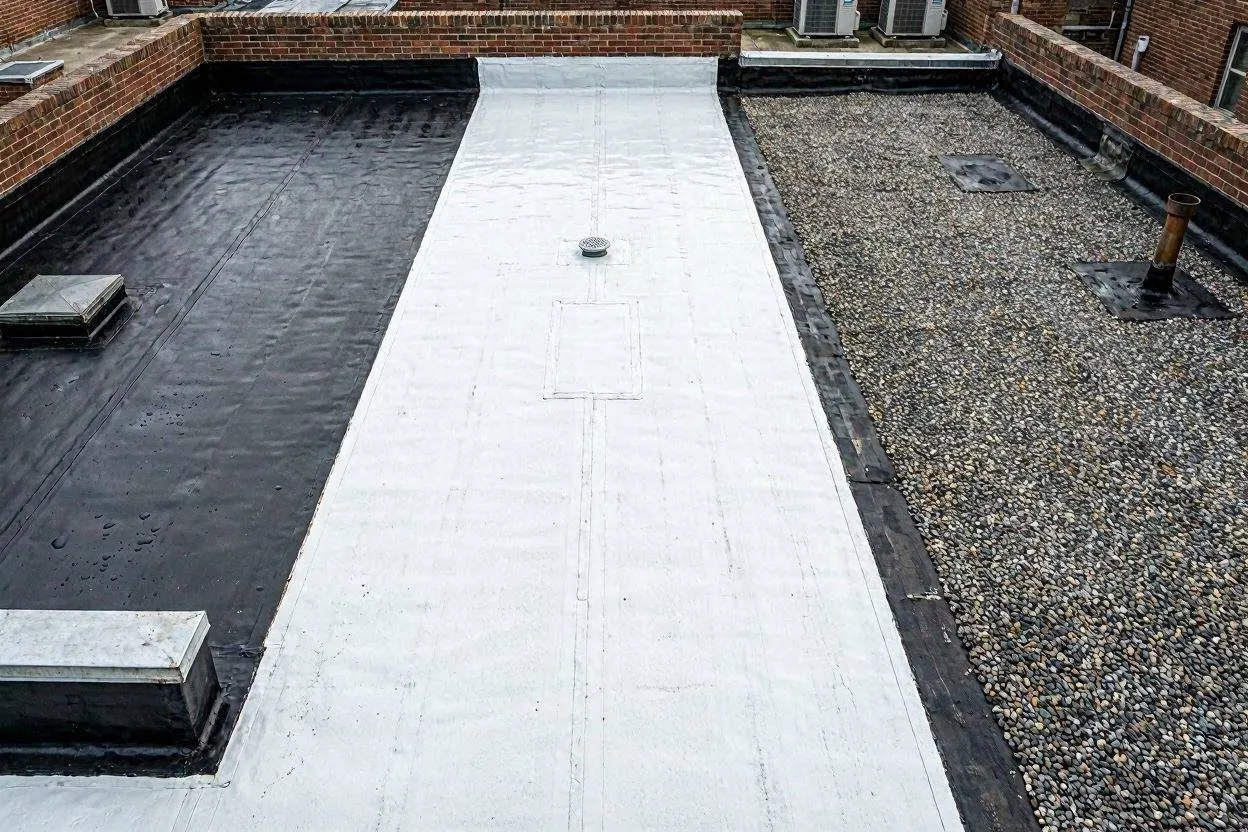
Flat roofs are almost universal in commercial construction and increasingly common in modern residential designs. But ‘flat’ is actually a misnomer — these roofs have a slight pitch (usually 1/4 inch per foot) to allow water drainage. They just look flat from street level. The three dominant materials are EPDM, TPO, and built-up roofing (BUR), each with distinct characteristics.
EPDM (Ethylene Propylene Diene Monomer) — Rubber Roofing
EPDM is a synthetic rubber membrane that’s been the commercial roofing standard for decades. It’s flexible, durable in cold weather, and relatively forgiving of minor ponding water. Installation involves adhering large rubber sheets to the roof deck, which makes it one of the faster flat roof installations when conditions are right.
- Cost: $4 – $8 per sq ft installed
- Lifespan: 15–25 years
- Best in: Cold climates, low-slope residential roofs, smaller commercial buildings
TPO (Thermoplastic Polyolefin) — The Commercial Favorite
TPO has become the most widely installed commercial roofing membrane in the country, largely because it’s white or light-colored (reflecting heat), relatively affordable, and heat-welded at the seams for a strong, waterproof bond. Simon Roofing dominates commercial roofing SEO, but their residential content is thin — a clear gap for service-first sites.
- Cost: $5 – $10 per sq ft installed
- Lifespan: 15–20 years
- Best in: Commercial properties, warm climates, energy-efficiency-focused projects
Built-Up Roofing (BUR)
BUR — also called tar and gravel — is the traditional flat roof system, built up in multiple layers of roofing felt and bitumen. It’s heavy, labor-intensive, and slower to install than membranes, but it’s extremely durable and time-tested. Many commercial buildings have BUR roofs that have lasted 30+ years.
- Cost: $4 – $7 per sq ft installed
- Lifespan: 20–30 years with maintenance
- Best in: Large commercial flat roofs, industrial applications
How to Actually Choose the Right Roofing Material
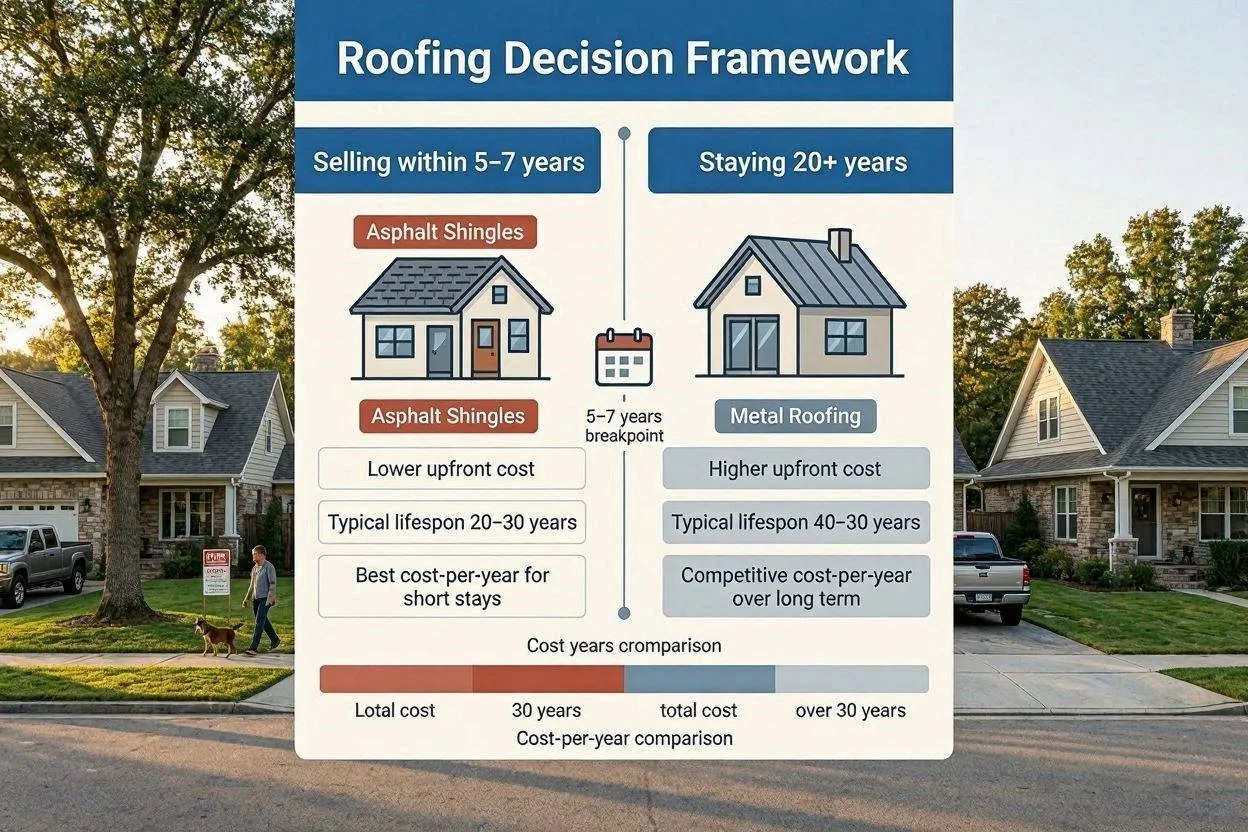
The comparison tables and cost figures are useful, but they don’t make the decision for you. Here’s a practical framework for how most homeowners and property managers should approach this:
How long are you staying? If you’re selling within 5–7 years, asphalt shingles almost always make the most financial sense. If you’re staying 20+ years, metal roofing’s higher upfront cost becomes genuinely competitive on a cost-per-year basis.
Where do you live? Climate is probably the most underweighted factor in these decisions. Metal is exceptional for hail (Texas, Colorado, Oklahoma), clay tile is built for the Southwest, EPDM handles cold climates well, and wood shakes are a bad idea in Florida.
What’s your risk tolerance for storm damage? If you’re in a hurricane or hail belt, your material choice directly affects your insurance premium and your claim experience. Impact-resistant metal or Class 4 shingles can save hundreds per year in premiums — sometimes enough to offset the cost difference.
What does your insurance company say? Before finalizing any material choice, call your insurance provider. Some materials trigger significant premium changes. Some older wood shake roofs are actually uninsurable in certain markets now.
How long does each roofing material last?
- Asphalt shingles (3-tab): 20–25 years
- Architectural asphalt: 25–30 years
- Exposed fastener metal: 30–45 years
- Standing seam metal: 50–70 years
- Wood shakes: 20–25 years (with maintenance)
- Clay / concrete tile: 50+ years
- Natural slate: 75–150 years
- EPDM rubber: 15–25 years
- TPO: 15–20 years
Not sure which material is right for your home?
RainyRoofers offers free roof inspections across the US. Our licensed inspectors will assess your existing roof, local weather patterns, and budget — then give you an honest recommendation with no sales pressure.
Conclusion
Choosing a roofing material comes down to three factors: how long you’re staying, where you live, and what you can afford upfront versus over time. Asphalt shingles win on cost and availability. Metal roofing wins on longevity and storm resistance. Slate and tile serve homeowners who want a roof that outlasts the mortgage. Flat roof materials like EPDM and TPO fit low-slope and commercial applications where membrane systems make more sense than shingles or panels.
No single material is “best.” The right choice depends on your climate, your budget, and your timeline. A homeowner in hail-prone Texas has different priorities than one in humid Florida or dry Colorado.