
Your roof is failing right now and you probably don’t know it yet. Most homeowners only think about their roof after a leak shows up on the ceiling. By then, the damage has already spread to the decking, insulation, and sometimes the walls. A small repair that costs $300–$500 turns into a full replacement at $8,000–$20,000.
This guide gives you 12 specific signs to check today. You’ll also find out how long your roof actually has left, what replacement costs in 2025, and the 5 questions every homeowner should ask before hiring a roofer.
How Long Does a Roof Actually Last?
The lifespan of a roof depends entirely on material, climate, and installation quality. Here are the real numbers:
| Roofing Material | Average Lifespan | Maintenance Level |
| Asphalt shingles | 15–25 years | Moderate |
| Composite shingles | 25–50 years | Low |
| Wood shingles (cedar) | 20–30 years | High |
| Metal roofing | 40–80 years | Low |
| Clay tile | 40–100 years | Low |
| Slate tile | 75–200 years | Very low |
| Rubber roofing | 30–50 years | Low |
Asphalt shingles cover around 80% of homes in the U.S., so most homeowners work with a 15–25 year window. Harsh climates — heavy snow in Minnesota, salt air in coastal Florida, extreme UV heat in Texas — cut that lifespan by 3–7 years. If your roof is over 20 years old, read every sign below carefully.
12 Signs You Need a New Roof
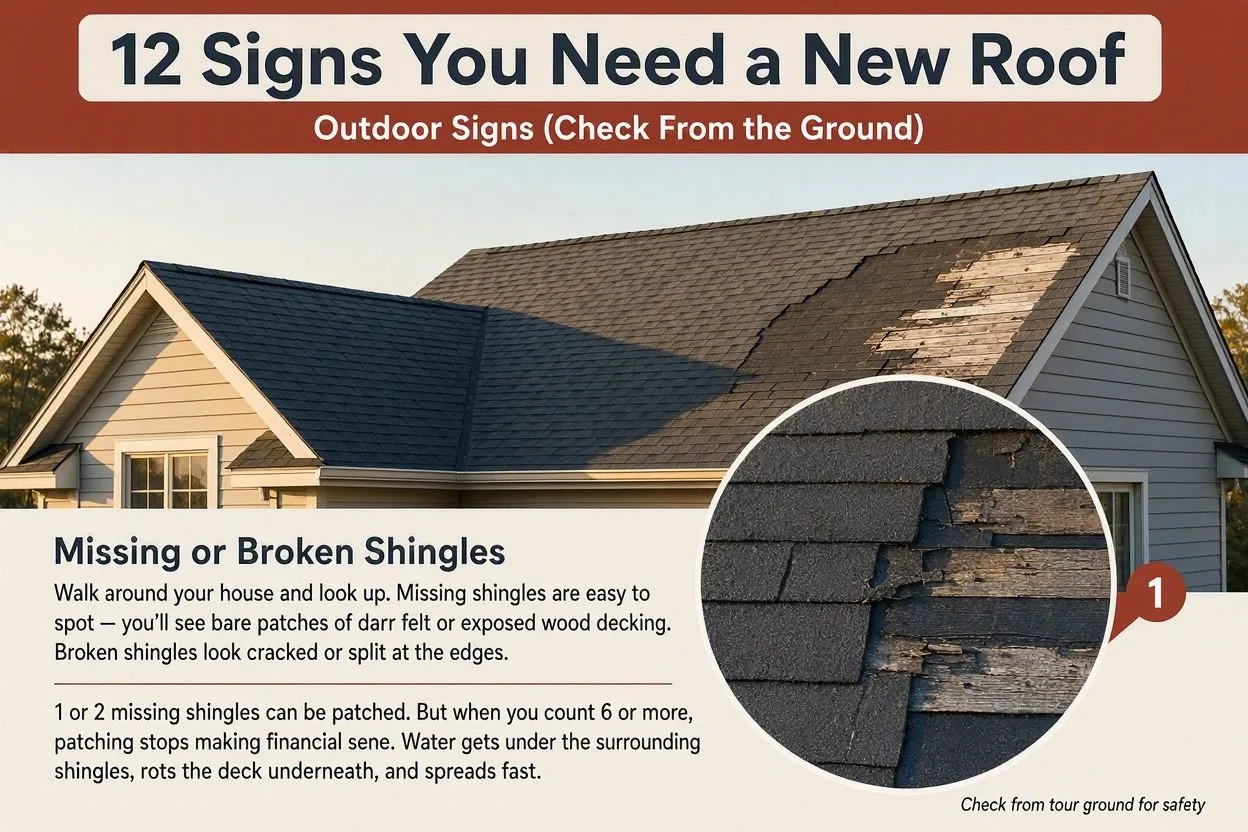
Outdoor Signs (Check From the Ground)
Missing or Broken Shingles
Walk around your house and look up. Missing shingles are easy to spot — you’ll see bare patches of dark felt or exposed wood decking. Broken shingles look cracked or split at the edges.
1 or 2 missing shingles can be patched. But when you count 6 or more, patching stops making financial sense. Water gets under the surrounding shingles, rots the deck underneath, and spreads fast. Use binoculars or a drone camera to get a better look without climbing up.
Curling or Cupping Shingles
Shingles curl in 2 directions. Cupping means the edges turn upward. Curling (also called clawing) means the middle lifts while edges stay flat. Both happen when moisture and heat cause the shingle layers to separate.
Curling shingles are a clear sign that the material has dried out and lost flexibility. At this stage, replacement is closer than repair.
Granules Collecting in Your Gutters
Asphalt shingles have a layer of crushed stone granules on the surface. These granules block UV rays and protect the asphalt underneath. When they fall off, the shingle starts aging 3–5x faster.
Clean your gutters and look for gritty, sand-like debris. A small amount is normal on new roofs. Heavy granule loss especially if the roof is 10+ years old means the shingles are burning out.
Moss, Algae, or Mold on the Surface
Green patches on your roof are not just ugly they trap moisture against the shingle surface for days after it rains. That constant dampness works into the cracks of aging shingles and accelerates rot.
Algae shows as black streaks running down the roof face. Moss appears as raised, fuzzy green patches, usually on the north-facing slope or under tree shade.
Don’t scrape moss off yourself. A stiff brush damages the granules and shortens the shingle life further. Call a roofing professional to treat and remove it properly.
Indoor Signs (Check From Inside Your Home)
Most homeowners never look indoors for roof problems. This is where damage hides longest and costs the most when finally found.
Water Stains on Ceilings or Walls
Brown or yellow rings on the ceiling mean water is sitting somewhere above it. The stain itself may be far from where the leak enters water travels along rafters and joists before dripping down.
Check every room, including closets. Also check the attic floor for dark wet patches after heavy rain. One stain can mean a missing shingle. Multiple stains in different rooms signal widespread deck failure.
Musty Smell in the Attic
Climb into your attic and breathe. A musty, damp smell means moisture is entering and sitting. Poor attic ventilation combined with a failing roof creates the perfect environment for mold to grow inside the roof deck — invisible from the outside.
Mold on roof decking spreads to rafters, insulation, and eventually the ceiling drywall below. Catching it early saves thousands.
Daylight Coming Through Roof Boards
Go into your attic on a bright day and turn off the lights. Look up at the roof deck. Pinpoints of light mean there are gaps — cracks, nail holes, or failed seams — where water gets in.
Any visible daylight through roof boards means water is already entering. This is not a repair situation. That section of decking needs replacement.
Sudden Rise in Energy Bills
Your roof acts as the main thermal barrier between your home and the outside. When shingles fail, attic ventilation drops, and outside heat or cold pushes directly through the ceiling. Your HVAC (heating, ventilation, and air conditioning) system runs longer to compensate.
If your summer cooling bill increased 15–25% without an obvious reason, check the roof and attic insulation together. A deteriorating roof is one of the top 3 causes of unexplained energy bill spikes in older homes.
Structural Signs (Serious Act Fast)
Sagging or Uneven Roofline
Stand at the end of your driveway and look at the ridgeline — the horizontal peak at the top of the roof. It should be perfectly straight. Any dip, wave, or curve means the structural supports underneath are weakening.
A sagging roofline signals rot or water damage in the rafters or decking. Left unaddressed, the section can fail during the next heavy snow or wind event. This is a structural emergency, not a cosmetic issue.
Call a licensed roofing contractor within 48 hours if you spot this.
Damaged or Rusted Flashing
Flashing is the thin metal strips around chimneys, skylights, roof vents, and wall joints. Flashing creates the watertight seal between the roof surface and anything that protrudes through it.
Cracked caulk, rust spots, lifted edges, or missing sections of flashing allow water to pour directly into the roof structure with every rain. Flashing damage is one of the most common causes of interior leaks — and one of the most overlooked during a visual inspection.
Age and Repair History Signs
The Roof Is 20+ Years Old
An asphalt shingle roof that is 20 years old is not in its final years — it is past its average service life in most U.S. climates. Even if the roof looks fine from the ground, the granule layer has thinned, the asphalt has dried, and the shingles are brittle underneath.
Get a professional inspection every year once your roof passes the 15-year mark. If you bought the home recently and don’t know the roof age, check the building permit records at your local city or county office.
You’re Patching the Same Spots Repeatedly
If a roofer has fixed the same leak twice, or if you’ve replaced shingles in the same area 3 or more times, the underlying deck or underlayment has failed. Patches stop water temporarily but don’t fix rotted wood or failed moisture barriers.
At this point, every repair dollar spent delays an inevitable replacement. Most roofing contractors will tell you straight: after the 3rd patch on the same area, replacement is the better investment.
Repair vs. Restore vs. Replace, How to Decide
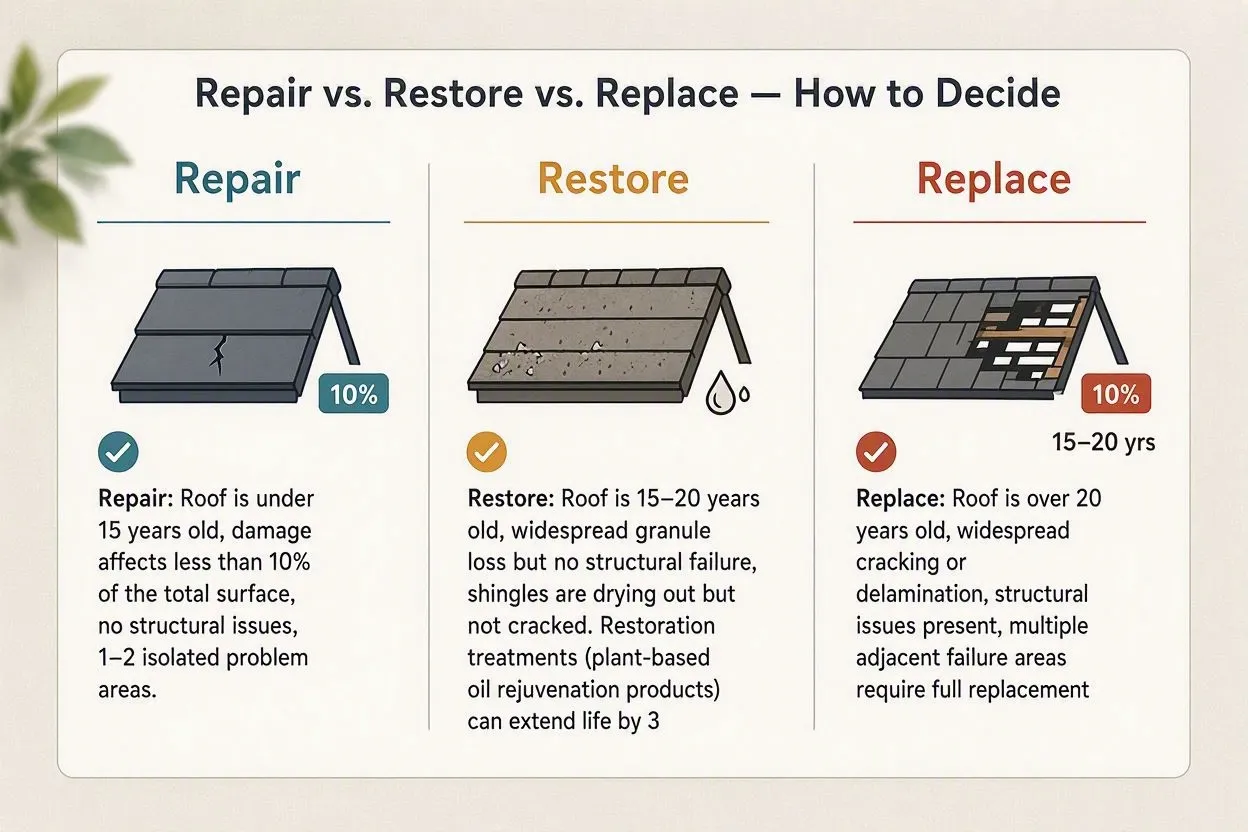
Competitors tell you to “call a professional.” Here is an actual decision framework:
Repair: Roof is under 15 years old, damage affects less than 10% of the total surface, no structural issues, 1–2 isolated problem areas.
Restore: Roof is 15–20 years old, widespread granule loss but no structural failure, shingles are drying out but not cracked. Restoration treatments (plant-based oil rejuvenation products) can extend life by 3–5 years at a fraction of replacement cost.
Replace: Roof is 20+ years old, damage covers more than 30% of the surface, structural sagging is present, multiple indoor signs (stains, smell, daylight) are visible, or you’ve patched the same area 3+ times.
When in doubt, get 3 separate contractor quotes. A trustworthy roofer will tell you honestly if repair is still viable.
Best Time of Year to Replace a Roof
Late summer and early fall (August–October) is the best window for roof replacement in most U.S. regions. Here’s why:
Temperature affects how asphalt shingles seal. Shingles need ambient temperatures of at least 40°F (4°C) to bond properly. Late summer gives warm days without extreme July heat that makes shingle installation physically harder and faster-aging.
Spring (April–May) is the second-best window — dry weather, moderate temperatures, and contractors coming off the slower winter season, which sometimes means better pricing.
Avoid replacing a roof in December–February in cold climates. Shingles installed below 40°F (4°C) don’t seal properly and may lift during the first spring wind storm.
Pro tip: Booking a replacement in November or February (off-season) saves homeowners 5–15% on labor costs in most markets, since demand drops sharply after the fall rush.
How Much Does Roof Replacement Cost in 2026?
The national average for a full roof replacement in the U.S. sits at $8,500–$22,000 for a standard single-family home, depending on 4 factors:
- Roof size — measured in “squares” (1 square = 100 sq ft / 9.3 sq m). Most homes range from 15–40 squares.
- Material — asphalt shingles cost $3.50–$5.50 per sq ft ($37–$59 per sq m). Metal roofing runs $7–$14 per sq ft ($75–$150 per sq m). Slate and clay tile cost $10–$30 per sq ft ($107–$322 per sq m).
- Labor — accounts for 40–60% of the total cost. Labor rates vary by region: $1.50–$3.00 per sq ft ($16–$32 per sq m) in most U.S. markets.
- Extras — old roof removal adds $1–$2 per sq ft ($10–$21 per sq m). New flashing, permits, and disposal fees add $500–$2,000 on top.
Get a minimum of 3 written quotes before signing anything. Ask each contractor to break out materials, labor, removal, and disposal separately on the quote sheet.
Does Homeowners Insurance Cover Roof Replacement?
Yes, if the damage is sudden and caused by a covered event. Standard homeowners insurance (HOI) covers roof damage from hail, wind, fallen trees, and fire. HOI does not cover damage from normal wear and aging.
After a major storm, follow these 5 steps:
- Document damage with photos and video within 24 hours
- Call your insurance company and open a claim
- Get a licensed contractor to provide a written damage assessment
- Meet the insurance adjuster at the property with the contractor present
- Get 3 contractor estimates before accepting the adjuster’s repair figure
Adjusters sometimes undervalue roof replacement claims. Having a contractor on-site during the adjuster visit increases the chance of a fair payout.
5 Questions to Ask Your Roofing Contractor
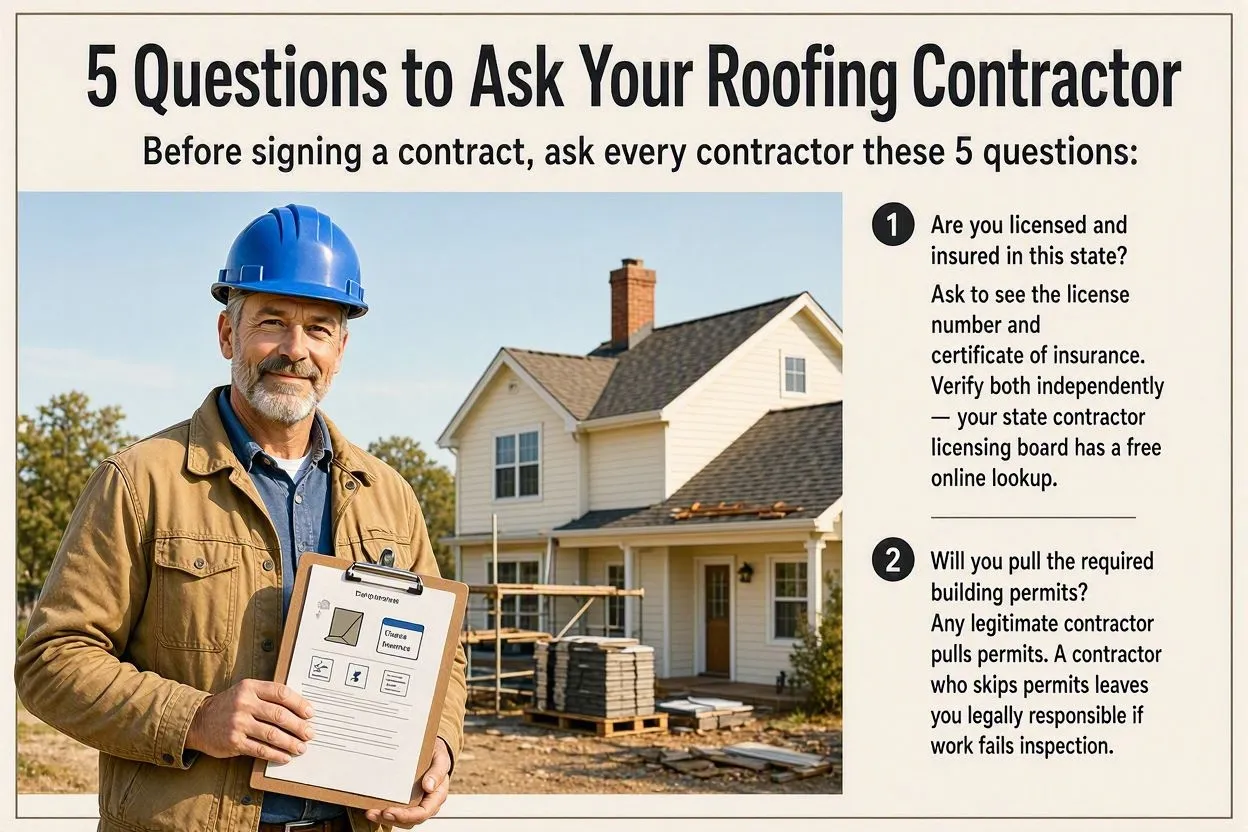
Before signing a contract, ask every contractor these 5 questions:
- Are you licensed and insured in this state? Ask to see the license number and certificate of insurance. Verify both independently — your state contractor licensing board has a free online lookup.
- Will you pull the required building permits? Any legitimate contractor pulls permits. A contractor who skips permits leaves you legally responsible if work fails inspection.
- Will you remove the existing roof or install over it? Installing new shingles over old ones hides rotted decking and voids most manufacturer warranties. Always remove the old roof first.
- How do you handle disposal of old materials? A professional brings a roll-off dumpster. Get confirmation in writing — some contractors leave debris cleanup to the homeowner.
- What warranty comes with the work? Materials carry manufacturer warranties (25–50 years on premium shingles). Workmanship warranties should cover at least 5 years. Get both in writing before work begins.
Repair vs. Replace: A Quick Cost Comparison
| Situation | Best Option | Estimated Cost |
| 1–5 missing shingles, roof under 15 yrs | Repair | $150–$500 |
| Flashing leak, no deck damage | Repair | $200–$600 |
| Granule loss, roof 15–20 yrs old | Restore | $1,000–$3,500 |
| Leak from aging deck, roof 20+ yrs | Replace | $8,500–$22,000 |
| Sagging + interior water stains | Replace immediately | $10,000–$25,000 |
So here’s what to do right now:
Go outside and look up. Check your gutters after the next rain. Climb into your attic with the lights off. If you spotted even 2–3 signs from this guide, book a professional inspection this week — not next month.
A licensed roofing contractor can tell you in 30 minutes whether you’re looking at a $300 patch, a $2,000 restoration, or a full replacement. That 30-minute inspection could save you $10,000–$20,000 in avoidable damage down the road. Your roof is your home’s first line of defense. Treat it like one.
Conclusion
Your roof gives you warning signs long before it fails completely, and catching them early separates a $300 patch from a $20,000 replacement. Missing shingles, granule loss in the gutters, water stains on ceilings, and a sagging ridgeline all point to the same underlying question: is the damage still isolated, or has it spread to the deck and structure?
Use the age of your roof as your starting filter. A roof under 15 years old with isolated damage almost always qualifies for repair. A roof between 15 and 20 years old with widespread granule loss but no structural failure is a candidate for restoration. A roof past 20 years, or one showing structural sagging and multiple indoor signs together, needs replacement.
Don’t wait for a leak to confirm what the outdoor and indoor signs already told you. Schedule a professional inspection the moment you spot two or more signs from this guide, get three written quotes, and ask each contractor the five questions above before signing anything. The inspection costs you 30 minutes. Skipping it can cost you tens of thousands of dollars in deck, insulation, and structural repairs you didn’t need to pay for.