
You’ve called three contractors for quotes. One says “I need to come see it.” Another says “email me photos.” The third ghosted you completely.
You just want a ballpark number before wasting time on site visits and sales pitches.
Here’s how to calculate your standing seam metal roof cost yourself using the exact formula contractors use.
Why Online Calculators Are Useless
Most “cost calculators” online are garbage.
They ask for your zip code and roof size, then spit out a range so wide it’s meaningless. “$18,000-$45,000” doesn’t help you budget.
The problem? Every roof is different. Online tools can’t see your pitch, count your valleys, or assess your complexity.
But you CAN estimate your own cost if you understand the variables contractors use.
It takes 15 minutes and gets you within 10-15% of actual quotes.
Step 1: Measure Your Roof Square Footage
You need your roof’s square footage, not your home’s square footage.
Quick estimate method:
Home square footage × 1.5 = approximate roof square footage
A 2,000 sq ft home = roughly 3,000 sq ft of roof surface.
This works for simple roofs with moderate pitch. Complex roofs with multiple stories? This underestimates.
Accurate method:
Measure each roof section separately. Length × width for each plane. Add them all together.
For pitched roofs, account for pitch multiplier:
- 4:12 pitch = multiply by 1.06
- 6:12 pitch = multiply by 1.12
- 8:12 pitch = multiply by 1.20
- 12:12 pitch = multiply by 1.41
Example: Roof section is 40′ × 30′ with 6:12 pitch
- Base area: 40 × 30 = 1,200 sq ft
- Pitch multiplier: 1,200 × 1.12 = 1,344 sq ft actual
Do this for every roof plane, then add them up.
If you’re not comfortable on the roof, use Google Earth’s measurement tool or hire a roofer to measure ($100-$200).
Read our related guide about Standing Seam Metal Roof Cost Per Square Foot: Real 2025 Pricing
Step 2: Choose Your Base Material Cost
Pick your metal type and quality level.
Steel (Galvalume) with standard SMP coating: Base cost: $11 per square foot installed
Steel with premium PVDF coating (Kynar 500): Base cost: $13 per square foot installed
Aluminum with PVDF coating: Base cost: $14 per square foot installed
Copper: Base cost: $28 per square foot installed
For most people, steel with PVDF coating is the sweet spot. That’s your $13/sq ft baseline.
Example calculation: 2,000 sq ft roof × $13 = $26,000 base estimate

Step 3: Add Complexity Factors
This is where your estimate gets accurate.
Roof pitch adjustment:
- 4:12 or less: No adjustment (baseline)
- 6:12 to 8:12: Add 10%
- 9:12 to 12:12: Add 25%
- Over 12:12: Add 40%
Steep roofs require safety equipment and slow installation.
Roof complexity adjustment:
Simple gable (two roof planes, no valleys): No adjustment
Moderate complexity (some valleys, basic hip roof): Add 15%
High complexity (multiple dormers, valleys, skylights): Add 30%
Very complex (Victorian, multiple stories, tons of penetrations): Add 50%
Accessibility adjustment:
Easy access from driveway: No adjustment
Difficult access (backyard, tight spaces): Add 10%
Multi-story or gated/restricted: Add 15%
Example continuing from Step 2:
- Base: $26,000
- Pitch (8:12): $26,000 × 1.10 = $28,600
- Complexity (moderate): $28,600 × 1.15 = $32,890
- Accessibility (easy): No change
Estimated cost: $32,890
Round to $33,000 for your planning number.
Step 4: Account for Extras
Base calculations don’t include everything.
Add these if applicable:
Tear-off and disposal: $1-$2 per sq ft
- 2,000 sq ft = add $2,000-$4,000
Deck repairs (if needed): $2-$5 per sq ft for damaged areas
- Estimate 10-20% of roof needs repair = add $1,000-$3,000
Skylights (each): $800-$1,500
New chimneys flashing: $600-$1,000
Upgraded ventilation: $500-$1,500
Continuing example with tear-off: $33,000 + $3,000 (tear-off) = $36,000 total estimate
Step 5: Apply Regional Adjustments
Where you live affects labor costs.
Regional multipliers:
Midwest: Use baseline (no adjustment)
South: Multiply by 0.95 (5% lower)
Northeast: Multiply by 1.15 (15% higher)
West Coast: Multiply by 1.20 (20% higher)
Florida (coastal): Multiply by 1.10-1.25 (hurricane codes)
Example for Northeast location: $36,000 × 1.15 = $41,400
Real Example Walkthrough
Let me show you an actual project I estimated.
Client specs:
- Home: 2,400 sq ft ranch
- Roof: 3,200 sq ft actual (measured)
- Pitch: 5:12
- Complexity: Simple gable, one small valley
- Location: Ohio (Midwest)
- Material choice: Steel with PVDF
- Tear-off needed: Yes
Calculation:
Step 1: Roof size = 3,200 sq ft ✓
Step 2: Base material cost 3,200 × $13 = $41,600
Step 3: Adjustments
- Pitch (5:12): No adjustment needed
- Complexity (simple with one valley): 1.05 multiplier
- $41,600 × 1.05 = $43,680
Step 4: Extras
- Tear-off: 3,200 × $1.50 = $4,800
- Total: $43,680 + $4,800 = $48,480
Step 5: Regional
- Midwest: No adjustment
- Final estimate: $48,500
Actual quotes he received: $46,800, $49,200, $52,000
My calculator estimate: $48,500 (right in the middle)
When Calculator Estimates Fail
This formula works for 80% of projects. It fails for:
Extremely complex roofs: Multiple roof planes at different heights, extensive dormers, complicated valleys. These need professional assessment.
Structural issues: If your decking is compromised, estimates blow up. You can’t know this without inspection.
Local code requirements: Some jurisdictions require specific upgrades (hurricane straps, enhanced ventilation) that add costs.
Material shortages: Steel prices fluctuate. Your $13/sq ft baseline might be $15/sq ft during shortages.
A friend tried to estimate his Victorian home’s roof using this method. He calculated $38,000. Actual quotes came in at $52,000-$58,000.
Why? His roof had 12 dormers, 8 valleys, 11:12 pitch, and three different roof levels. Way too complex for simple calculations.
For standard ranch homes, split-levels, and simple two-stories? This formula nails it.
How to Use Your Estimate
Your calculated number is a planning tool, not a final budget.
Add 10-15% buffer for unknowns: If you calculate $30,000, budget $33,000-$34,500.
Use it to filter quotes: If you estimate $32,000 and get quotes at $28,000, $31,000, and $48,000—the $48,000 guy is overpricing or found issues you missed. The $28,000 guy is cutting corners.
Know when to walk away: Someone quotes you 50% over your estimate? Get second opinions before assuming you’re wrong.
At Rainy Roofers, we give itemized quotes showing exactly how we calculated costs. If your DIY estimate is close to our quote, you did it right.
FAQs About Cost Estimation
How accurate is a DIY cost calculator?
Using this method, you’ll get within 10-15% of actual quotes for simple to moderate complexity roofs. Complex roofs with lots of features? Professional assessment needed.
What if my estimate doesn’t match contractor quotes?
Check your square footage measurement—this is where most errors happen. Verify your complexity assessment. Then get 3-5 quotes to see if contractors are consistent.
Can I use this for other metal roofing types?
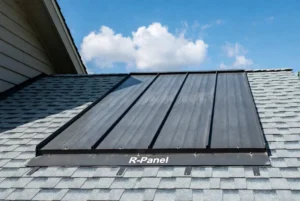
Yes, but adjust base costs. PBR panels and R-Panel metal roofing run $7-$12/sq ft instead of $10-$16. Same calculation method, different starting number.
Should I share my estimate with contractors?
No. Get their quotes first, then compare to your estimate. If you tell them your number, they’ll just match it.
What’s the most common calculation mistake?
Using home square footage instead of roof square footage. Your 2,000 sq ft home probably has 2,800-3,200 sq ft of roof surface.
The Bottom Line on Estimating
Here’s your takeaway.
You can estimate your standing seam metal roof cost accurately enough to budget and filter quotes.
Measure roof size. Choose base material cost ($11-$14/sq ft). Add complexity factors. Include extras. Apply regional adjustments.
For simple roofs, you’ll be within $2,000-$4,000 of actual quotes. For complex roofs, you’ll be close enough to know if quotes are reasonable.
Then get 3-5 professional quotes and compare.
At Rainy Roofers, we respect educated customers. Do your homework, run your numbers, then call us for an itemized quote.
Your estimate tells you what’s reasonable. Professional quotes tell you what’s real