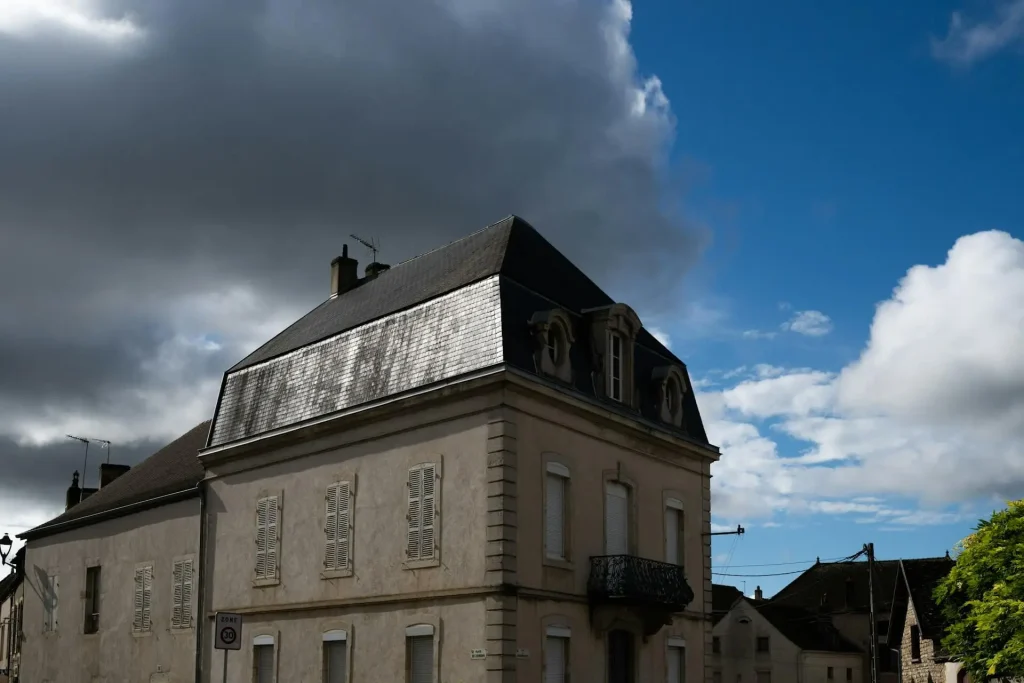
The mansard roof looks incredible on paper extra attic space, classic French architecture, that Tudor cottage vibe everyone loves. Then you get the replacement quote and nearly pass out. I’ve walked homeowners through this exact scenario dozens of times. That beautiful double-mansard roof sloped roof you fell in love with? It’s about to become your most expensive home maintenance project.
Let me break down what a mansard roof actually is and what you’re signing up for.
What Is a Mansard Roof? (Definition & Overview)
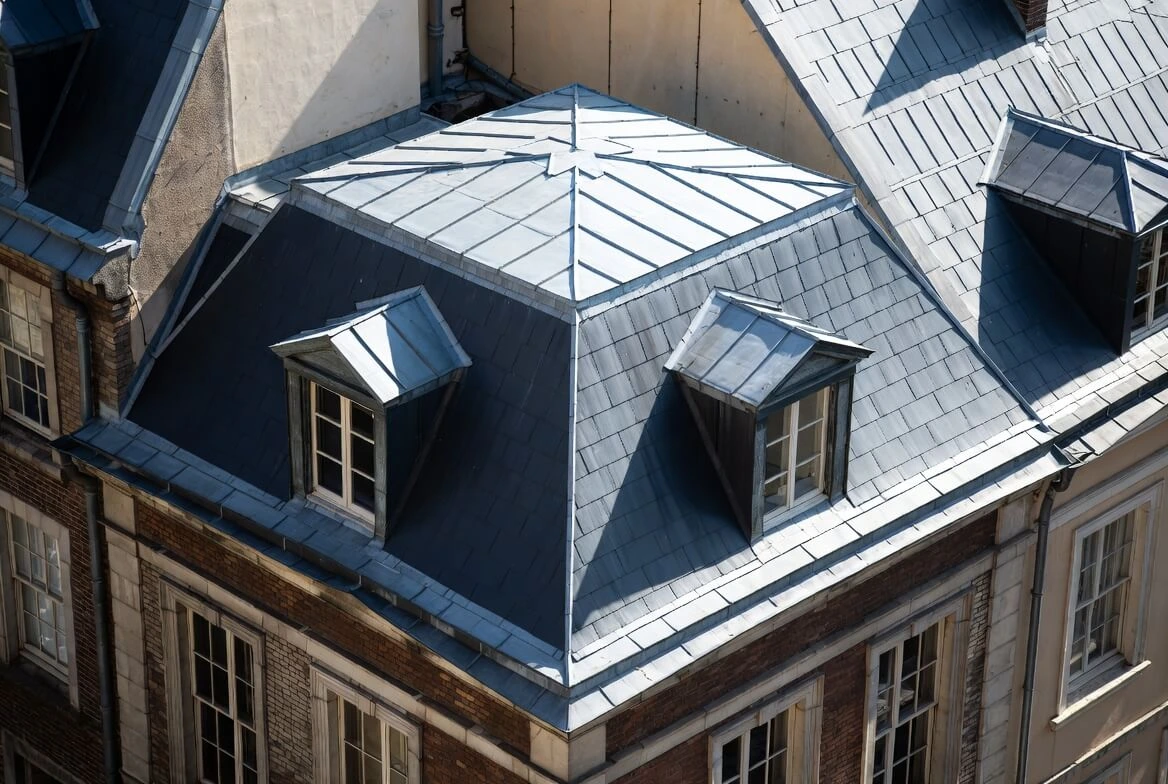
A mansard roof (also called a French roof or curb roof) is a four-sided roof with two distinct slopes on each side. The lower slope is extremely steep typically 70–80 degrees, appearing nearly vertical from the street. The upper slope is much more gradual, around 30–35 degrees, and is often completely invisible from ground level.
Think of it as your home’s upper walls being made of roof instead of siding. That’s the simplest way to visualize it. The result is a boxy, full-height upper story entirely under the roof structure that functions as usable living space.
Mansard Roof Quick Facts
- Also known as: French roof, curb roof
- Lower slope pitch: 70–80 degrees (near-vertical)
- Upper slope pitch: 30–35 degrees (low)
- Sides: Four (wraps all four sides of the building)
- Origin: 16th-century France (popularized 17th century)
- Average replacement cost: $15,000–$40,000+
- Best for: Maximizing attic/living space, urban homes, historic style
Mansard Roof History: From the Louvre to Suburban America
The mansard roof style traces back to French architect Pierre Lescot, who used it on the southwest wing of the Louvre in 1546. But it became a mainstream architectural movement in the 17th century when renowned architect François Mansart incorporated it into practically every residential design he produced — and the style was named after him.
His great-nephew Jules Hardouin-Mansart brought it to global prominence by using it extensively in the Palace of Versailles, cementing it as a symbol of French Renaissance architecture and European sophistication.
In the United States, mansard roofs surged in popularity during the Second Empire architectural period (1860s–1880s), appearing on government buildings, Victorian-era townhouses, and upscale residences in cities like Boston, Philadelphia, New York, and Washington D.C. A second wave of popularity hit in the 1960s–70s, when fast-food chains like McDonald’s used the style extensively for franchise buildings.
Today, mansard roofs remain a feature of historic neighborhoods and are experiencing renewed interest in urban areas where space premiums make the extra floor of living space highly valuable.
What Does a Mansard Roof Look Like?
Look at any mansard roof images online and you’ll spot the pattern immediately.
The most obvious feature is that steep, almost-vertical lower section wrapping around all four sides of the building. No flat gable edges just continuous roofing on every side. The upper section has a much gentler slope leading to the ridge. Often completely invisible from the ground.
Types of Mansard Roofs: All 4 Styles Explained
All mansard roofs share the same double-slope structure, but the profile of the lower slope varies significantly between styles. Here are the four main types of mansard roof designs:
1. Straight Mansard Roof
The straight mansard is the classic, most common design. The lower slope runs in a perfectly straight vertical (or near-vertical) line, creating rectangular rooms with standard ceiling heights on the upper floor. The geometry is clean, the waterproofing is simpler, and construction costs are lower than the curved variations.
Best for: Residential homes, townhouses, and any application where maximizing interior space is the priority. The straight profile delivers the most usable square footage of all four types.
Common on: New England colonial homes, urban brownstones, and Second Empire style architecture.
2. Convex Mansard Roof
The convex mansard features a lower slope that curves outward — like the silhouette of a bell or an inverted bowl. This elegant profile softens the building’s appearance and gives it a more graceful, sculptural quality compared to the straight version.
Best for: Historic preservation projects, government buildings, courthouses, and Victorian-era residential architecture where the decorative profile is a priority.
Watch out for: The curved lower slope requires specialized materials, skilled craftsmen, and increases installation cost significantly. Interior space is slightly reduced versus a straight mansard due to the outward bow of the walls.
3. Concave Mansard Roof
The concave mansard curves inward at the lower slope — the opposite of convex. The slope bows in toward the building before flaring outward at the eave line, creating a dramatic, theatrical profile. Buildings with concave mansard roofs appear taller and more imposing from the street.
Best for: Traditional French provincial homes, formal residential architecture, and buildings where a dramatic, tall impression is desired.
Watch out for: The concave curve creates drainage challenges — water tends to collect in the curved areas. Professional waterproofing and drainage planning are essential. Interior space is reduced compared to straight or convex designs.
4. S-Shape Mansard Roof
The S-shape mansard combines both convex and concave curves — starting with an inward curve at the top of the lower slope and transitioning to an outward curve at the bottom. The result is an elegant S-curve profile that creates a uniquely sophisticated roofline found on fine historic architecture.
Best for: High-end historic restorations and premium custom homes where the architectural statement is paramount. Rarely used in new construction due to cost and complexity.
Watch out for: The most expensive and complex of the four types. Requires highly skilled craftsmen, custom materials, and careful drainage engineering. Maintenance is also the most involved.
| Mansard Type | Lower Slope Profile | Interior Space | Relative Cost | Best Application |
| Straight | Vertical, flat line | Maximum | Baseline | Most residential homes |
| Convex | Curves outward (bell) | Good | +20–35% | Victorian, courthouses |
| Concave | Curves inward | Reduced | +25–40% | French provincial, formal |
| S-Shape | Convex + concave curve | Moderate | +35–55% | Historic restorations |
What Is the Purpose of a Mansard Roof?
The primary purpose of a mansard roof is to create maximum usable living space within the roof structure without increasing the visible height of the building. That steep lower section effectively transforms what would be wasted triangular attic space into rooms with full-height walls and ceilings.
The Tax Loophole That Launched a Movement
Here’s the brilliant historical trick: in 17th and 18th-century France and later in parts of the United States, building height was taxed or regulated based on the number of floors measured to the ridge. The mansard design was a clever architectural workaround — because the upper floor was technically “inside the roof,” it wasn’t counted as a full story.
Architects squeezed an entire extra floor of living space into buildings while staying compliant with height restrictions and avoiding additional floor taxes. The style became wildly popular in Paris precisely because it was both beautiful and financially smart.
The Modern Case for a Mansard Roof
- Adds a complete upper floor with full ceiling heights — not the sloped, cramped space of a gable or hip attic
- Dormers on all four sides provide natural light throughout the upper level
- Vertical expansion without purchasing additional land
- Future-proofing — easy to add another story later if needed
- Premium aesthetic that increases property value and curb appeal
Mansard Roof Advantages: Why Homeowners Choose This Style
1. Maximum Livable Attic Space
This is the defining advantage. The steep lower slopes create nearly full-height vertical walls on all four sides, effectively adding an entire livable floor without expanding the building’s footprint. A standard gable or hip attic gives you cramped, unusable triangular space. A mansard roof gives you rooms.
In urban areas where land is expensive, this vertical efficiency makes mansard roofs a highly practical choice — the cost of a mansard roof is often offset by the value of the living space it creates.
2. Exceptional Future Expansion Potential
The mansard roof design makes future additions straightforward. Because the structure is already built to accommodate a full floor, converting or expanding the upper level requires minimal structural changes. Many homeowners add a mansard roof specifically as a long-term investment in expansion capacity.
3. Timeless Architectural Elegance
Few roof styles command attention like a mansard. The French architectural heritage, the dramatic silhouette, the rhythmic dormer windows all combine to give homes a level of curb appeal and sophistication that gable or hip roofs simply can’t match. Well-designed mansard roofs consistently command premium resale value.
4. Natural Light Through Dormers
Dormer windows set into all four sides of the steep lower slope provide generous natural light to the upper floor. This makes mansard roofs better-lit than comparable gable attics, and the cross-ventilation options improve indoor air quality and energy efficiency.
5. Design Flexibility
Mansard roofs can be customized with four distinct profile styles (straight, convex, concave, S-shape), multiple dormer window styles, various roofing materials, balconies, and decorative trim. The design adapts to both historic and contemporary architectural styles.
Mansard Roof Disadvantages: The Real Costs and Risks
1. Poor Weather Resistance on the Upper Section
The upper section of a mansard roof has a very low pitch — often nearly flat. This is the single biggest technical problem with mansard design. Low slopes don’t shed water and snow effectively. Water and snow accumulate rather than run off, dramatically increasing the risk of leaks, water infiltration, and even structural damage under heavy snow loads.
In regions with heavy snowfall or frequent heavy rain, the upper section requires a watertight membrane system (EPDM, TPO, or PVC) rather than standard shingles, plus careful drainage engineering and regular maintenance.
2. High Installation and Replacement Costs
Mansard roof replacement cost runs $15,000–$40,000+ depending on size, materials, and location. That’s significantly higher than a standard gable roof ($8,000–$20,000) for several structural reasons:
- Workers cannot walk on the near-vertical lower slope — everything is done from ladders
- Labor time is dramatically longer than flat or moderately pitched roofs
- Two separate roofing systems required (steep slope + low-slope membrane)
- Premium materials required on the lower slope (standard asphalt won’t stay)
- Finding experienced mansard contractors is genuinely difficult
3. Ongoing Higher Maintenance Costs
That flat or low-slope upper section accumulates debris, standing water, and snow. It needs regular inspection and cleaning to prevent problems. The dormer windows add additional flashing points that can develop leaks over time. Compared to a simple gable or hip roof, mansard maintenance is more frequent and more expensive.
4. Limited Contractor Availability
Most roofing contractors don’t work on mansard roofs regularly. The steep lower slope, the dual roofing systems, and the dormer complexity require specialized experience. Finding a contractor who actually knows what they’re doing with a mansard roof — and has a portfolio to prove it — takes time and effort.
5. Not Ideal for High-Wind Areas
Mansard roofs have large surface areas on all four sides. In high-wind regions, this creates significant uplift potential, particularly on the large lower slope sections. Proper structural anchoring and wind-rated materials are essential but add to the cost.
Before You Commit to a Mansard Roof
- Get at least 3 quotes from contractors with documented mansard experience
- Check local building codes — some areas restrict steep roof slopes or dormer specifications
- Budget for a watertight membrane system on the upper section — this is non-negotiable
- Plan for higher ongoing maintenance costs from year one
- In snow-heavy regions, get a structural engineering assessment before committing
Mansard Roof vs Gambrel Roof: Key Differences
Mansard and gambrel roofs are frequently confused because they share the same double-slope profile. Here’s the critical difference:
| Feature | Mansard Roof | Gambrel Roof |
| Number of sides | Four (wraps all sides) | Two (gable ends on other two) |
| Origin style | French architecture | Dutch/colonial architecture |
| Typical uses | Urban townhouses, historic homes | Barns, Dutch Colonial homes |
| Upper floor coverage | Full floor on all four sides | Full floor on two sides only |
| Attic space | More (four sides) | Good but less than mansard |
| Wind exposure | Four-sided exposure | Two gable ends exposed |
| Historical period | Second Empire, French Renaissance | Dutch Colonial, barn construction |
| Modern popularity | Urban, historic neighborhoods | Rural, suburban traditional |
Bottom line: if you want the attic-to-living-space conversion on a barn-style home with two gable ends, that’s a gambrel. If you want a completely enclosed, four-sided upper floor with no gable ends, that’s a mansard.
Mansard Roof Materials: What Actually Works
Material selection for a mansard roof is more complex than standard roofs because you’re dealing with two fundamentally different roof sections with different pitching, drainage, and structural challenges. Here’s what works:
Lower Steep Slope — Material Options
Synthetic Slate Shingles
Cost: $8–$14/sq ft installed. Lifespan: 40–50 years.
The best all-around choice for most mansard roofs. Synthetic slate is lightweight (preventing sliding), highly durable, weather-resistant, and designed to mimic natural slate perfectly. Most products include 50-year warranties. It handles the steep pitch without the weight concerns of natural slate.
Natural Slate
Cost: $15–$30/sq ft installed. Lifespan: 75–150 years.
The traditional, premium choice for historic mansard roofs. Natural slate is extraordinarily beautiful and extraordinarily durable. It requires structural reinforcement to handle its weight, specialized installation expertise, and a larger budget — but there is nothing more authentic on a historic mansard.
Metal Roofing (Standing Seam)
Cost: $10–$18/sq ft installed. Lifespan: 40–70 years.
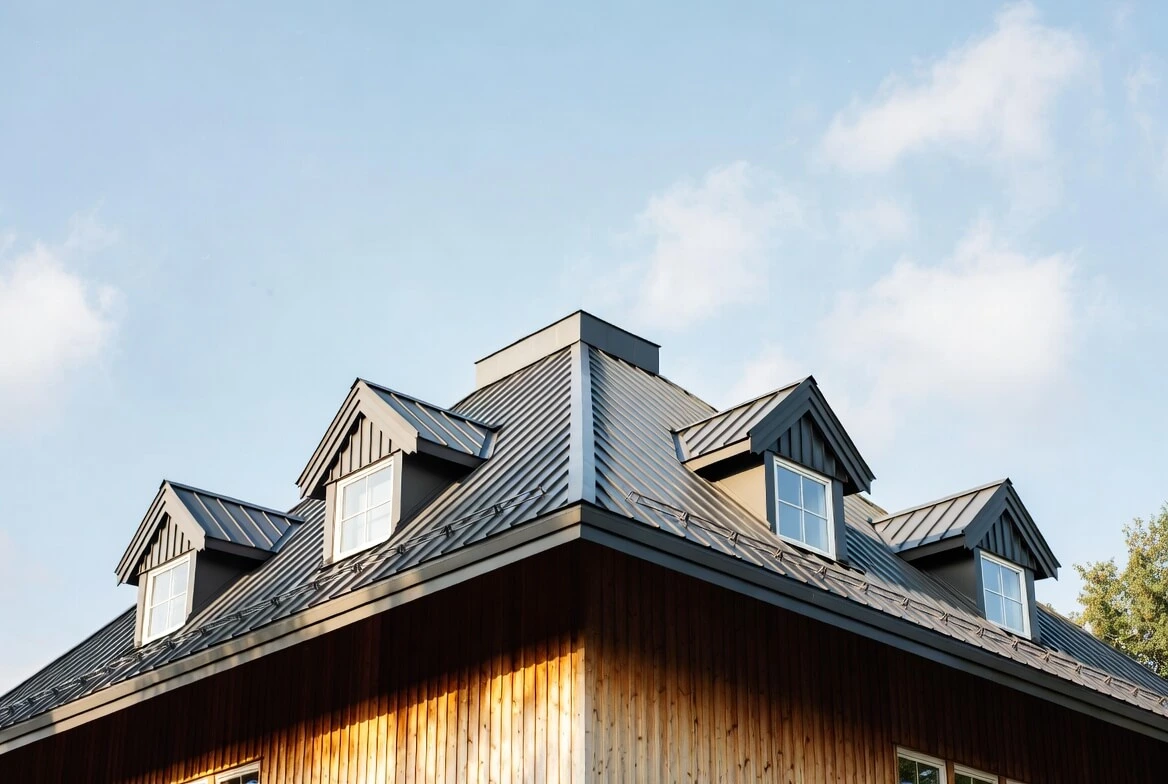
Metal mansard roofs are growing in popularity for their combination of durability, low maintenance, and light weight. Standing seam metal handles the steep pitch excellently and is available in a wide range of colors and finishes. Darker colors (mansard brown, charcoal, dark gray) hide imperfections and look particularly sharp.
Cedar Shake
Cost: $8–$12/sq ft installed. Lifespan: 20–35 years.
Natural cedar is lighter than asphalt and provides excellent insulation. It ages to an attractive silver-gray. Requires more maintenance — regular treatment to prevent moisture, moss, and insect damage.
Upper Low-Slope Section — Material Options
The upper section (typically below 2:12 pitch) needs a watertight membrane system — not shingles. Three main options:
- EPDM (rubber membrane) — the workhorse. Nearly bulletproof, very affordable, lasts 20–30+ years. Black color absorbs heat.
- TPO — white and reflective, keeps rooms below cooler. Good performance, 20–25 year lifespan.
- PVC — premium option. Highly durable, chemical resistant, white and reflective. 25–30 year lifespanNever Use Standard Asphalt Shingles on a Mansard Lower SlopeStandard asphalt shingles will slide off the near-vertical lower slope of a mansard roof if not installed with the correct technique. Even when installed correctly, the steep pitch dramatically increases wear rate and reduces lifespan. Always use synthetic slate, natural slate, metal, or cedar shake on the steep lower section.
| Material | Cost/Sq Ft | Lifespan | Weight | Best For |
| Synthetic Slate | $8–$14 | 40–50 yrs | Light | Most mansard roofs |
| Natural Slate | $15–$30 | 75–150 yrs | Heavy | Historic/premium builds |
| Metal (Standing Seam) | $10–$18 | 40–70 yrs | Light | Modern mansards, snow regions |
| Cedar Shake | $8–$12 | 20–35 yrs | Medium | Natural/rustic aesthetic |
| EPDM (upper) | $4–$8 | 20–30 yrs | Very light | Upper flat section |
| TPO (upper) | $5–$10 | 20–25 yrs | Very light | Upper flat, energy efficient |
Mansard Roof Cost: Full Breakdown for 2026
Mansard roof replacement is expensive. Plan for $15,000–$40,000 for most residential projects, with complex or large-scale mansard roofs exceeding $60,000. Here’s what drives the cost:
Cost by Size and Material
| Home Size | Roof Area (Est.) | Synthetic Slate | Metal Roofing | Natural Slate |
| 1,000 sq ft | ~1,200 sq ft | $10,000–$17,000 | $12,000–$22,000 | $18,000–$36,000 |
| 1,500 sq ft | ~1,800 sq ft | $14,000–$25,000 | $18,000–$32,000 | $27,000–$54,000 |
| 2,000 sq ft | ~2,400 sq ft | $19,000–$34,000 | $24,000–$43,000 | $36,000–$72,000 |
| 2,500 sq ft | ~3,000 sq ft | $24,000–$42,000 | $30,000–$54,000 | $45,000–$90,000 |
What Makes Mansard Roofs So Expensive?
- Labor rates are 40–60% higher than standard roofs — workers operate entirely from ladders on the steep lower section
- Two separate roofing systems required — one for steep slope, one watertight membrane for the flat top
- Premium materials required — no budget asphalt shingles on the steep lower slope
- Dormer windows add multiple flashing points requiring precision work
- Experienced mansard contractors are scarce, creating a supply/demand premium
- Tear-off is more complex and time-consuming than standard slope roofs
Cost-Saving Tips for Mansard Roof Replacement
- Get 3+ quotes — price variation between contractors can be 30–40% on mansard work
- Replace both sections simultaneously — doing upper and lower separately costs more long-term
- Choose synthetic slate over natural slate to save 40–60% on materials
- Consider TPO or EPDM for the upper section — functionally equivalent to PVC at lower cost
- Schedule in shoulder seasons (spring/fall) when contractor demand is lower
The Disadvantages Nobody Warns You About
What is the disadvantage of a mansard roof? Several, actually.
Poor weather resistance: The flat or low-slope top section has terrible drainage. Water and snow sit there instead of running off, leading to leaks or even roof collapse in heavy snow.
High maintenance: That sitting water accelerates wear. You’ll see damage and leaks more frequently than with steeper roofs.
Limited contractor options: Most roofers don’t work on mansard roofs regularly. Finding someone experienced enough to do it right is tough.
Expensive repairs: Even minor fixes cost more because of the complexity and ladder work required.
Weight restrictions: You can’t just slap any material on there. Heavy options increase sliding risk and structural load.
How long do mansard roofs last? With proper materials and maintenance, 30-50 years. But that requires actually maintaining it, which people often skip because repairs are so expensive.
Modern Mansard Roof Design (Yes, People Still Build These)
Modern mansard roof designs are cleaner and simpler than historical versions.
Contemporary architects use straighter lines, larger dormer windows for more natural light, and metal roofing for easier maintenance. The mansard roof house style works well for urban townhouses where vertical space matters more than horizontal sprawl.
You’ll see them in older city neighborhoods—Philadelphia, Boston, Washington DC—but rarely in new suburban developments.
Can you add a mansard roof to an existing house? Technically yes, but it’s wildly expensive. You’re essentially rebuilding the entire top of your home. A mansard roof extension makes more sense than a full conversion. Add it to one section to create extra space without redoing everything.
Mansard Roof Construction Details Worth Knowing
Mansard roof construction requires precise planning. The lower section needs to come out about two feet from the building before slanting up. This creates enough angle for water drainage despite the steep pitch.
Dormers are typically integrated into the lower slope for light and ventilation. These add complexity and cost but make the attic space actually livable.
The ridge at the top connects all four sides. Unlike a hip roof with one consistent pitch, the mansard has that dramatic angle change. Mansard roof detail plans should show both the steep lower section and the gentler upper slope, plus how they connect at the angle break.
Do mansard roofs need gutters? Absolutely. That lower section dumps water fast, and the upper section needs drainage for sitting water.
Solar Panels and Energy Efficiency
Can you put solar panels on a mansard roof? On the upper low-slope section, yes. The steep lower sides? Not practical. The upper section’s gentler angle actually works well for solar panel installation if oriented correctly.
What is the 33% rule in solar panels? Panels should be installed at roughly 33% of your latitude angle for optimal year-round production. For mansard roofs, that upper 35-degree section is close to ideal for many locations.
Which roof type is the most energy efficient? Mansard roofs can be efficient because that extra attic space acts as an insulation buffer. But only if properly sealed and insulated.
Planning Permission and Regulations
Do I need planning permission for a mansard roof? In most areas, yes—especially for new construction or conversions.
A mansard roof extension definitely requires permits. You’re changing the roof line and adding livable space, which triggers building codes and zoning reviews. Historical districts have even stricter rules. Your mansard roof design might need to match surrounding architecture.
Check local regulations before assuming you can build one.
How Long Do Mansard Roofs Last?
With proper materials and regular maintenance, a mansard roof should last 30–50 years. Here’s the breakdown by section:
| Section | Material | Expected Lifespan | Key Maintenance |
| Lower steep slope | Synthetic slate | 40–50 years | Annual inspection, re-flashing dormers |
| Lower steep slope | Natural slate | 75–150 years | Occasional slate replacement, flashing |
| Lower steep slope | Metal (standing seam) | 40–70 years | Minimal — check seams and flashings |
| Upper flat section | EPDM membrane | 20–30 years | Annual inspection, patch as needed |
| Upper flat section | TPO membrane | 20–25 years | Annual inspection, keep clean |
| Dormer windows | All materials | 20–30 years | Flashing inspection after every storm |
The upper flat section is typically the first to need attention — its low slope and exposure to standing water accelerates wear. Plan to replace the upper membrane system every 20–25 years even when the lower section is still performing well.
Alternative Roof Styles to Consider
What is another name for a mansard roof? French roof or curb roof. What is the opposite of a mansard roof? Probably a simple gable roof—single slope on two sides, flat gable edges, minimal complexity.
What style of house has a mansard roof? French Second Empire, Victorian, Tudor Revival, and some Colonial Revival homes. If you want that extra attic space without mansard complexity, consider a gambrel roof or a steep-pitched gable with dormers.
What Actually Matters About Mansard Roofs
Look, mansard roofing are gorgeous. That classic French architecture turns heads. But they’re expensive to install, expensive to maintain, and expensive to replace.
If you’re buying a house with one, budget for that eventual roof replacement. It’s coming, and it won’t be cheap.
If you’re building new or adding one, understand you’re choosing aesthetics over practicality. Nothing wrong with that—just go in with eyes open. The extra attic space is legitimately useful. Just make sure that benefit outweighs the lifetime costs of maintaining that complex double-sloped design on all four sides.
Conclusion
A mansard roof buys you real living space and a look nothing else matches, but that trade comes with a bill attached at every stage, install, upkeep, and eventual replacement. If you already own a home with one, plan financially for its eventual replacement rather than being caught off guard. If you are choosing this style for a new build, go in knowing you are paying for character, not efficiency, and make sure that tradeoff still feels worth it once you have seen the real numbers.