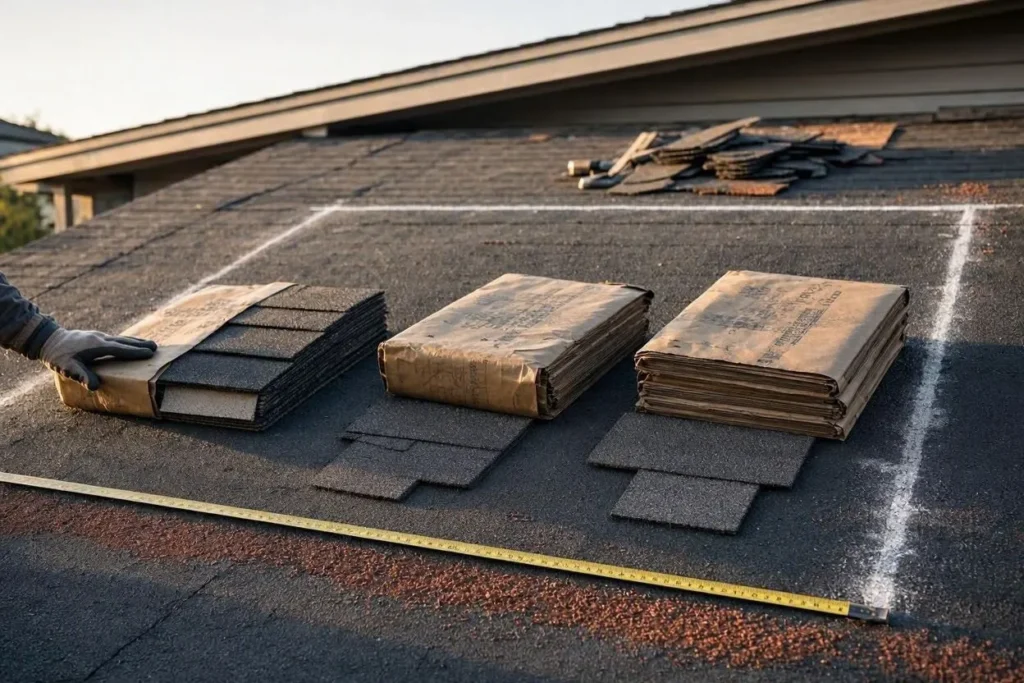
Most standard asphalt shingles need 3 bundles to cover one roofing square, though luxury and designer shingles can require 4 to 6 bundles depending on the brand. A roofing square equals 100 square feet, so a 2,000-square-foot roof works out to 20 squares and roughly 60 bundles before waste gets added. The exact count shifts with shingle type, roof pitch, and how complex the roofline is, so the sections below break down each variable with real numbers.
What Is a Roofing Square?
A roofing square is a unit of measurement equal to 100 square feet of roof surface, not a literal 10×10 shape. Contractors and manufacturers use it instead of raw square footage because it keeps material estimates, labor pricing, and supplier orders consistent across a job.
A 1,000-square-foot roof comes out to 10 squares. Push that to 2,400 square feet, and you’re looking at 24 squares. The math stays simple: divide total roof area by 100. What trips people up isn’t the division, it’s confusing house footprint with actual roof surface, since a sloped roof always covers more area than the floor plan below it.
How Many Bundles of Shingles Are in a Square?
Three bundles cover one roofing square for standard 3-tab and architectural asphalt shingles. That’s the industry default, and it holds true across most major brands sold in the United States (US).
The ratio changes once you move into premium territory. CertainTeed’s Belmont line runs 4 bundles per square. Grand Manor, a heavier designer product from the same manufacturer, needs 5. GAF Slateline, despite sitting in the luxury category, still packages at 3 bundles per square, proving the rule isn’t universal even within one price tier. Wood shake and cedar shingles typically need 4 to 5 bundles per square too, though shake sizing varies more than asphalt does.
| Shingle Type | Bundles Per Square |
| 3-Tab Asphalt | 3 |
| Architectural (Laminated) | 3 |
| Premium/Designer | 2.5 to 3 |
| Luxury (Belmont-style) | 4 |
| Luxury (Grand Manor-style) | 5 |
| Wood Shake/Cedar | 4 to 5 |
Answering how many bundles of shingles are in a square starts with this three-bundle baseline, but the packaging label on your specific product is the final word. Manufacturers are required by law to print coverage area directly on the wrapper.
How Many Shingles Are in a Bundle?
A standard bundle holds 20 to 29 individual shingles, with the exact count depending on whether they’re 3-tab or architectural. Three-tab shingles run lighter and smaller, so bundles hold more of them.
3-tab bundles contain 26 to 29 shingles each. Architectural bundles hold fewer, usually 20 to 22, because each shingle is thicker and larger. Multiply that out across 3 bundles and a square of architectural shingles works out to roughly 64 shingles. Luxury shingles flip the pattern entirely: bundles hold just 10 to 16 pieces since the individual shingles are heavier and denser.
| Architectural Shingle Brand | Shingles Per Bundle | Shingles Per Square |
| CertainTeed Landmark | 21-22 | 65 |
| GAF Timberline HDZ | 20-22 | 64 |
| Owens Corning Duration | 20+ | 64 |
| TAMKO Heritage | 20+ | 64 |
These four brands dominate US residential roofing, and their per-square counts land within a tight range of each other, which is exactly why the 3-bundle standard became an industry shorthand in the first place.
Bundle Requirements by Shingle Type
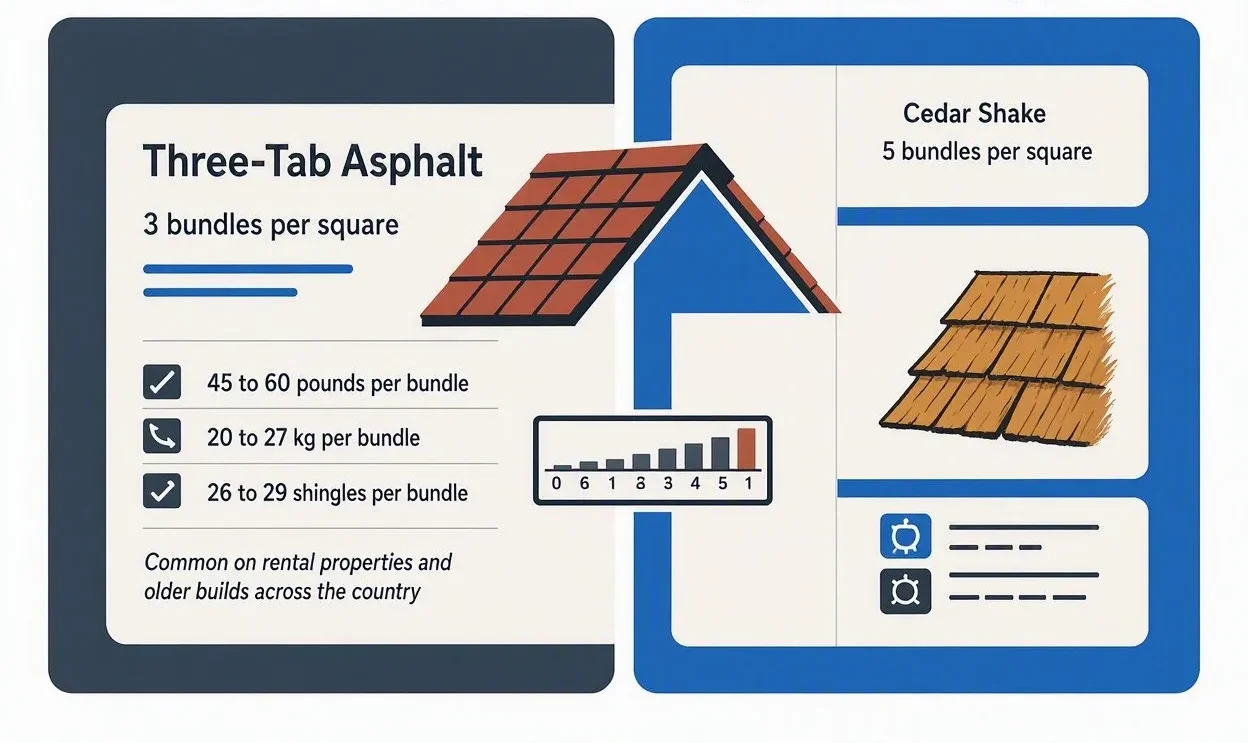
Bundle counts vary by shingle category, ranging from 3 bundles per square for standard products up to 5 for cedar shake. Each type carries its own weight range and coverage footprint too.
Three-Tab Asphalt
Three bundles cover a square. Each bundle weighs 45 to 60 pounds (20 to 27 kg) and holds 26 to 29 shingles. This is the budget option most homeowners recognize, still common on rental properties and older builds across the country.
Architectural (Laminated)
Three bundles per square remains standard here, though bundles run heavier at 60 to 80 pounds (27 to 36 kg). Coverage per bundle sits close to 33.3 square feet, with a 5.5-inch exposure common on many product lines.
Premium and Designer
These sometimes drop to 2.5 bundles per square instead of the usual 3, since individual shingles are thicker and cover slightly more area each. Bundle weight often exceeds 100 pounds (45 kg).
Wood Shake (Cedar)
Four to 5 bundles fill a square, with each bundle containing anywhere from 200 to 400 individual shakes. Weight climbs to 75-100 pounds (34-45 kg) per bundle, and coverage per bundle drops to around 25-35 square feet because of the reduced 7.5-inch exposure.
How Roof Pitch Changes Your Bundle Count
Steeper roofs need more bundles than the house footprint suggests, because slope adds surface area that a flat measurement misses entirely. A 1,000-square-foot attic under a low-slope roof covers less actual material than the same attic under a steep gable.
Roofers apply a pitch multiplier to correct for this. A 4:12 pitch adds about 5% to the flat area. Climb to 6:12, and the multiplier reaches roughly 1.118, adding just under 12%. At 9:12, that jumps to 1.25, a 25% increase over the footprint. Extreme pitches at 12:12 or steeper can push the multiplier past 1.4, meaning the actual roof surface is 40% larger than what the ground-floor square footage implies.
| Roof Pitch | Multiplier | Added Surface Area |
| 4:12 | 1.054 | ~5% |
| 6:12 | 1.118 | ~12% |
| 8:12 | 1.202 | ~20% |
| 10:12 | 1.305 | ~30% |
| 12:12 | 1.414 | ~41% |
Skip this step, and you’ll underorder. Badly. A contractor quoting bare footprint numbers on a steep roof either doesn’t know the multiplier or isn’t applying it, and that’s worth asking about directly.
Why a Waste Factor Matters
Add 10 to 15 percent extra bundles beyond your base calculation to cover cuts, overlaps, and installation waste. Complex rooflines with multiple valleys, dormers, or hips push that range up to 15 to 20 percent.
The National Roofing Contractors Association (NRCA) backs this range as standard industry practice. Skipping it isn’t a small risk, it’s the single most common reason roofing jobs stall mid-install. Cut shingles at valleys and ridge lines create small unusable scraps. Starter strips along the eaves eat into the count too, often consuming 3 to 4 bundles on a larger roof that some calculations forget to include separately.
Here’s what waste factor looks like applied to a real order. A 20-square roof needing 60 base bundles becomes 66 bundles once a straightforward 10% waste factor gets added. Push that same roof through a complex layout with a 15% factor, and the order climbs to 69 bundles. Small percentage, real difference on the delivery truck.
How to Calculate Bundles for Your Roof
To calculate bundles, measure roof area, divide by 100 for squares, multiply by bundles-per-square, then add a waste factor. Five steps get you from raw measurement to a supplier-ready order.
- Measure the roof surface, not the house footprint. Use a tape measure on each plane, or pull numbers from architectural drawings on new construction.
- Apply the pitch multiplier if you measured from the attic floor instead of climbing onto the roof directly.
- Divide total square footage by 100 to convert into roofing squares. A 2,240-square-foot roof becomes 22.4 squares, rounded up to 23.
- Multiply squares by bundles-per-square for your shingle type. At 3 bundles per square, 23 squares needs 69 bundles.
- Add 10 to 15 percent waste, bringing that 69-bundle order to roughly 76-79 bundles depending on roof complexity.
Working example: a 2,000-square-foot roof at 6:12 pitch. Apply the 1.118 multiplier first, landing at 2,236 actual square feet. Divide by 100 for 22.36 squares, rounded to 23. At the standard 3-bundle rate, that’s 69 bundles. Add 10% waste and the final order comes to 76 bundles, not the 60 you’d get from skipping the pitch adjustment entirely.
Bundle Weight and Handling
A single shingle bundle weighs between 45 and 120 pounds (20 to 55 kg), depending on shingle type. Architectural bundles land in the 60-80 pound range, while luxury products regularly exceed 100 pounds (45 kg).
That weight matters for two reasons beyond just carrying them up a ladder. Roof deck load capacity has limits, and stacking too many bundles in one spot during delivery can stress framing, especially on older homes. A 2,000-square-foot roof using roughly 60-70 architectural bundles adds up to 4,200-4,900 pounds (1,905-2,222 kg) of material sitting on the structure during installation. Crews plan staging around that weight, spreading bundles across multiple roof sections rather than piling everything at one access point.
Other Materials Besides Field Shingles
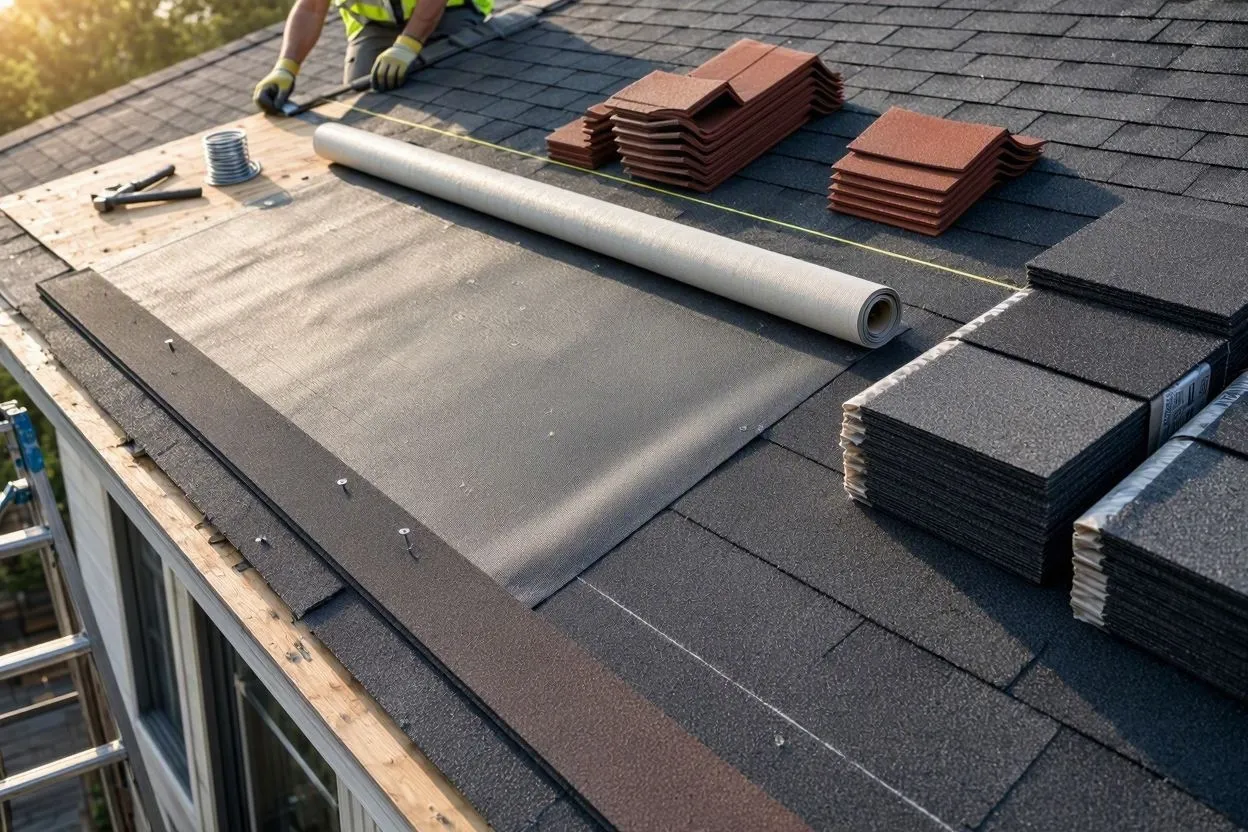
A full shingle order needs more than field shingles alone. Starter strips, ridge caps, hip caps, underlayment, and roofing nails all factor into the final material list, and skipping any one of them stalls the job partway through.
Starter shingles go down first along the eaves, nailing line facing up, covered by the first visible course. These consume extra material that basic square-to-bundle math doesn’t account for. Ridge and hip caps finish the peaks, sold separately and measured in linear feet rather than square footage, with coverage of 20-36 linear feet per bundle depending on the product. Synthetic underlayment rolls typically cover 1,000 square feet each, so a 20-square roof needs two rolls minimum.
Nails deserve their own line item too. Ring-shank roofing nails, 1.25 inches long, go in at 2 to 3 per shingle. A 2,000-square-foot roof burns through roughly 10,000 to 15,000 nails, which comes out to a 5-pound box or two depending on nail gauge.
Cost Per Square and What It Covers
Roofing companies typically charge $350 to $550 per square, though the final number depends on material grade, roof accessibility, and local labor rates. That range covers materials and installation together, not shingles alone.
Geographic location shifts pricing meaningfully. Coastal states with wind-rated code requirements often sit at the higher end of that range. A steep or cut-up roof adds labor hours too, since crews move slower and safer on pitches above 8:12. Getting multiple quotes remains the only reliable way to know what a specific job actually costs in a specific market.
Common Ordering Mistakes
The most frequent mistake is using house footprint instead of actual roof surface area, which underestimates material by 20 to 30 percent on steep roofs. A handful of other errors show up just as often across real job sites.
Forgetting starter shingles trips up first-time DIY installers regularly, since the eave strip isn’t always included in basic bundle math. Zero waste factor is another one, treating the base calculation as final rather than a starting point. Not checking the specific product label causes trouble too, particularly with premium architectural lines that dip to 2.5 bundles per square instead of the standard 3. Ignoring roof complexity rounds out the list, since a roof cut up with multiple valleys and a chimney uses noticeably more material than a simple gable of the same square footage.
Impact-Resistant and Algae-Resistant Shingles
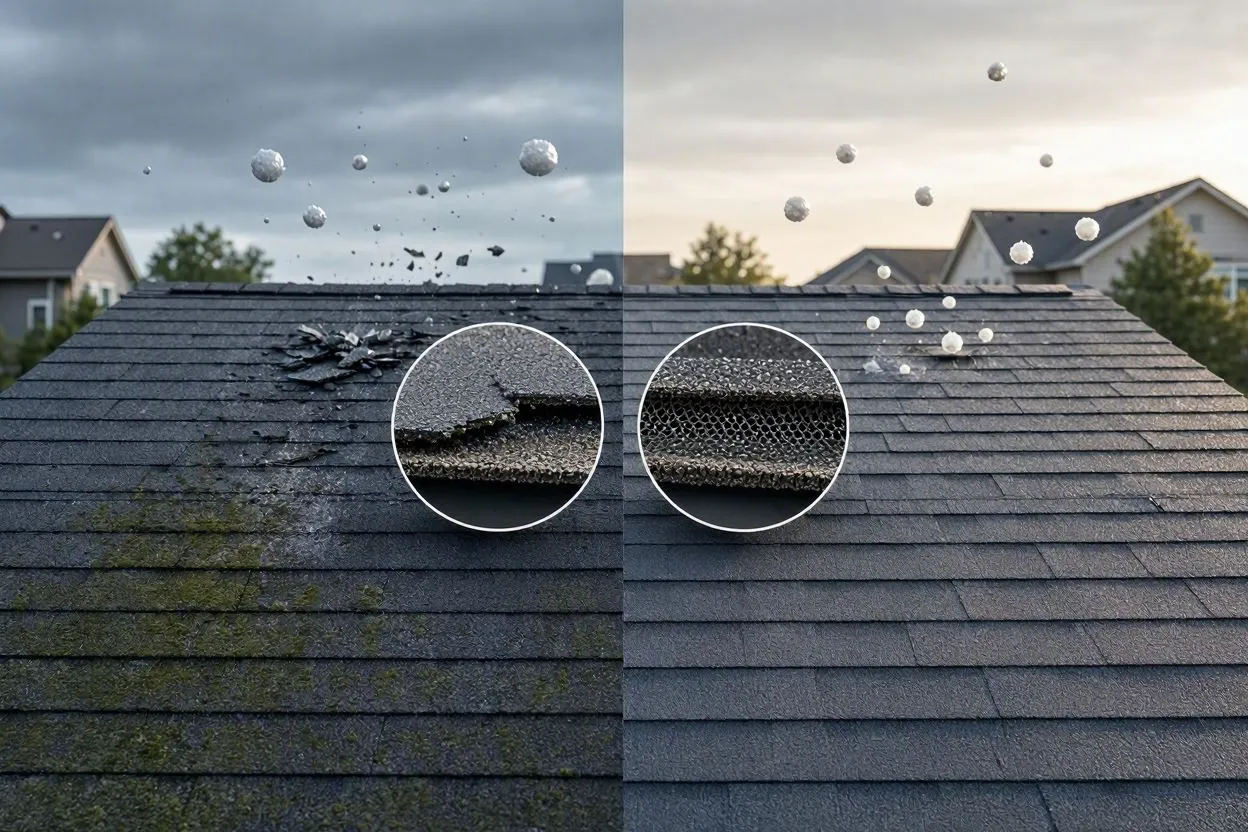
Impact-resistant shingles, often rated Class 4 under the industry’s impact-resistance testing standard, don’t change bundle-per-square math but do affect insurance premiums in hail-prone regions. These products still bundle at the standard 3-per-square rate for most brands, since the reinforcement comes from a modified mat rather than added thickness.
Algae-resistant (AR) shingles carry a similar note. The AR treatment prevents dark streaking from algae growth and doesn’t alter coverage area or bundle count either. What it does affect is long-term appearance, which matters in humid climates across the Southeast and Gulf Coast where algae staining shows up within a few years on untreated products.
Why Labels and Dye Lots Matter
Every shingle bundle carries a dye lot number, and matching lots across an order prevents visible color variation once shingles go up. Manufacturing batches can shift shade slightly, and a mismatched bundle stands out on a finished roof.
Keep leftover bundles after the job wraps. A stored spare, kept dry and out of direct sun, makes future repairs match the existing roof instead of introducing an obviously different shade years later. Warranty claims sometimes ask for this dye lot information too, so holding onto a wrapper or two from the original order isn’t a bad habit.
Conclusion
Getting the bundle count right starts with the 3-bundle standard, then adjusts for shingle type, roof pitch, and waste. A homeowner ordering for a straightforward 2,000-square-foot gable roof can trust the basic math. Anyone dealing with a steep pitch, luxury shingles, or a roofline cut up with valleys and dormers needs the fuller calculation, pitch multiplier and waste factor included, before placing that order. Check the product label every time. Manufacturers vary enough between brands that assuming 3 bundles per square without confirming can leave a crew short mid-install, which costs more in delay than the extra five minutes checking the wrapper ever would.