Terracotta roof tiles are kiln-fired clay tiles that last 100 years or more, carry a Class A fire rating, cost $9 to 35persquarefoot(97 to $377 per m²) installed in the US and weigh 600 to 1,500 lb per 100 sq ft (29 to 73 kg/m²). British and Australian prices land in a similar band once converted. That premium buys a roof covering that rarely needs replacing, though the membrane underneath it does, usually every 25 to 50 years. Warm, dry regions such as Arizona and South Australia suit terracotta best. Frost-rated grades still perform on English and New England roofs, provided the tile meets the right local standard and the frame can carry the load.
What Are Terracotta Roof Tiles?
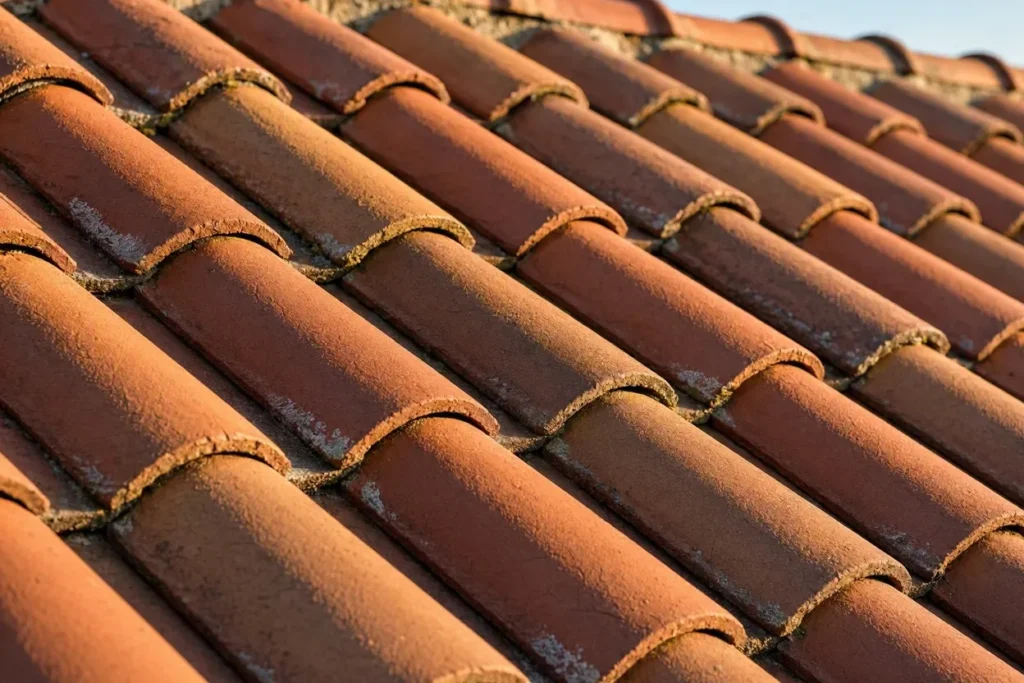
Terracotta roof tiles are roof coverings shaped from natural clay or shale and fired in a kiln until the particles fuse into a hard, weather-resistant body. The name is Italian for “baked earth.” Because the color comes from the fired clay itself, it runs right through each tile instead of sitting on top as a coating, which is why a 40-year-old terra cotta roof often looks fresher than a 15-year-old concrete one. ASTM International (American Society for Testing and Materials) sets the US definition in ASTM C1167: tiles made from clay, shale or similar earthy materials and heat-treated until a fired bond forms.
Is Terracotta the Same as Clay Tile?
Yes, terracotta is a type of clay roof tile, not a separate material. Some contractor blogs frame the 2 as rivals with different firing temperatures. The standards don’t. ASTM C1167 sits under International Classification for Standards (ICS) code 91.100.25, a category literally titled “Terracotta building products.” In trade use, “terracotta” describes unglazed red-to-orange fired clay, and “clay roof tiles” is the umbrella term that also covers glazed and blended finishes.
Why Buyers Search for Clay Shingles and Ceramic Roof Shingles
Homeowners use at least 6 names for one product: clay shingles, clay roof shingles, ceramic roof shingles, terracotta shingles, terra cotta shingles and brick roof tiles. Search engines lump them together. Roofers split them. To an installer, a shingle is a flat, overlapping unit, so “terracotta shingle roof tiles” and “clay tile roof shingles” point to flat profiles such as Ludowici’s Georgian and Cotswold lines rather than curved barrel tile. Searches for “terra roof” or “terra cotta roofing” nearly always mean a complete terracotta roof. Product listings muddy things further, labeling the same S-type tile as terracotta roof shingles on one site and terracotta shingles tiles on the next. Ask for the profile name and dimensions, because a quote for terra cotta roof shingles could mean either a flat tile or a curved one.
Why Choose Terracotta Clay Roof Tiles?
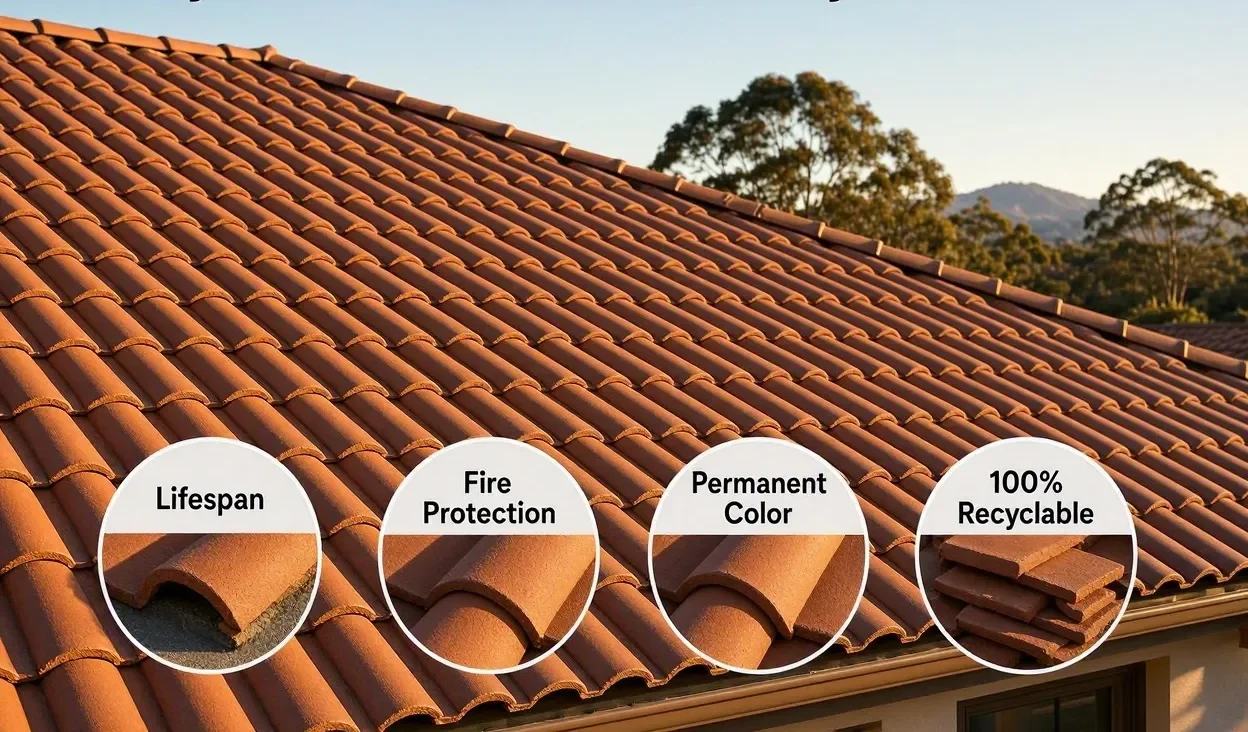
Terracotta clay roof tiles earn their price through 4 benefits: century-scale lifespan, non-combustible fire protection, permanent color and full recyclability. No other common pitched-roof covering combines all 4.
- Lifespan: Fired clay doesn’t rot or curl. A well-built roof outlasts the people who paid for it, and Ludowici’s 75-year material warranty covers most of a mortgage twice over.
- Fire protection: Clay is non-combustible and carries a Class A fire rating, the top classification for roof coverings, which matters in California’s wildland-urban interface and Australia’s bushfire-prone areas.
- Color: Kiln-fired pigment sits inside the tile body, so UV exposure in Phoenix or Perth doesn’t bleach it the way it strips surface coatings.
- Recyclability: Sandbaggy rates its barrel tile as 100% recyclable, and Marley’s Acme clay plain tile carries the same rating alongside a published embodied-carbon figure.
Heat performance is a quieter advantage. Curved profiles trap a ventilated air space between tile and deck, which slows heat moving into the attic on a 40°C (104°F) afternoon. Among clay tile roofing materials, the deeper the curve, the bigger that air gap becomes.
Clay Roof Tiles Types and Profiles
Clay roof tiles come in 5 main profiles: S-type, two-piece barrel, interlocking, flat shingle and pantile. The profile you pick decides the minimum roof pitch and the finished look.
| Profile | Shape | Other names | Main markets | Typical minimum pitch |
| S-type | One-piece S curve | Spanish tile, S tile | US Southwest, Florida, Australia | 4:12 (18°); 2.5:12 (12°) with double underlayment under US codes |
| Two-piece barrel | Separate pan and cover | Mission tile, pan and cover | California, Florida, Mexico | 4:12 (18°); 2.5:12 (12°) with double underlayment under US codes |
| Interlocking | Flat or ribbed with side locks | French tile, Marseille tile | Australia, US, Europe | Set by the manufacturer |
| Flat shingle | Small, flat, double-lapped | Plain tile, clay shingle | UK, US Northeast | 35° for most UK plain tiles; 30° for some cambered tiles |
| Pantile | Single wave | Old English pantile | UK east coast | About 30° |
Coverage varies more than most buyers expect. NHD Tile Store’s Verea S-type tile measures 19.8 by 11.1 in (50 by 28 cm) and lays at 88 pieces per square, while Sandbaggy’s Mexican two-piece barrel needs about 220 pieces for the same 100 sq ft (9.29 m²). A UK plain tile roof, by contrast, takes roughly 60 tiles per m² at a 100 mm (3.9 in) gauge.
Glazed vs Unglazed Terracotta Roof Tiles
Glazed tiles carry a fired-on ceramic coating, and unglazed tiles show the bare fired clay. Glaze cuts water uptake and sheds moss, which suits humid coastal towns such as Brisbane and Fort Lauderdale. Unglazed terracotta weathers into a softer patina that fits period homes. Neither one needs paint, and Australian restorers point out that glazed terracotta won’t take a color coat at all, since the glaze already is the finish.
Terra Cotta Shingle Color Options
Terra cotta shingle color runs from classic red and orange to brown, buff, gray and near-black. Spanish maker Verea alone sells its S-type tile in at least 6 finishes through NHD Tile Store, including Red, Mocha, Graphite and Fume. Blends such as Verea’s Jacobea mix scatter several shades across one roof, so a single replacement tile years later won’t stand out. Matching an older house with terracotta color roof shingles takes a physical sample, not a screen photo; NHD charges $35 for one piece shipped by FedEx or UPS.
How Much Do Terracotta Roof Tiles Cost?
A new terracotta roof costs $9 to 35persquarefoot(97 to $377 per m²) installed in the US. Prices in Britain and Australia fall in a similar band after conversion. Roof complexity drives most of the spread, because every hip and valley means cut tiles and slower labor.
| Market | Installed cost per m² | Installed cost per sq ft | Source |
| United States | 97-377 | 9-35 | HomeGuide (via FL Specialty Roofing); FoxHaven 2026 cost guide |
| United Kingdom (clay tile) | £100-£210 | £9-£20 | BestBuilders, 2026 |
| Australia (terracotta) | A90-A250 | A8-A23 | New Life in Aus, Bark and What’s The Damage, 2026 |
Tearing off an old US roof adds $1 to $3 per square foot (FoxHaven). British quotes fold in scaffolding, which BestBuilders lists as the single largest fixed cost after the tiles themselves.
Terracotta Roof Tiles for Sale: Material Prices
Tiles alone cost about $3 to $8 per square foot from US online sellers. NHD Tile Store lists Verea’s red S-type tile at $3.59 a piece, $315.58 per square or $1,357.02 per 378-piece pallet covering 430 sq ft (40 m²). Over at Sandbaggy, the per-foot price on Mexican barrel tile falls from $8.00 to $5.18 as an order grows from 100 to 4,000 sq ft. Freight bites. A full NHD pallet weighs 3,000 lb (1,361 kg) and travels by truck, and Sandbaggy’s tile is pickup-only from Riverside, California, with a 2 to 3 week lead time. British buyers pay £1.50 to £6 per clay tile (BestBuilders).
Lifetime Cost Against Concrete and Asphalt
Terracotta wins on cost per year of service, not on upfront price. What’s The Damage puts a A180perm²terracottarooflasting60yearsataboutA3 per m² per year. Concrete tiles last 40 to 60 years against 60 to 100 for clay (BestBuilders), and asphalt shingles need replacing far sooner than either. For a homeowner staying 30 years or longer, that math favors clay.
How Long Does a Terracotta Roof Last?
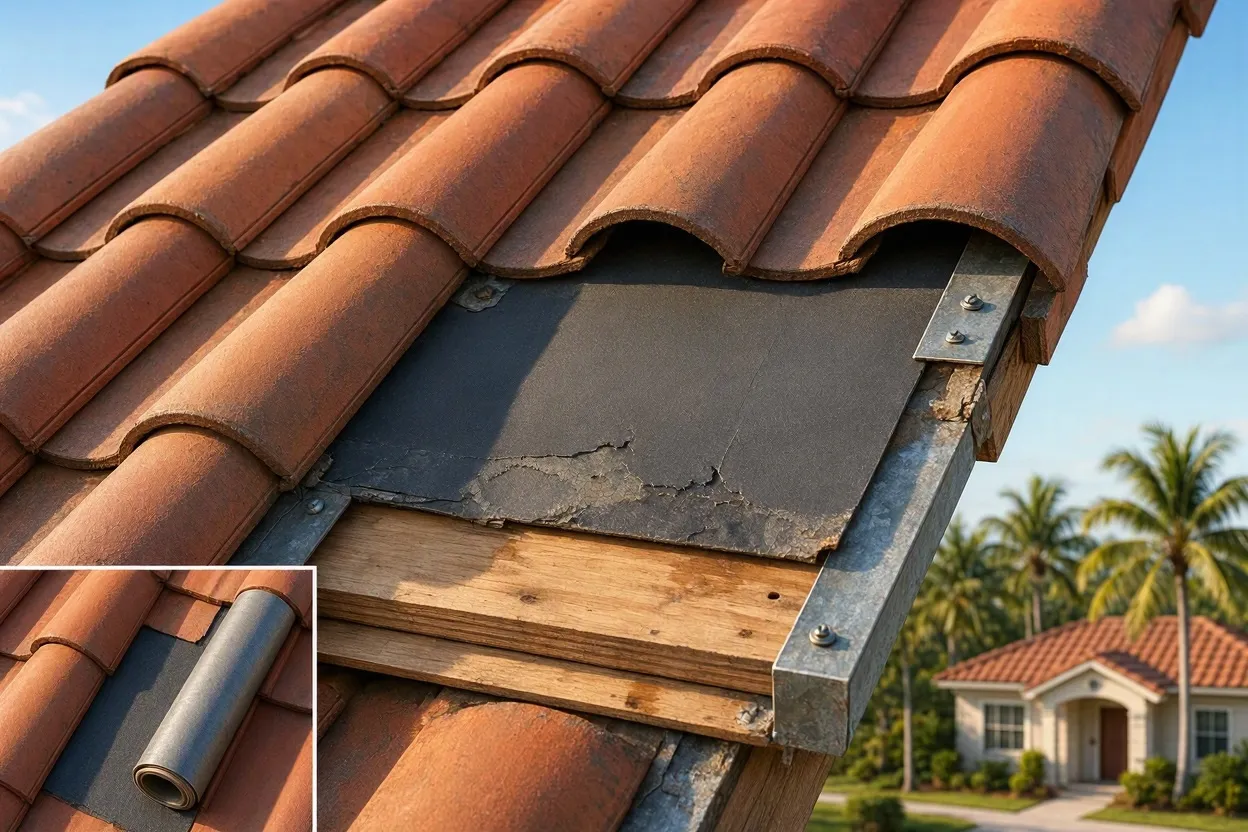
A properly installed terracotta roof lasts 100 years or more, but the underlayment beneath it lasts 25 to 50 years. That gap matters more than any brochure claim. Tiles shed water; they don’t seal it out, so wind-driven rain that slips past a tile meets the membrane, not the deck. In Florida, FL Specialty Roofing reports that every tile roof needs a high-temperature, self-adhered underlayment such as Polyglass TU Plus or Owens Corning Titanium PSU 30. British estimates run more conservative, with BestBuilders giving clay tiles 60 to 100 years. Ludowici backs its tiles with a 75-year material warranty, and home inspectors at InterNACHI (International Association of Certified Home Inspectors) warn that fasteners and flashing often wear out before the tiles do.
What Are the Disadvantages of Terracotta Roof Tiles?
Terracotta roof tiles have 4 main disadvantages: heavy weight, high upfront cost, breakage underfoot and dependence on the underlayment.
- Weight: A finished terracotta roof weighs 600 to 1,500 lb per 100 sq ft (29 to 73 kg/m²), so older framing often needs an engineer’s check before a switch from asphalt. Steel sheeting, for comparison, can weigh as little as 5 kg/m² (1 lb/sq ft).
- Cost: Clay sits near the top of the price chart in all 3 markets, beaten in Britain only by natural slate.
- Fragility: Terracotta cracks under concentrated foot pressure and hard hail strikes. Discontinued profiles turn a simple repair into a hunt for matching tiles.
- Underlayment dependence: Unglazed tiles absorb some moisture, which adds weight and feeds efflorescence and moss. Well-fired tiles keep this low; NHD’s Verea tile absorbs under 3% of its weight in water.
Terracotta vs Concrete Roof Tiles
Terracotta outlasts concrete and keeps its color, while concrete costs less upfront. Most people can’t tell them apart from the street on day one. Fifteen summers later, they can.
| Factor | Terracotta (clay) | Concrete |
| Lifespan | 60-100+ years | 40-60 years |
| UK fitted cost | £100-£180 per m² | £75-£130 per m² |
| Australian installed cost | A90-A160 per m² | A45-A90 per m² |
| Weight (UK plain tile) | 69.6 kg/m² (14.3 lb/sq ft) | 73.8 kg/m² (15.1 lb/sq ft) |
| Color | Fired through, no fading | Surface color that fades |
| Recoating cycle (Sydney) | 15-20 years | 12-15 years |
Weight surprises people. Clay plain tiles from Edilians come in lighter than Marley’s concrete plain tiles, so swapping concrete plain tiles for clay on a British roof adds no structural load.
Standards and Codes for Terracotta Roof Tiles in the US, UK and Australia
Each market uses its own product standard and installation code, and a tile approved in one country is not automatically approved in another. Check the spec sheet for the right reference before ordering.
| Market | Product standard | Installation code | Extra climate rule |
| United States | ASTM C1167-22 | International Residential Code (IRC) R905.3, plus state codes in Florida and California | Miami-Dade Notice of Acceptance (NOA) in High-Velocity Hurricane Zones (HVHZ) |
| United Kingdom | BS EN 1304:2013 | BS 5534:2014+A2:2018 | Twice-nailed perimeter tiles for wind uplift |
| Australia | AS 2049-2002 (R2015) | AS 2050:2018 | AS 3959:2018 bushfire construction and Bushfire Attack Level (BAL) ratings |
Which Terracotta Tile Grade Handles Freeze-Thaw?
Grade 1 tiles under ASTM C1167 handle severe weathering, so specify them anywhere winters bring repeated freeze-thaw cycles. The standard sorts tiles into 3 grades by weathering resistance and tests them for freeze-thaw durability, breaking strength, efflorescence and permeability. Australian tiles go through AS 4046.6 for freeze-thaw and AS 4046.7 for salt attack, the second one being the test that matters on a beachfront in Perth or the Gold Coast.
Hurricane and Bushfire Rules
Terracotta is non-combustible and carries a Class A fire rating, but its wind and ember resistance depend on how it is fixed. Under AS 3959:2018, tiled roofs in the Flame Zone (BAL-FZ) need every tile screw- or clip-fixed to the battens. Florida’s hurricane coast takes a different route: tile systems in the HVHZ need product approval, and installers follow the approved attachment method tile by tile, often with foam adhesive or mechanical fasteners.
How to Install a Terra Cotta Tile Roof
To install a terra cotta tile roof correctly, a licensed tile roofer follows 5 steps:
- Check the frame for the extra dead load, especially on houses built for asphalt.
- Confirm the pitch: US codes allow 2.5:12 (12°) as a minimum, with a double underlayment layer between 2.5:12 and 4:12, while most UK plain tiles need 35°.
- Lay the right underlayment: double Type 30 felt on low US slopes, high-temperature self-adhered membrane in Florida, a BS 5534 underlay in Britain or reflective sarking in Australia.
- Fix each tile to the manufacturer’s schedule using nails, clips, screws or approved foam adhesive, and twice-nail the perimeter courses on British roofs.
- Order 5 to 10% extra tile for cuts and breakage, plus a few spares stored for future repairs.
Professional installation pays for itself here. Barrel tile on a 2.5:12 roof is code-legal, yet Jack Gray, a roof consultant with more than 25 years in the trade, still advises against tile on 2.5:12 or 3:12 roofs (Roof Observations).
How to Maintain a Terracotta Roof
To maintain a terracotta roof, inspect it every year and after big storms, then swap cracked tiles before water reaches the membrane. Cleaning should be gentle. Australian restorers price terracotta restoration in Sydney at A35toA55 per m² because the tiles need softer washing and terracotta-specific sealers rather than the high-pressure blast that concrete tiles tolerate. Ridge caps eventually need rebedding and repointing, a standard part of any Australian restoration quote. Skip the paint: Sandbaggy advises against painting kiln-fired tiles, since paint traps moisture and adds an upkeep cycle the clay never needed.
Can You Put Solar Panels on a Terracotta Roof?
Yes, solar panels mount on terracotta roofs using tile hooks that pass under or through the tile course to reach the rafters. Each hook bolts to a rafter beneath a lifted tile, and the tile goes back over it with a notch or a flashed replacement. Ask for spare tiles from the same batch before the job starts, because a solar crew working on brittle clay breaks a few as a matter of routine.
Clay Roof Replacement: Repair, Re-Lay or Replace?
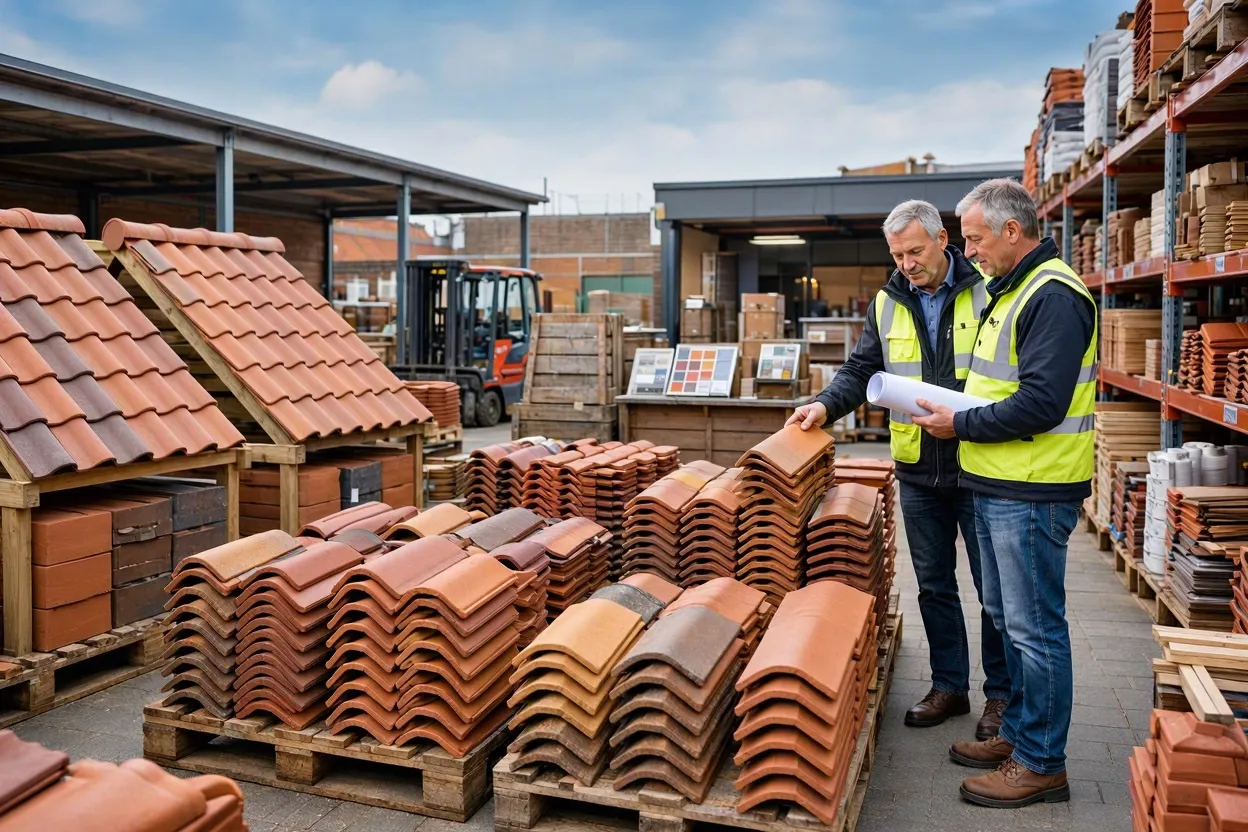
Most clay roof replacement jobs keep the tiles and renew everything underneath. BestBuilders reports that re-laying existing tiles over new membrane and battens saves 25 to 40% against a full new covering, and it’s the standard approach on British clay and slate roofs.
- Repair when damage is isolated, such as a few slipped or cracked tiles.
- Re-lay when the tiles are sound but the felt or membrane has perished.
- Restore when color and pointing have worn but fewer than about 15% of tiles are broken, a threshold Sydney restorers use.
- Replace when the frame has failed or tiles are spalling across the whole roof.
Where Can I Buy Clay Roof Tiles?
You can buy clay roof tiles from 4 sources: manufacturer dealer networks, roofing distributors, online tile stores and reclamation yards.
- Manufacturers: Ludowici makes more than 40 profiles in New Lexington, Ohio, and runs showrooms from Atlanta to Southern California. British specifiers buy from Sandtoft, Marley, BMI Redland and Edilians.
- Distributors: ABC Supply stocks clay and concrete tile from Crown, Eagle, Ludowici, Terreal North America, Verea and Westlake Royal, though not every branch carries every brand.
- Online stores: NHD Tile Store in Miami ships pallets nationwide by freight, and Sandbaggy sells barrel tile for pickup in Riverside, California. Read the returns policy first, since both treat clay tiles for sale online as final once purchased.
- Reclamation yards: Salvage dealers supply weathered tiles for heritage repairs and color matching.
Buying Reclaimed Clay Tiles
Reclaimed tiles make sense for repairs and listed buildings, not for whole new roofs. Old tiles carry unknown frost history, so ask the yard where they came from and check each one for laminating faces or hairline cracks. Expect to pay a premium for rare profiles: discontinued Australian terracotta runs A50toA100 per tile from Sydney salvage yards. Anyone asking where to buy clay roof tiles for a small patch job should start with the original maker, since firms such as Ludowici still produce historic and custom profiles to order.
FAQs About Terracotta Roof Tiles
Are terracotta roof tiles better than concrete tiles?
Yes, for lifespan and color. Clay lasts 60 to 100+ years without fading, while concrete averages 40 to 60. Concrete wins on price, costing about half as much per m² in Australia.
Can you walk on a terracotta roof?
No, not casually. Terracotta cracks under concentrated foot pressure, so roofers spread their weight on crawl boards and step only where tiles overlap. Book a professional for inspections.
Can you paint terracotta roof tiles?
No, painting is not recommended. Kiln-fired color never fades, and paint traps moisture against the clay. Glazed tiles reject coatings entirely; only unglazed or previously painted terracotta accepts one.
Are brick roof tiles the same as terracotta?
Yes, in most cases. “Brick roof tiles” is an informal name for fired clay tiles made from brick-type clays. Look for ASTM C1167, BS EN 1304 or AS 2049 on the spec sheet.
Do terracotta roof tiles work in cold climates?
Yes, with frost-rated grades. Specify ASTM C1167 Grade 1 for freezing US regions or BS EN 1304 tiles in Britain, and install a proper underlay to block ice-dam leaks.
Conclusion
Terracotta roof tiles are worth the money for owners who plan to stay long term and whose framing can carry the load. The tiles outlive almost everything else on the house. Budget instead for the parts that don’t: a new membrane every few decades and the odd cracked tile. Start with a structural check, then order 2 or 3 physical samples, and ask every roofer quoting the job to name the product standard and fixing method in writing. That one request filters out most of the bad quotes.