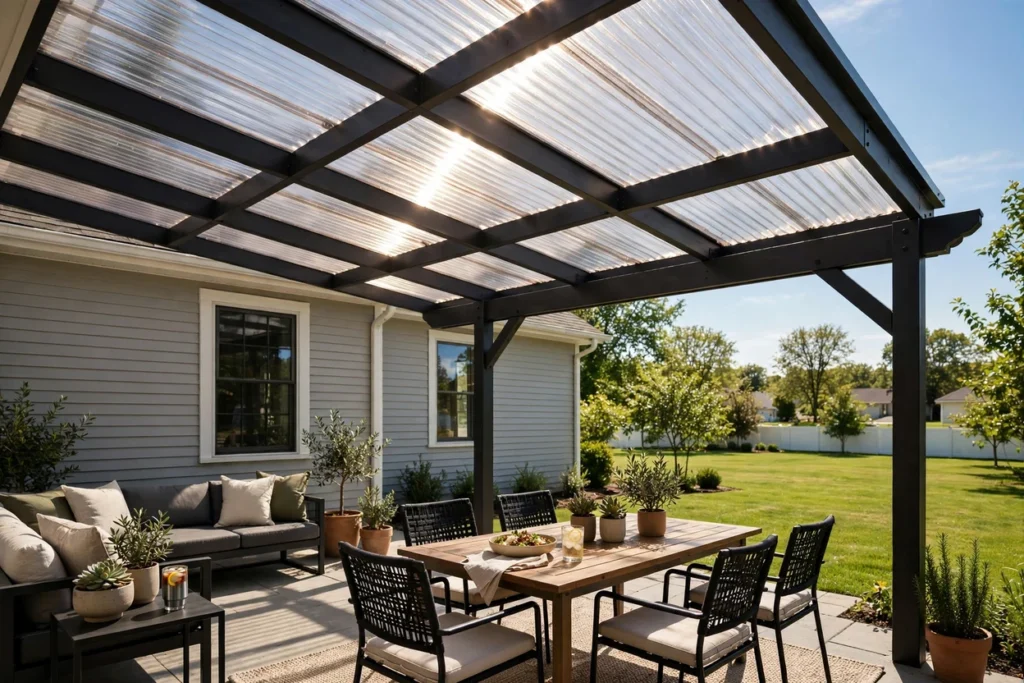
Clear roof panels are translucent plastic sheets that let daylight through a roof while still shedding rain. UV-protected corrugated polycarbonate is the best pick for most US patios and pergolas, and it’s the right sheet for carports too. Greenhouses do better with twinwall polycarbonate. PVC fits budget sheds. Whatever the sheet, install it UV side up to the manufacturer’s span chart, driving screws through oversized pre-drilled holes.
Key Takeaways
- Polycarbonate is the default clear roofing material in the USA because it resists hail and stays flexible in freezing weather.
- PVC roof panels cost less than polycarbonate, but PVC turns brittle in cold weather and handles hail poorly.
- The labeled UV-protected side of a clear panel always faces the sun, and installing a panel upside down typically voids the warranty.
- Purlin spacing comes from the manufacturer’s span chart, adjusted for local snow load and wind uplift.
- To clean clear panels, use mild dish soap, lukewarm water and a soft bristle brush. Never use abrasives, ammonia or a pressure washer.
- Clean rooftop solar panels from the ground when possible, and hire a professional for any job that requires climbing on the roof.
What Are Clear Roof Panels?
Clear roof panels are translucent plastic sheets that replace opaque roofing to let daylight through while shedding rain. US retailers sell clear roof panels in four main materials: polycarbonate, polyvinyl chloride (PVC), fiberglass reinforced plastic (FRP) and acrylic. Profiles vary too. Shoppers can pick corrugated or flat multiwall sheets sized for patio covers, pergolas, greenhouses, carports and sheds.
The panels sit on purlins. A purlin is a horizontal framing member that runs across the rafters or beams and carries the weight of the roofing sheets above it.
Screws hold each panel down, and every screw carries an ethylene propylene diene monomer (EPDM) washer that squeezes against the sheet as it tightens. That seals the hole against rain.
Most product lines offer a fully clear tint alongside two shaded options, opal and bronze, and the choice changes how the space below feels. Clear transmits the most light. Opal, a milky white, and bronze both cut glare and keep heat from building up underneath.
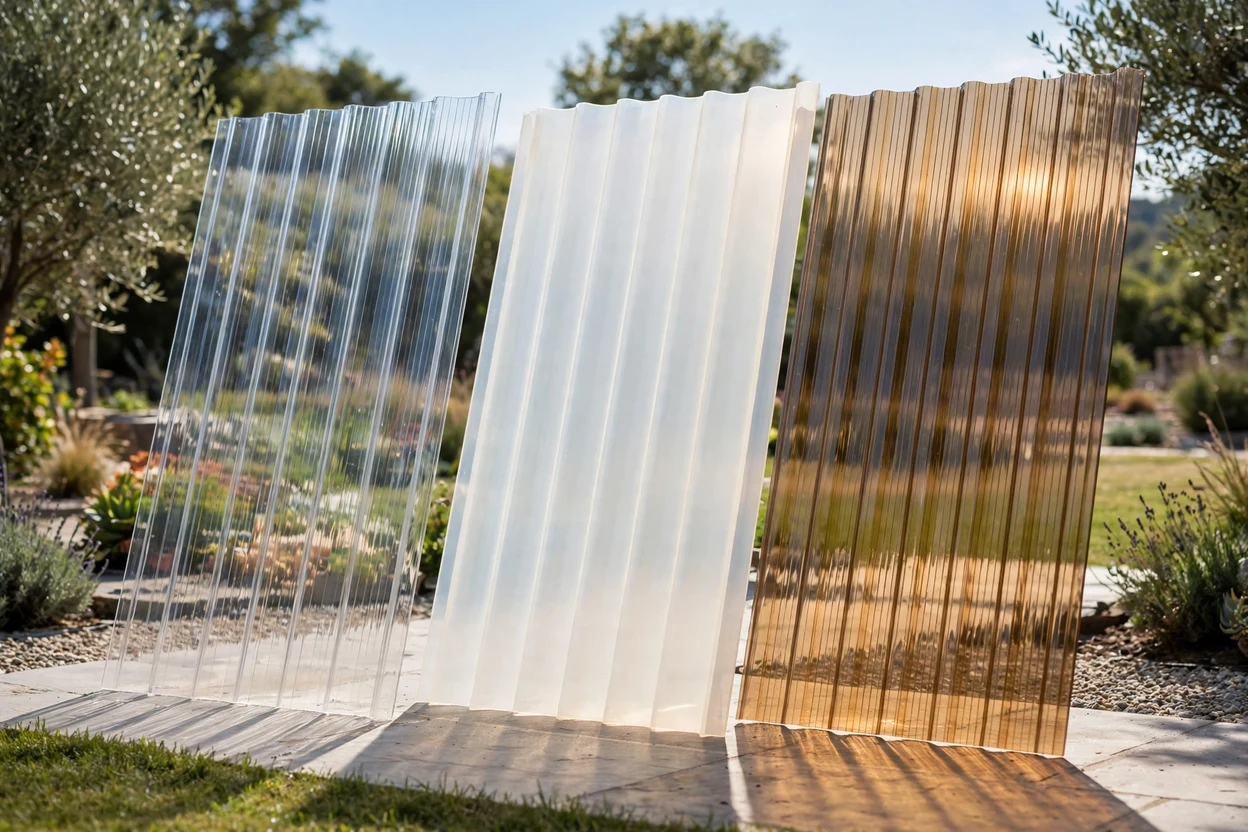
Clear Plastic Roof Panels Compared by Material
Clear polycarbonate is the best all-around material for clear plastic roof panels because it combines high impact resistance, flexibility in freezing weather and ultraviolet (UV)-protected grades. PVC wins on purchase price. FRP belongs on barns and utility buildings, while acrylic fits projects where optical clarity counts for more than hail resistance.
This table compares the four main clear panel materials sold in the USA.
| Material | Impact Resistance | Cold Weather | Main Drawback | Best Use |
|---|---|---|---|---|
| Polycarbonate | Very high, shatter resistant | Stays flexible | Higher price than PVC | Patios, carports, hail regions |
| PVC | Moderate | Can turn brittle | Weak in hail and frost | Budget sheds, covered walkways |
| FRP | Moderate | N/A | Surface weathers over time | Barns, utility buildings |
| Acrylic | Lower than polycarbonate | Can crack under impact | Brittle under hail | Skylights, mild climates |
Clear Polycarbonate Roof Panels
Clear polycarbonate roof panels dominate US big-box shelves. The reason is simple. The material is lightweight and shatter resistant, and a DIY builder can cut it easily with standard tools instead of buying specialty equipment.
One widely sold brand family is Palram. Its Suntuf line covers corrugated polycarbonate, and its Palruf line covers PVC panels, both stocked through major US retailers.
Hail-prone states such as Texas and Colorado call for polycarbonate. Here’s why. A thin sheet of glass or acrylic can crack under the very same hailstorm that a polycarbonate panel rides out.
Most quality polycarbonate sheets carry a UV-protective layer on just one face, and a label on the protective film marks which face that is. That side faces the sky.
Clear PVC Roof Panels
PVC roof panels are the budget entry point for clear corrugated roofing. Menards is a good example. The retailer sells a PVCLite corrugated panel at 26 in (66 cm) wide, which is typical of the budget sheets found in big-box aisles.
In a mild climate, PVC works fine over a garden shed or a firewood cover. Temporary structures in that climate qualify too. Northern winters are another story, since PVC turns brittle in freezing weather and a falling branch or a heavy hailstorm can then crack it.
That trade-off is real. Pick PVC only when a low purchase price matters more to the project than service life or impact resistance will.
Fiberglass and Acrylic Panels
FRP is a legacy option that’s still sold for agricultural and utility buildings. It’s translucent, not truly clear. As the surface resin weathers, the glass fibers underneath can become exposed, which dulls the panel and gives dirt somewhere to cling.
Acrylic, also called poly(methyl methacrylate) (PMMA), offers excellent optical clarity and a glass-like look. The catch is brittleness. It’s more rigid and more brittle than polycarbonate, so it belongs on sheltered skylights and awnings rather than open patio roofs in hail country.
Is Polycarbonate Better Than PVC for Roofing?
Yes, polycarbonate is better than PVC for roofing in most US climates because polycarbonate resists hail impact and stays flexible in freezing weather. PVC still has a narrow place. It makes sense only for budget sheds and temporary covers, plus mild-climate projects where a lower purchase price outweighs long-term durability and impact resistance.
This table compares polycarbonate vs PVC roofing on the factors buyers weigh most.
| Factor | Polycarbonate | PVC |
|---|---|---|
| Hail resistance | High | Moderate |
| Freezing weather | Stays flexible | Can crack |
| Purchase price | Higher | Lower |
| UV-protected grades | Widely available | Varies by product |
| Best For | Patio covers, carports, greenhouses | Sheds, temporary covers |
| Verdict | Default choice | Budget choice |
PVC is the smarter buy for a small detached shed in a mild Southern or coastal climate, the kind of setting where its cold-weather weakness rarely shows. Temporary covers fit too. Think of anything that’ll be replaced within a few seasons.
Everything else points to polycarbonate. Any roof sheltering people or vehicles calls for it, and so does a greenhouse full of plants, especially where the sheet must survive hail and snow on top of years of direct sun.
Corrugated vs Multiwall Panel Profiles
Corrugated panels are the right profile for most DIY patio, pergola and shed roofs because they are light, flexible and fasten directly to purlins. Multiwall sheets are different. They suit greenhouses and sunrooms, where insulating air channels and reduced condensation, along with diffused light, matter more than low cost and simple installation.
This table compares the main clear panel profiles.
| Profile | Structure | Key Benefit | Best Use |
|---|---|---|---|
| Corrugated | Single wavy sheet | Easy DIY install | Patios, pergolas, sheds |
| Twinwall | Two layers with air channels | Insulates, diffuses light | Greenhouses |
| Multiwall (3+ walls) | Several stacked layers | Higher insulation | Sunrooms, year-round greenhouses |
| Flat solid | Single flat sheet | Glass-like view | Skylights, awnings |
Corrugated polycarbonate panels need closure strips at the eave and ridge. Skip them and pests move in. The strips fill the gaps under the waves, blocking wind-driven rain as well as insects and birds that would otherwise get in.
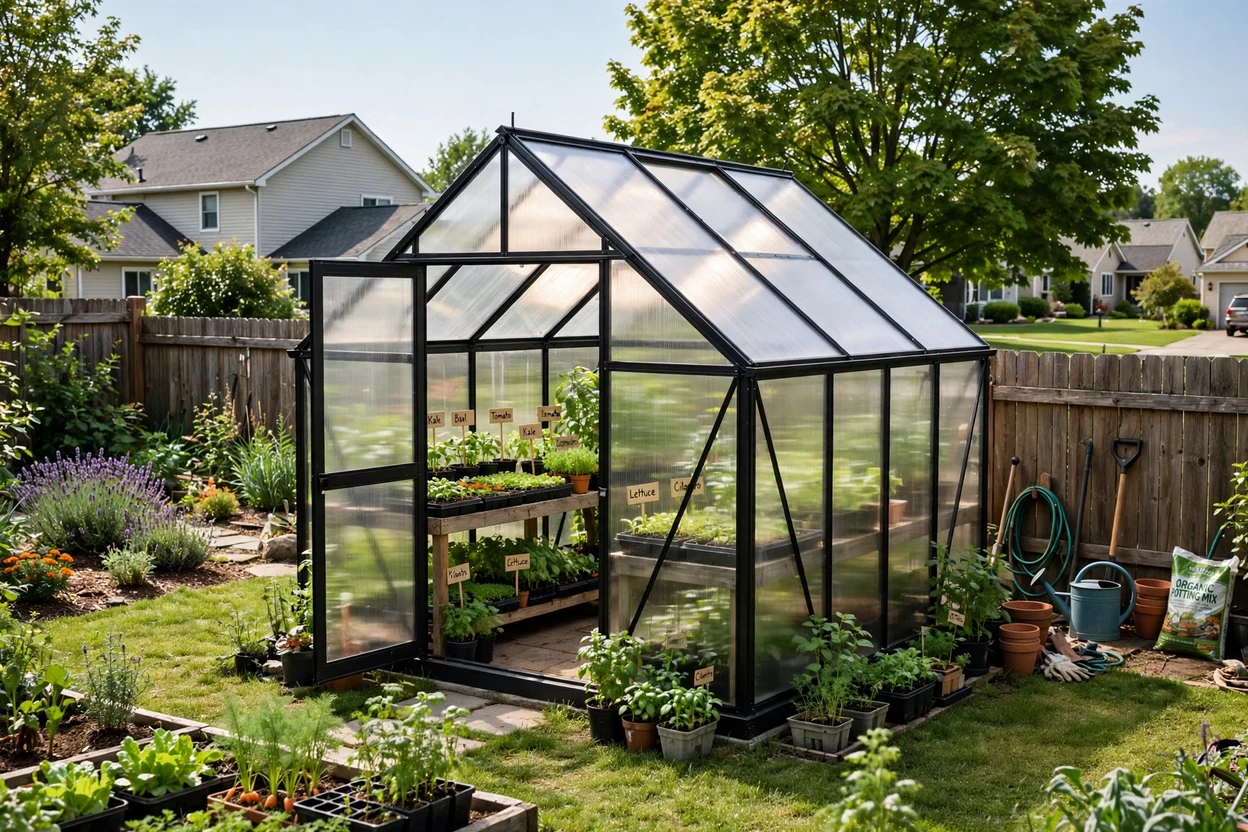 Twinwall polycarbonate sheet and other multiwall sheets need their open channels sealed. Solid sealing tape goes on the upper edge and vented tape on the lower edge, with an end
cap fitted over both to finish the job. Dirt and algae stay out. Moisture still drains.
Best Clear Roof Panels by Project
The best clear roof panels for most projects are UV-protected corrugated polycarbonate for patios and pergolas, twinwall or multiwall polycarbonate for greenhouses and sunrooms, and PVC or FRP for sheds and utility buildings. Tint matters too. Go with opal or bronze wherever glare and heat buildup underneath are a concern for the people using the space.
This table matches each common project to a material and tint.
| Project | Best Material | Best Tint | Why |
|---|---|---|---|
| Patio cover | Corrugated polycarbonate | Opal or bronze | Cuts glare and heat |
| Pergola roof | Corrugated polycarbonate | Clear or bronze | Light weight, hail resistance |
| Greenhouse roof | Twinwall polycarbonate | Clear | Insulation and diffused daylight |
| Sunroom | Multiwall polycarbonate | Opal or bronze | Insulation and glare control |
| Carport roof | Corrugated polycarbonate | Bronze | Protects vehicles from hail |
| Shed roof | PVC or FRP | Clear | Low-cost daylight |
Clear Roof Panels for Patio Covers
Clear roof panels are a strong choice for a patio. UV-protected polycarbonate admits daylight and blocks rain, and it also keeps the adjacent rooms of the house brighter than a solid roof ever would. That’s a real bonus.
Opal or bronze tint keeps a patio cooler and cuts glare on outdoor furniture and screens, which makes the space more comfortable on bright afternoons. Fully clear tint has its niche. It suits a north-facing patio or a covered walkway where maximum light matters most.
Pitch matters. Slope the patio cover away from the house so runoff drains into a gutter rather than running down against the wall.
Pergolas, Greenhouses and Sheds
A pergola roof needs added purlins across the top beams, because pergola rafters alone are usually too far apart to support panels. The payoff is worth it. Clear pergola panels in corrugated polycarbonate keep the structure’s open feel and add rain protection.
Greenhouses benefit from twinwall polycarbonate. Its air channels hold heat on cold nights and spread light more evenly across the plants growing below the roof.
Sheds offer two options. Clear shed roof panels can cover the whole roof, or they can alternate with metal panels of a matching profile to create daylight strips.
Snow changes the math. In Minnesota and Michigan, as well as across the Mountain West, check the panel’s load rating against the local snow load before you finalize purlin spacing.
Do Clear Roof Panels Block UV Rays?
Yes, coated clear roof panels block UV rays to the level stated on the manufacturer’s spec sheet, because the protective layer absorbs UV before it degrades the sheet. Uncoated or budget sheets are weaker. They let more UV through and yellow faster, so confirm both the UV rating and the protected face before anything goes in the cart.
That coating shields the panel too. Left unprotected, polycarbonate yellows and clouds after prolonged sun exposure, and it gradually loses the impact strength that made it worth buying.
Abrasive cleaning and harsh chemicals can wear a UV coating off early, and scratches do the same damage over time. Gentle cleaning prevents that. It keeps the layer intact for the full warranty term.
Flipping a panel is costly. An upside-down install puts the unprotected face toward the sun, so the sheet yellows early and the manufacturer warranty typically stops applying.
Do Clear Roof Panels Get Hot Underneath?
Yes, clear roof panels pass solar heat along with daylight, so the space underneath warms quickly in direct sun, especially across the Sun Belt from Arizona to Florida. There are fixes. Opal or bronze tints, multiwall sheets, open sides and ventilation at the high end all reduce heat buildup without blocking every bit of daylight.
Moving air helps. Open gable ends or a gap at the ridge let hot air escape rather than pooling under the roof all afternoon.
Condensation drip is a common complaint under clear roofs. Overnight, warm and humid air meets the cooler panel surface, and the moisture that forms there drips straight onto the furniture below. It’s a nuisance.
Three measures reduce condensation drip:
- Build adequate roof pitch so droplets run downslope instead of falling.
- Choose multiwall sheets, which keep the inner surface warmer.
- Keep air moving with open sides or ventilation.
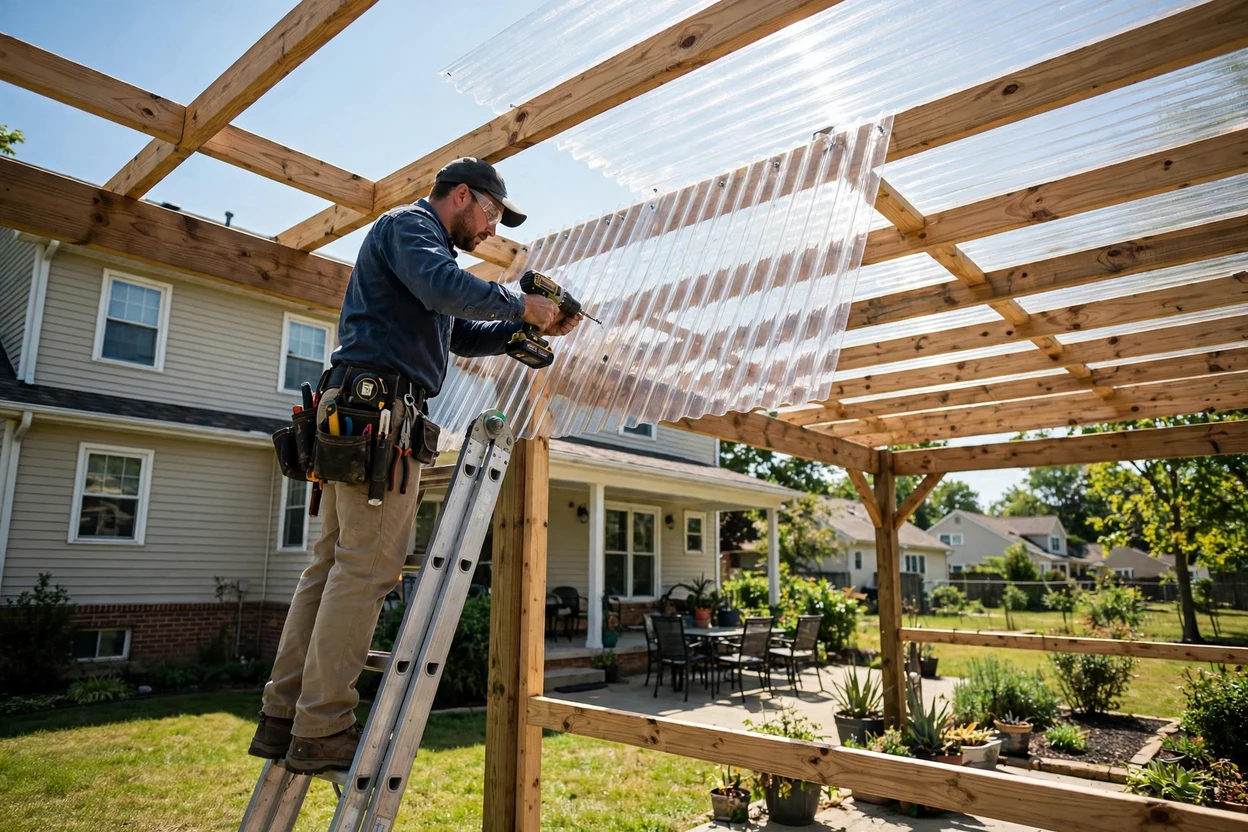
How to Install Clear Roof Panels
To install clear roof panels, build a sloped frame with purlins spaced to the manufacturer’s span chart, lay each panel UV-protected side up, overlap the corrugations and pre-drill oversized holes. Fasten each panel with EPDM-washer screws, then finish by adding closure strips and sealing tape at the eaves and ridge. That’s the core sequence.
Every manufacturer publishes its own installation guide. Treat it as the final word, since that guide overrides any general advice, including the steps laid out in this section of the article.
Tools and Materials
This table lists the tools and materials for a typical corrugated panel installation.
| Item | Purpose |
|---|---|
| Fine-tooth circular saw blade | Cuts panels without chipping |
| Drill and metal-cutting bit | Pre-drills oversized fastener holes |
| EPDM-washer screws | Fasten and seal each panel |
| Closure strips | Seal corrugations at eave and ridge |
| Sealing tape and end caps | Close multiwall channels |
| Crawl boards | Spread load across purlins |
| Safety glasses and gloves | Protect against sharp edges, chips |
Purlin spacing isn’t one-size-fits-all. Exact spans come from the manufacturer’s span chart, and the factors that follow push that spacing wider or closer depending on the project.
This table shows how project factors change purlin spacing.
| Factor | Effect on Purlin Spacing |
|---|---|
| Thicker panel | Wider spacing allowed per chart |
| Heavy snow load | Closer spacing |
| High wind uplift | Closer spacing, more fasteners |
| Low roof pitch | Follow manufacturer minimum, often closer |
Installation Steps
Follow these steps for a corrugated panel roof.
- Confirm building permit and HOA requirements before buying materials.
- Check the manufacturer’s minimum roof pitch and build the frame to meet it, sloping away from the house.
- Space purlins according to the manufacturer’s span chart, local snow load and wind uplift requirements.
- Fasten closure strips along the eave and ridge purlins.
- Cut panels with a fine-tooth blade while the panel is fully supported and the protective film is still on.
- Lay the first panel with the UV-protected side facing up, starting at the end opposite the prevailing wind.
- Overlap each adjacent panel by the number of corrugations the manufacturer specifies.
- Pre-drill oversized holes so the panel can slide during thermal expansion and contraction.
- Drive EPDM-washer screws at the crown or valley the manufacturer specifies, snug but never overtightened.
- Peel the protective film soon after installation, before sun exposure bakes it onto the sheet.
- Seal multiwall sheet ends with the correct tape and end caps.
DIY installers skip oversized holes more than any other step. That’s a mistake. Plastic panels expand and contract as the temperature swings, and a tight hole turns that movement into a crack that spreads out from around the screw.
Do You Need a Permit for Clear Roof Panels?
Yes, most US jurisdictions require a building permit for an attached patio cover or new roofed structure using clear roof panels, though many exempt small detached sheds and like-for-like panel replacements. The local building department sets the rules. Approval from a homeowners association (HOA) usually applies separately, so a single project can easily need both sign-offs before work starts.
Most US jurisdictions base their residential rules on the International Residential Code (IRC), then add local amendments. The IRC model code exempts one-story detached accessory structures up to 200 sq ft (18.58 m²) from permits, though many cities and counties change that threshold. Check locally.
Don’t skip the HOA. Many associations regulate the color, tint, height and placement of patio covers, so submit plans and get approval before ordering a single panel.
Some jurisdictions ask for fire performance data on roofing near property lines or under eaves. Panels tested to ASTM E84, the standard surface burning test for building materials, carry a flame spread rating that inspectors can check on site. Request the rating sheet from the manufacturer.
Can You Walk on Clear Roof Panels?
No, clear roof panels cannot support foot traffic, so anyone working on the roof must stand only on crawl boards laid across several purlins. One step between purlins can crack the sheet and send a person through it. The fall is the real danger. That’s why working from a ladder at the roof edge is the safer default for nearly every cleaning or repair task.
Repair a cracked panel by replacing the full sheet. Patches won’t hold. Tape and patch kits both leak eventually, and they look worse with every season of sun and rain they sit through.
Pull the fasteners from the damaged panel, then slide in a replacement of the same brand and profile so the corrugations line up. Refasten it through fresh oversized holes.
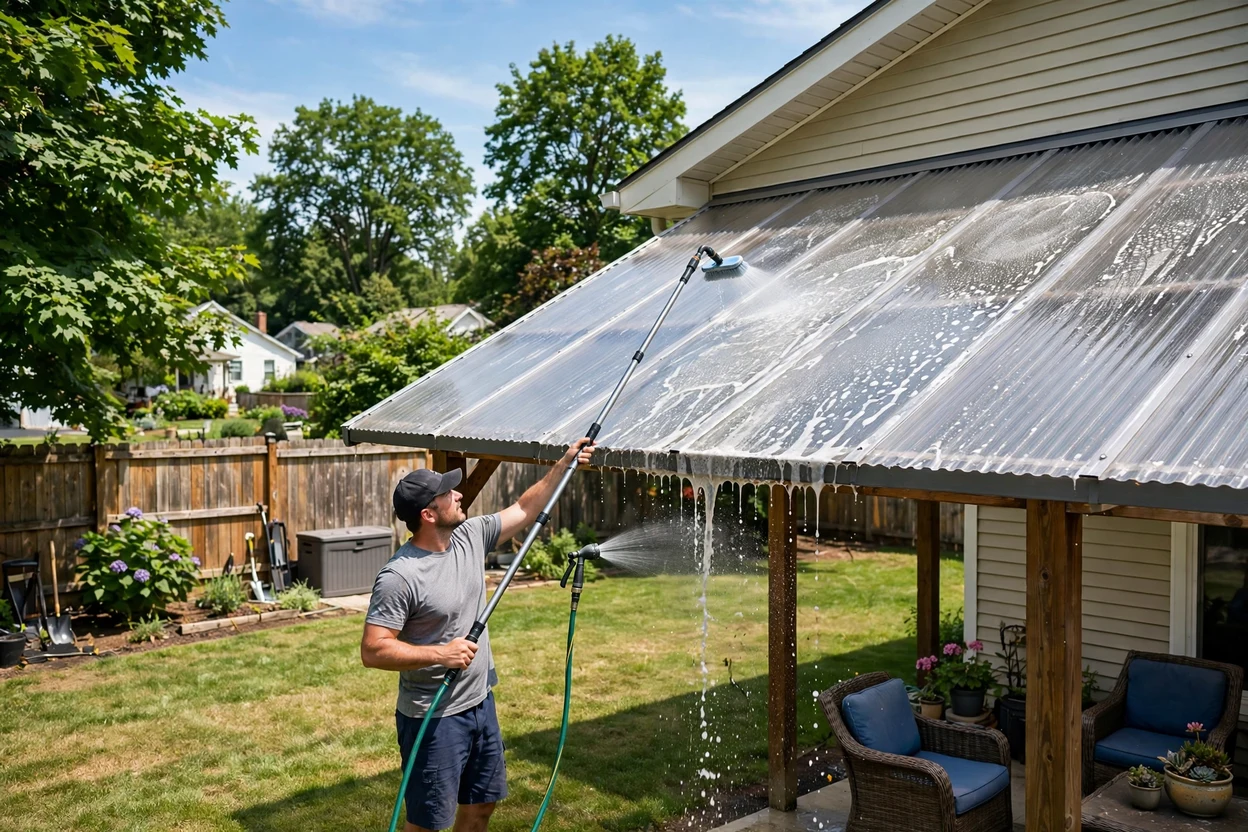
How to Clean Clear Roofing Panels
To clean clear roofing panels, rinse loose debris with a garden hose, then wash with mild dish soap in lukewarm water using a soft bristle brush or microfiber cloth, and rinse again. Skip the harsh stuff. Abrasive pads, ammonia-based glass cleaners, solvents and high-pressure washers all scratch the surface or strip the UV layer, so keep them away from the panels.
Follow these steps to clean roof panels without scratching them.
- Rinse the panels from the ground or a ladder with a garden hose to remove grit.
- Mix a few drops of mild dish soap into a bucket of lukewarm water.
- Wash with a soft bristle brush on an extension pole, working downslope.
- Rinse thoroughly with clean water to remove all soap.
- Dry spots with a microfiber cloth if water spotting bothers you.
Pressure washing polycarbonate is a mistake. High-pressure spray can damage the UV layer and force water past the seals, and it’s strong enough to lift closure strips right off the purlins.
Algae and moss take more patience. On a polycarbonate roof covered in either, repeat the soap wash with a soft brush, then trim back the overhanging branches that shade the roof and drop debris on it. Check with the panel manufacturer before using any algae treatment, since the product has to be approved for polycarbonate.
Frequency depends on surroundings. Clean clear panels at least once a year, and plan on more frequent washes for roofs under trees or near dusty roads.
How to Clean Solar Panels on a Roof
To clean solar panels on a roof, read the solar panel or installer manual first, then rinse the photovoltaic (PV) panels from the ground with a garden hose and a soft brush on an extension pole. Climbing is the line. Hire a professional for any job that requires climbing onto the roof rather than taking on that fall risk yourself.
Soiling is the buildup of dust, pollen, bird droppings and leaves on the panel glass. It blocks sunlight and cuts output. Rain removes most light soiling in many US regions, while dry Southwest climates and homes near farms or construction sites see heavier buildup.
Homeowners asking how to clean solar panels on roof arrays safely should follow these steps.
- Check the manual for approved cleaning methods and warranty conditions.
- Turn the system off if the manual instructs it.
- Clean in the early morning or evening, when the glass is cool.
- Rinse with a garden hose from the ground.
- Scrub gently with a solar panel cleaning brush on an extension pole.
- Rinse again to remove loosened dirt.
Cleaning affects the solar warranty when the method breaks the manufacturer’s rules, so it pays to know those rules before any brush touches the glass. Abrasive tools and harsh chemicals are common examples. Pressure washers are another.
Roof work carries a serious fall risk. The Occupational Safety and Health Administration (OSHA) treats falls as a leading construction hazard, so cleaning solar panels from the ground or hiring an insured cleaner is the safer path.
Clean Solar Panels Automatically
Yes, roof solar panels can be cleaned automatically. Two approaches exist. Robotic cleaners physically travel across the panel surface, while sprinkler-style systems instead spray water through nozzles mounted along the array.
Homeowners researching how to clean solar panels on roof automatically will find these systems marketed mainly for large commercial and utility arrays. Residential math is different. Rain plus an occasional manual rinse usually costs less, and automation pays off mainly where heavy dust returns quickly.
How Long Do Clear Polycarbonate Panels Last?
Clear polycarbonate roof panels last for the term stated in the manufacturer’s written warranty when installed and cleaned correctly, and no verified independent lifespan figure is available. Real-world results vary. Actual service life depends on UV layer quality, whether the correct side faces up, the cleaning method, local hail exposure and the quality of the supporting frame underneath.
The following mistakes commonly void a panel warranty:
- Installing the panel with the UV-protected side facing down
- Using fasteners or washers the manufacturer does not approve
- Cleaning with abrasives, ammonia or solvents
- Applying incompatible sealants that attack polycarbonate
- Ignoring the published span chart
Save your paperwork. Keep the receipt and the panel label, and take photos of the installation as it goes up, because manufacturers typically ask for this evidence when reviewing a warranty claim.
Buying Clear Roofing Panels in the USA
Buy clear roofing panels from Lowe’s, The Home Depot or Menards for standard corrugated sizes, and from plastics suppliers for multiwall sheets, custom cuts and specialty thicknesses. Stick to one brand family. Panels, closure strips and fasteners should all come from that same family, because mixing profiles leaves gaps that turn into leaks.
Big-box retailers stock corrugated clear roofing panels in polycarbonate and PVC, with matching closure strips and screws in the same aisle. Stock varies by store. Searching “clear roof panels near me” on each retailer’s site shows what’s on local shelves.
This table lists what to confirm before checkout.
| Buying Check | What to Confirm |
|---|---|
| Material | Polycarbonate, PVC, FRP or acrylic |
| Profile | Matches closure strips and existing roof |
| UV protection | Stated on spec sheet and label |
| Load rating | Fits local snow and wind requirements |
| Warranty | Written term and conditions |
| Fire rating | ASTM E84 data if code requires |
| Accessories | Same-brand screws, strips, tape |
Buy one spare panel from the same production run. Batches differ. Tints shift slightly from one run to the next, so a spare kept in the garage means a future repair will actually match the rest of the roof.
FAQs
Which side of a polycarbonate panel faces up?
The labeled UV-protected side faces the sun. Look for markings on the protective film or a printed edge, and check them before cutting so the face doesn’t get lost while the sheet is being handled.
Can you pressure wash polycarbonate roof panels?
No. High-pressure spray strips the UV coating and forces water past seals, and it can lift closure strips loose as well. A garden hose with mild soap and a soft brush cleans them safely.
What voids a clear roof panel warranty?
Several mistakes do it. Common causes are an upside-down installation, unapproved fasteners, abrasive or ammonia cleaners, incompatible sealants and spans that exceed the published chart.
Which tint keeps a covered patio cooler?
Opal and bronze tints keep a patio cooler than fully clear sheets do. Both cut glare. They also block a share of the solar heat while still admitting softened daylight to the space below the cover.
Does cleaning rooftop solar panels affect the warranty?
Yes, cleaning can affect the warranty if the method breaks the manufacturer’s rules. Read the manual first. Many solar manufacturers prohibit abrasive tools and harsh chemicals on the glass, and they rule out pressure washers just as firmly.
Conclusion
Clear panel technology keeps improving, with better UV layers and stronger multiwall designs leading the way, plus tints built to manage heat in a hotter Sun Belt. The buying logic doesn’t change. Polycarbonate is the answer for anything facing hail or snow, and for any roof with people underneath. Follow the manufacturer’s span chart and fastening rules, and clean gently so the UV layer lasts the full warranty term.
Get the paperwork moving early. Anyone planning a patio cover or pergola this year, or a greenhouse, should start with three steps: a permit check, an HOA submission and a same-brand material list. A roof built that way delivers years of daylight, and pairing it with a safe ground-level solar cleaning routine keeps the whole home performing.