
A roofing contract template is a fill-in-the-blank legal agreement that sets the scope, price, payment schedule, timeline, warranties and cancellation rights for a roof repair or replacement. The best roofing contract template goes further. It names both parties, lists exact materials, attaches proof of insurance and follows federal and state consumer rules.
Key Takeaways
- A written roofing contract protects both the homeowner and the roofer by putting price, scope, materials and deadlines in one signed document.
- The Federal Trade Commission (FTC) Cooling-Off Rule gives buyers 3 business days to cancel many contracts signed at home for $25 or more.
- California caps home improvement down payments at $1,000 or 10% of the contract price, whichever is less.
- A change order clause sets the price for hidden damage, such as rotted roof decking, before work starts.
- Texas and Colorado law bar roofers from waiving or paying a homeowner’s insurance deductible.
- A lien waiver collected with final payment protects homeowners from mechanic’s liens filed by unpaid suppliers or subcontractors.
What Is a Roofing Contract Template?
A roofing contract template is a reusable document that roofing contractors fill in for each job to create a binding agreement with a property owner. Standard clauses come prebuilt. Those clauses cover scope, payment, warranties, insurance and cancellation, and the contractor adds job-specific details such as the address and price, plus the exact materials.
Contractors and homeowners lean on the same clause list. A contractor uses a roofing contractor contract template so that every bid going out the door follows the same consistent structure and wording. Homeowners read a sample roofing contract differently. It shows them whether a roofer’s paperwork covers the essentials.
A roofing contract agreement template usually arrives as a Microsoft Word file, a Google Docs file or a fillable PDF. Word and Google Docs versions are easier to edit for each new job, since every field stays open for changes. PDFs pair better with e-signature tools.
Not every roofing document binds anyone. A single job can generate an estimate, a proposal, a contract, change orders and lien waivers, and each one carries different legal weight. This table compares the five most common roofing documents.
| Document | Purpose | Legally Binding |
|---|---|---|
| Estimate | States a proposed price and scope | No, until accepted in writing |
| Proposal | Offers price, scope and terms for acceptance | Yes, once signed by both parties |
| Contract | Sets all legal terms of the job | Yes, once signed by both parties |
| Change Order | Modifies scope, price or schedule mid-project | Yes, once signed by both parties |
| Lien Waiver | Releases lien rights after payment | Yes, once signed by the releasing party |

What Should Be Included in a Roofing Contract?
A roofing contract should include the parties’ names and addresses, the contractor’s license number, proof of insurance, a detailed scope of work, exact materials, total price, payment schedule, start and completion dates, permit responsibility, change order terms, warranties, cancellation notice, dispute resolution and signatures. Missing any of these clauses invites disputes.
This table lists each core clause, what it states and whom it mainly protects.
| Clause | What It States | Main Protection |
|---|---|---|
| Parties | Legal names, addresses, phone numbers | Both parties |
| License Number | State or local contractor license | Homeowner |
| Insurance | General liability and workers’ compensation coverage | Homeowner |
| Scope of Work | Tear-off, decking, underlayment, flashing, cleanup | Both parties |
| Materials | Manufacturer, product line, color, quantity | Homeowner |
| Price | Total contract price in US dollars | Both parties |
| Payment Schedule | Deposit, progress and final payment triggers | Both parties |
| Timeline | Start date, completion date, weather delays | Both parties |
| Permits | Who pulls and pays for permits | Homeowner |
| Change Orders | Approval process and unit prices for extra work | Both parties |
| Warranties | Manufacturer and workmanship coverage | Homeowner |
| Cancellation | Notice of right to cancel | Homeowner |
| Dispute Resolution | Mediation, arbitration or court venue | Both parties |
| Signatures | Printed names, signatures and dates | Both parties |
Parties, License and Insurance
The parties clause lists the contractor’s legal business name, mailing address, phone number, email and license number, along with the homeowner’s name and the property address. That license number matters most. With it, the homeowner can confirm the contractor’s status at the state contractor licensing board or the local licensing office.
The insurance clause confirms two policies: general liability and workers’ compensation. General liability pays for property damage the crew causes on site, such as a cracked window pane or a gouged concrete driveway. Injuries are different. Workers’ compensation covers crew injuries, which lowers the chance that an injured worker’s costs land on the homeowner.
Attach a current Certificate of Insurance (COI) to the contract, and list the homeowner as the certificate holder on that document. Don’t skip this step.
Scope of Work and Materials
Plain terms work best. The scope of work names every task, and for a roof replacement it should cover each item listed here, from the first shingle pulled to the last nail swept:
- Tear-off of existing shingles down to the decking, with the number of layers removed
- Inspection of the decking, with any replacement handled through a change order
- Underlayment type, such as synthetic underlayment or felt
- Ice and water barrier at eaves and valleys where local code requires it
- Drip edge, step flashing, chimney flashing and pipe boots
- Ridge vents or other attic ventilation
- Cleanup, magnetic nail sweep and debris haul-away
List materials by manufacturer, product line and color, such as “GAF Timberline HDZ, Charcoal,” so the homeowner knows exactly which shingle goes on the roof. Any substitution needs written approval.
Roofers measure area in squares. One square equals 100 square feet (9.29 square meters), and the contract should state the total number of squares so the homeowner can compare bids line by line.
In areas with a history of ice dams, the International Residential Code (IRC) requires an ice barrier from the eave edge to at least 24 inches (610 mm) inside the exterior wall line. Local adoption varies, though. Write the scope to match the code version your local building department enforces.
Payment Schedule and Price
State one total contract price in US dollars, then split payments into stages tied to clear events, such as material delivery and final inspection. Each payment line should show the amount and its trigger, plus the payment method. Tie the final payment to completion, cleanup and a signed lien waiver. That keeps both sides accountable.
Timeline and Weather Delays
The timeline clause gives an estimated start date and either a completion date or a duration in working days. Weather complicates that. A weather delay clause extends the schedule without penalty when rain, high wind, snow or cold falls outside the shingle manufacturer’s installation limits.
Change Orders for Hidden Damage
A change order is a signed amendment that changes the scope, price or schedule after the contract starts. Rotted decking is the classic example. It’s a typical hidden cost on a tear-off, since nobody can see the damaged wood until the old shingles come off.
Set a unit price in the original contract, such as a fixed dollar amount per 4 x 8 foot (1.22 x 2.44 meter) sheet of plywood or oriented strand board (OSB). Proof comes first. Before any extra charge, the contractor should provide photos of the damaged decking and get the homeowner’s written approval.
Cancellation, Disputes and Signatures
The cancellation clause includes the notice of right to cancel required by federal or state law, along with the deadline and the contractor’s mailing address. Disputes get their own clause. It names mediation, arbitration or a court venue in the county where the property sits.
An indemnification clause makes the contractor responsible for claims caused by the crew’s work. For ending the contract for cause, a termination clause sets the steps either party must follow. Signatures close it out. Both parties sign and date the final page, and each one keeps a signed copy of the full agreement.

Free Roofing Contract Template You Can Copy
This free roofing contract template covers the 14 core clauses of a US residential roof replacement in plain English. Copy the text into Word or Google Docs, then replace every bracketed field with the details of your specific job and property. Legal review comes next. Have a licensed attorney in your state review the template before first use.
- Parties. This Roofing Agreement is made on [Date] between [Contractor Legal Name], License No. [Number], of [Address] (“Contractor”), and [Owner Name] of [Property Address] (“Owner”).
- Insurance. Contractor carries general liability insurance and workers’ compensation insurance and attaches a current Certificate of Insurance naming Owner as certificate holder.
- Scope of Work. Contractor will remove [Number] layer(s) of existing roofing down to the decking, install [Underlayment Type], install ice and water barrier at [Locations], replace drip edge and flashing at [Locations], and install [Ventilation Type] across [Number] squares.
- Materials. Contractor will install [Manufacturer] [Product Line] shingles in [Color]. Substitutions require Owner’s written approval.
- Contract Price. Owner will pay a total of $[Amount] for the work described.
- Payment Schedule. Deposit of $[Amount] is due at signing, within any state limit. Progress payment of $[Amount] is due on [Trigger]. Final payment of $[Amount] is due on completion, final inspection and delivery of a signed lien waiver.
- Timeline. Work starts on or about [Date] and reaches substantial completion within [Number] working days, extended for weather delays and approved change orders.
- Permits and Code. [Contractor or Owner] will obtain and pay for all required permits. All work will meet the locally adopted building code.
- Change Orders. Extra work requires a written change order signed by both parties. Replacement decking costs $[Amount] per 4 x 8 foot (1.22 x 2.44 meter) sheet, with photos provided before replacement.
- Cleanup. Contractor will protect lawns, plants and property, remove all debris, and run a magnetic nail sweep each workday and at completion.
- Warranties. Manufacturer warranty: [Name and Term], registered by Contractor. Workmanship warranty: [Term], covering installation defects, transferable [Yes or No].
- Right to Cancel. Owner may cancel this agreement as stated in the attached Notice of Cancellation. [Insert the federal and state notice text exactly as required.]
- Dispute Resolution. The parties will try mediation before [arbitration or court] in [County], [State]. The laws of [State] govern this agreement.
- Signatures. Contractor: [Printed Name, Signature, Date]. Owner: [Printed Name, Signature, Date].
This roof contract sample is a starting point, not legal advice. Use it as a roofing contract agreement template for replacements, and cut the tear-off lines for repair-only jobs. Rules shift, though. State rules on cancellation notices, deposits and licensing change over time, so confirm the required wording with your state attorney general’s office or contractor licensing board.
How to Fill Out a Roofing Contractor Contract Template
Fill out a roofing contractor contract template by entering verified party details, measuring the roof, listing exact materials, setting a staged payment schedule, attaching insurance proof and state cancellation notices, and signing with dated copies for both parties. Each step that follows matches a clause in the template, so you can work through the document from top to bottom. Go in order.
- Enter both parties’ legal names and addresses and the contractor’s license number.
- Measure the roof and record total squares, pitch and the number of existing layers.
- Write the scope of work line by line, from tear-off to cleanup.
- Name the shingle manufacturer, product line, color and underlayment.
- Set the total price and tie each payment to a specific event.
- Add a unit price for decking replacement and other likely extras.
- Assign permit responsibility and list the required inspections.
- Attach the Certificate of Insurance and any required license disclosures.
- Insert the federal Notice of Cancellation and any state-required notices.
- Review the contract with the homeowner, then sign, date and give a copy to each party.
Do Roofers Need a Written Contract?
Yes, roofers need a written contract, and many states require one for home improvement work; California, for example, requires a written contract for home improvement jobs over $500. A written agreement proves the agreed price, scope and warranty if a dispute reaches small claims court or arbitration. Memory can’t do that.
Verbal deals are hard to prove. Worse, a handshake roofing agreement can also break state consumer rules in any state where a written contract is mandatory.
Contractors benefit too. A written contract supports the contractor’s mechanic’s lien rights, meaning the legal claim against the property that an unpaid contractor, subcontractor or supplier can file. Many states require specific written notices before a lien is valid.
Homeowners lower lien risk by collecting a lien waiver with each payment, and the type of waiver decides when the release actually kicks in. A conditional lien waiver takes effect once the payment clears. Unconditional waivers take effect immediately.
Can You Cancel a Roofing Contract After Signing?
Yes, you can cancel a roofing contract within 3 business days under the FTC Cooling-Off Rule if you signed it at your home and the sale was $25 or more. State laws go further for some buyers. They can add longer windows or extra cancellation rights on top of the federal rule.
The deadline is midnight of the third business day after signing. Saturdays count. Sundays and federal holidays don’t, and the seller must tell you about the right to cancel and hand over two copies of a cancellation form.
To cancel, sign and date one copy of the form and mail it before the deadline. Use certified mail. It gives you proof of the send date, and the seller must refund your payments within 10 days of receiving the cancellation.
This table compares how the federal rule applies in common signing situations.
| Situation | Federal Right | Notes |
|---|---|---|
| Signed at home, $25 or more | 3 business days | FTC Cooling-Off Rule applies |
| Signed at temporary location, $130 or more | 3 business days | Hotel rooms, fairgrounds, convention centers |
| Signed at contractor’s office | None under FTC rule | State law may still apply |
| Buyer-requested emergency repair | Can be waived | Requires buyer’s handwritten, signed waiver statement |

How Much Deposit Should a Roofer Ask For?
A roofer’s deposit should stay within state law and be tied to a clear event, such as signing or material delivery; California caps home improvement down payments at $1,000 or 10% of the contract price, whichever is less. No federal deposit cap exists.
No verified figure for a typical national deposit is available. Start with state law. Check your state’s home improvement rules, then compare deposit terms across at least three bids before committing to any one roofer.
Contractors often justify a deposit as payment toward materials ordered for the specific job. Never pay the full price upfront. Paying by check or card leaves a paper record if the deposit or the job itself ever turns into a dispute.
This table shows a sample staged payment structure and the paperwork for each stage.
| Stage | Trigger | Document to Collect |
|---|---|---|
| Deposit | Contract signed by both parties | Signed contract copy |
| Progress Payment | Materials delivered to the site | Delivery ticket or invoice |
| Final Payment | Completion and passed inspection | Lien waiver and warranty paperwork |
| Depreciation Payment | Insurer releases held-back funds | Final invoice to insurer |
Who Pulls the Permit on a Roofing Job?
The licensed roofing contractor usually pulls the building permit for a roof replacement, and the contract should name that duty, the permit fee and the inspection steps in writing. A homeowner who pulls the permit personally often takes on legal responsibility for code compliance. That shift matters.
Permit rules vary by city and county. Most local roofing codes are based on the IRC, and Chapter 9 of that code sets the requirements for roof assemblies on homes.
Skipping a required permit can lead to fines, stop-work orders and failed inspections. Unpermitted work can also complicate a future home sale or an insurance claim long after the crew has packed up and left. Ask for the permit number. The final inspection record belongs with the contract.
What Warranty Should a Roofing Contract Include?
A roofing contract should include both a manufacturer warranty covering material defects and a written workmanship warranty covering installation errors, each with its length, coverage, exclusions and transfer terms spelled out. Registration deadlines belong in that same clause. So do any contractor certification requirements.
This table compares manufacturer and workmanship warranties.
| Feature | Manufacturer Warranty | Workmanship Warranty |
|---|---|---|
| Provider | Shingle manufacturer | Roofing contractor |
| Coverage | Material defects | Installation errors, such as flashing leaks |
| Length | Set by product and warranty tier | Set by contractor in the contract |
| Upgrades | System warranties through certified contractors | N/A |
| Main Risk | Voided by improper installation | Contractor closing its business |
Manufacturers such as GAF, Owens Corning and CertainTeed offer upgraded system warranties when a certified or credentialed contractor installs a full set of their components. Terms change. Confirm current coverage on the manufacturer’s website, and get a copy of the warranty registration once the job wraps up.
Roofing Insurance Claim Contracts
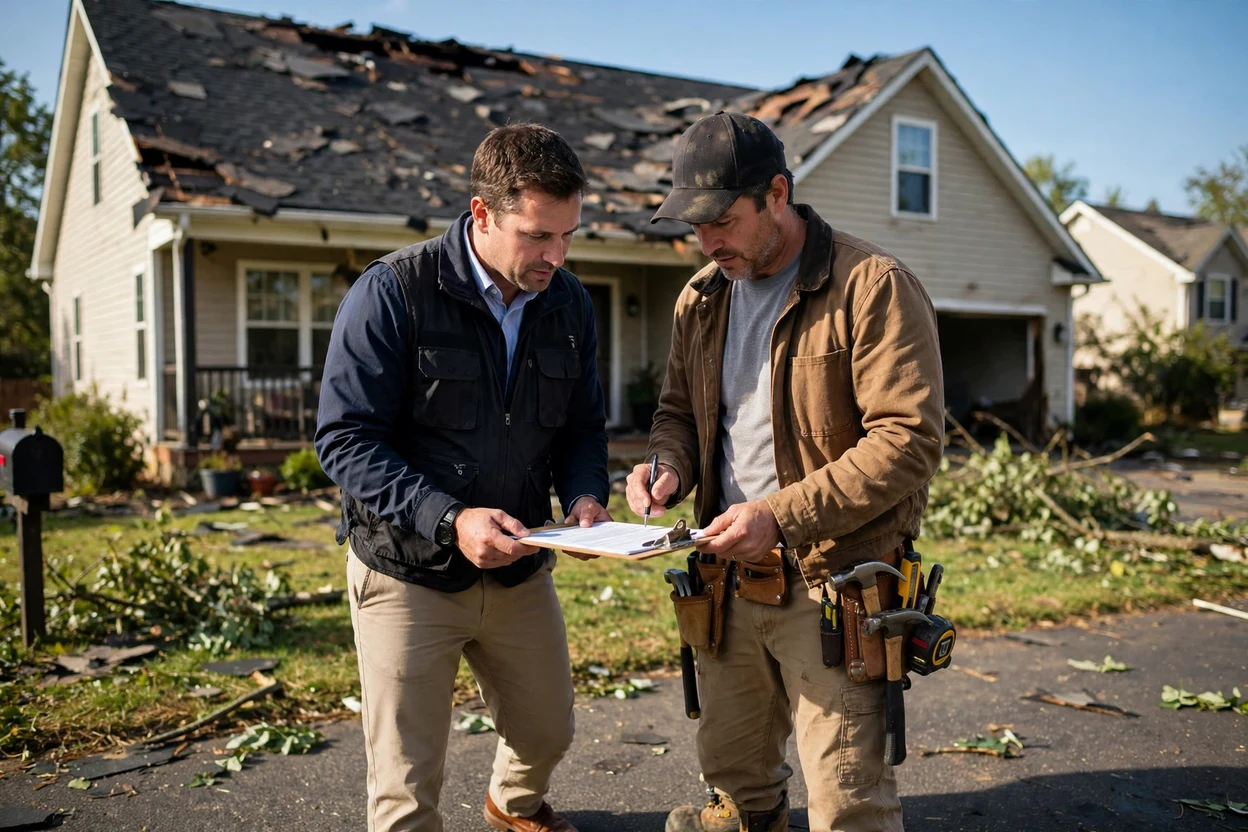
A roofing insurance claim contract is a roofing agreement for storm, hail or wind damage that an insurer will pay for in part or in full, and it needs extra clauses covering the claim, the deductible, supplements and the order of insurance payments. Hail-prone states add rules. Texas and Colorado are two clear examples.
What Is a Roofing Contingency Agreement?
A roofing contingency agreement is a short contract a homeowner signs before the insurer approves a claim. The catch is the commitment. If the insurer approves the claim, the agreement commits the homeowner to hire that roofer, usually at the price the insurer has approved for the work.
Colorado law lets homeowners cancel a roofing contract within 72 hours of receiving notice that the insurer denied the claim in whole or in part. Read every contingency agreement in full. A first door-knock visit is never the time to sign one.
Can a Roofer Waive Your Insurance Deductible?
No. Texas and Colorado ban roofers from waiving, paying or rebating a homeowner’s deductible. In any state, inflating a claim to cover the deductible misrepresents the loss to the insurer, and that creates trouble for both the homeowner and the roofer.
The contract should state plainly that the homeowner pays the deductible, with no rebate or side deal tucked into the price. A “free roof” pitch is a warning sign.
How Insurance Payments Affect the Payment Schedule
Many homeowner policies pay in two parts. This table explains the terms behind those two payments and how each one shapes the contract.
| Term | Meaning | Contract Impact |
|---|---|---|
| Actual Cash Value (ACV) | Replacement cost minus depreciation | Funds the first payment |
| Replacement Cost Value (RCV) | Full cost to replace the roof | Sets the total contract price |
| Recoverable Depreciation | Difference between RCV and ACV | Released after completion, funds final payment |
| Deductible | Homeowner’s share of the loss | Paid by the homeowner, never waived |
If a mortgage lender is named on the policy, the insurance check may list the lender as co-payee, which means the lender has to endorse it before anyone can deposit the funds. Build that step into the timeline.
Is a Roofing Estimate the Same as a Contract?
No, a roofing estimate is not a contract; an estimate is a price offer, and it becomes binding when both parties sign an acceptance that includes the essential terms, such as scope, price and schedule. Many roofers print an acceptance line on the proposal, so signing it can create a binding agreement. Watch for it.
Read the fine print first. If an estimate or proposal lacks warranty, change order or cancellation terms, ask for a full contract before any work begins on the roof.

State Roofing Contract Rules to Check Before Signing
Roofing contract rules change by state, so every roofing contract template needs a final check against the state’s licensing, cancellation, deposit and insurance-claim laws before use. The rules in the table that follows are examples, not a full list, and each one should be confirmed with its official source. Laws change.
This table compares selected state and federal rules that affect roofing contracts.
| Jurisdiction | Rule | Official Source |
|---|---|---|
| Federal (all states) | 3-day cancellation for home sales of $25 or more | FTC, 16 CFR Part 429 |
| California | Down payment capped at $1,000 or 10% | Contractors State License Board |
| California | Written contract required for jobs over $500 | California Legislative Information |
| Colorado | Written roofing contract and deductible waiver ban | Colorado General Assembly |
| Colorado | 72-hour cancellation after insurer denies claim | Colorado General Assembly |
| Texas | Contractors cannot waive or pay deductibles | Texas Department of Insurance |
| All states | Licensing set by state, county or city | State or local licensing office |
Some states license roofers statewide, while others leave licensing to cities and counties. Either way, ask for the license number. Then verify that number directly with the issuing office before you sign the contract or hand over any deposit money.
Roofing Contract Red Flags for Homeowners
The biggest roofing contract red flags are a missing license number, no proof of insurance, a large upfront payment demand, vague materials, no cancellation notice, and any offer to cover your insurance deductible. Each red flag signals higher risk of poor work, lost money or insurance trouble. Treat each one as a reason to pause.
This table lists common red flags and the risk each one creates.
| Red Flag | Why It Matters |
|---|---|
| No license number | Blocks verification with the licensing office |
| No Certificate of Insurance | Crew injuries or property damage may fall on you |
| Full payment upfront | Leaves no bargaining power if work stalls |
| Vague materials list | Allows cheaper product substitutions |
| No cancellation notice | May violate the FTC Cooling-Off Rule |
| Deductible waiver offer | Illegal in some states, signals claim inflation |
| Pressure to sign immediately | Common storm-chaser sales tactic |
Contractors can turn the red flag table into a pre-signing checklist. It catches gaps early. A contract that clears every row is easier to defend in a dispute and faster to get signed by a cautious homeowner.
Frequently Asked Questions
Can I Edit a Roofing Contract Template in Word or Google Docs?
Yes. Paste the text into Microsoft Word or Google Docs and replace each bracketed field. Then save a PDF copy for signing, so neither party can quietly change the terms after the other side has already agreed.
Is a Verbal Roofing Agreement Enforceable?
No, a verbal deal isn’t reliable protection. Its terms are hard to prove, and California requires written home improvement contracts above $500, so a handshake can also break state law. Put every roofing job in writing before work starts.
Does the 3-Day Cancellation Rule Apply to Insurance Roofing Jobs?
Yes, when you signed at home for $25 or more. Insurer funding doesn’t remove federal cancellation rights. Colorado goes a step further and adds a separate 72-hour cancellation window after an insurer denies a claim in whole or in part.
What Happens If No Permit Is Pulled for a Roof?
Unpermitted roofing can bring fines, stop-work orders and failed inspections. Problems can surface later, too. Missing permits can complicate a home sale or a future insurance claim, and some building departments make owners expose finished work for inspection.
Does a Contingency Agreement Commit Me to One Roofer?
Yes, if the insurer approves the claim. The agreement binds you to that roofer at the approved price, though federal and state cancellation rights still apply. Colorado homeowners can also cancel within 72 hours of a full or partial denial.
Conclusion
State lawmakers revise roofing, licensing and insurance-claim rules regularly, especially in hail-prone states, so a contract that’s compliant today can fall out of date. Start with the sample roofing contract template in this guide. Keep it current. Then update it whenever your state changes its deposit, cancellation or licensing rules, and have a local attorney review it once a year.
Contractors who send clear, clause-complete paperwork build trust faster and close jobs with fewer disputes. Homeowners win too. By reading every clause, verifying the license and insurance, and collecting a lien waiver at final payment, they avoid the most expensive surprises on the next roof.