
Concrete Column Calculator
Estimate the volume of concrete required to pour columns or piers — round, square, or rectangular — plus bag count and total cost.
Use the inside diameter of your tube form (e.g. 8", 10", 12").
If you're pouring multiple columns of the same size, set the count here.
Recommended 5–10% extra for spillage and over-pour.
Bag size selected above will be used.
How is this calculated?
Round column: volume = π × (diameter ÷ 2)² × height.
Square column: volume = side × side × height.
Rectangular column: volume = width × depth × height.
Total volume is multiplied by the number of identical columns. A waste allowance (10% by default) is then added so you order enough.
Bag estimates use standard yields: 40 lb ≈ 0.30 ft³, 60 lb ≈ 0.45 ft³, 80 lb ≈ 0.60 ft³.
Tip: Tube-form columns (Sonotube®) are a common DIY choice. For load-bearing columns, follow your structural engineer's spec for diameter and rebar.
Concrete Column Calculator: How Many Bags Do You Need?
A concrete column calculator gives you exact cubic yards, bag count, and cost before you buy a single bag. Enter column shape, diameter or width, height, and number of columns — the calculator does the math in seconds.
Most DIYers and contractors use the wrong number. They eyeball it, run short mid-pour, or order 10 extra bags they cannot return. This guide shows you exactly how the concrete column calculator works, how to use it correctly, and what every number means.
What Is a Concrete Column Calculator?
A concrete column calculator is an online tool that computes the volume of concrete needed to fill a column or pier — round, square, or rectangular — based on its dimensions. The calculator outputs cubic feet, cubic yards, bag count by size, and total material cost.
The tool applies 3 standard formulas:
- Round column: Volume = π × (diameter ÷ 2)² × height
- Square column: Volume = side × side × height
- Rectangular column: Volume = width × depth × height
All 3 formulas produce volume in cubic feet. Divide by 27 to convert to cubic yards (yd³) — the unit ready-mix suppliers use.
How to Use the Concrete Column Calculator in 5 Steps
To use the concrete column calculator, enter these 5 inputs:
- Select column shape — round, square, or rectangular
- Enter dimensions — diameter for round columns; side length for square; width and depth for rectangular
- Enter column height in feet or inches
- Enter number of identical columns — the calculator multiplies volume automatically
- Set waste allowance — use 5% for experienced pourers, 10% for DIY projects
The calculator returns total volume in cubic feet and cubic yards, bag count by size (40 lb / 60 lb / 80 lb), and estimated material cost.
Step 1: Choose Column Shape
Round columns (cylinders) are the most common for deck footings, porch piers, and Sonotube form work. Square columns apply to wood-post footings and masonry piers. Rectangular columns work for foundation walls and custom structural supports.
Step 2: Enter Column Dimensions
For round columns, use the inside diameter of the tube form — not the outside. A standard Sonotube® 10-inch tube has an inside diameter of 9.5 inches (24.1 cm). Entering the outside diameter overestimates concrete volume by 5–10%.
Sonotube Diameter | Inside Diameter | Common Use |
|---|---|---|
8 inches (20.3 cm) | 7.5 in (19.1 cm) | Railings, small sheds |
10 inches (25.4 cm) | 9.5 in (24.1 cm) | Standard deck posts |
12 inches (30.5 cm) | 11.5 in (29.2 cm) | Heavy beams, porch columns |
16 inches (40.6 cm) | 15.5 in (39.4 cm) | Commercial piers |
Step 3: Enter Column Height
Column height must extend at least 6 inches (15.2 cm) below the frost line. Frost line depth varies by location:
- Southern states (Texas, Florida, Georgia): 0–12 inches (0–30.5 cm)
- Mid-Atlantic (Virginia, Ohio, Missouri): 24–36 inches (61–91.4 cm)
- Northern states (Minnesota, Michigan, Maine): 42–60 inches (106.7–152.4 cm)
- Mountain West (Colorado, Wyoming): 36–48 inches (91.4–121.9 cm)
A footing that stops above the frost line heaves every winter. One frost cycle can shift a post 0.5–1 inch (1.3–2.5 cm) vertically. After 5 years, the structure becomes unsafe.
Step 4: Enter Number of Columns
The calculator multiplies single-column volume by the total count. A 12 × 16 foot (3.7 × 4.9 m) deck typically needs 6–8 columns depending on post spacing. A standard porch with 4 corner posts needs 4 columns. Enter the exact count — this prevents running short or over-ordering.
Step 5: Set Waste Allowance
Set waste allowance to 10% for DIY projects and 5% for professional pours. Concrete spills occur at every stage — mixing, transporting, and pouring. An 80 lb (36.3 kg) bag costs $5–7. Wasting 1–2 bags costs less than a second trip to the hardware store.
Concrete Volume Per Column: Reference Chart
This table shows cubic feet and 80 lb bag count for the most common round column sizes at standard depths.
Diameter | Depth | Volume (ft³) | Volume (yd³) | 80 lb Bags Needed |
|---|---|---|---|---|
8 in (20.3 cm) | 24 in (61 cm) | 0.87 ft³ | 0.032 yd³ | 2 bags |
8 in (20.3 cm) | 36 in (91.4 cm) | 1.05 ft³ | 0.039 yd³ | 2 bags |
10 in (25.4 cm) | 36 in (91.4 cm) | 1.64 ft³ | 0.061 yd³ | 3 bags |
10 in (25.4 cm) | 48 in (121.9 cm) | 2.18 ft³ | 0.081 yd³ | 4 bags |
12 in (30.5 cm) | 36 in (91.4 cm) | 2.36 ft³ | 0.087 yd³ | 4 bags |
12 in (30.5 cm) | 48 in (121.9 cm) | 3.14 ft³ | 0.116 yd³ | 6 bags |
16 in (40.6 cm) | 48 in (121.9 cm) | 5.59 ft³ | 0.207 yd³ | 10 bags |
80 lb (36.3 kg) bags yield approximately 0.60 ft³ each. 60 lb (27.2 kg) bags yield 0.45 ft³. 40 lb (18.1 kg) bags yield 0.30 ft³. Always round up to the next whole bag.
Ready-Mix vs Premix Bags: Which Is Right for Your Project?
Use premix bags for projects under 1 cubic yard (0.76 m³). Order ready-mix for projects over 1.5 cubic yards (1.15 m³). The crossover point is where ready-mix delivery costs less than the labor of mixing dozens of bags by hand.
Project Size | Recommended Method | Reason |
|---|---|---|
Under 1 yd³ (0.76 m³) | Premix bags | No delivery minimum, flexible timing |
1–1.5 yd³ (0.76–1.15 m³) | Either option | Compare total cost including labor |
Over 1.5 yd³ (1.15 m³) | Ready-mix delivery | Faster pour, more consistent mix |
Over 4 yd³ (3.06 m³) | Ready-mix required | Full truck load, eliminates short-load fee |
Ready-mix concrete costs $125–$165 per cubic yard (yd³) plus a short-load delivery fee of $50–$200 for orders under 4 yards. Premix 80 lb bags cost $5–$7 each, which equals $375–$525 per cubic yard in materials alone — 3× more expensive than ready-mix but requires no minimum order.
How Many Bags of Concrete for Common Column Projects
Deck Footings (8-Column Deck)
A standard 12 × 16 foot (3.7 × 4.9 m) residential deck with 8 footings at 10-inch (25.4 cm) diameter and 42-inch (106.7 cm) depth needs:
- Volume per column: 1.91 ft³ (0.054 m³)
- Total volume: 15.27 ft³ (0.432 m³) = 0.57 yd³ (0.432 m³)
- 80 lb bags needed: 26 bags (with 10% waste: 29 bags)
- Approximate material cost: $145–$200
This falls under 1 yd³ — premix bags are the correct choice.
Porch Columns (4 Columns)
A covered porch with 4 columns at 12-inch (30.5 cm) diameter and 48-inch (121.9 cm) depth needs:
- Volume per column: 3.14 ft³ (0.089 m³)
- Total volume: 12.57 ft³ (0.356 m³) = 0.47 yd³ (0.356 m³)
- 80 lb bags needed: 21 bags (with 10% waste: 24 bags)
- Approximate material cost: $120–$168
Commercial Pier Foundation (6 Piers)
A light commercial structure with 6 piers at 16-inch (40.6 cm) diameter and 60-inch (152.4 cm) depth needs:
- Volume per pier: 8.73 ft³ (0.247 m³)
- Total volume: 52.36 ft³ (1.48 m³) = 1.94 yd³ (1.48 m³)
- Ready-mix required: Order 2.1 yd³ (1.61 m³) to include waste
- Approximate material cost: $260–$346
Rebar and J-Bolt Requirements
Load-bearing concrete columns require rebar — no exceptions. The concrete handles compressive loads well but fails under tension without steel reinforcement.
Standard Rebar Sizing for Residential Columns
Column Diameter | Rebar Size | Number of Bars | Placement |
|---|---|---|---|
8 in (20.3 cm) | #4 rebar | 1 bar | Center of column |
10 in (25.4 cm) | #4 rebar | 1–2 bars | Centered or split |
12 in (30.5 cm) | #4 or #5 rebar | 2 bars | 6 inches (15.2 cm) apart |
16+ in (40.6+ cm) | #5 rebar | 3–4 bars | Evenly spaced at 4 in (10.2 cm) from edge |
Rebar extends from 3 inches (7.6 cm) above the footing pad to 2 inches (5.1 cm) below the top of the column. Set the rebar before pouring — pushing rebar into wet concrete does not achieve proper placement.
J-Bolt and Post Anchor Installation
Set J-bolts or post anchors while the concrete is still wet — within 10–15 minutes of pouring. Use a string line and level to position anchors exactly over the layout marks. Concrete that hardens with a misplaced anchor requires demolition and repour — a $150–$400 mistake.
Standard J-bolt placement for residential post anchors: 2.5 inches (6.4 cm) from column centerline, set to manufacturer-specified embedment depth (typically 4–6 inches / 10.2–15.2 cm).
Concrete Column Sizing: What Size Column Do You Need?
A residential concrete column should be at least 10 inches (25.4 cm) in diameter for single-story structures and 12 inches (30.5 cm) for two-story loads. These minimums apply to standard soil conditions. Poor soil, high water tables, or heavy loads require a structural engineer’s specification.
Structure | Min. Column Size | Recommended Depth | Rebar Required? |
|---|---|---|---|
Fence post or railing | 8 in (20.3 cm) | 24–30 in (61–76.2 cm) | No |
Deck post (single story) | 10 in (25.4 cm) | 36–42 in (91.4–106.7 cm) | Yes |
Porch column | 12 in (30.5 cm) | 42–48 in (106.7–121.9 cm) | Yes |
Two-story deck or addition | 12–16 in (30.5–40.6 cm) | 48–60 in (121.9–152.4 cm) | Yes |
Commercial pier | 16+ in (40.6+ cm) | Per engineer spec | Yes — engineer required |
5 Calculation Mistakes That Cost Money
These 5 errors show up on job sites every week:
Mistake 1: Using home square footage instead of column dimensions — calculate column volume, not floor area
Mistake 2: Measuring Sonotube outside diameter instead of inside diameter — always use inside diameter for accurate volume
Mistake 3: Skipping waste allowance — minimum 5% for pros, 10% for DIY; running short mid-pour creates cold joints
Mistake 4: Not accounting for frost line depth — a column 6 inches too shallow heaves annually until the structure fails
Mistake 5: Ordering ready-mix for under 1 yd³ — short-load fees of $50–$200 make premix bags cheaper for small pours
How Concrete Cures: What to Expect After Pouring
Concrete reaches 70% of its final compressive strength (PSI) within 7 days and over 90% within 28 days. Do not apply structural loads — post weight, beam connections, ledger boards — until the column reaches 7-day strength.
Time After Pour | Approximate Strength | What You Can Do |
|---|---|---|
24–48 hours | 20–30% of final PSI | Remove form tube (Sonotube) |
3–7 days | 50–70% of final PSI | Light loads only — no heavy beams |
7 days | 70% of final PSI | Standard residential loads |
28 days | 90%+ of final PSI | Full design load — safe for all applications |
Cold weather slows curing significantly. Concrete poured below 50°F (10°C) requires insulating blankets or heated enclosures to cure properly. Below 40°F (4.4°C), do not pour without active heating measures — water in the mix will freeze before hydration completes.
Frequently Asked Questions
How many 80 lb bags do I need for a concrete column?
A 10-inch diameter, 36-inch deep column needs 3 bags of 80 lb concrete. A 12-inch diameter, 48-inch deep column needs 6 bags. Use the calculator above for exact counts on any size.
What is the formula for calculating concrete column volume?
For round columns: Volume = π × radius² × height. For a 10-inch diameter (5-inch radius), 36-inch deep column: 3.14159 × (5÷12)² × 3 = 1.64 cubic feet. Divide by 27 to convert to cubic yards (0.061 yd³).
Do concrete columns need rebar?
Yes — all load-bearing concrete columns require rebar. Non-structural fence posts and railings can omit rebar, but any column supporting a deck, porch, or structure needs vertical rebar from footing to top.
How deep should a concrete column be?
A concrete column must extend at least 6 inches below the frost line. Frost line depth ranges from 0 inches in South Florida to 60 inches in northern Minnesota. Check your local building code for the required depth in your area.
How many bags of concrete for a 12-inch Sonotube?
A 12-inch Sonotube at 48-inch depth needs 6 bags of 80 lb concrete (3.14 ft³ total). At 36-inch depth, it needs 4 bags (2.36 ft³). Always add 10% waste — buy 7 bags for 48-inch depth.
Can I mix concrete in a Sonotube?
No — never mix concrete inside the tube. Mix in a separate wheelbarrow or mixer, then pour into the tube. Mixing inside the form creates air pockets, uneven hydration, and structural weak points.
Need Roofing Help in USA?
Related Tools

Estimate the number of blocks, total cost, and mortar bags needed for your wall.

Estimate how much concrete you need to pour a wall — including openings for doors and windows, waste allowance, bag count, and total cost.
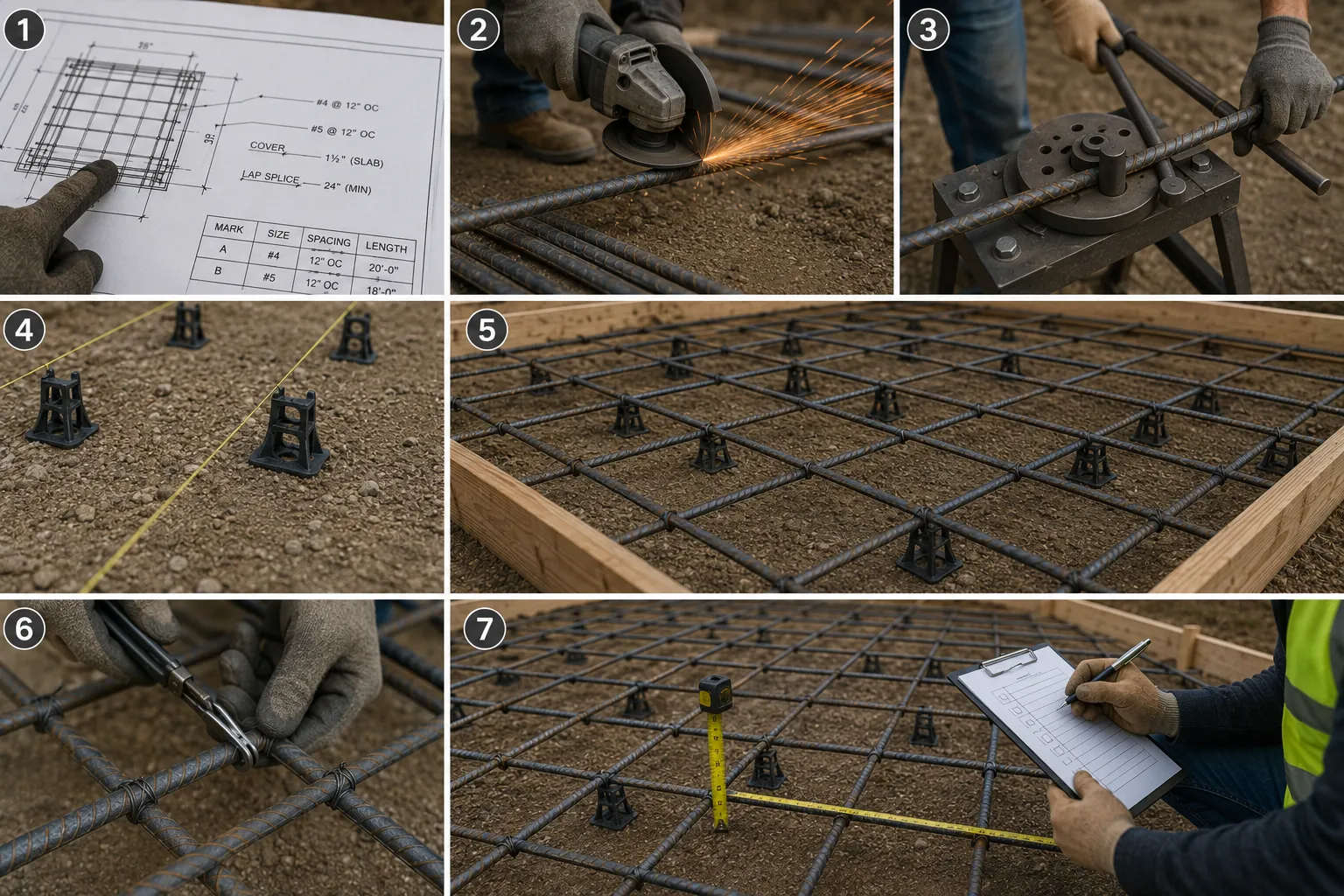
Rebar (Reinforcement Steel Calculator)
Estimate the amount of reinforcement steel (rebar) needed for slabs, beams, columns, and footings — including bar spacing, lap length, weight, and total cost calculation.

Calculate the volume of concrete needed for a flight of stairs — including the optional top platform — then estimate bags and total cost.

Estimate the total cost of pouring a slab, footing, or column — including concrete volume, premix bags needed, and waste allowance.