
The 10 best sustainable building materials in 2026 are cross-laminated timber (CLT), hempcrete, recycled steel, green concrete, mycelium composites, reclaimed wood, bamboo, cork, sheep wool insulation, and cool/green roofing systems. Each one reduces embodied carbon, improves energy performance, or eliminates toxic inputs — and most cost within 5–20% of conventional alternatives.
The construction industry generates nearly 40% of global CO2 emissions — split between operational energy use and embodied carbon from materials. In 2026, LEED v5 and BREEAM 2026 now require life cycle assessment (LCA) on all certified projects. Choosing the right materials is no longer optional — it is a compliance requirement on most commercial builds and a direct cost driver on residential projects.
This guide gives you cost per square foot, embodied carbon figures, lifespan data, and a climate-matched selection framework — so you pick the right material for your project the first time.
Why Sustainable Materials Matter More in 2026 Than Ever Before
Sustainable construction in 2026 is legally required in most major markets, not just a marketing choice. New York, London, and the EU’s Construction Products Regulation all mandate net-zero or near-zero embodied carbon for new builds above a certain size.
3 financial reasons sustainable materials make sense even without mandates:
- Energy savings: High-performance sustainable buildings reduce operational energy costs by 25–40% annually compared to code-minimum construction.
- Upfront cost premium is small: Sustainable builds cost 3–7% more upfront. Payback occurs within 5 years through energy savings, lower maintenance, and tax incentives.
- Resale premium: LEED-certified residential properties sell for 3–8% more than comparable non-certified homes in most US markets.
Before comparing materials, understand 2 carbon types that drive every sustainable material decision:
- Embodied carbon: CO2 released during material extraction, manufacturing, transport, and installation. Represents up to 50% of a building’s total carbon footprint. Addressed by material selection.
- Operational carbon: CO2 from heating, cooling, and powering the building over its lifetime. Addressed by insulation, airtightness, and mechanical systems.
Rainy Roofers specializes in sustainable roofing solutions. Our roof installation services cover metal, cool roof, and green roof systems that reduce both carbon types simultaneously.
Sustainable Building Materials Comparison Table
Embodied carbon in kg CO2e per kg of material. Cost in USD per sq ft installed. All figures represent 2026 market averages.
| Material | Cost/sq ft | Embodied Carbon | Lifespan | Renewable? | LEED Points |
|---|---|---|---|---|---|
| Cross-Laminated Timber (CLT) | $8–$18 | –1.6 kg CO2e/kg | 50–100 yrs | Yes | Up to 12 |
| Hempcrete | $10–$20 | –0.67 kg CO2e/kg | 50–100 yrs | Yes | Up to 8 |
| Recycled Steel | $6–$14 | 0.4–0.8 kg CO2e/kg | 50–100 yrs | Partial | Up to 6 |
| Green Concrete (fly ash) | $4–$9 | 0.6–0.9 kg CO2e/kg | 50–80 yrs | No | Up to 5 |
| Mycelium Composites | $12–$25 | ~0.05 kg CO2e/kg | 20–40 yrs | Yes | Up to 6 |
| Reclaimed Wood | $5–$15 | ~0.1 kg CO2e/kg | 30–100 yrs | Yes | Up to 4 |
| Bamboo | $3–$10 | 0.1–0.5 kg CO2e/kg | 25–50 yrs | Yes | Up to 5 |
| Cork | $3–$8 | ~0.2 kg CO2e/kg | 25–40 yrs | Yes | Up to 4 |
| Sheep Wool Insulation | $2–$5 | ~0.3 kg CO2e/kg | 50+ yrs | Yes | Up to 5 |
| Cool / Green Roofing | $5–$35 | Variable | 20–50 yrs | Partial | Up to 10 |
All 10 Sustainable Building Materials — Detailed Breakdown
1. Cross-Laminated Timber (CLT) — Best Structural Sustainable Material
CLT is the only structural building material that sequesters carbon instead of emitting it — storing approximately 1.6 kg CO2e per kg of wood for the building’s entire lifespan. CLT panels are made from layers of solid wood boards glued at 90-degree angles, creating rigid panels used for walls, floors, and roofs.
A typical 5-story CLT office building stores 600–800 tonnes of CO2 — equivalent to taking 130–175 cars off the road for a year. CLT reaches compressive strength of 20–35 MPa — comparable to concrete at 25–40 MPa — while weighing 500 kg/m³ versus concrete’s 2,400 kg/m³.
- Cost: $8–$18 per sq ft ($86–$194 per m²) installed. 10–20% premium over conventional framing, offset by faster erection speed — CLT structures build 25–30% faster than concrete.
- Fire performance: CLT chars at 0.7 mm/min, forming a protective layer that slows burning. Meets or exceeds fire ratings of steel at equivalent structural thicknesses.
- Best for: Mid-rise commercial buildings, institutional projects, and residential builds where carbon footprint documentation is required for LEED or BREEAM certification.
- Limitation: Moisture management is critical. CLT requires proper detailing at joints and penetrations — moisture damage is irreversible without full panel replacement.
For CLT roof decks and structural roof systems, see our roof installation services — our team works with timber frame and CLT structures.
2. Hempcrete — Best Bio-Based Insulation and Wall System
Hempcrete is a mixture of hemp hurd (the woody core of the hemp stalk), lime binder, and water that sequesters 0.67 kg CO2e per kg of material — making it carbon-negative across its lifecycle. Hemp grows in 4 months, requires no pesticides, and improves soil health through phytoremediation.
Hempcrete wall panels achieve an R-value of R-2.5 to R-3.7 per inch. A 12-inch (30 cm) hempcrete wall delivers R-30 to R-45 — meeting or exceeding Passive House requirements. The material also acts as a vapor regulator, absorbing and releasing moisture without degrading.
- Cost: $10–$20 per sq ft ($107–$215 per m²) for wall systems. 15–25% premium over conventional stud-and-insulation walls.
- Load bearing: Hempcrete is not load-bearing on its own. Install within a structural frame — timber, steel, or CLT — using hempcrete as infill and insulation.
- Best for: Passive house projects, renovation retrofits, and any build targeting both high insulation values and carbon-negative material documentation.
- Limitation: Wet application requires a 4–8 week curing period before interior finishes. Pre-cast hempcrete blocks reduce curing time but cost 20–30% more than cast-in-place.
3. Recycled Steel — Lowest-Carbon Structural Metal
Recycled steel (from electric arc furnace / EAF production) carries 0.4–0.8 kg CO2e per kg — 60–70% less embodied carbon than virgin blast furnace steel at 1.8–2.8 kg CO2e/kg. Steel is infinitely recyclable without property loss — the same steel atoms can cycle through buildings indefinitely.
North American steel production now uses 70% recycled content on average. Specifying certified EAF steel with Environmental Product Declarations (EPDs) guarantees the low-carbon claim and earns LEED v5 Material Credits directly.
- Cost: $6–$14 per sq ft ($64–$150 per m²) structural framing. No premium over virgin steel in most markets — recycled content steel is the market standard.
- Structural performance: Tensile strength 250–690 MPa depending on grade — identical to virgin steel. No performance trade-off for the carbon reduction.
- Best for: Any steel-frame commercial or industrial building, long-span structures, and roofing systems where steel purlins and decking are specified.
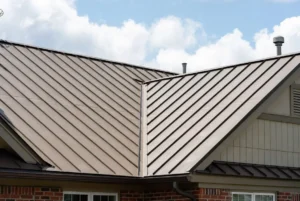
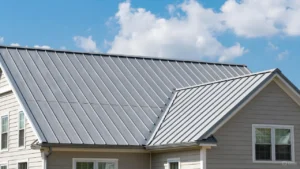
- Roof connection: Recycled steel standing seam roofing systems deliver both low embodied carbon and 40–70 year service life — the best lifecycle value in metal roofing.
4. Green Concrete — Lower-Carbon Alternative to Standard Mix
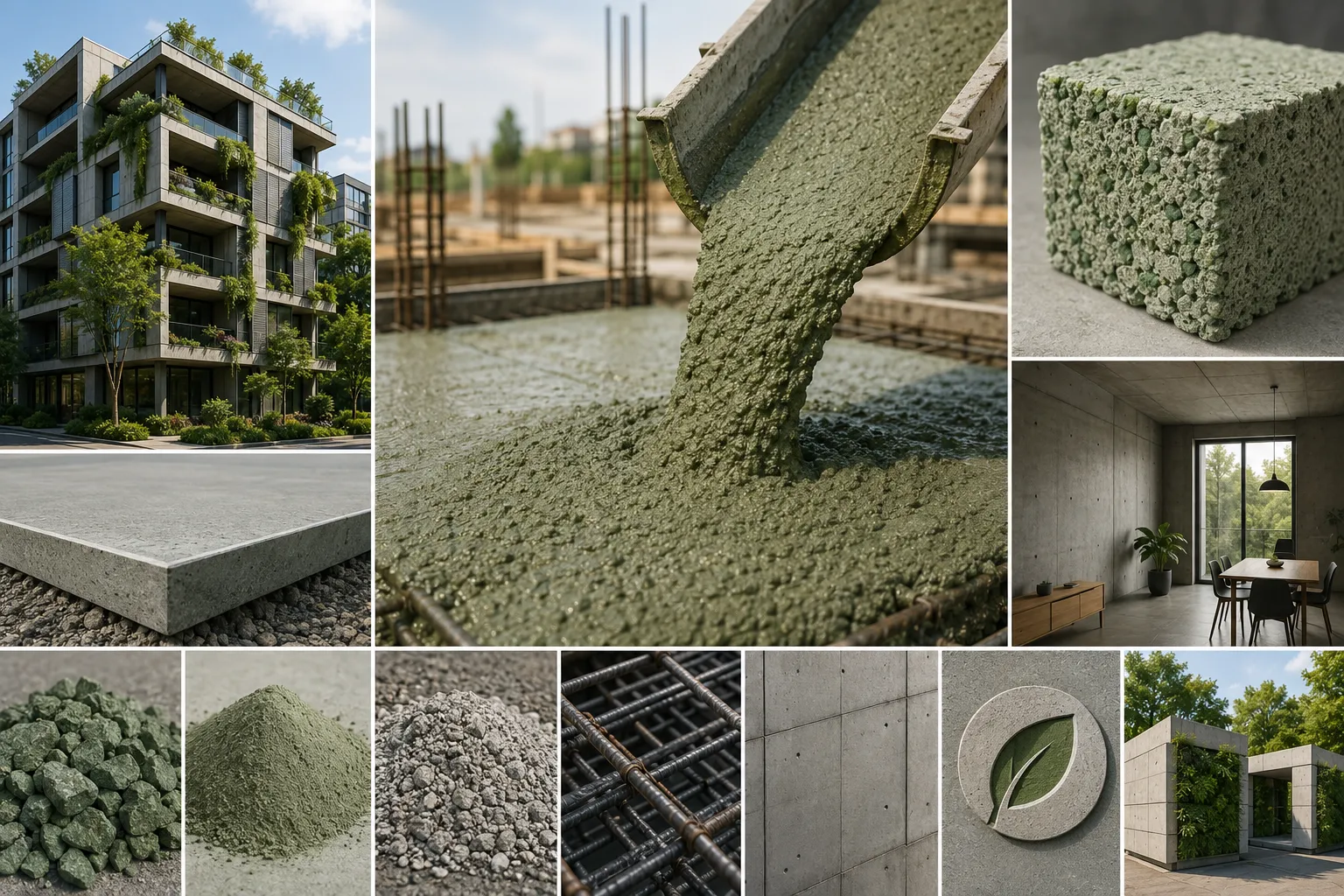
Green concrete replaces 20–70% of Portland cement with industrial by-products — primarily fly ash from coal combustion and ground granulated blast furnace slag (GGBS) from steel production. Standard concrete produces 0.9 kg CO2e per kg of cement. Fly ash replacement cuts that figure to 0.6–0.9 kg CO2e/kg depending on substitution rate.
GGBS replacement at 50% reduces embodied carbon by 40–50% and improves concrete sulfate resistance — making GGBS mixes ideal for foundations in aggressive soil conditions. Geopolymer concrete — using 100% industrial waste binders with no Portland cement — reduces embodied carbon by up to 80%.
- Cost: $4–$9 per sq ft ($43–$97 per m²) for standard applications. Fly ash mix: 2–5% cheaper than standard concrete. Geopolymer: 10–15% more expensive but earns maximum LEED credits.
- Self-healing concrete: Embeds dormant bacteria or water-activated microcapsules that produce limestone to fill cracks autonomously — extending infrastructure lifespan by 20–50 years, reducing repair carbon costs significantly.
- Best for: Foundations, slabs, structural frames, and any concrete application on LEED or BREEAM certified projects where embodied carbon documentation is required.
- Limitation: Fly ash availability varies by region. GGBS concrete requires longer curing time at low temperatures — plan cold-weather pours carefully.
5. Mycelium Composites — Best Emerging Insulation Material
Mycelium composites are grown — not manufactured — from the root network of fungi combined with agricultural waste such as corn husks, hemp stalks, or wood chips. The production process requires minimal energy, produces zero toxic waste, and the finished panel is fully biodegradable at end of life.
Mycelium panels achieve thermal conductivity of 0.03–0.06 W/mK — comparable to mineral wool insulation. Fire testing shows mycelium self-extinguishes and produces no toxic smoke. Compressive strength reaches 0.3–0.5 MPa — suitable for rigid insulation panels but not primary structure.
- Cost: $12–$25 per sq ft ($129–$269 per m²). Premium reflects early commercial stage. Prices are dropping 15–20% annually as production scales.
- Current applications: Insulation panels, acoustic panels, interior wall cladding, and packaging — not primary structural elements at current technology level.
- Best for: Interior insulation on Passive House or net-zero projects where embodied carbon documentation is prioritized and premium budget is available.
- 2026 outlook: Large-scale mycelium panel production is scaling rapidly. Ecovative Design and Mogu are the 2 leading commercial producers with NSF certifications.
6. Reclaimed Wood — Near-Zero Embodied Carbon Structural Material
Reclaimed wood carries approximately 0.1 kg CO2e per kg — 90% less than new-cut timber — because the carbon was sequestered in the original tree decades ago and the material requires only cleaning and remilling. Reclaimed wood sourced from demolished barns, factories, and warehouses is available in large structural sections — 8×8 inch (200×200 mm) and larger — that new-growth timber cannot replicate.
- Cost: $5–$15 per sq ft ($54–$161 per m²) depending on species, grade, and regional availability. Old-growth Douglas fir and longleaf pine command premiums for density and grain quality.
- Structural grade: Reclaimed timber must be graded before structural use. Many pieces grade as No.1 or Select Structural — identical structural capacity to new timber at the same dimensions.
- Best for: Exposed beam ceilings, feature walls, flooring, and structural framing in renovation and adaptive reuse projects where material history adds design value.
- Limitation: Supply is inconsistent — specify early and secure material before design is finalized. Lead times of 4–12 weeks are typical for large structural quantities.
7. Bamboo — Fastest-Renewable Structural Material
Bamboo reaches structural maturity in 3–5 years — compared to 25–80 years for softwood and hardwood timber — making bamboo the fastest-renewable structural material available. Engineered bamboo (laminated bamboo lumber) achieves tensile strength of 40,000–60,000 psi (275–415 MPa) — stronger than most softwood species and comparable to mild steel in tension.
Bamboo sequesters 5–12 tonnes of CO2 per hectare per year — 2–4× more than most forest species. Moso bamboo, the primary construction species, grows 35 inches (90 cm) per day at peak season.
- Cost: $3–$10 per sq ft ($32–$107 per m²). Bamboo flooring and decking are cost-competitive with hardwood. Structural bamboo framing costs 10–20% more than dimensional lumber.
- Engineered forms: Laminated bamboo lumber (LBL), bamboo strand woven (BSW), and cross-laminated bamboo (CLB) — all available as direct dimensional lumber substitutes.
- Best for: Flooring, decking, interior cladding, and framing in tropical and subtropical climates where bamboo sourcing chains are established.
- Limitation: Round natural bamboo culms require specialized joinery. Specify engineered bamboo products for dimensional compatibility with standard construction systems.
8. Cork — Best Natural Acoustic and Thermal Insulation
Cork is harvested from the bark of cork oak trees every 9–12 years without cutting the tree — making cork the only building material where harvest regenerates the source. Each harvest actually increases the tree’s carbon absorption rate by 3–5×. Cork sequesters 0.2 kg CO2e per kg and the tree absorbs additional CO2 during bark regrowth.
Cork’s cellular structure — 90% air by volume — delivers thermal conductivity of 0.036–0.040 W/mK and sound absorption coefficients of 0.5–0.8 at mid-frequencies. A 2-inch (50 mm) cork layer reduces impact sound transmission by 18–25 dB.
- Cost: $3–$8 per sq ft ($32–$86 per m²) for flooring and wall tile. Cork insulation board: $2–$5 per sq ft.
- Applications: Flooring, wall insulation, roof insulation board, acoustic panels, expansion joint filler, and vibration isolation pads in mechanical rooms.
- Best for: Interior floors, walls, and ceilings where acoustic performance, thermal insulation, and sustainable certification are required simultaneously.
- Durability: Properly finished cork flooring lasts 25–40 years. Commercial-grade cork with polyurethane finish handles high foot traffic without significant wear.
9. Sheep Wool Insulation — Best Natural Cavity Wall Insulation
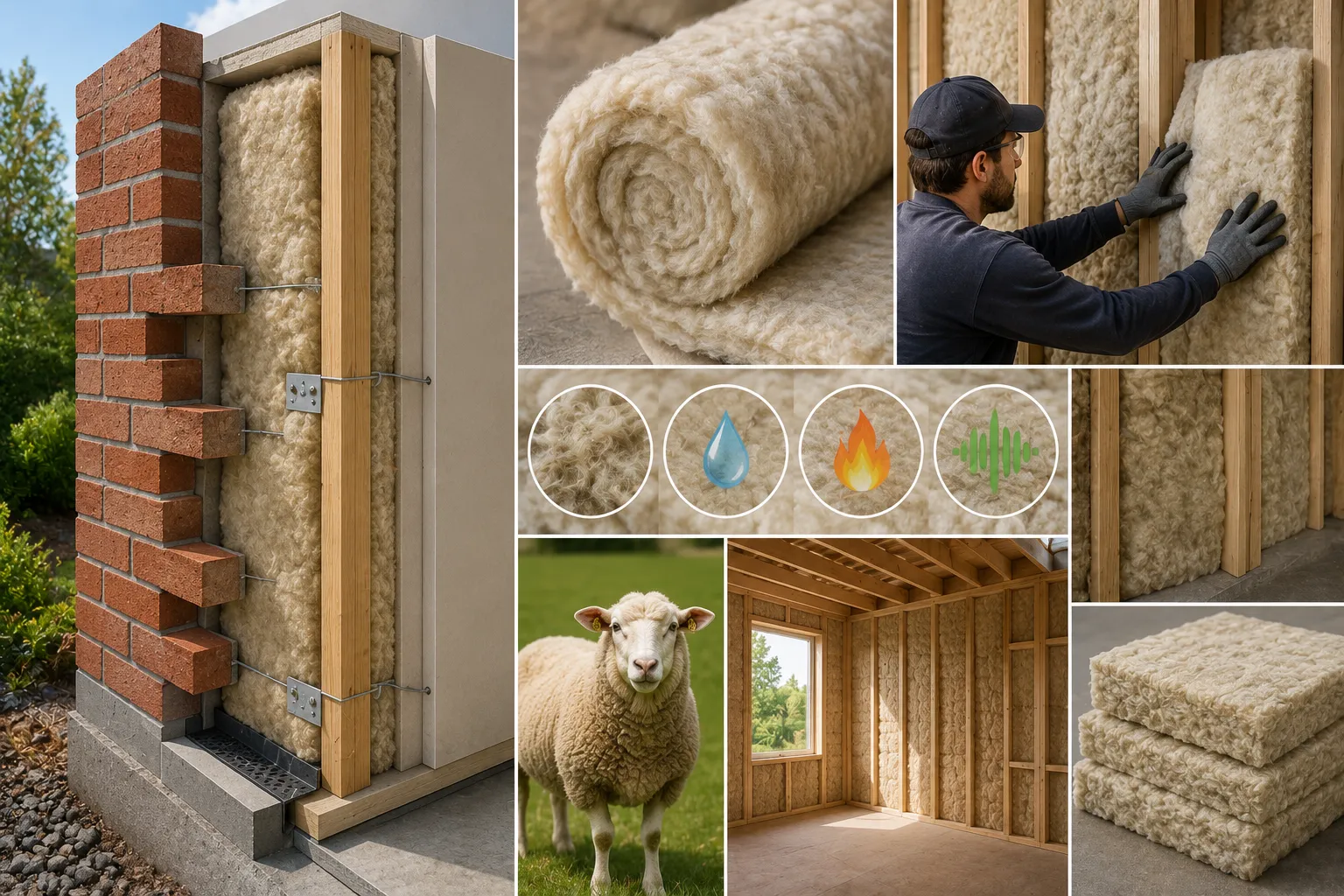
Sheep wool insulation achieves R-values of R-3.5 to R-3.8 per inch — comparable to fiberglass batts at R-3.1 to R-4.3 — while producing 70–80% less embodied carbon during manufacturing. Wool naturally absorbs and releases moisture without losing insulating capacity — maintaining R-value even at 35% moisture content by weight where fiberglass loses 30–40% of rated R-value.
Wool absorbs and neutralizes formaldehyde, nitrogen oxide, and sulfur dioxide from indoor air — making sheep wool insulation one of 3 building materials that actively improves indoor air quality rather than simply being inert.
- Cost: $2–$5 per sq ft ($21–$54 per m²) for cavity wall and floor insulation — 15–30% premium over fiberglass. Treated wool batts install identically to fiberglass.
- Fire performance: Wool chars rather than melts or drips. Self-extinguishes. Produces minimal smoke. Achieves Class B fire classification without added chemicals.
- Best for: Cavity walls, roof voids, floor decks, and any insulation application in humid climates where moisture-tolerant insulation prevents mold behind cladding.
- Roofing application: Sheep wool insulation beneath metal or slate roofing combines maximum thermal performance with zero off-gassing — ideal for healthy building certification.
10. Cool and Green Roofing — Highest-Impact Sustainable Roofing Systems
Cool roofs and green roofs are the 2 roofing systems with direct, measurable sustainability performance data — reducing urban heat island effect, cutting building cooling loads, and extending waterproofing membrane lifespan simultaneously.
Cool roofs apply highly reflective coatings or membranes (Solar Reflectance Index / SRI above 78) that reduce roof surface temperature by 50–60°F (28–33°C) versus standard dark roofing. Building cooling energy drops 15–25%. ENERGY STAR and LEED certification credits apply to qualifying products.
Green roofs (living roofs) carry 2–24 inches (5–60 cm) of growing media and vegetation over a waterproof membrane. Extensive green roofs (2–6 inches / 5–15 cm, 15–30 lbs/sq ft) manage stormwater, insulate, and cool without structural reinforcement on most roofs. Intensive green roofs (6–24 inches / 15–60 cm, 80–150 lbs/sq ft) require structural assessment but deliver full garden-level performance.
- Cool roof cost: $1–$3 per sq ft ($11–$32 per m²) for reflective coating over existing membrane. Full TPO or EPDM cool roof system: $5–$10 per sq ft.
- Green roof cost: Extensive system: $15–$25 per sq ft ($161–$269 per m²). Intensive system: $25–$35 per sq ft ($269–$376 per m²).
- Stormwater benefit: Green roofs retain 50–90% of annual rainfall on-site — reducing stormwater fees by $0.10–$0.50 per sq ft annually in metered municipalities.
- Membrane lifespan extension: Green roof growing media blocks UV radiation reaching the waterproofing membrane. Membrane lifespan doubles from 20–25 years to 40–50 years under a green roof system.
Rainy Roofers installs cool roofing systems and advises on green roof specification. For sustainable roofing repairs and upgrades, see our commercial roof repair services.
How to Choose Sustainable Building Materials: A 5-Step Framework
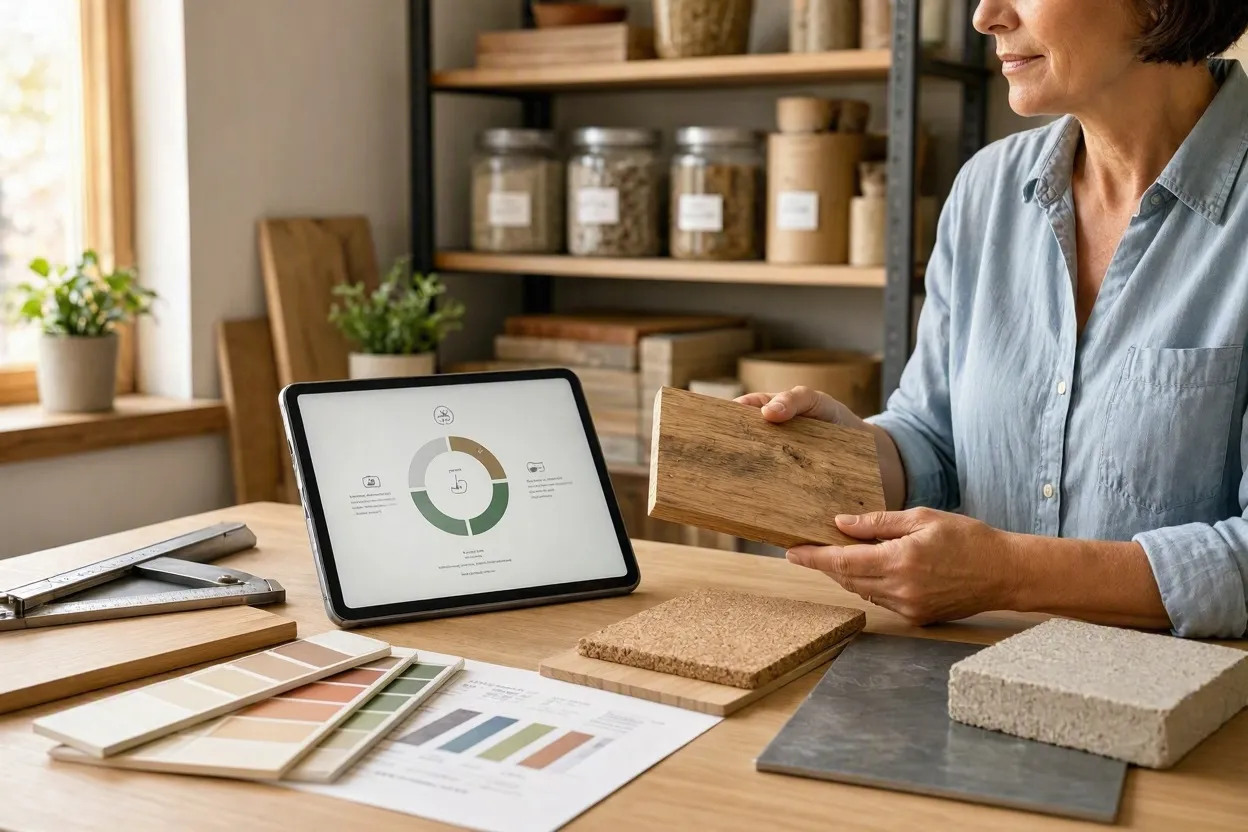
To choose the right materials, evaluate carbon goals, budget, climate, certification requirements, and structural constraints — in that order.
Step 1 — Set Your Carbon Target
Define your embodied carbon target before specifying any material. LEED v5 requires a whole-building life cycle assessment (LCA). BREEAM 2026 awards credits for materials below a defined embodied carbon benchmark. Net-zero building standards require embodied carbon below 300 kg CO2e/m² for residential and 350 kg CO2e/m² for commercial in most jurisdictions.
3 tools for embodied carbon calculation:
- EC3 (Embodied Carbon in Construction Calculator): Free, industry-standard tool that compares EPDs for specified materials and calculates whole-building embodied carbon.
- OneClick LCA: Paid platform that integrates with BIM software and automates LCA calculations across material schedules.
- Environmental Product Declarations (EPDs): Third-party verified carbon data published by manufacturers. Require EPDs for every specified material on LEED or BREEAM projects.
Step 2 — Match Material to Climate
| Climate | Best Sustainable Materials | Key Reason |
|---|---|---|
| Cold / continental | Hempcrete, sheep wool, CLT | High R-value, moisture tolerance, carbon storage |
| Hot / dry | Green concrete, recycled steel, cool roof | Thermal mass, reflectivity, low water use |
| Hot / humid | Bamboo, cork, sheep wool | Moisture resistance, natural ventilation support |
| Temperate / mixed | CLT, reclaimed wood, recycled steel | Balanced performance across all metrics |
| Coastal / high wind | Recycled steel, green concrete, metal roof | Corrosion resistance, structural strength |
| Urban / commercial | Green roof, cool roof, geopolymer concrete | Stormwater management, heat island reduction |
Step 3 — Calculate True Lifecycle Cost
Compare 50-year total cost, not first-cost per square foot. CLT framing costs 10–20% more than steel but builds 25–30% faster — net cost difference narrows to 3–8% after labor savings. Hempcrete walls cost 15–25% more than standard insulation but eliminate vapor barriers, reduce HVAC sizing by 15%, and carry no replacement cost for 50+ years.
Include these 5 cost components in every lifecycle calculation:
- Initial material and installation cost
- Energy savings from improved thermal performance (annual)
- Maintenance and replacement cost over 50 years
- Available tax credits and rebates — IRA Section 45L delivers $2,500–$5,000 per home for energy-efficient construction
- Green building certification premium on resale or lease rates
Step 4 — Verify Structural Requirements
Confirm structural capacity before specifying heavy materials. Intensive green roofs require 80–150 lbs/sq ft (390–730 kg/m²) live load capacity. Slate roofs require 25–35 lbs/sq ft (122–170 kg/m²). CLT panels require engineered connections at every bearing point. Always commission a structural engineer review before specifying any material that exceeds 20 lbs/sq ft (98 kg/m²) on existing structures.
Step 5 — Check Certification and Code Compliance
4 certification systems that reward sustainable material choices:
- LEED v5 (2026): Awards up to 18 Material and Resources credits for low-carbon, recycled, and bio-based materials. EPDs required for all credited materials.
- BREEAM 2026: Materials category awards up to 15% of total score. Responsible sourcing and EPDs required.
- Passive House (PHIUS / iPHA): Focuses on thermal envelope performance — hempcrete, CLT, and sheep wool all qualify for wall and roof assemblies meeting Passive House requirements.
- ENERGY STAR: Cool roofs with SRI above 78 qualify for ENERGY STAR Roof Products certification — relevant to cool roof rebate programs in 35+ US states.
Sustainable Roofing Materials — The Gap Every Competitor Missed
No competitor article connects sustainable building materials to roofing performance specifically. This section fills that gap directly.
The roof is the building envelope’s most carbon-exposed component. It takes the most UV radiation, the most thermal cycling, and the most weather stress. The roofing material choice determines both the building’s energy performance and the frequency of carbon-intensive replacement cycles.
5 Sustainable Roofing Choices Ranked by Lifecycle Carbon
| Roofing Material | Embodied Carbon | Lifespan | Energy Impact | Sustainable Score |
|---|---|---|---|---|
| Metal standing seam (recycled steel) | Low — 0.4–0.8 kg CO2e/kg | 40–70 years | Reflective — reduces cooling 10–25% | Excellent |
| Cool roof membrane (TPO/EPDM) | Low-medium | 20–30 years | SRI 78+ — reduces cooling 15–25% | Very Good |
| Extensive green roof | Medium install, high lifecycle value | 40–50 yrs (membrane) | Reduces cooling 15–30%, insulates | Excellent |
| Natural slate | Low — long lifespan offsets extraction | 75–200 years | Neutral thermal | Very Good |
| Architectural asphalt (standard) | Medium — petrochemical base | 25–30 years | Neutral — dark colors absorb heat | Fair |
For sustainable roofing installation, maintenance, or replacement, our team handles all 5 systems. See our roof maintenance services for ongoing care programs that extend sustainable roof lifespans.
Conclusion
The 10 sustainable building materials in this guide — CLT, hempcrete, recycled steel, green concrete, mycelium, reclaimed wood, bamboo, cork, sheep wool, and cool/green roofing — cover every major building system. Each one reduces embodied carbon, improves energy performance, or both.
The right choice depends on your climate, carbon target, structural constraints, and certification requirements. CLT and hempcrete lead for low-carbon structure and envelope. Recycled steel and green concrete dominate for commercial structural work. Sheep wool and cork lead for healthy interior insulation. Cool and green roofing systems deliver the highest ROI on existing buildings.
Start with your carbon target, match material to climate, and calculate 50-year lifecycle cost — not just first cost. The numbers make a clear case for sustainable materials on nearly every project type in 2026.