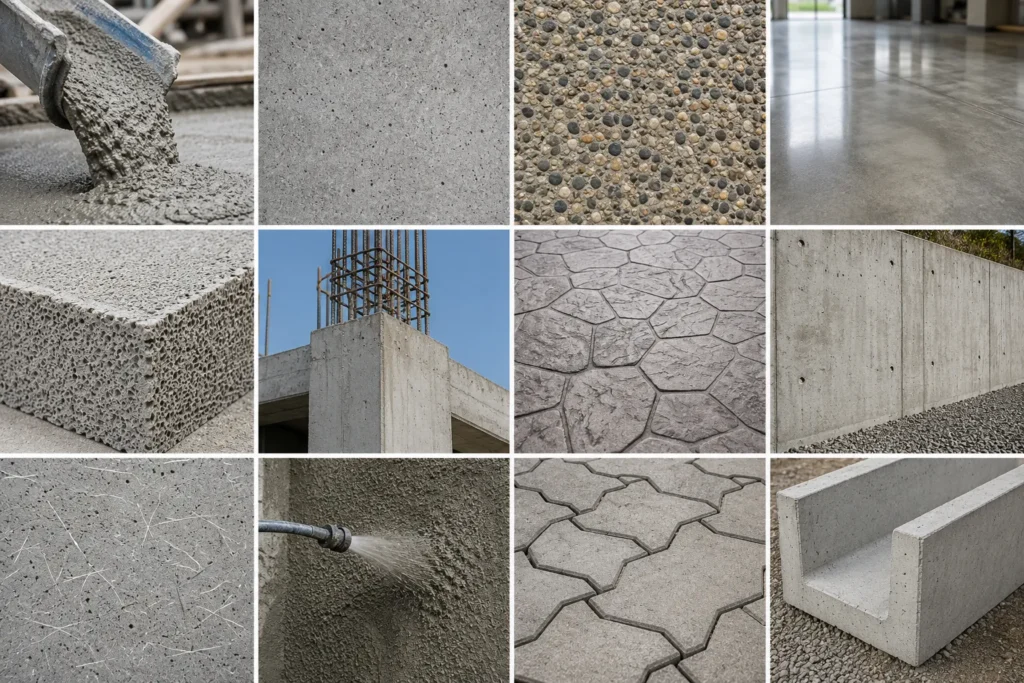
There are 12 main types of concrete used in construction: plain, reinforced, ready-mix, high-strength, lightweight, high-density, air-entrained, self-consolidating, pervious, stamped, shotcrete, and rapid-setting. Each type differs in compressive strength, water-cement ratio, admixtures, and which project it suits.
Picking the wrong mix causes real problems. A driveway poured with sidewalk-grade concrete cracks under vehicle weight within 2–3 winters. A foundation built with standard residential mix instead of high-strength concrete fails to meet structural load requirements. This guide gives you the specs, costs, and project matches for all 12 types — so you order the right mix the first time.
Before ordering any concrete, use the concrete cost calculator to estimate volume, bag count, and total material cost for your specific slab dimensions.
What Is Concrete and What Goes Into It?
Concrete is a composite material made from 4 ingredients: Portland cement, water, fine aggregate (sand), and coarse aggregate (gravel or crushed stone). The cement reacts with water in a chemical process called hydration, which binds the aggregates into a hard, rock-like mass. Admixtures — chemical or mineral additives — modify this basic formula to achieve specific properties.
The water-cement (w/c) ratio is the single most important variable in any concrete mix. A lower w/c ratio produces stronger, denser concrete. A higher w/c ratio makes the mix easier to work with but reduces final strength. Standard residential concrete uses a w/c ratio of 0.45–0.60. High-strength concrete targets 0.25–0.35.
Compressive strength: Measured in psi (pounds per square inch) or MPa (megapascals). 1 MPa = 145 psi
Standard mix ratio: 1:2:4 — 1 part cement, 2 parts sand, 4 parts coarse aggregate
Standard weight: 150 lbs per cubic foot (2,400 kg/m³) for normal concrete
Cure time: 70% strength in 7 days, 99% strength at 28 days under normal conditions
12 Types of Concrete: Quick Comparison Table
Compressive strength is measured at 28 days after pouring. Cost is per cubic yard (cu yd) in USD for ready-delivered mix in the US, not including labor or finishing.
| Concrete Type | Compressive Strength | Best Use | Cost/Cu Yd (USD) | Lifespan |
| Plain (Normal) | 2,500–3,000 psi (17–21 MPa) | Sidewalks, patios | $100–$130 | 30–50 yrs |
| Reinforced (RCC) | 3,000–5,000 psi (21–34 MPa) | Foundations, beams | $130–$175 | 50–100 yrs |
| Ready-Mix | 3,000–5,000 psi (21–34 MPa) | Any large pour | $140–$180 | 50–100 yrs |
| High-Strength (HPC) | 6,000–20,000 psi (41–138 MPa) | High-rises, bridges | $200–$350+ | 100+ yrs |
| Lightweight | 2,000–3,000 psi (14–21 MPa) | Roof decks, blocks | $110–$150 | 30–50 yrs |
| High-Density | 3,500–6,000 psi (24–41 MPa) | Radiation shielding | $250–$450+ | 50–100 yrs |
| Air-Entrained | 3,000–4,000 psi (21–28 MPa) | Cold climates, roads | $120–$160 | 40–60 yrs |
| Self-Consolidating (SCC) | 4,000–8,000 psi (28–55 MPa) | Dense rebar zones | $180–$280 | 50–100 yrs |
| Pervious | 600–1,500 psi (4–10 MPa) | Parking lots, paths | $110–$140 | 20–40 yrs |
| Stamped / Decorative | 3,000–4,000 psi (21–28 MPa) | Patios, driveways | $150–$250 | 25–50 yrs |
| Shotcrete | 4,000–6,000 psi (28–41 MPa) | Tunnels, pools, slopes | $160–$240 | 30–60 yrs |
| Rapid-Setting | 2,500–4,000 psi (17–28 MPa) | Repairs, cold weather | $170–$260 | 20–40 yrs |
*Prices last verified May 2026. Costs vary by region, batch size, and supplier. Always add 5–10% waste margin when ordering.
12 Types of Concrete: Full Breakdown
1. Plain Concrete (Normal Strength)
Plain concrete reaches 2,500–3,000 psi (17–21 MPa) compressive strength and costs $100–$130 per cubic yard. It uses the standard 1:2:4 mix ratio with no reinforcement and no special admixtures. This is the baseline concrete — simple, affordable, and widely available at every ready-mix plant in the US.
Plain concrete handles compression well but has low tensile strength — roughly 10% of its compressive strength. Any application involving bending, pulling, or heavy dynamic loads needs reinforcement added.
Best applications: Sidewalks, garden paths, patio slabs, non-structural fill
Setting time: Initial set in 45–90 minutes, final set in 6–8 hours
Avoid using for: Driveways, foundations, beams, retaining walls — tensile demand is too high
2. Reinforced Concrete (RCC)
Reinforced cement concrete (RCC) embeds steel rebar or welded wire mesh into the mix to handle both compressive and tensile forces. Compressive strength ranges from 3,000–5,000 psi (21–34 MPa). It is the most widely used structural concrete type in residential and commercial construction.
Steel and concrete bond naturally because both expand and contract at nearly the same rate with temperature changes — roughly 12 millionths per degree Celsius. This thermal compatibility prevents internal cracking at the steel-concrete interface over decades of heating and cooling cycles.
Best applications: Foundations, slabs-on-grade, beams, columns, retaining walls
Rebar cover: Minimum 1.5 inches (38 mm) of concrete over rebar to prevent corrosion
Key standard: ACI 318 — American Concrete Institute code governing all structural reinforced concrete in the US
Competitor gap: All 4 competitors list RCC without mentioning the ACI 318 standard or minimum rebar cover requirements — 2 specs every contractor and homeowner pouring a foundation needs to know.
3. Ready-Mix Concrete
Ready-mix concrete is batched at a central plant and delivered by truck-mounted drum mixers — the same gray trucks you see on job sites. It costs $140–$180 per cubic yard delivered. Ready-mix accounts for over 70% of all concrete used in US construction because it eliminates on-site mixing errors and guarantees a consistent, tested mix design.
Ready-mix plants use computerized batching systems that weigh every ingredient to within 0.5% accuracy. This precision is impossible to match by hand-mixing bags on site. Each load comes with a batch ticket showing water-cement ratio, slump, cement content, and admixtures — documentation required on most permitted projects.
Minimum order: Most plants require 1 cubic yard minimum; many charge a short-load fee under 3 cubic yards
Delivery window: Mix must be placed within 90 minutes or 300 drum revolutions after water contacts cement
Slump range: 4–6 inches (100–150 mm) for standard residential pours
Use the concrete weight calculator to find the total weight of your ready-mix order before delivery — important for access road weight limits and pump truck positioning.
4. High-Strength Concrete (HSC) / High-Performance Concrete (HPC)
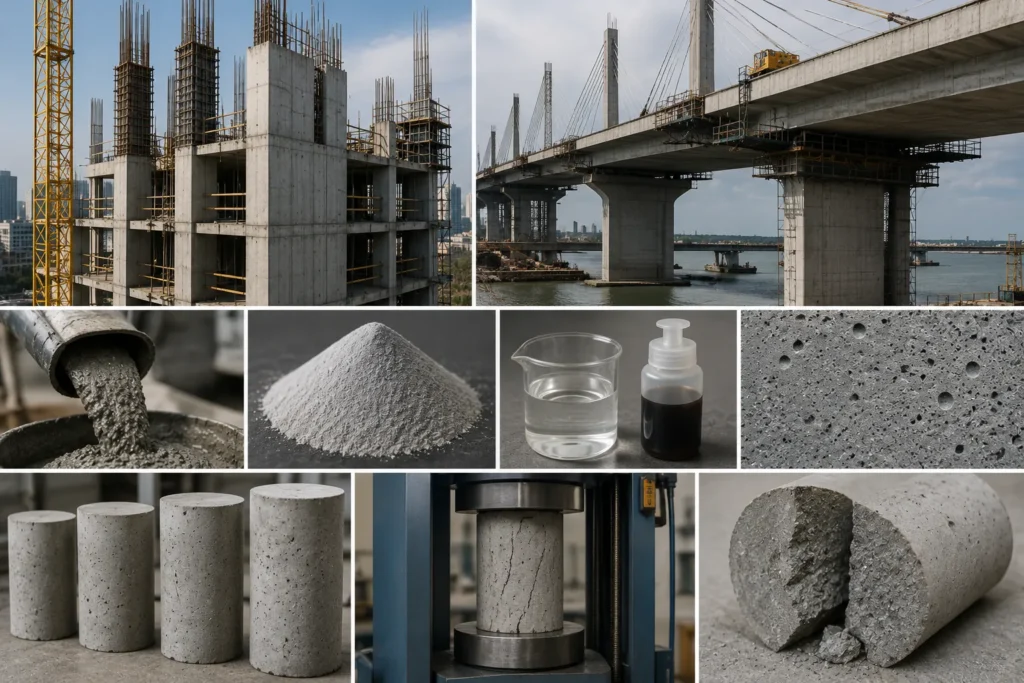
High-strength concrete (HSC) exceeds 6,000 psi (41 MPa) and reaches up to 20,000 psi (138 MPa) in specialty mixes. It costs $200–$350+ per cubic yard. Achieving this strength requires a very low water-cement ratio (0.25–0.35), silica fume or fly ash as supplementary cementitious materials (SCM), and high-range water reducers (superplasticizers) to maintain workability despite the low water content.
High-performance concrete (HPC) is a broader term — it includes HSC but also covers mixes engineered for high durability, low permeability, or specific chemical resistance even if compressive strength is moderate. A bridge deck exposed to deicing salts might use HPC for permeability, not strength.
Best applications: High-rise columns, long-span bridges, precast structural elements, nuclear containment structures
Silica fume: Added at 5–10% of cement weight — fills micro-pores and dramatically reduces permeability
Testing: Cylinder break tests at 7 and 28 days required on structural projects
5. Lightweight Concrete
Lightweight concrete has a density below 1,920 kg/m³ (120 lbs/cu ft) compared to 2,400 kg/m³ (150 lbs/cu ft) for standard concrete. Compressive strength ranges from 2,000–3,000 psi (14–21 MPa). The weight reduction comes from lightweight aggregates — expanded clay, shale, pumice, perlite, or scoria — that replace heavy gravel.
The structural weight savings are significant. A standard 6-inch concrete roof slab weighs 75 lbs/sq ft (366 kg/m²). The same slab in lightweight concrete weighs 50 lbs/sq ft (244 kg/m²) — a 33% reduction that cuts foundation load and allows longer spans with lighter steel.
Best applications: Roof decks, floor toppings, concrete blocks, long-span bridge decks
Thermal benefit: Lightweight concrete insulates better than standard — thermal conductivity is 0.2–0.7 W/m·K vs 1.7 W/m·K for normal concrete
Limitation: Lower strength rules it out for load-bearing columns and foundations in most designs
6. High-Density Concrete (Heavyweight Concrete)
High-density concrete weighs 3,000–4,000 kg/m³ (187–250 lbs/cu ft) — up to 65% heavier than standard concrete. Heavy aggregates like barite (barium sulfate), magnetite, or iron pellets replace standard gravel. Cost runs $250–$450+ per cubic yard depending on aggregate type and availability.
The primary purpose is radiation shielding. Gamma rays and X-rays attenuate (weaken) as they pass through dense mass. High-density concrete at 3,500 kg/m³ provides the same radiation protection as standard concrete but in a thinner slab — critical in hospitals, nuclear plants, and research facilities where floor space is expensive.
Best applications: Nuclear power plant containment walls, hospital radiation therapy rooms, X-ray suites, particle accelerator shielding
Barite concrete density: Typically 3,200–3,500 kg/m³ (200–219 lbs/cu ft)
Competitor gap: All 4 analyzed competitors skip high-density concrete entirely — it appears in none of their type lists
7. Air-Entrained Concrete
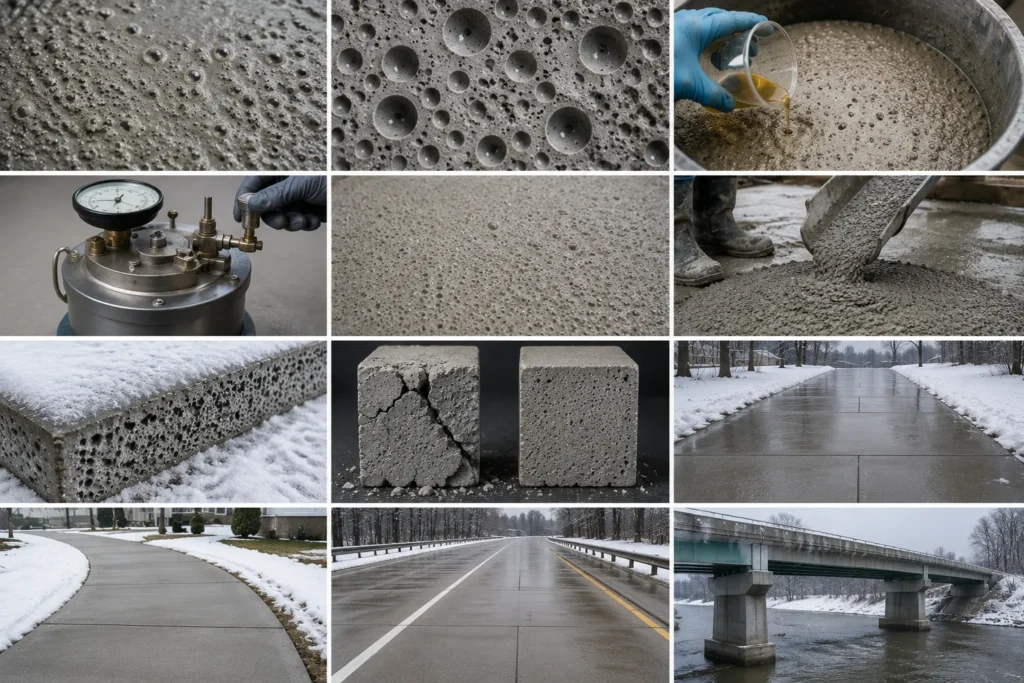
Air-entrained concrete contains 4–8% microscopic air bubbles uniformly distributed throughout the mix. These bubbles — created by adding foaming agents like vinsol resin, fatty acids, or synthetic surfactants — give water inside the concrete space to expand when it freezes. Without that space, ice expansion creates internal pressure that cracks the slab from the inside out.
Any concrete structure exposed to freeze-thaw cycles — driveways, sidewalks, roads, bridge decks in cold climates — needs air entrainment. The American Concrete Institute recommends 5–7% air content for concrete in severe exposure conditions (ASTM C 94 / ACI 308).
Best applications: Driveways, sidewalks, roads, bridge decks, any exterior concrete in climates below 32°F (0°C)
Strength trade-off: Each 1% of added air reduces compressive strength by roughly 5% — compensate with a lower w/c ratio
Test method: ASTM C231 pressure meter test checks air content before placement
8. Self-Consolidating Concrete (SCC)
Self-consolidating concrete (SCC) flows under its own weight and fills complex formwork without vibration. Compressive strength reaches 4,000–8,000 psi (28–55 MPa). SCC uses high doses of superplasticizers and viscosity-modifying admixtures (VMA) to achieve a slump flow of 18–32 inches (450–810 mm) while staying cohesive enough not to segregate.
Standard concrete needs mechanical vibrators to consolidate around dense rebar cages. In precast plants or tight column forms, getting a vibrator into every corner is physically impossible. SCC eliminates that problem — it self-levels, wraps around every rebar bar, and produces a bubble-free, smooth surface without any rodding or vibration labor.
Best applications: Precast elements, columns with heavy reinforcement, architectural concrete requiring smooth surfaces
Testing: Slump flow test (ASTM C1611) and J-ring test (ASTM C1621) measure flowability and passing ability
Cost premium: 30–60% more than standard ready-mix due to superplasticizer and VMA dosing
9. Pervious Concrete (Permeable Concrete)
Pervious concrete allows 3–8 gallons of water per minute per square foot to pass through it by eliminating fine aggregate (sand) from the mix. Without sand to fill the voids between coarse aggregate particles, the hardened concrete contains 15–25% connected pore space. Compressive strength is lower — 600–1,500 psi (4–10 MPa) — but drainage performance replaces strength as the design goal.
The US Environmental Protection Agency (EPA) lists pervious concrete as a Best Management Practice for stormwater control. A 4-inch pervious concrete parking lot handles 100-year storm events without runoff because water soaks directly through the pavement into the subgrade instead of flowing into storm drains.
Best applications: Parking lots, low-traffic roads, pedestrian paths, residential driveways, greenhouses
Maintenance: Vacuum sweeping every 1–2 years to remove sediment that clogs pores
Climate limit: Not suitable in areas with significant frost heave — the pores trap water that freezes and expands
10. Stamped and Decorative Concrete
Stamped concrete is standard concrete mix — 3,000–4,000 psi (21–28 MPa) — textured and colored before it fully hardens to mimic brick, stone, slate, or tile. Cost runs $150–$250 per cubic yard for materials, plus $8–$20 per square foot for professional stamping labor. The base concrete spec is no different from a standard slab — the decorative value comes from surface treatment, not mix design.
Color is added 3 ways: integral color mixed into the batch, broadcast hardener dusted onto the surface before stamping, or acid staining after curing. Integral color penetrates the full depth of the slab — chips and scratches don’t expose a gray core. Surface color is cheaper but shows wear at high-traffic points within 5–8 years.
Best applications: Patios, driveways, pool decks, walkways, interior floors
Sealing: Required every 2–3 years with a penetrating or film-forming sealer to protect color and resist staining
Slip resistance: Specify a broom finish or anti-slip additive in the sealer for outdoor stamped surfaces — smooth stamps are slippery when wet
11. Shotcrete (Sprayed Concrete)
Shotcrete is concrete pneumatically projected at high velocity onto a surface — no formwork required. The impact compacts the mix in place. Compressive strength reaches 4,000–6,000 psi (28–41 MPa). Two processes exist: wet-mix shotcrete (pre-batched with water, pumped wet) and dry-mix shotcrete (dry ingredients pneumatically conveyed, water added at the nozzle).
Shotcrete bonds to irregular surfaces — rock faces, curved pool shells, tunnel linings — that formwork cannot follow. Swimming pools are almost exclusively built with shotcrete because the process wraps around curves, steps, and benches that would be impossible to form and pour conventionally.
Best applications: Swimming pools, tunnels, underground structures, slope stabilization, repair of deteriorated concrete
Rebound: Dry-mix produces 15–30% rebound (wasted material). Wet-mix produces 5–10% rebound
Thickness: Applied in layers of 2–4 inches (50–100 mm) per pass to prevent sloughing
12. Rapid-Setting Concrete
Rapid-setting concrete reaches structural strength in 1–4 hours instead of 28 days. Initial set occurs in 10–45 minutes depending on product and temperature. Standard concrete closing a highway lane needs 28 days to reach design strength. Rapid-setting concrete reopens the lane in 4 hours. It costs $170–$260 per cubic yard — the premium pays for itself in reduced traffic management costs alone.
Cold weather slows all concrete curing. At 40°F (4°C), standard concrete takes 3–4 days to reach 70% strength. At 32°F (0°C), hydration nearly stops. Rapid-setting mixes with calcium sulfoaluminate (CSA) cement or accelerating admixtures cure reliably down to 20°F (-7°C) without heated enclosures.
Best applications: Road and runway repairs, utility cuts, bridge deck patches, winter construction
Mixing: Requires clean tools — CSA cement reacts with traces of Portland cement and can set prematurely
Limitation: Higher shrinkage than Portland cement mixes — control joints at closer spacing prevent random cracking
How to Choose the Right Concrete Type for Your Project
The right concrete type depends on 4 factors: required strength, exposure conditions, placement method, and budget. Use this decision framework before calling a ready-mix supplier.
For Residential Slabs and Driveways
Use 3,500–4,000 psi (24–28 MPa) air-entrained concrete in any climate that drops below freezing. In mild climates, 3,000 psi (21 MPa) plain mix handles residential driveways. Thickness matters equally — a 4-inch (100 mm) slab suits foot traffic, a 6-inch (150 mm) slab handles passenger vehicles, and an 8-inch (200 mm) slab with rebar handles trucks.
For Foundations and Structural Elements
Use 3,500–5,000 psi (24–34 MPa) reinforced concrete with a minimum 3-inch (75 mm) slump for foundation walls and footings. Check your local building code — most US jurisdictions require a minimum 2,500–3,000 psi for residential foundations, but 4,000 psi is now standard practice. Submit mix design documentation with your permit application.
For High-Traffic Outdoor Surfaces
Use 4,000 psi (28 MPa) air-entrained concrete with a fiber reinforcement additive for driveways, commercial parking lots, and loading docks. Polypropylene fibers at 1.5 lbs per cubic yard (0.9 kg/m³) reduce plastic shrinkage cracking by 80% during the first 24 hours after placement — before control joints are cut.
For Specialty Applications
- Pool construction: Shotcrete — wraps contoured shells without formwork
- Road repairs: Rapid-setting — opens to traffic in 4 hours
- Pervious pavement: Pervious concrete — eliminates stormwater runoff
- Radiation rooms: High-density concrete — shielding in minimum thickness
- Precast panels: SCC — smooth surface finish, no vibration labor
Concrete Weight by Type: Quick Reference
Standard concrete weighs 4,050 lbs per cubic yard (2,400 kg/m³). Weight changes with aggregate type and air content. These numbers matter for structural load calculations, truck weight limits on access roads, and pump truck positioning.
- Standard / normal concrete: 4,050 lbs/cu yd (2,400 kg/m³)
- Lightweight concrete: 2,430–3,240 lbs/cu yd (1,440–1,920 kg/m³)
- High-density concrete: 5,400–6,750 lbs/cu yd (3,200–4,000 kg/m³)
- Air-entrained concrete: 3,700–3,900 lbs/cu yd (2,200–2,310 kg/m³)
- Pervious concrete: 2,430–3,100 lbs/cu yd (1,440–1,840 kg/m³)
5 Concrete Mix Mistakes That Cost Contractors and Homeowners Money
1. Adding Extra Water to the Truck on Site
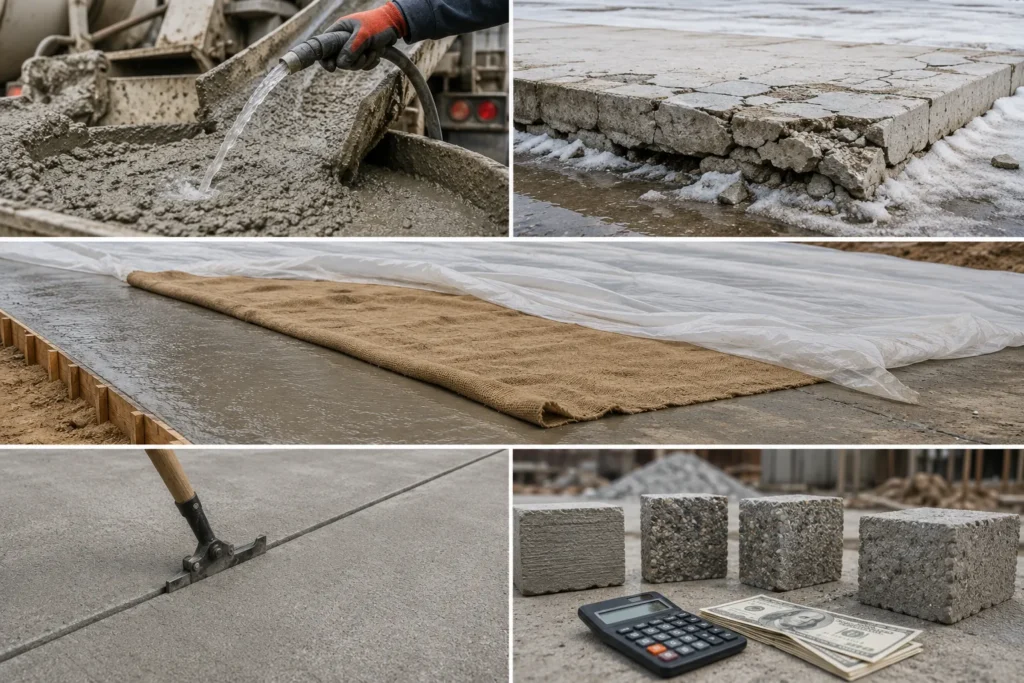
Adding water to ready-mix on site is the single most common concrete mistake. Each gallon added per cubic yard increases the water-cement ratio by 0.05 and reduces compressive strength by 200–300 psi (1.4–2.1 MPa). A 3,500 psi mix becomes a 2,900 psi mix. If your design requires 3,500 psi, you now have code-failing concrete. Add a high-range water reducer (superplasticizer) instead — it improves workability without weakening the mix.
2. Ordering Plain Mix for an Outdoor Slab in a Freeze-Thaw Climate
Plain concrete without air entrainment fails in freeze-thaw climates within 3–5 winters. Ice expansion pressure — up to 4,000 psi (27.6 MPa) — shatters concrete from the inside. Any exterior slab in a state that experiences sub-freezing temperatures needs 5–7% entrained air. Specify air-entrained concrete on every outdoor pour north of the Mason-Dixon line.
3. Skipping Curing Procedures
Concrete that dries too fast loses 30–40% of its potential strength. Evaporation from wind and sun pulls water out of the mix before hydration completes. Cure fresh concrete by covering it with wet burlap and plastic sheeting or applying a liquid curing compound (ASTM C309) immediately after finishing. Maintain curing for 7 days minimum, 14 days for high-strength applications.
4. Not Cutting Control Joints Deep Enough
Control joints must be at least one-quarter the slab thickness — 1 inch deep in a 4-inch slab, 1.5 inches deep in a 6-inch slab. Shallow joints don’t weaken the slab enough to guide cracks, so the concrete cracks randomly instead. Space control joints at 2–3 times the slab thickness in feet — every 8–10 feet for a 4-inch driveway slab.
5. Choosing Concrete Type by Price Alone
The cheapest mix per cubic yard is never the cheapest slab over 10 years. A $100/cu yd plain mix driveway that cracks and spalls in 5 years costs more total than a $130/cu yd air-entrained mix that lasts 40 years. Factor in replacement cost and downtime when comparing concrete mix pricing.
FAQs
What is the most common type of concrete used in construction?
Ready-mix reinforced concrete at 3,000–4,000 psi (21–28 MPa) is the most used type — it covers foundations, slabs, driveways, and structural elements for most residential and commercial projects. Over 70% of all US concrete poured is ready-mix delivered by truck.
What type of concrete is strongest?
Ultra-high-performance concrete (UHPC) reaches 20,000–30,000 psi (138–207 MPa) — roughly 8x stronger than standard mix. For typical construction, high-strength concrete (HSC) at 8,000–12,000 psi (55–83 MPa) covers most heavy structural needs. Standard residential work never requires anything above 5,000 psi.
What type of concrete is best for a driveway?
4,000 psi (28 MPa) air-entrained concrete, 4 inches (100 mm) thick for cars and 6 inches (150 mm) thick for trucks, is best for driveways. In freeze-thaw climates, air entrainment is non-negotiable. Add fiber reinforcement at 1.5 lbs/cu yd and cut control joints every 10 feet to prevent random cracking.
How long does concrete take to reach full strength?
Standard concrete reaches 99% of design strength at 28 days under normal curing conditions. It hits 70% at 7 days and 85% at 14 days. Rapid-setting concrete reaches structural strength in 1–4 hours. Cold weather below 50°F (10°C) slows hydration significantly — at 40°F (4°C), expect 3–4 days to reach 70% strength.
What is the difference between concrete and cement?
Cement is one ingredient in concrete — concrete is the finished material. Portland cement is a fine gray powder made from limestone and clay. Concrete is cement mixed with water, sand, and gravel. Saying ‘cement driveway’ or ‘cement sidewalk’ is technically incorrect — the correct term is concrete. Cement alone hardens to a brittle, weak paste. Aggregate gives concrete its bulk strength and durability.
Estimate Your Concrete Project Before You Order
Ordering too little concrete causes cold joints — a structural weakness where old and new concrete meet. Ordering too much wastes $140–$180 per extra cubic yard. Get the volume right before calling your supplier.
Use the concrete block calculator if your project uses concrete masonry units (CMU) — it estimates block count, mortar bags, and total cost based on wall dimensions. Both tools are free and return results in under 60 seconds.