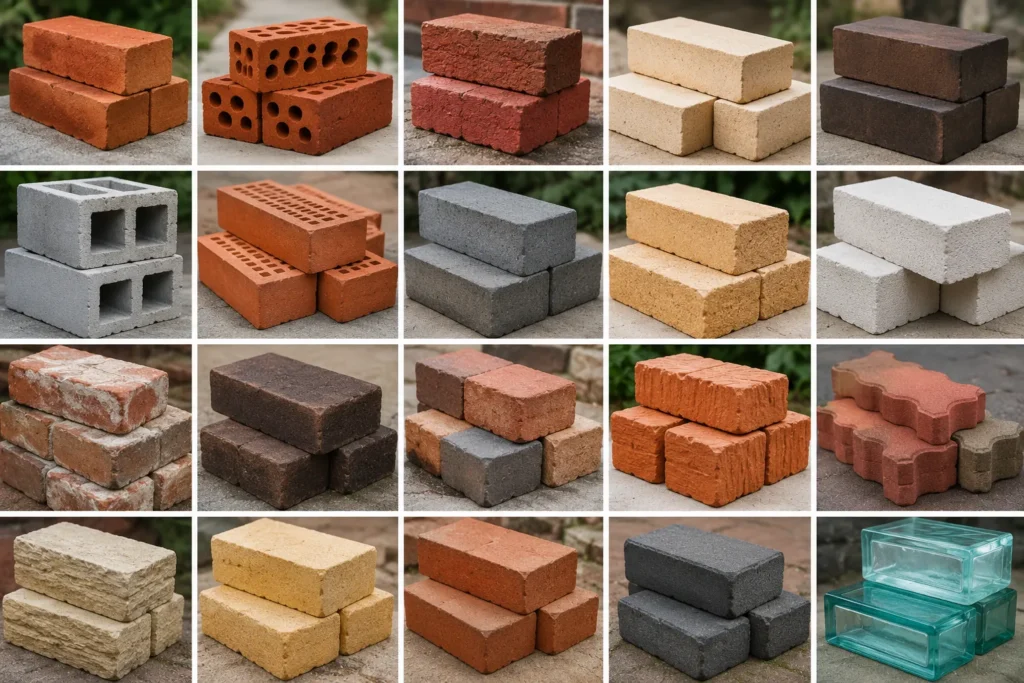
There are 10 main types of bricks used in construction. Each type has a different composition, compressive strength, water absorption rate, and ideal use case. Picking the wrong one costs money, causes structural failure, or fails inspection.
This guide covers every major brick type what it’s made from, where it performs best, what it costs, and what competitors’ guides consistently leave out.
All Brick Types at a Glance
| Brick Type | Main Material | Best Use | Cost per 1,000 | Lifespan |
| Clay (burnt) | Fired clay | General walls, facades | $400 – $900 | 100+ years |
| Concrete | Cement + aggregate | Load-bearing, commercial | $350 – $700 | 50 – 100 years |
| Fire (refractory) | Alumina clay | Fireplaces, kilns, ovens | $1,700 – $3,000 | 20 – 30 years |
| Fly ash | Fly ash + lime | Walls, partitions | $300 – $600 | 50+ years |
| Sand lime (calcium silicate) | Sand + lime | Facing, acoustic walls | $400 – $750 | 50 – 75 years |
| Engineering | High-density clay | Foundations, sewers, below-grade | $400 – $900 | 100+ years |
| AAC blocks | Cement + aerated | Thermal insulation, partitions | $500 – $900 | 50+ years |
| Sun-dried (adobe) | Raw clay | Rural, low-load walls | $150 – $400 | 20 – 50 years |
| Face bricks | Clay or clay-concrete | Exposed exterior walls | $350 – $800 | 75+ years |
| Hollow / perforated | Clay or concrete | Non-load partitions, insulation | $300 – $650 | 50+ years |
1. Clay Bricks (Burnt Clay Bricks)
Clay bricks are the most widely used brick in construction worldwide. They are made by shaping clay-rich soil into molds, drying it, then firing it in a kiln at 900°C to 1,200°C (1,650°F to 2,200°F). The firing process vitrifies the clay and gives the brick its hardness, color, and durability.

Properties
- Compressive strength: 3.5 MPa to 35 MPa depending on class
- Water absorption: 12% to 20% moderate; requires damp-proof courses in wet climates
- Thermal mass: high absorbs heat slowly and releases it gradually
- Standard size: 190 mm × 90 mm × 90 mm (7.5 in × 3.5 in × 3.5 in)
Best uses
- Residential walls load-bearing and non-load-bearing
- Garden walls, boundary walls, and retaining structures
- Exterior facades where traditional brick aesthetics matter
4 classes of clay brick you’ll encounter on site
- First class: machine-molded, kiln-fired, sharp edges, uniform color; highest quality
- Second class: slightly irregular shape, minor surface defects; suitable for general construction
- Third class: hand-molded, less uniform; used for temporary structures only
- Fourth class (overburnt): fired too long, irregular but very hard; used as ballast and hardcore fill
Cost: $400 to $900 per 1,000 bricks ($0.40 to $0.90 each).
2. Concrete Bricks
Concrete bricks are manufactured from Portland cement, sand, aggregate, and water. They are cast in molds and cured either air-dried or steam-cured. Concrete bricks are denser, heavier, and more dimensionally uniform than clay bricks.
Properties
- Compressive strength: 7 MPa to 40 MPa typically stronger than standard clay bricks
- Water absorption: 6% to 10% lower than clay, better moisture resistance
- Weight: 2.3 kg to 3.2 kg per brick (5 lb to 7 lb) heavier than clay
- Fire resistance: excellent does not burn or warp under heat
Best uses
- Load-bearing walls in commercial and industrial buildings
- Boundary walls, retaining walls, and basement construction
- Projects where dimensional consistency and high compressive strength are critical
Cost: $350 to $700 per 1,000 bricks. Concrete bricks are generally cheaper per unit than clay but heavier to transport, which affects total project cost.
Use the concrete block calculator to estimate how many concrete blocks or bricks your project needs before ordering.
3. Fire Bricks (Refractory Bricks)
Fire bricks withstand temperatures from 1,750°F to 3,300°F (954°C to 1,815°C). Standard clay bricks crack at 1,200°F (649°C). Fire bricks are made from refractory clay high in alumina (Al₂O₃) content fired at extremely high temperatures.
Properties
- Alumina content: 25% to 45% in standard fire brick; up to 99% in high-alumina bricks
- Low thermal conductivity resists heat transfer outward while containing intense internal heat
- Low coefficient of thermal expansion doesn’t crack with repeated heating and cooling cycles
- High density: 1,900 to 2,400 kg/m³ (119 to 150 lb/ft³)
Best uses
- Fireplaces and fire pits the only brick safe for direct flame contact
- Pizza ovens, wood-fired stoves, and outdoor cooking structures
- Industrial furnace linings, pottery kilns, and steel plant applications
- Chimney liners and flue surrounds
Cost: $1,700 to $3,000 per 1,000 bricks ($1.70 to $3.00 each). The high cost reflects specialized raw materials and extreme manufacturing temperatures. Do not substitute standard clay bricks in fire applications they will crack and fail.
4. Fly Ash Bricks
Fly ash bricks use fly ash a fine waste residue from coal-burning power plants — as the primary ingredient. Mixed with lime, cement, and water, then pressed under high pressure and steam-cured in an autoclave for 8 to 12 hours. No kiln firing required.
Properties
- Compressive strength: 7.5 MPa to 10 MPa comparable to second-class clay bricks
- Water absorption: 6% to 12% lower than clay bricks
- Weight: lighter than clay bricks by 30% reduces structural dead load
- Smooth, uniform surface requires less mortar and reduces material waste
Best uses
- Interior partition walls in residential and commercial buildings
- Non-load-bearing walls where weight reduction matters
- Green building projects fly ash bricks reuse industrial waste and lower carbon footprint
Cost: $300 to $600 per 1,000 bricks. One of the most cost-effective options available. Widely used in regions where coal power plants produce large volumes of fly ash.
5. Sand Lime Bricks (Calcium Silicate Bricks)
Sand lime bricks are made from 88% to 92% sand and 8% to 12% lime, pressed under 15 to 20 bar (220 to 290 psi) of pressure and cured in an autoclave. No clay, no kiln. The chemical reaction between lime and silica during autoclave curing creates calcium silicate hydrate the binding compound that gives these bricks strength.
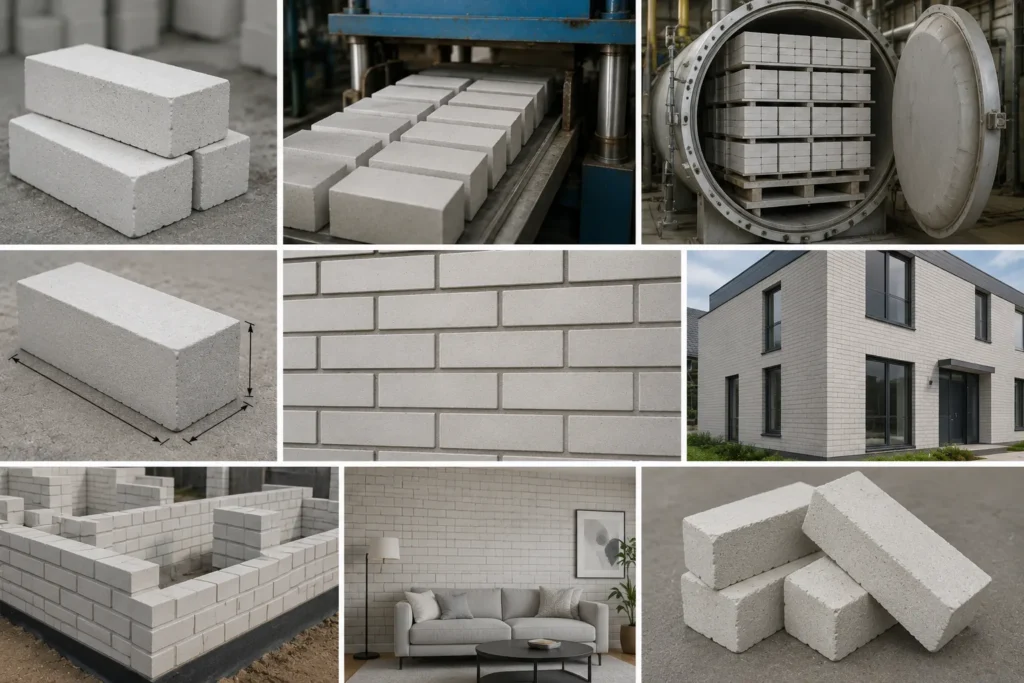
Properties
- Compressive strength: 10 MPa to 20 MPa — higher than standard clay
- Smooth, light gray finish — more uniform appearance than clay
- Excellent acoustic insulation — denser molecular structure blocks sound effectively
- Good frost resistance — suitable for cold climates
Best uses
- Exposed facing brickwork where a uniform, clean appearance matters
- Party walls and internal dividing walls where sound insulation is a priority
- Below-grade construction in moderate-moisture environments
Cost: $400 to $750 per 1,000 bricks.
6. Engineering Bricks
Engineering bricks are the strongest standard brick available for construction. Made from the highest-density clay, fired at temperatures above 1,200°C (2,192°F) to achieve near-vitrification. The result: extremely low water absorption and very high compressive strength.
Properties — 2 classes
- Class A — compressive strength above 125 MPa; water absorption below 4.5%; used in severe engineering applications
- Class B — compressive strength above 75 MPa; water absorption below 7%; more common in general construction
Best uses
- Foundations and below-grade structures — low water absorption prevents moisture ingress
- Manholes, sewers, and drainage channels — resists chemical attack and water penetration
- Retaining walls, bridge abutments, and damp-proof courses
- Industrial floors subject to heavy loads and chemical exposure
Cost: $400 to $900 per 1,000 bricks. Comparable to clay brick cost, but engineering bricks outperform clay in structural and moisture-critical applications.
Estimating a foundation or footing? Use the concrete footing calculator alongside your brick estimate to get accurate material quantities for below-grade work.
7. AAC Blocks (Aerated Autoclaved Concrete)
AAC (Aerated Autoclaved Concrete) blocks are made from cement, lime, sand, water, and an aerating agent — typically aluminum powder. The aluminum reacts with lime to produce hydrogen gas, which creates millions of tiny air pores throughout the block. The porous structure is what gives AAC blocks their defining properties.
Properties
- Weight: 550 to 650 kg/m³ 5 times lighter than concrete, 3 times lighter than clay brick
- Thermal insulation: R-value of approximately 0.9 to 1.25 per inch far better than solid clay or concrete
- Fire resistance: up to 4 hours at direct flame excellent for fire-rated wall assemblies
- Compressive strength: 3 MPa to 8 MPa lower than clay; not suitable for heavy load-bearing
Best uses
- External walls in climates with high heating or cooling demands thermal mass saves energy costs
- Internal partition walls where weight reduction on the structure is important
- High-rise buildings where structural dead load must be minimized
Cost: $500 to $900 per 1,000 blocks. AAC blocks are larger than standard bricks a single AAC block replaces 6 to 8 standard bricks so the per-unit comparison understates the material efficiency.
8. Sun-Dried Bricks (Adobe Bricks)
Sun-dried bricks are the oldest form of manufactured brick in human history. Made by mixing clay-rich soil, water, and organic fiber (straw or grass), shaped into molds, and dried in sunlight for 2 to 4 weeks. No kiln.
Properties
- Compressive strength: 1 MPa to 3 MPa significantly weaker than fired bricks
- Water absorption: very high deteriorates rapidly in wet or humid climates
- Thermal mass: excellent thick adobe walls regulate interior temperature in hot, dry climates
- Breathable allows moisture vapor to pass through walls without trapping condensation
Best uses
- Low-rise rural housing in hot, dry climates American Southwest, North Africa, Middle East
- Temporary or low-load structures where cost is the primary constraint
- Heritage restoration projects where original materials must be matched
Cost: $150 to $400 per 1,000 bricks. The lowest cost option available, but not suitable for any application where moisture, rain, or structural loads are present.
9. Face Bricks
Face bricks are not a separate material they are any brick manufactured specifically for visible, exposed applications. Face bricks are made to tighter dimensional tolerances with consistent color, smooth or textured surface finish, and low efflorescence risk. Most are clay-based, some are clay-concrete blends.
Properties
- Dimensional tolerance: ±1 mm to ±2 mm significantly tighter than utility bricks
- Efflorescence resistance: low salt content reduces white staining on finished surfaces
- Wide color range: from pale yellow to deep red, blue-black, and buff tones
- Compressive strength: 20 MPa to 50 MPa structural-grade face bricks qualify for load-bearing use
Best uses
- Exterior facades, entrance walls, and any brickwork that remains permanently visible
- Feature walls, fireplaces surrounds, and architectural detailing
- Any project where uniform color and consistent texture are required
Cost: $350 to $800 per 1,000 bricks. Premium glazed or hand-made face bricks can reach $2.00 to $5.50 per brick for high-end architectural projects.
10. Hollow and Perforated Bricks
Hollow bricks have large internal voids typically 30% to 50% of total volume. Perforated bricks have smaller holes running through the full depth. Both are made from clay or concrete. The voids reduce weight, improve thermal insulation, and allow rebar insertion for reinforced masonry.
Properties
- Weight reduction: 25% to 40% lighter than equivalent solid bricks
- Thermal insulation: air pockets reduce heat transfer through the wall assembly
- Compressive strength: 3.5 MPa to 15 MPa — suitable for non-load-bearing and lightly loaded walls
- Mortar consumption: lower — fewer solid surfaces to bed
Best uses
- Interior partition walls in residential and commercial buildings
- Cavity wall construction — the void space creates a thermal break
- Reinforced masonry where rebar is threaded through hollow cores and grouted
Cost: $300 to $650 per 1,000 bricks.
How to Choose the Right Brick for Your Project
Brick selection comes down to 4 factors. Match all 4 and you won’t choose wrong.
| Your Priority | Best Brick | Why |
| Maximum strength | Engineering brick (Class A) | 125+ MPa, near-zero water absorption |
| Fire resistance | Refractory fire brick | Only brick safe above 1,200°F (649°C) |
| Thermal insulation | AAC block | R-value 5 to 10x higher than solid brick |
| Lowest cost | Sun-dried or fly ash | 30–60% cheaper than clay or concrete |
| Exposed aesthetics | Face brick | Tight tolerances, consistent color, low efflorescence |
| Below-grade / wet conditions | Engineering brick (Class B) | Water absorption below 7% |
| Weight reduction | Hollow / AAC block | 25–40% lighter than solid equivalents |
| Acoustic insulation | Sand lime (calcium silicate) | Dense molecular structure blocks sound |
| Eco-conscious build | Fly ash bricks | Reuses coal combustion waste, lower carbon footprint |
Calculating wall area for your brick project? The concrete wall calculator estimates material quantities based on wall dimensions and thickness — adjust for brick size to get accurate counts.
3 Things Most Brick Guides Don’t Cover
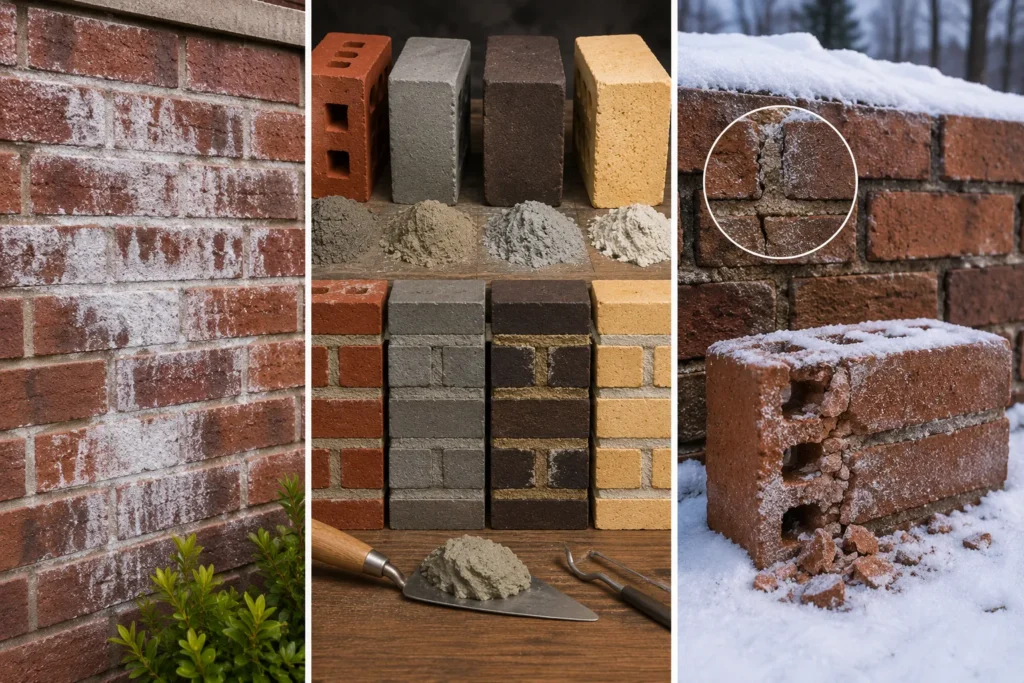
1. Efflorescence — the white staining problem
Efflorescence is the white, chalky deposit that appears on brick surfaces when soluble salts migrate to the face of the brick and crystallize. It’s harmless structurally but looks bad on exposed brickwork.
Clay bricks are most prone to it. Face bricks are manufactured with low salt content specifically to reduce this risk. If your project involves permanently visible brickwork, specify low-efflorescence face bricks and use sulfate-resistant mortar.
2. Mortar compatibility matters as much as brick type
A strong brick laid with incompatible mortar fails faster than a weaker brick laid correctly. Mortar must be weaker than the brick it bonds — if mortar is stronger, thermal expansion cracks the brick face instead of the joint, which is much harder to repair.
Standard clay and concrete bricks pair with Type S or Type N mortar. Engineering bricks need sulfate-resistant mortar in below-grade applications. Fire bricks require refractory mortar — standard mortar disintegrates above 500°F (260°C).
3. Frost resistance class determines cold-climate performance
Bricks are classified by frost resistance: F0 (not frost resistant), F1 (frost resistant), and F2 (highly frost resistant). In climates with more than 25 freeze-thaw cycles per year — most of the northern United States and Canada — specify F2-rated bricks for any exposed exterior application. Using F0 bricks in a freeze-thaw climate causes spalling within 3 to 5 winters.
Brick Cost Summary: 2026 Prices
| Brick Type | Per Brick | Per 1,000 | Per sq ft (installed) |
| Clay (burnt) | $0.40 – $0.90 | $400 – $900 | $8 – $18 |
| Concrete | $0.35 – $0.70 | $350 – $700 | $7 – $15 |
| Fire (refractory) | $1.70 – $3.00 | $1,700 – $3,000 | $20 – $40 |
| Fly ash | $0.30 – $0.60 | $300 – $600 | $6 – $12 |
| Sand lime | $0.40 – $0.75 | $400 – $750 | $8 – $16 |
| Engineering | $0.40 – $0.90 | $400 – $900 | $8 – $18 |
| AAC blocks | $0.50 – $0.90 | $500 – $900 | $9 – $18 |
| Sun-dried (adobe) | $0.15 – $0.40 | $150 – $400 | $3 – $8 |
| Face bricks | $0.35 – $0.80 | $350 – $800 | $7 – $16 |
| Hollow / perforated | $0.30 – $0.65 | $300 – $650 | $6 – $13 |
Get an accurate material cost for your wall or structure using the concrete cost calculator — input your dimensions to estimate total spend before speaking to a contractor.
FAQs
What is the strongest type of brick?
Engineering bricks (Class A) are the strongest, with compressive strength above 125 MPa. They also have the lowest water absorption rate — below 4.5% — making them the correct choice for foundations, sewers, and any application where structural load and moisture resistance both matter.
Which brick is best for exterior walls?
Face bricks are best for exposed exterior walls. They are manufactured to tight dimensional tolerances, low efflorescence standards, and available in a wide color range. For cold climates, specify F2-rated face bricks with frost resistance certification. For structural exterior walls, choose a face brick with minimum 20 MPa compressive strength.
Can you use regular bricks in a fireplace?
No — standard clay bricks crack and fail above 1,200°F (649°C). Fireplaces, fire pits, pizza ovens, and any direct-flame application require refractory fire bricks rated for the specific temperature range. Use refractory mortar, not standard mortar, to bed them.
What are the most cost-effective bricks for construction?
Fly ash bricks are the most cost-effective for general construction — $300 to $600 per 1,000 — with compressive strength comparable to second-class clay bricks and lower water absorption. Sun-dried bricks are cheaper but only suitable for dry climates and low-load structures.
How many bricks do I need per square foot of wall?
Conclusion
The right brick is the one that matches your structural requirements, climate, and application not the cheapest or the most common one on the market.
Load-bearing structural work needs engineering or high-strength clay bricks. Fire applications need refractory bricks no exceptions. Thermal performance requires AAC blocks or hollow cavity construction. Exposed facades need low-efflorescence face bricks with appropriate frost resistance for your climate.
Most project failures trace back to one of 3 mistakes: using the wrong brick class for the load, skipping frost resistance specification in cold climates, or pairing incompatible mortar with the brick. Get those 3 right and the material will perform for decades.