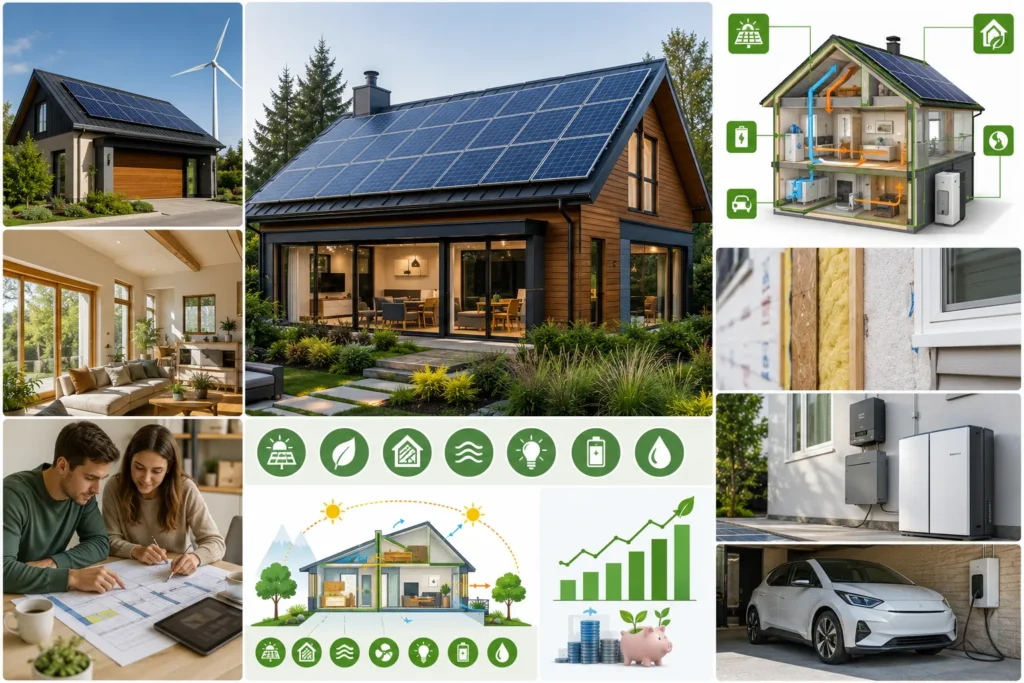
A net zero energy home produces as much energy as it consumes over 1 year. Builders reach this balance by cutting energy demand through insulation and air sealing, then offsetting the remaining load with rooftop solar panels.
This guide covers exact 2026 costs, the 3 main paths to net zero, the role your roof plays in the system, and the financial return you can expect. You get specific numbers, not vague estimates.
What Is a Net Zero Energy Home?
A net zero energy home, also called a Net Zero Energy Building (NZEB), generates 100% of its annual energy use from on-site renewable sources. The home stays connected to the power grid. It draws power on cloudy days and sends excess power back during peak solar production.
3 systems work together to reach net zero status: a tight building envelope, high-efficiency mechanical equipment, and a correctly sized solar array.
How a Net Zero Home Differs From an Energy-Efficient Home
An energy-efficient home uses less power than a standard home. A net zero home goes further: it produces enough power to cover 100% of its own use.
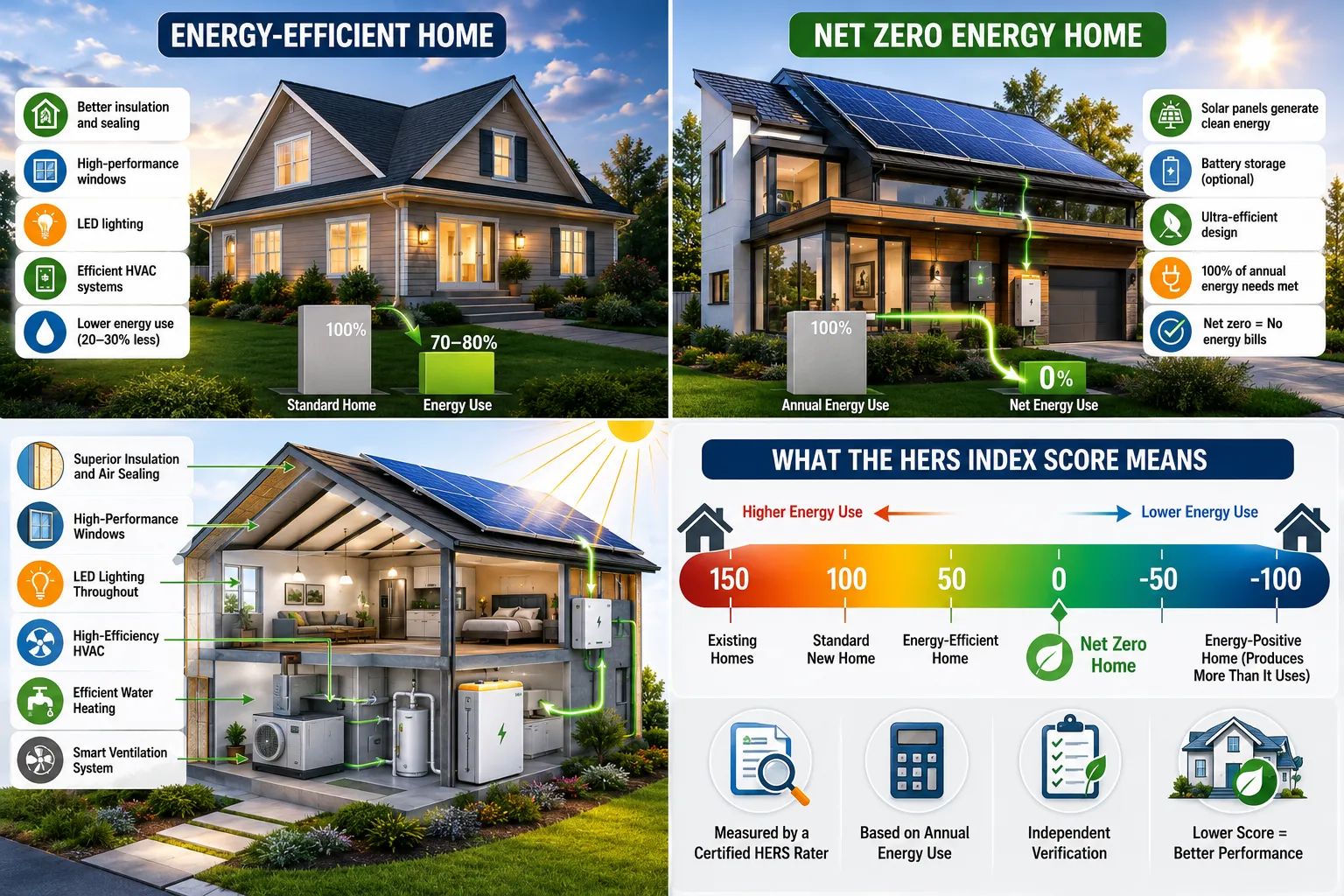
An energy-efficient home might cut energy use by 20-30% through better insulation alone. A net zero home pairs that same efficiency work with a solar array sized to offset every remaining kilowatt-hour (kWh).
What the HERS Index Score Means
The Home Energy Rating System (HERS) Index measures a home’s energy efficiency on a scale of 0 to 150. A score of 0 means net zero.
A standard new home built to current International Energy Conservation Code (IECC) requirements scores around 100. A net zero home scores 0. A score below 0 — such as -5 or -10 — means the home produces more power than it uses, which is called a positive energy home.
How Much Does a Net Zero Energy Home Cost in 2026?
A net zero energy home costs 5-10% more than standard new construction. For a 2,000 square foot (186 square meter) home, that premium runs $20,000 to $50,000.
New Construction Costs
To build a net zero home from the ground up, budget for 3 cost categories beyond standard construction:
- Building envelope upgrades: $8,000-$15,000 for high-performance insulation, air sealing, and triple-pane windows
- Mechanical systems: $12,000-$20,000 for a 16+ SEER heat pump system and heat pump water heater
- Solar array: $15,000-$25,000 for a 6-10 kilowatt (kW) photovoltaic (PV) system after federal tax credits
A 2,000 sq ft (186 sq m) net zero home built in 2026 totals $350,000-$450,000 in most U.S. markets, compared to $320,000-$400,000 for standard construction at the same size.
Regional labor rates and local permitting fees shift these numbers by 10-15% in either direction. Coastal markets in California and the Northeast typically sit at the high end of the range, while Midwest and Southern markets land closer to the low end.
Retrofit Costs for an Existing Home
Retrofitting an existing home to net zero costs more than building new — typically $60,000 to $120,000 total.
3 factors drive retrofit costs higher than new construction: existing insulation removal, ductwork modification for new HVAC equipment, and structural roof checks before solar installation.
A professional roof inspection before any retrofit identifies whether the existing structure can support a solar array without added reinforcement.
How to Build a Net Zero Energy Home
To build a net zero energy home, follow 4 steps in order: design the building envelope first, install high-efficiency mechanical systems second, size the solar array third, and verify performance with a HERS rater fourth.
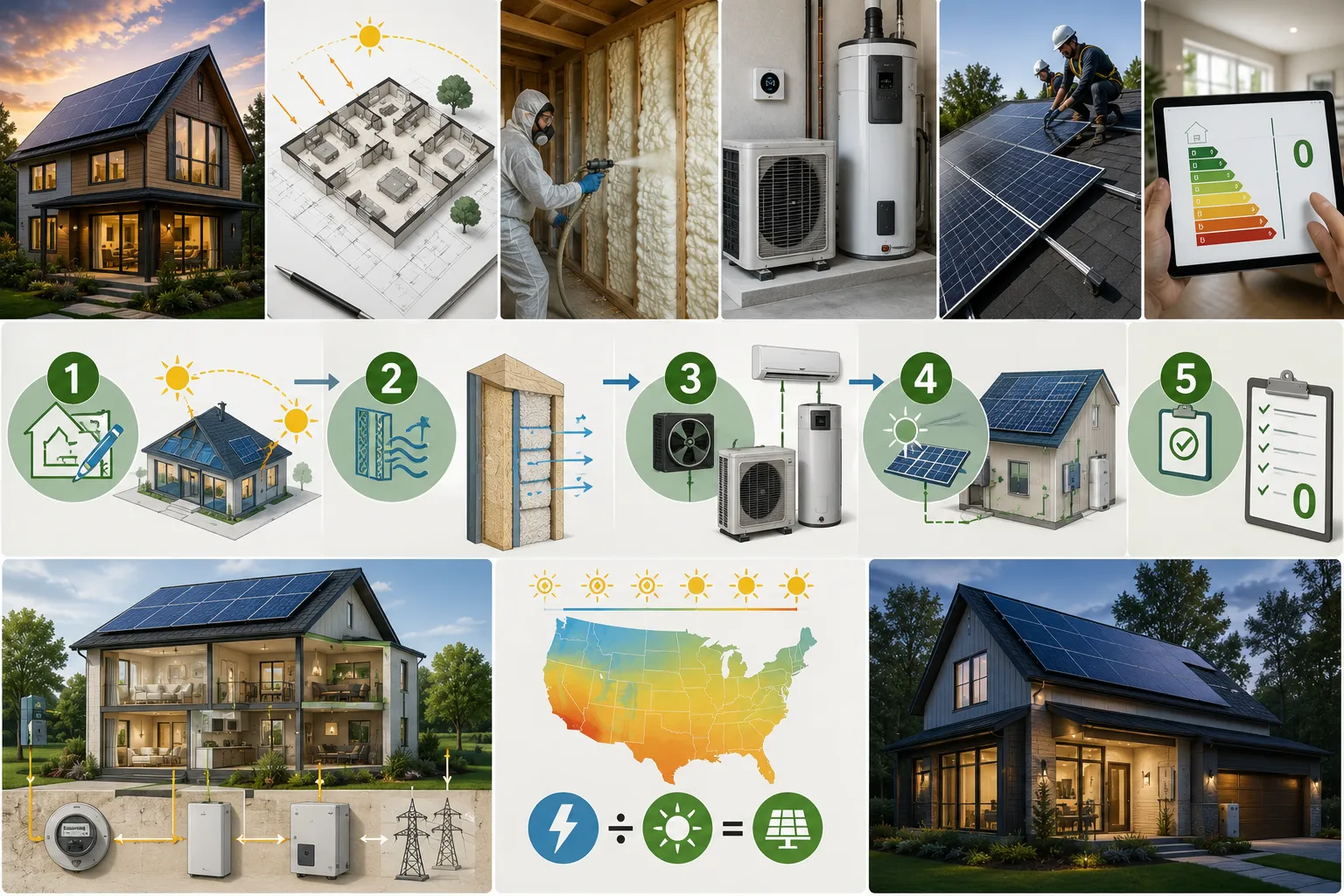
- Design a compact, well-oriented floor plan. South-facing windows in the Northern Hemisphere increase passive solar heating during winter months.
- Install a high-performance building envelope. This includes spray foam or rigid insulation rated R-30 to R-60, plus continuous air sealing at every seam.
- Add energy-efficient mechanical systems. A 16+ SEER heat pump and a heat pump water heater cut energy demand by 40-60% compared to standard equipment.
- Size and install the solar array. Most 2,000 sq ft (186 sq m) net zero homes need a 6-10 kW photovoltaic (PV) system.
- Verify the result with a HERS rating. A certified rater confirms the home reaches a HERS score of 0.
How to Size a Solar Array for Net Zero
To size a solar array for net zero, divide your home’s annual energy use in kWh by your region’s solar production factor.
A typical U.S. home uses 10,000-12,000 kWh per year. In a region with strong sun exposure, 1 kW of solar panels produces roughly 1,400-1,600 kWh annually. That math points to a 7-8 kW system for an average home, though a HERS rater calculates the exact figure for your specific house.
How to Retrofit an Existing Home to Net Zero
To retrofit an existing home to net zero, start with an energy audit, then work through the building envelope, mechanical systems, and solar array in that order.
An energy audit costs $300-$600 and identifies the 3-5 biggest sources of energy loss in your specific home. Most existing homes lose the most energy through 3 points: attic insulation gaps, window seals, and an aging roof system.
Homes older than 20 years often need full roof replacement before solar installation, since panels typically carry a 25-year warranty and outlast an aging roof underneath them.
What Role Does the Roof Play in a Net Zero Energy Building?
The roof carries 2 jobs in a net zero energy building: it holds the solar array, and it forms the top of the building envelope that prevents heat loss.
A poorly insulated or aging roof undermines both jobs at once. Heat escapes through gaps in attic insulation, forcing the HVAC system to work harder and raising the energy load the solar array has to offset.
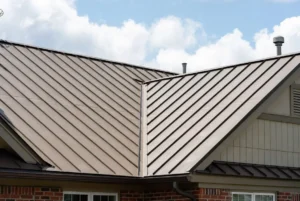
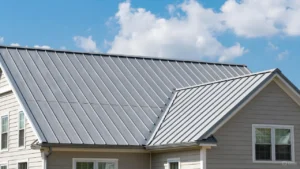
Reflective or metal roofing options reduce attic heat gain in summer by up to 34% compared to standard asphalt shingles, based on U.S. Department of Energy cool roof research. Lower attic heat means less strain on cooling equipment and a smaller solar array needed to reach net zero.
3 roof factors affect net zero performance directly: insulation R-value at the roofline, structural capacity for solar panel weight, and roof orientation for maximum sun exposure.
A south-facing roof plane in the Northern Hemisphere captures the most direct sunlight across the day, which lowers the total panel count needed to reach net zero. East- and west-facing roof sections still work for solar, though output drops by 10-20% compared to true south-facing arrays.
Net Zero vs. Zero Energy Ready vs. Passive House
A net zero home generates 100% of its energy on-site. A zero energy ready home meets the same efficiency standard but has no solar array installed yet. A Passive House meets an even stricter envelope standard with lower total energy demand.
- Net zero energy home: HERS score of 0, solar array installed and active
- Zero energy ready home: HERS score of 0 once solar is added, but the array is not yet installed
- Passive House: ultra-low energy demand through extreme insulation, often 70-90% below a standard home, with or without solar
A zero energy ready home costs less upfront since the solar array purchase gets delayed. The homeowner adds panels later, once budget allows, while keeping the structure ready to support them.
What Are the Financial Benefits of a Net Zero Energy Home?
A net zero energy home saves the average household $2,000-$3,000 per year in utility costs. Over a 25-year solar panel warranty period, that adds up to $50,000-$75,000 in saved energy bills.

3 additional financial benefits apply beyond direct energy savings:
- Higher resale value: net zero homes sell for 3-5% more than comparable standard homes, based on multiple regional appraisal studies
- Federal tax credits: the solar Investment Tax Credit covers a percentage of system costs through 2026, reducing upfront investment
- Lower insurance risk: newer roofing and electrical systems installed during net zero construction often qualify for reduced insurance premiums
State-level incentives add further savings in many regions. Property tax exemptions for the added home value from solar panels, along with state rebate programs, can reduce the net cost of a solar array by an additional $2,000-$5,000 depending on location.
Quick Reference: Net Zero Home Upgrade Tasks
Use this table to plan your net zero project in the correct sequence:
| Task | Timing | Method | Difficulty |
| Air sealing | 1 day (8 hours) | Caulk and weather-strip gaps | Easy |
| Attic insulation upgrade | 1-2 days | Blown-in cellulose, R-49 to R-60 | Moderate |
| Window replacement | 2-4 days | Double or triple-pane, low-E glass | Moderate |
| HVAC heat pump install | 1-2 days | 16+ SEER ducted or ductless unit | Hard |
| Solar panel installation | 1-3 days | Rooftop photovoltaic (PV) array | Hard |
| Roof inspection and prep | 2-3 hours | Structural check before solar install | Easy |
Start Your Net Zero Energy Home Project
A net zero energy home pays for itself through lower utility bills, a stronger resale value, and a roof system built to support solar for the next 25 years. The roof is the foundation of that system.
Rainy Roofers provides roof inspection services across all 50 states, with same-day scheduling and a free, no-obligation estimate. Request your inspection today and find out if your roof is ready for net zero.
Conclusion
A net zero home is achievable through new construction or a retrofit, but the roof sits at the center of both paths since it carries the solar array and forms the top of the insulated envelope. New builds add a 5 to 10% cost premium that typically pays back within 10 to 15 years, while retrofits cost more overall but still deliver $2,000 to $3,000 in annual savings once complete. Before adding solar to any existing roof, get a structural and age inspection first, since installing panels on a roof with limited years left just means paying to remove and reinstall them later.