A metal roof costs $8–$14 per sq ft ($86–$150 per m²) installed, while asphalt shingles cost $4–$7 per sq ft ($43–$75 per m²). Metal lasts 40–70 years; shingles last 15–30 years.
The right choice between metal roof vs shingles depends on 4 factors: your budget, how long you plan to stay in the home, your local climate, and whether you plan to add solar panels. This guide breaks down every difference so you can decide with real numbers.
Metal Roof vs Shingles: Full Cost Comparison for a 2,000 Sq Ft Home
A 2,000 sq ft (186 m²) home needs roughly 20 roofing squares (1 square = 100 sq ft / 9.3 m²). Here is what you pay for each material:
Asphalt shingles: $8,000–$14,000 total installed. 3-tab shingles sit at the lower end; architectural shingles, such as Owens Corning Duration or GAF Timberline HDZ, cost more but last 25–30 years versus 15–20 for 3-tab.
Metal roofing: $16,000–$28,000 total installed. Standing seam steel starts at $8/sq ft ($86/m²). Corrugated panels cost slightly less. Copper and zinc reach $20–$30/sq ft ($215–$323/m²) but last 80–100 years.
The 60-year cost math changes the picture. Sheffield Metals data shows: 1 metal roof over 60 years costs $17,457. Three asphalt shingle roofs over the same period cost $26,211. Metal saves $8,754 over 60 years before energy savings.
You also save up to 40% on energy bills with metal, because metal reflects 25–40% more solar radiation than asphalt. On a $2,400/year energy bill, that is $960 per year back in your pocket.
If you need residential roof replacement and plan to stay in your home 15+ years, metal roofing delivers better total value despite higher upfront cost.
Metal Roof vs Shingles: Lifespan, Durability, and Maintenance
How Long Each Roofing Material Lasts
Metal roofs last 40–70 years. Copper and zinc extend that to 80–100 years. Manufacturers such as Metal Roofing Alliance members back metal roofs with 30–50 year warranties yet the physical product often outlasts the warranty by decades.
Asphalt shingles last 15–30 years in real-world conditions. A “30-year shingle” typically delivers 24–25 years when exposed to thermal cycling — the expansion and contraction from daily temperature changes. Granule loss accelerates after year 15, reducing waterproofing performance.
How to Maintain Each Roof Type
To maintain a metal roof, inspect seams and fasteners once per year. Tighten any loose fasteners thermal cycling can work them loose over 10–15 years. Clear debris from valleys twice per year. Total annual time: under 2 hours.
To maintain asphalt shingles, check for granule loss in gutters every 6 months. Replace cracked or curled shingles immediately to stop water infiltration. Treat algae growth with a zinc sulfate solution. Budget $300–$600 per year for shingle maintenance on a 2,000 sq ft (186 m²) roof.
Schedule a residential roof inspection once per year regardless of material catching minor issues prevents $3,000–$8,000 repair bills.
Metal Roof vs Asphalt Shingles: Performance in Extreme Weather
Wind Resistance
Metal roofs resist wind speeds up to 140 mph (225 km/h). Standing seam panels interlock and fasten to the deck — no exposed edges for wind to catch. Asphalt shingles resist 60–130 mph (97–209 km/h) depending on grade. Standard 3-tab shingles lose performance above 60 mph (97 km/h).
Snow and Ice Dam Formation
Metal roofs shed snow faster because snow slides off the smooth surface above 30 degrees pitch. Asphalt shingles trap snow longer, raising the risk of ice dam formation where water backs up under shingles and leaks into the ceiling. A single ice dam repair costs $1,000–$3,500.
Fire Resistance
Metal carries a Class A fire rating the highest as an inherent material property. Asphalt shingles achieve Class A only with a fire-resistant treatment. In wildfire-prone regions, a non-combustible metal roof provides meaningful structural protection that treated shingles cannot match.
Metal Roof vs Shingles: Quick-Reference Comparison Table
Use this table to compare both materials across 7 key factors at a glance.
| Factor | Metal Roof | Asphalt Shingles | Metal — Difficulty | Shingle — Difficulty |
| Upfront cost / sq ft | $8–$14 (USD) | $4–$7 (USD) | Higher | Lower |
| Lifespan | 40–70 years | 15–30 years | Easy — set and forget | Moderate — replacements |
| Annual maintenance | Minimal — inspect seams | Moderate — granule checks | Easy | Moderate |
| Energy savings | Up to 40% | 5–15% | Easy — reflective surface | Harder — heat absorbed |
| Fire rating | Class A — inherent | Class A — treated only | Easy — non-combustible | Moderate — needs coating |
| Installation | Specialist required | Most contractors qualified | Complex | Simple |
| Resale value boost | 1–6% increase | Minimal | Easy — marketing hook | None |
4 Disadvantages of Metal Roofing You Need to Know
Higher Upfront Installation Cost
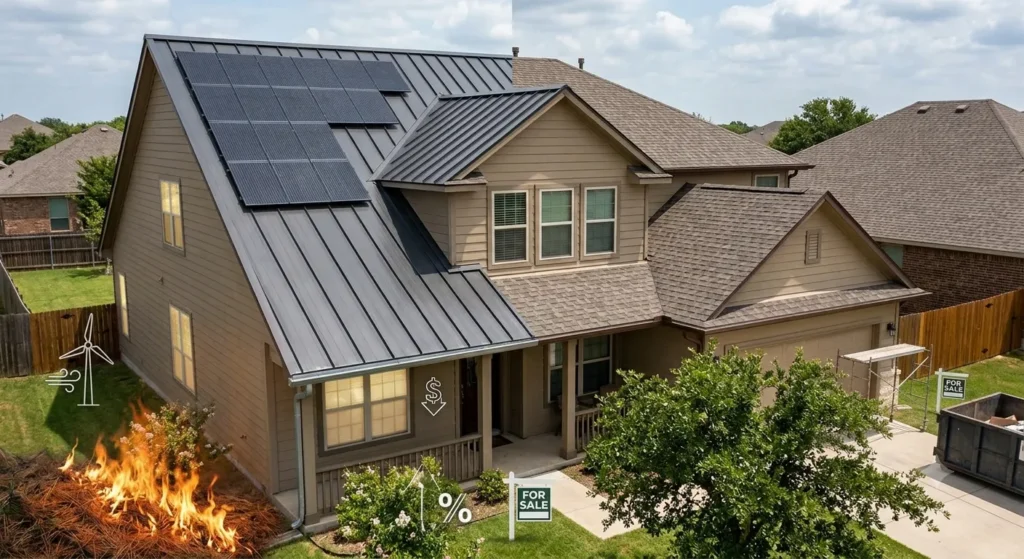
Metal roofing costs 2–3x more upfront than asphalt shingles. On a 2,000 sq ft (186 m²) home, that is an extra $8,000–$14,000 at installation. The cost difference narrows over time through energy savings and avoided replacement cycles, but the upfront gap is real.
Noise From Rain and Hail
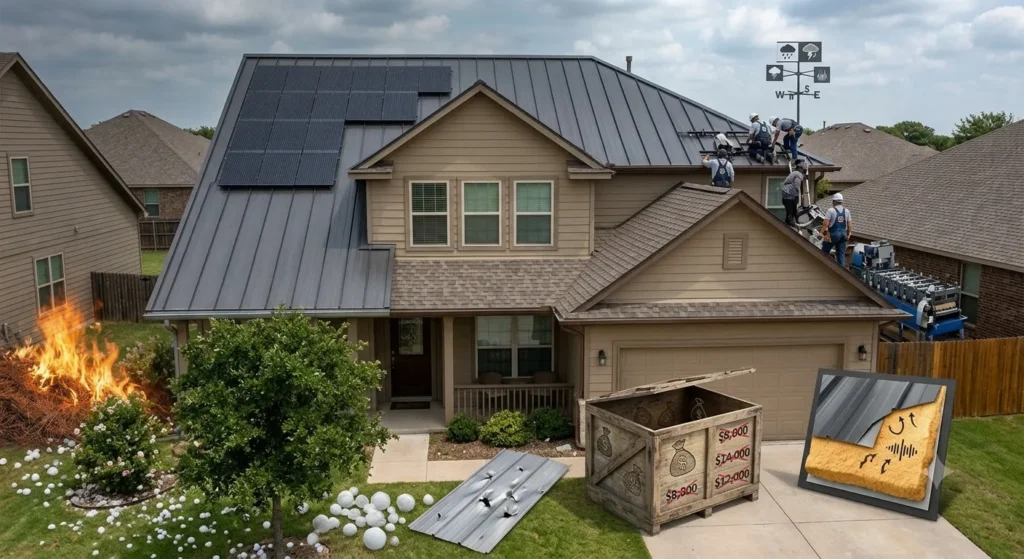
Without proper insulation, rain on metal creates audible noise inside the home. The fix is a closed-cell spray foam insulation layer (R-6 per inch / 2.54 cm) between the metal and the roof deck. This adds $1,500–$3,000 to installation but reduces sound transmission to match or beat a shingled roof.
Denting From Impact
Aluminum and copper panels dent under hail impact above 1 inch (2.54 cm) diameter. Steel, including Galvalume-coated steel, resists denting better and costs less than copper. If you live in a hail corridor states such as Texas, Colorado, and Nebraska choose 26-gauge steel standing seam over aluminum.
Specialist Installation Required
Metal roofing requires certified installers familiar with seam techniques, thermal expansion gaps, and fastener placement. Not every roofing contractor installs metal. Choosing an unqualified installer voids most manufacturer warranties. Always verify Metal Roofing Alliance (MRA) credentials before hiring.
Which Roofing Material Is Better for Energy Efficiency and Solar Panels?
Energy Efficiency by Climate
In hot climates (Florida, Texas, Arizona), metal roofs with a Solar Reflectance Index (SRI) above 29 reduce cooling costs by 25–40%. ENERGY STAR-rated metal panels re-emit up to 90% of absorbed solar radiation. Unpainted metal roofs absorb more heat, so choose a light-colored PVDF-coated panel in warm climates.
In cold climates (Minnesota, Michigan, Montana), asphalt shingles retain heat better than bare metal. However, a metal roof with proper attic insulation (R-49 minimum per Energy.gov guidelines) eliminates that disadvantage and still sheds snow faster.
Metal Roofing and Solar Panel Compatibility
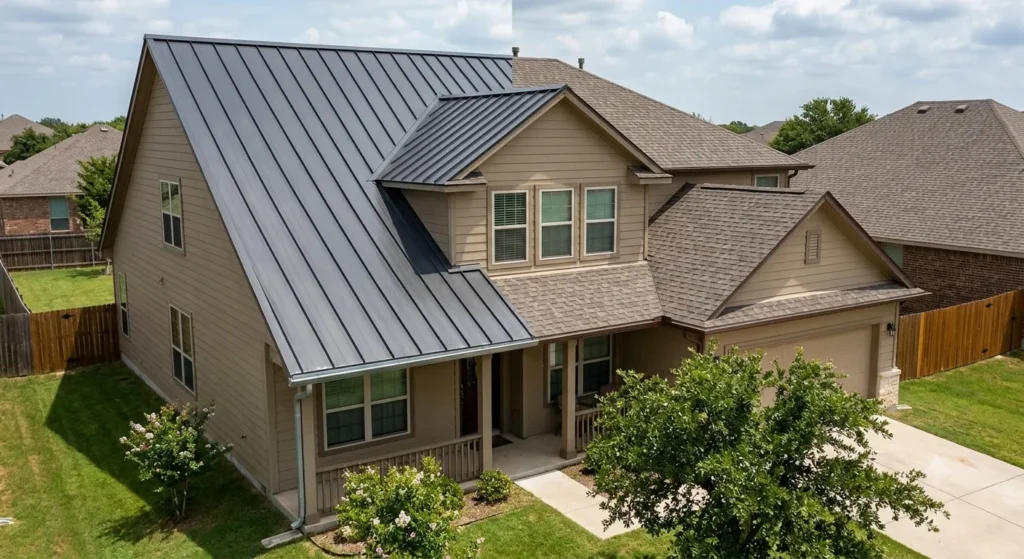
Metal roofs are the best substrate for solar panel installation. Standing seam panels accept S-5! rail-free clamps — no roof penetrations needed. Asphalt shingles require penetration-based mounts, which create leak points and must be removed when shingles need replacing (every 20–25 years). A solar installation on a metal roof will outlast 2–3 shingle replacement cycles without repositioning.
Our metal roofing services include standing seam installation pre-configured for solar mounting no secondary contractor needed.
Metal Roof vs Shingles: Which Material Should You Choose in 2026?
Choose Metal Roofing If You Meet 3 of These 5 Conditions
- You plan to stay in the home for more than 15 years
- Your area experiences wildfires, heavy snow, or winds above 90 mph (145 km/h)
- You plan to add solar panels now or within 10 years
- Your energy bill exceeds $1,800 per year and you want to cut cooling costs
- You want resale value — a new metal roof raises home value by 1–6%
Choose Asphalt Shingles If You Meet 3 of These 4 Conditions
- Your roofing budget is under $10,000 for a 2,000 sq ft (186 m²) roof
- You plan to sell the home within 10 years
- Your climate is moderate — no wildfires, limited hail, mild winters
- You need a fast installation — shingles install in 1–2 days vs 3–5 for metal
Conclusion
Metal roofing costs more upfront but outlasts asphalt shingles by 2–3 replacement cycles, saves up to 40% on energy bills, and increases resale value by 1–6%. Asphalt shingles cost less today and install faster — the right call for shorter-term homeowners in moderate climates.
The metal roof vs shingles decision comes down to 1 number: how many years you plan to stay. Beyond 15 years, metal wins on total cost. Under 10 years, shingles are the practical choice.
Ready to get an exact price for your home? Our team at Rainy Roofers provides free same-day estimates for both metal and shingle roofs across the US. Visit our residential roof replacement page or call +1 (866) 817-9140 to book today.