
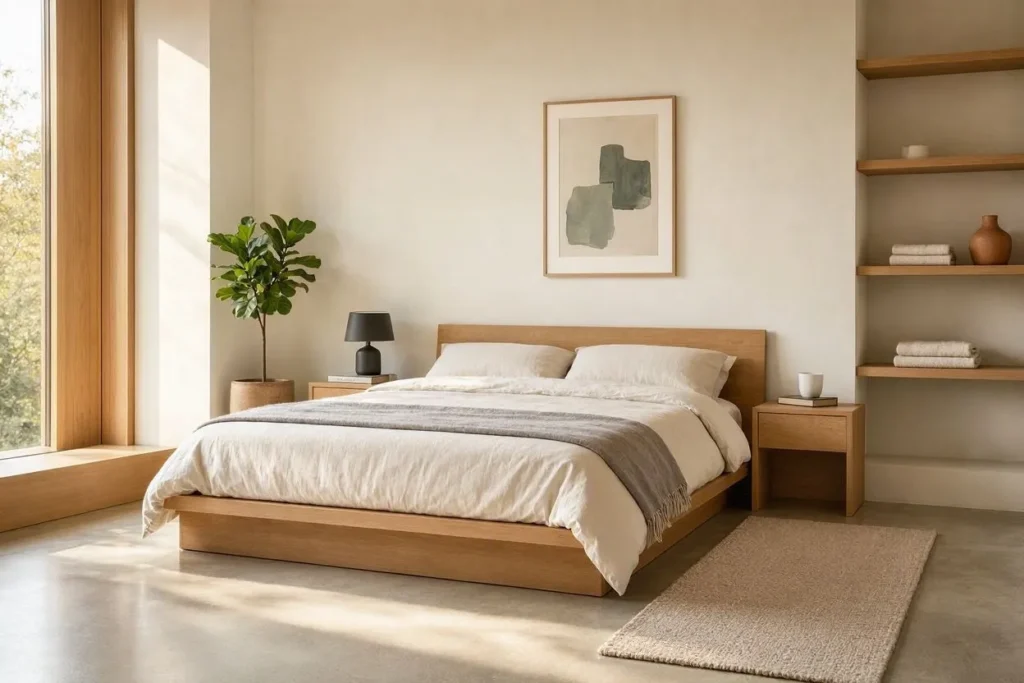
A cluttered bedroom keeps your brain working after the lights go off. Clear out the extra furniture, the mismatched decor, and the surfaces buried under stuff you forgot you owned, and the room finally does its actual job.
Below are 11 changes that get you there. None need a renovation, a few cost less than takeout for two, and you can start tonight.
The style runs on one rule: keep only what has a function, then add warmth back through colour and texture. Minimalist doesn’t mean bare.
1. Start With a Full Decluttering Pass
Sort every item in the room into three piles (keep, donate, toss) before you touch anything else. Do this before storage, colour, or furniture, because a cleared room shows you how much space you actually have. Skip it and you’ll design around clutter instead of removing it.
The two-hour sort
Block out two hours for a standard 120-square-foot bedroom. Pull everything off the nightstands, dressers, and windowsills, then handle each item once. Dead chargers, expired skincare, and books you haven’t opened in a year sort themselves. Anything you hesitate on for more than about 10 seconds goes into a “maybe” box you revisit in 30 days. Still unopened? It goes.
Give what survives a permanent home
Whatever stays needs a fixed spot: a drawer for chargers, a basket for loose jewelry, a shelf for the three books on your nightstand. Small items without an assigned spot drift back onto flat surfaces within a week. Every time.
2. Solve Storage Before You Decorate
Handle storage next, using vertical wall space and the area under the bed so you don’t have to buy more furniture. A room with unresolved storage will fill back up no matter how carefully you decorate it, which is why this comes before any decision about paint or furniture.
Use the walls before you buy furniture
Wall-mounted hooks near the closet catch the bags, scarves, and jackets that would otherwise pile onto a chair. Floating shelves 12 to 18 inches above a dresser add storage without touching your floor space. Under-bed bins sized for a standard queen frame’s 8-inch clearance take the seasonal stuff out of sight. A 10-by-10-foot bedroom usually has enough vertical wall space to eliminate one full piece of furniture, typically a second dresser, once shelving and hooks go in.
3. Choose a Neutral, Warm-Toned Colour Palette
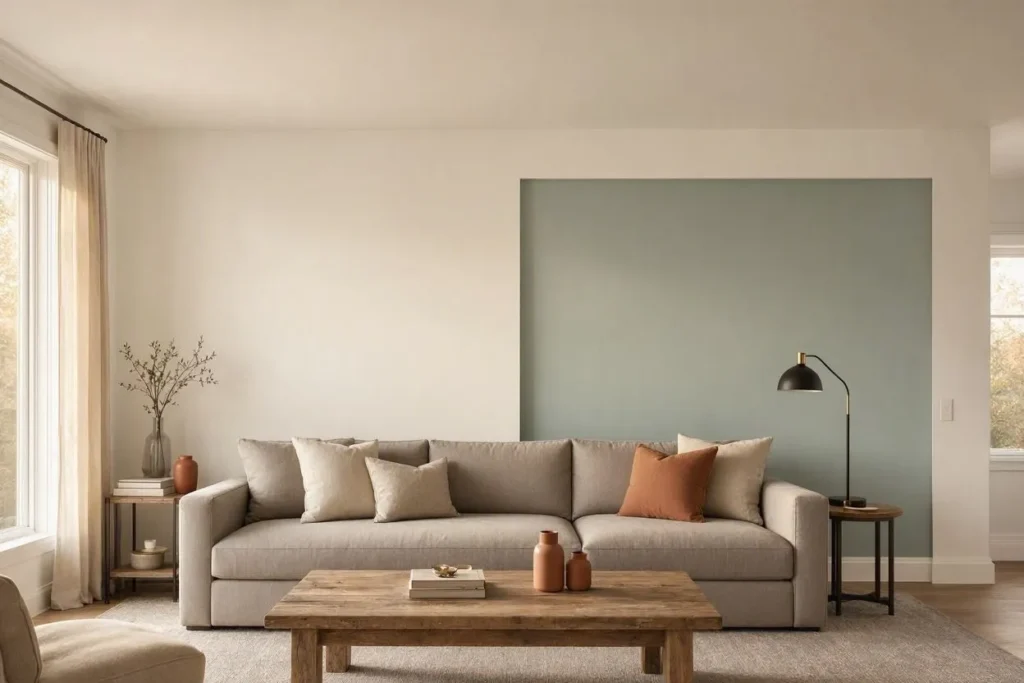
Build the room on two or three neutrals (white, grey, beige, taupe) and add one accent colour in small doses. Cool neutrals do promote calm, but an all-white or all-grey room can read as sterile without something warmer mixed in.
Sherwin-Williams Sea Salt and Benjamin Moore Cloud White work as base colours because they shift slightly warm depending on the light. If bright white feels too stark, a soft greige holds the same effect with more depth. Save saturated colour for small things: one throw pillow, one framed print, a vase on the dresser. Three or four touches in the same hue tie a room together. Ten do not.
Dark paint fits here too, despite the assumption that minimalism has to mean pale. A charcoal or deep navy wall in a well-lit room reads cosy rather than heavy, provided the rest of the palette stays simple.
4. Pick a Simple, Low-Profile Bed Frame
A platform bed with exposed legs is the safest choice, because a low profile keeps sightlines open across the room. Bulky headboards and ornate frames add visual weight that fights everything else you’re doing. If your floor space allows it, consider skipping the headboard entirely: linen bedding against a plain wall makes a cleaner line than most headboards manage.
Choose the bed before the rest of the furniture. Nightstands, rugs, and lighting all take their cue from its position and finish, so locking that decision in early prevents a room full of pieces that don’t quite match.
5. Limit Furniture to What Serves a Purpose
Four pieces or fewer in a standard bedroom: the bed, one or two nightstands, and either a dresser or a bench. Anything beyond that has to answer a specific need, extra seating or extra storage, rather than filling space out of habit.
A wireframe nightstand with a single drawer costs less than solid wood and visually disappears against a light wall, which keeps even a 90-square-foot room from feeling cramped. Skip the armoire: a rolling clothing rack or a set of floating shelves does the same work with a fraction of the bulk, and both are widely available under $150.
Rooms with high ceilings or more than 150 square feet can absorb one extra piece, usually an accent chair with exposed metal legs. Under that, stop at three.
6. Use Layered, Warm Lighting
Use two or three light sources at different heights instead of one overhead fixture. A ceiling light on its own gives you flat, harsh lighting that works directly against the calm you’re after.
Pick the right bulb temperature
Pair a dimmable overhead with a table lamp on the nightstand, plus a floor lamp in a reading corner if you have one. Look for bulbs between 2700K and 3000K. Warm light in the evening is standard sleep-hygiene advice, and daylight-toned bulbs above 4000K make winding down harder. A smart bulb system like Philips Hue shifts brightness and warmth automatically as the evening goes on, though that’s a nice-to-have rather than a requirement.
Work with the daylight you have
Natural light counts just as much. Sheer curtains in a neutral tone let daylight through without putting you on display, and one well-placed mirror across from a window bounces enough of it around to make a small bedroom feel noticeably more open.
7. Add Texture So the Room Doesn’t Feel Cold
Layer at least two different textures into the bedding and soft furnishings. Colour alone can’t carry warmth in a neutral room. Texture does that work.
A knit throw at the foot of the bed, a jute rug underfoot, and linen sheets on the mattress give you three distinct textures inside one colour story. None of it reads as clutter, since each piece is doing a job: warmth, comfort, floor coverage. Rounded furniture edges push the same way, and a nightstand with soft corners feels more inviting than a sharp-cornered one in the identical finish. Choose cotton, linen, and wool over polyester where you can. The difference shows up in photographs as clearly as it does in the room.
8. Keep Wall Decor to One Focal Point
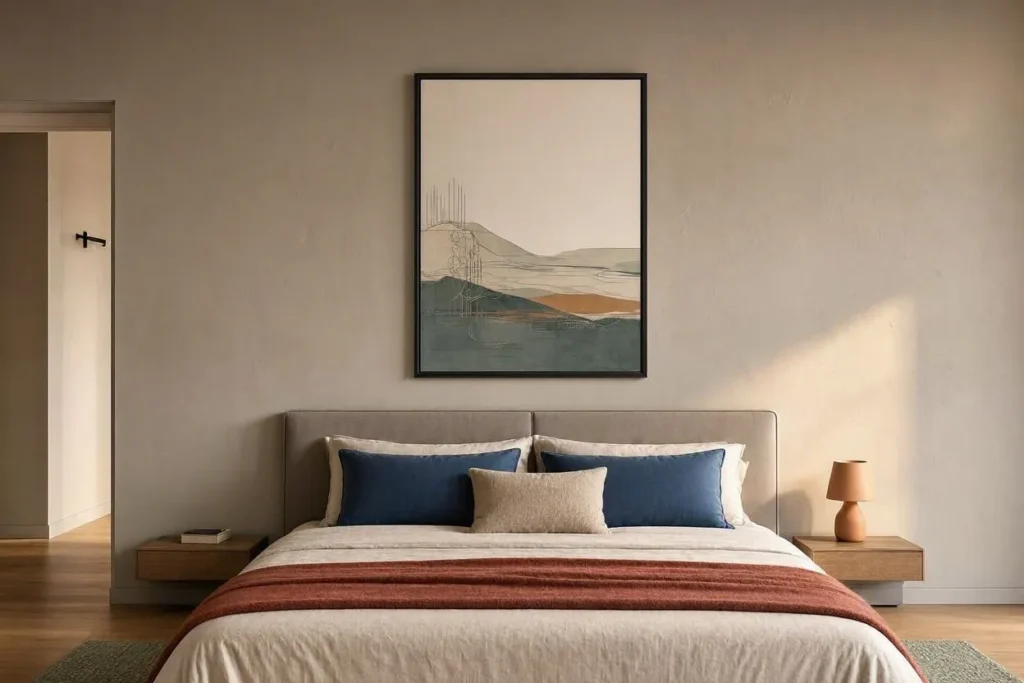
One focal point per room: a large mirror, an oversized print, or a small cluster of two or three frames on a single wall. Bare walls can feel unfinished, but decorating all four undoes the open effect you were going for.
Use the wall across from the bed or the one behind the headboard, since those are the sightlines you actually look at. A single 30-by-40-inch print anchors a room better than five small frames scattered around it. If art isn’t your thing, a mirror fills the wall and reflects light at the same time. Leave the other walls bare. Two focal points just compete.
9. Bring in One or Two Plants
One or two low-maintenance plants add colour and life without adding clutter. A fiddle-leaf fig, a snake plant, or a small pothos on the dresser brings something living into a neutral room without demanding daily attention.
Snake plants are the easiest of the three by a wide margin. They tolerate low light and want water only every two or three weeks, which makes them the obvious pick for a bedroom that never gets direct sun. A single 10-inch pot beside the dresser, or a 4-inch pot on the nightstand, is enough green. Stop at two, or the plants start competing with the focal point you just chose.
10. Try a Japandi-Style Palette
Japandi, a blend of Japanese and Scandinavian minimalism, pairs raw wood tones with soft neutrals and low-profile furniture. It borrows the warmth of Scandinavian textiles and combines it with the restraint of Japanese wabi-sabi, which prefers natural imperfection to polished uniformity.
A Japandi bedroom usually means unfinished or lightly stained oak against a wall in warm white or soft clay, with undyed linen bedding reinforcing the raw-material feel. A strictly Scandinavian room leans cooler and brighter. Japandi lets you go darker on the wood and work in muted earth tones like sage green or rust orange, in small doses. It’s the fastest way to give the room an identity instead of defaulting to white and grey.
11. Make It Work in a Small Bedroom or Rental
A rented bedroom can still go minimalist using removable solutions: adhesive hooks, peel-and-stick wallpaper, freestanding furniture that leaves the walls alone. Renters deal with two constraints on top of the space problem, no painting and no permanent fixtures, and those rule out several standard strategies.
Renter-safe swaps
Adhesive strips hold hooks and light shelving without a drill and come off cleanly at move-out, though check the weight rating and don’t trust them with a loaded shelf. Peel-and-stick wallpaper in one neutral tone covers an accent wall, same focal-point logic as paint, without touching your lease. A freestanding clothing rack or rolling cart replaces built-in storage and comes with you to the next place.
If the room is under 100 square feet
Under 100 square feet, the highest-impact purchase is a bed with under-frame drawers. It replaces a dresser’s worth of storage, and the dresser is usually the largest and least flexible thing in a small rental.
Common Minimalist Bedroom Mistakes to Avoid
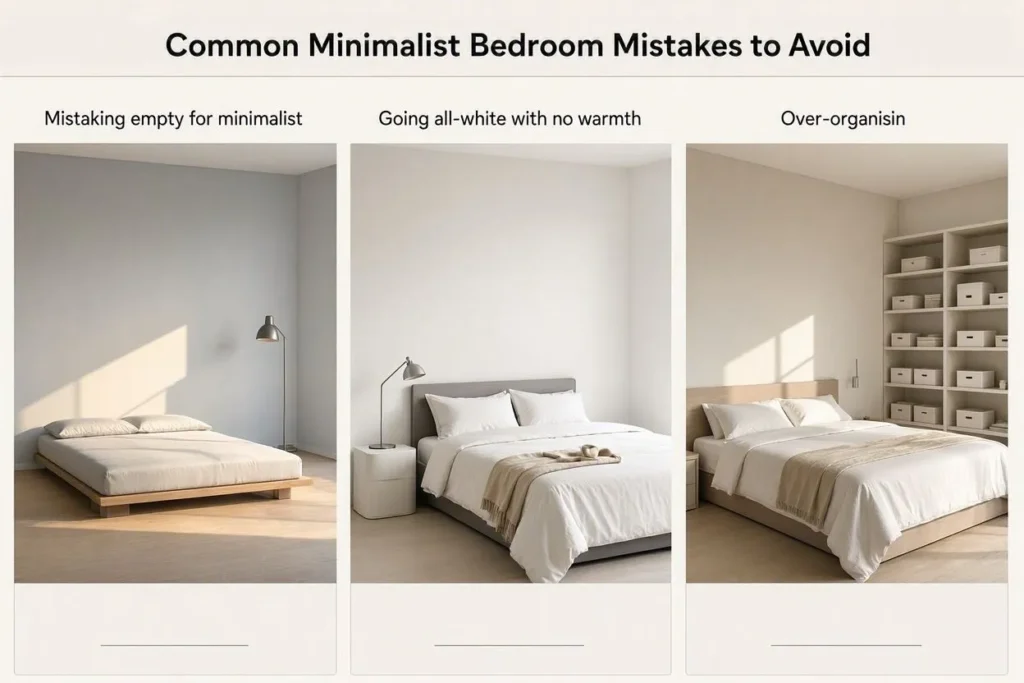
Mistaking empty for minimalist
The most common error is confusing “empty” with “minimalist,” which leaves you with a cold room rather than a calm one. A mattress and one lamp isn’t minimalism, it’s an unfinished room. The style asks you to curate, not to strip.
Going all-white with no warmth
An all-white room with no warm undertone and no texture reads clinical. One warmer neutral or one layer of texture fixes it.
Over-organising instead of removing
A room full of matching bins looks tidy, but if those bins hold things that shouldn’t be in the bedroom at all, you’ve just made the clutter neater.
Shopping before decluttering
Buying furniture first leaves you with pieces sized for a room that doesn’t exist yet. Clear the space, then measure, then shop.
Minimalist Bedroom Ideas on a Budget
A full refresh can land around $300 if you spend on paint and textiles before furniture. Furniture is what makes these projects expensive, and it’s rarely what makes the biggest difference.
Where the money goes
A gallon of interior paint runs roughly $40 to $80 depending on brand and tier, and covers a 12-by-12-foot room with two coats. Add neutral bedding, a woven throw, a snake plant, and a mirror, and you’ve hit the focal point and lighting goals with no new furniture. Selling what you cleared out covers a good share of it: a used dresser or nightstand often moves for $50 to $150 locally.
Where to Start
A minimalist bedroom is an interior design decision before it’s a shopping list. Clear the clutter, choose a warm neutral colour palette for the walls, and keep only the bedroom furniture that earns its place: the bed, a nightstand, one dresser. Layer in texture with linen bedding, a woven rug, and a knit throw so the room decor reads warm rather than bare. The same decorating rules scale from a rented studio bedroom to a full primary suite: fewer objects, more intention behind each one.