You look at your closet door every day and probably haven’t given it a second thought in years. This guide covers all eight major door types with prices, standard sizes, and a few options most articles skip, like renter-friendly swaps that need zero drilling.
A fifteen-dollar handle swap counts as a fix. So does tearing the whole thing out and starting over. What matters is picking whichever one fits your space, your budget, and how much you want the door to stand out versus fade into the wall.
Note: prices below are typical retail ranges as of 2026 and vary by region, retailer, and material grade. Check a local supplier for current numbers before budgeting a project.
The Eight Main Types of Closet Doors

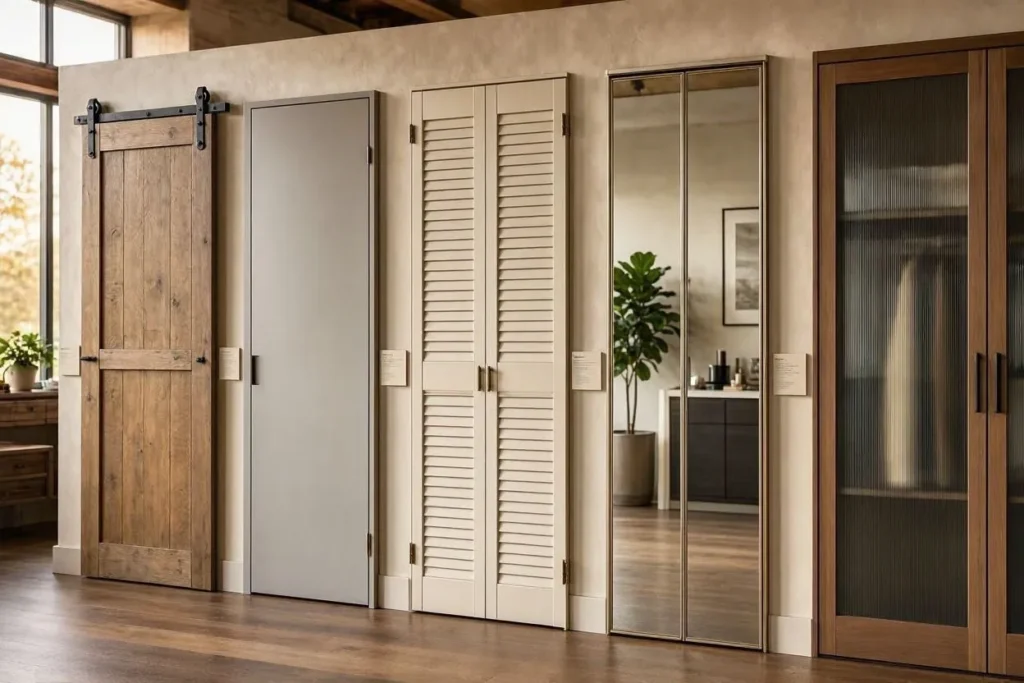
Bifold, sliding (bypass), barn, French, pocket, accordion, hidden (bookcase or Murphy), and louvered doors each trade off differently on cost, floor space, and style. Standard closet doors run 80 inches tall; width depends on the type, as shown below.
Bifold Doors
Fold in half on a track mounted inside the closet frame and need about half the swing clearance of a hinged door. A 60-inch opening typically takes two 30-inch panels (individual panels generally run 12 to 18 inches wide), and installation takes an hour or two with basic tools. A plain white four-panel bifold starts around $60 to $150 unfinished, which is why you see them in nearly every production-built home in the country.
Sliding (Bypass) Doors
Run on a track and glide side to side instead of swinging out. Two or three panels overlap on the same track, so only half the closet opens at once. That’s fine if furniture already sits close to the closet wall, but a hassle if you need full access. Panels typically run 24 to 36 inches wide, and expect $100 to $400 for a standard set.
Barn Doors
Hang from an exposed track above the frame, with the track and rollers visible on the wall. You’ll need roughly 1.5 to 2 times the width of the opening in clear wall space for the door to slide fully open, so a 36-inch closet needs about 60 inches. Unfinished pine, stained or painted, is the default for farmhouse-style bedrooms. Budget $150 to $600 including hardware.
French Doors
Swing open on hinges as a pair of glass-paneled panels that meet in the middle. Both panels need room to swing, so save these for walk-in closets with 4 feet or more of clearance rather than a tight reach-in. Pre-hung pine sets start around $200; solid wood with divided glass runs past $800.
Pocket Doors
Slide directly into a cavity built inside the wall. No swing space, no visible track, nothing sticking out into the room. Retrofitting one into an existing wall means opening drywall and often relocating outlets or switches, which is why it’s the priciest option here: typically $500 to $1,500 including framing. New construction and full remodels are where they make the most financial sense, since the wall cavity gets built during framing anyway.
Accordion Doors
Fold into narrow pleats along a top track and take up almost no depth when open. A single panel can span an opening up to 8 feet wide without a center post, handy for a wide reach-in closet in a hallway or laundry room. Vinyl versions run $40 to $100 and install in under an hour.
Hidden (Bookcase or Murphy) Doors
Disguise a closet as a built-in bookcase or a stretch of wall paneling, swinging on concealed hinges with no handle or trim to give it away. A pre-built Murphy door kit costs $300 to $900 before shelving and paint, and fits a standard 24- to 36-inch rough opening. Home offices and media rooms lean on these often, since the disguise keeps the room’s sightlines clean.
Louvered Doors
Have horizontal slats that let air circulate even when the door’s shut, which matters more than you’d think for linen and laundry closets, where trapped humidity can mildew fabric in a matter of weeks. A standard louvered bifold set costs $70 to $180 and just needs the occasional dusting.
Best Options for Small Spaces
Sliding, bypass, and accordion doors work best in tight rooms because none of them swing outward. A hinged door needs 24 to 30 inches of open floor space to clear fully, and a studio apartment or narrow hallway rarely has that much to spare. If your bed sits close to the closet wall, a swinging door will clip the frame every single time. A sliding door just glides past it.
Mirrored sliding panels do double duty, standing in for a full-length mirror while bouncing daylight deeper into the room. A pocket door works even better where the wall allows it, though framing costs usually rule that out for renters or anyone on a tight budget.
Corner closets have their own headache: a hinged door swinging out of a corner often hits the adjacent wall before it’s fully open. Bifold doors dodge that entirely, since each panel folds back on itself instead of swinging in a wide arc. Measure the swing radius against nearby furniture before you buy any hinged door.
Choosing a Material
Solid wood costs $150 to $600 per door. It holds paint and stain well and can be sanded down and refinished if it ever gets scratched. MDF costs less, $50 to $150, and resists warping better in humid climates, though it doesn’t refinish nearly as cleanly. Glass, whether clear, frosted, or mirrored, adds light and depth but shows fingerprints more than either wood option. Frosted glass is the compromise: it blurs whatever’s behind it while still letting light through.
Climate Matters More Than You’d Think
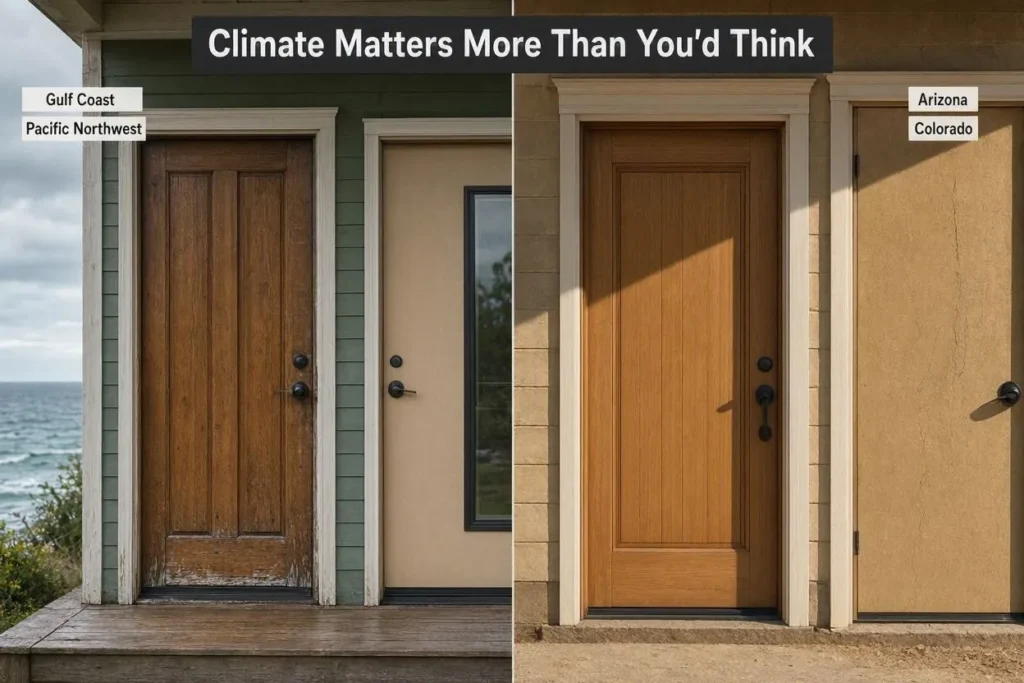
In humid regions like the Gulf Coast or Pacific Northwest, unsealed solid wood tends to swell and stick within a year or two, so MDF or a metal-framed glass door usually holds up better. In dry climates like Arizona or Colorado, it’s the opposite: low humidity keeps solid wood stable, so it’s actually the safer bet there.
Cost Summary
| Door type | Typical price |
| Accordion | $40–$100 |
| Bifold (unfinished) | $60–$150 |
| Louvered | $70–$180 |
| Sliding/bypass | $100–$400 |
| Barn (with hardware) | $150–$600 |
| French (pre-hung, pine) | $200–$500 |
| Hidden/Murphy | $300–$900 |
| Pocket (with framing) | $500–$1,500 |
Labor adds $75 to $200 per door for a professional installer, though bifold, sliding, and accordion doors are simple enough for most homeowners to install themselves in under two hours with a drill and a level. Custom-cut doors for nonstandard openings add $50 to $150 over off-the-shelf sizes.
Renter-Friendly Alternatives
A tension curtain rod with fabric panels wedges into place on spring pressure alone. No drilling, no marks left behind when the lease ends. Beaded curtains and macrame panels work the same way and add texture without any permanent hardware.
If you’d rather keep the door itself, peel-and-stick wallpaper is the move. It pulls off cleanly within the first year or two, though it can leave a bit of residue if it sits much longer than that, so test a small corner first before committing.
Accessible Options for Aging in Place
Pocket doors and bifold doors with lever-style pulls work best here, since both need less grip strength and less arm reach than a standard swinging door. A pocket door removes the swing entirely, which matters a lot for anyone using a wheelchair or walker and needing a wide, unobstructed path.
Lever handles swap in for round doorknobs on any door type, cost $15 to $40 per set, and take a screwdriver and ten minutes. It’s a small change, but it makes a real difference for someone with arthritis or limited hand mobility. The ADA’s accessibility guidelines call for at least 32 inches of clear passage width at doorways, and most closet openings already clear that once the door’s out of the way.
Sustainable Materials
Reclaimed wood and FSC-certified lumber are the two most sustainable picks, since both cut demand for newly harvested timber. Reclaimed barn wood, often pulled from decommissioned agricultural buildings, carries visible grain and nail holes that give a door genuine character, the kind you can’t fake with new lumber. A single reclaimed panel, roughly 30 by 80 inches, typically runs $80 to $250 depending on species and condition. Salvage yards and architectural reclamation warehouses are your best bet for finding one.
It’s worth spending the extra $5 to $10 per can on a low-VOC finish, too. Standard oil-based finishes off-gas for weeks after you paint, and that’s air you’re breathing every night if it’s a bedroom closet.
Modernizing Without Replacing
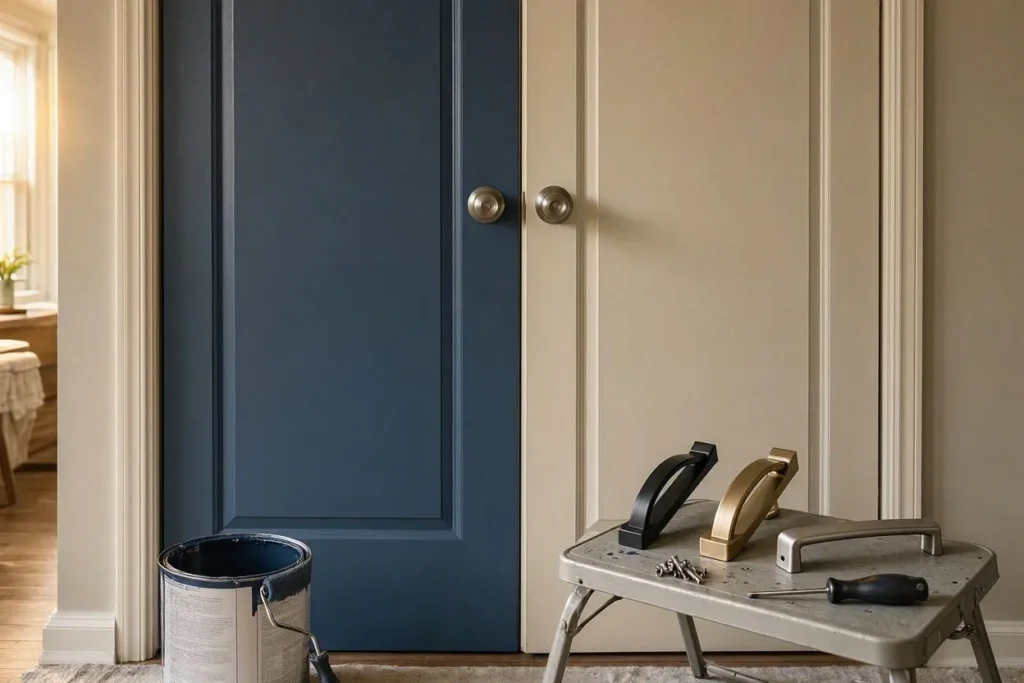
Swapping the hardware is the fastest fix. New handles in matte black, brushed gold, or satin nickel cost $10 to $30 per set and take less than 10 minutes to install with a screwdriver.
Paint works almost as fast. One gallon covers 4 to 6 standard doors, and a bold color like matte navy turns a builder-grade beige bifold into a focal point without touching the hardware or the closet behind it.
Bottom Line
Closet door ideas range from a $40 curtain rod to a $1,500 custom pocket door. Bifold and sliding doors solve most small-space problems for under $400; barn doors and French doors turn a closet into a design feature where there’s room to spare. Measure the opening, pick a material suited to your climate, and go from there.