
Home improvement financing is any loan, credit line, or payment plan a homeowner uses to pay for repairs, upgrades, or renovations instead of paying cash upfront. Options range from unsecured personal loans to loans backed by home equity, government-insured programs, and payment plans arranged directly through a contractor. Which one makes sense comes down to three things: how big the project is, the homeowner’s credit score, and how much equity is already sitting in the property. A $6,000 bathroom refresh calls for a different funding source than a $45,000 whole-home renovation, and lenders price the risk on each option differently.
This guide walks through eight financing paths, compares them side by side, and flags the credit-score thresholds and red flags worth knowing before signing anything.
What Is Home Improvement Financing?
Home improvement financing is borrowed money used specifically to repair, remodel, or upgrade a residential property. Lenders structure these products as either secured loans, which use the home as collateral, or unsecured loans, which rely on the borrower’s credit profile alone. A kitchen remodel, roof replacement, HVAC (heating, ventilation, and air conditioning) swap, or accessibility upgrade all count as home improvement projects under most lender definitions.
Two things set this kind of financing apart from ordinary consumer credit. First, several programs, including FHA (Federal Housing Administration) Title I loans, require the money to go toward specific categories of work, like health, safety, or accessibility improvements. Second, secured options tie approval to the home’s appraised value, not just the borrower’s income. A homeowner with $80,000 in equity and a 620 credit score will often qualify for a larger secured loan than an unsecured personal loan would allow at that same credit tier.
How Do You Choose the Right Home Improvement Financing Option?

Start by matching the loan type to the project’s cost and timeline. Small, urgent repairs under $10,000 usually fit better with unsecured personal loans or promotional-rate credit cards, since underwriting takes days instead of weeks. Larger renovations above $25,000 typically make more sense through a home equity loan (a lump sum borrowed against the home), a HELOC (a revolving credit line secured by the home), or a cash-out refinance (a new, larger mortgage that pays out the difference in cash), because those options carry lower interest rates in exchange for putting the property up as collateral.
Three questions narrow the decision fast:
- How much does the project actually cost, in real dollars rather than a rough estimate?
- Is there equity available, and if the home was bought within the last couple of years, has enough equity even built up yet?
- Does the money need to show up in days, or can the project wait three to six weeks for underwriting?
A homeowner replacing a failed water heater for $1,800 doesn’t need a 15-year secured loan for that. Someone adding a $60,000 addition, on the other hand, should compare at least three lenders before signing anything, since rates on home equity products can swing by two full percentage points between institutions.
Types of Home Improvement Financing
Eight financing paths cover nearly every renovation scenario a homeowner in the United States will run into.
1. Personal Loans
A personal loan for home improvement is an unsecured installment loan that doesn’t require equity or collateral. Borrowers get a lump sum upfront and repay it in fixed monthly installments, typically over two to seven years. Rates typically start in the high-single digits (APR, or Annual Percentage Rate) for borrowers with excellent credit and climb past 20% for borrowers in the fair-credit range, and these numbers move with the broader interest-rate environment, so it’s worth checking current offers from a couple of lenders before assuming a specific rate applies.
Approval depends almost entirely on credit score and income, not the home’s value. Someone funding a $15,000 kitchen refresh through a personal loan can often close within one to three business days. Compare that to three to six weeks for a home equity loan that needs an appraisal first.
2. Home Equity Loans
A home equity loan lets homeowners borrow a lump sum against the equity already built up in the property, repaid at a fixed rate over a set term. Because it’s secured by the home, rates typically run a few percentage points lower than unsecured personal loans for the same credit tier, though the exact spread depends on the lender. Lenders generally cap borrowing at 80% to 85% of the home’s combined loan-to-value ratio, though this cap varies by lender and should be confirmed with specific institutions rather than treated as universal.
A homeowner with a $400,000 home and a $250,000 mortgage balance has roughly $150,000 in equity. At an 80% loan-to-value cap, that homeowner could access up to $70,000 through a home equity loan, depending on the lender’s underwriting guidelines.
3. Home Equity Line of Credit (HELOC)
A HELOC works like a revolving credit line secured by the home, letting homeowners draw funds as needed instead of getting one lump sum. Interest applies only to what’s actually drawn, not the full credit limit, which makes it a good fit for phased renovations where the total cost isn’t fully known upfront. Most HELOCs carry variable rates tied to the prime rate, so monthly payments can shift as market rates move.
A homeowner tackling a multi-phase renovation (new siding this spring, a kitchen remodel next year) draws $20,000 for phase one and leaves the rest of the credit line untouched until phase two starts. That flexibility has a tradeoff, though. Variable rates mean the payment on that same $20,000 balance could rise if the prime rate climbs mid-project.
4. Cash-Out Refinance
A cash-out refinance replaces the existing mortgage with a new, larger one and hands the difference to the homeowner in cash. This works best for large-scale renovations, and only for homeowners comfortable resetting their mortgage term and paying new closing costs, typically 2% to 5% of the loan amount.
Closing costs on a $300,000 refinance could run $9,000, so the math only works if the new rate is competitive with the current mortgage rate. If rates have gone up since the original loan closed, a cash-out refinance can end up raising the overall interest cost even after accounting for the renovation funds.
5. FHA Title I Property Improvement Loans
FHA Title I loans are government-insured loans built for homeowners with limited equity who need to fund repairs that improve a home’s safety, health, or accessibility. Loans up to $7,500 require no collateral at all. Above that threshold, the loan must be secured by a mortgage on the property, and the total borrowing limit depends on the property type; single-family homes typically cap around $25,000.
A first-time homeowner two years into a mortgage, without enough equity for a traditional home equity loan, can still qualify for a $6,000 Title I loan to replace a failing furnace, since the program doesn’t require equity for loans under $7,500. HUD (U.S. Department of Housing and Urban Development) keeps a public list of approved Title I lenders, which cuts down the risk of ending up with an unlicensed one.
6. Contractor-Offered Installment Plans
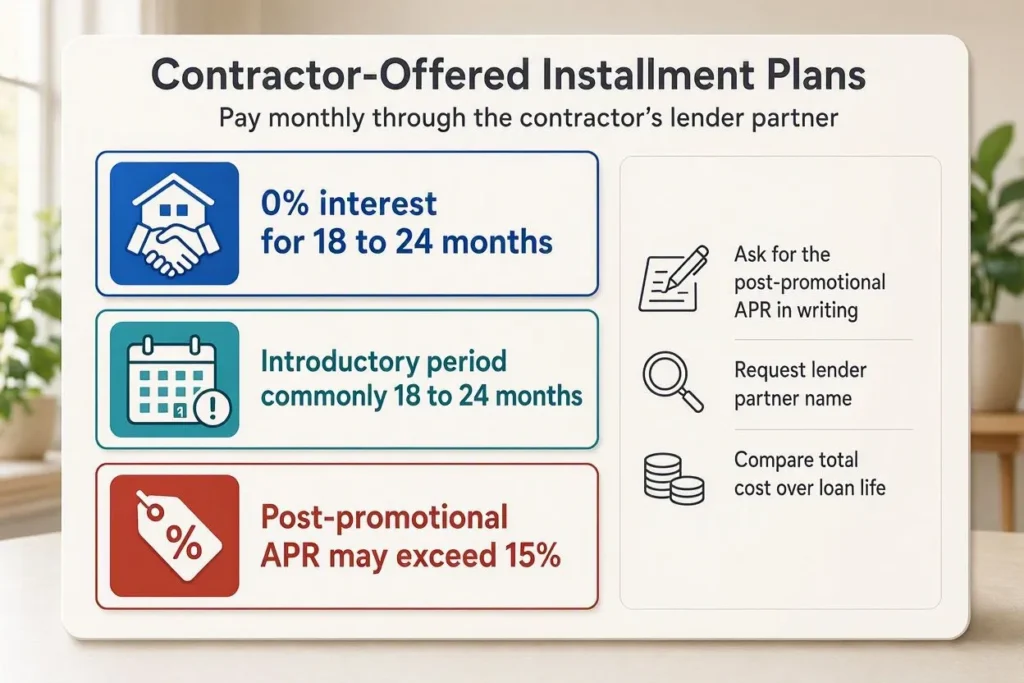
These let homeowners pay for a project in monthly installments arranged directly through the contractor, who partners with a third-party lender. They often advertise 0% interest for an introductory period, commonly 18 to 24 months, before switching to a standard rate that can run well above 15% APR once the promotion ends, and the exact rate varies significantly by lender partner, so it’s worth asking for the post-promotional rate in writing before signing.
A homeowner financing a $12,000 bathroom remodel through a contractor’s 0%-for-24-months plan pays nothing in interest if the balance clears before month 24. Miss that deadline, though, and the same balance can accrue interest retroactively from the original purchase date, depending on the plan’s terms. That’s the detail buried in fine print that a lot of borrowers skip reading.
7. 0% Introductory APR Credit Cards
A 0% introductory APR credit card lets homeowners charge smaller projects and pay the balance down without interest during the promotional period, usually 12 to 21 months. No collateral required, and approval can happen within minutes. Once the promotional period ends, the average card APR climbs into the low-to-mid 20s, a figure that shifts with rate-hike cycles and is worth checking against current data before relying on it.
This fits small projects best. Think a $3,000 fence repair or a $1,500 appliance replacement, not a kitchen remodel, since most cards’ credit limits fall well short of what a bigger renovation actually costs.
8. PACE (Property Assessed Clean Energy) Financing
PACE financing lets homeowners fund energy-efficiency upgrades, like solar panels, insulation, and energy-efficient windows, through an assessment added to their property tax bill rather than a traditional loan. Repayment happens alongside property taxes, typically over 10 to 20 years, and the obligation can transfer to the next owner if the home sells before it’s paid off.
PACE programs only operate in states and municipalities that have adopted enabling legislation, so availability varies a lot by ZIP code. A homeowner in a PACE-eligible county installing a $22,000 solar system can spread that cost across two decades of property tax installments instead of one lump-sum loan payment.
Home Improvement Financing Options Compared
| Financing Type | Collateral Required | Typical Rate Range | Funding Speed | Best For |
| Personal Loan | No | High-single digits to 20%+ APR | 1–3 business days | Small- to mid-size projects, fast funding |
| Home Equity Loan | Yes | A few points below personal loan rates | 2–6 weeks | Large, one-time renovations |
| HELOC | Yes | Variable, prime-based | 2–6 weeks | Phased or ongoing projects |
| Cash-Out Refinance | Yes | Tied to mortgage rates | 30–45 days | Major renovations, rate-favorable timing |
| FHA Title I Loan | No (under $7,500) | Fixed, government-set caps | 1–4 weeks | Limited-equity homeowners |
| Contractor Installment Plan | No | 0% promo, then 15%+ APR | Same day | Contractor-bundled projects |
| 0% APR Credit Card | No | 0% promo, then low-to-mid 20s APR | Minutes | Small purchases under $5,000 |
| PACE Financing | Yes (tax lien) | Fixed, program-specific | 4–8 weeks | Energy-efficiency upgrades |
What Credit Score Do You Need for Home Improvement Financing?
Most home improvement financing options require a credit score somewhere between 580 and 700, though the exact bar depends on the lender and loan type. Unsecured personal loans and 0% APR credit cards generally sit at the higher end of that range, since there’s no collateral backing the debt. Secured options like home equity loans, HELOCs, and cash-out refinances allow a little more flexibility, because the home itself reduces the lender’s risk.
FHA Title I loans set the lowest bar here. A borrower with a 580 credit score and documented income can qualify for a Title I loan even without a strong credit history, as long as the loan amount stays within program limits. Lenders also weigh debt-to-income ratio (DTI) alongside credit score, and DTI caps for secured home improvement products commonly fall somewhere in the 40s to low 50s, though the exact threshold varies by lender and loan program, so it’s worth confirming the specific cap with any lender before applying.
How Do You Finance Home Improvements With Bad Credit?
Homeowners with credit scores below 580 really have three realistic paths: FHA Title I loans, secured financing backed by home equity, or a co-signer on an unsecured loan. FHA Title I loans don’t set a hard minimum score the way conventional lenders do, since the government insures part of the loan against default. Secured options work because the home’s value carries most of the underwriting weight, not the borrower’s credit history.
A homeowner with a 540 credit score and $40,000 in home equity often qualifies for a home equity loan, just at a higher rate than someone with excellent credit would get. A co-signer with strong credit can also unlock approval on an unsecured personal loan that would otherwise get rejected, though the co-signer becomes equally responsible for repayment if the primary borrower misses a payment.
What Are the Warning Signs of Predatory Contractor Financing?

Yes, predatory contractor financing exists, and it usually shows up as pressure to sign on the spot, vague APR disclosures, or terms that only surface in fine print after the promotional period ends. Legitimate contractors give written terms before asking for a signature, including the post-promotional APR, the exact date the promotional rate expires, and whether interest accrues retroactively if the balance isn’t paid off in full.
Four signs point to a predatory setup:
- A contractor who won’t provide the lender’s name or NMLS (Nationwide Multistate Licensing System) number in writing.
- Loan paperwork that only discloses the APR after the homeowner has already signed a work order.
- Deferred-interest terms that charge interest from the original purchase date if the balance isn’t cleared by the deadline, rather than just on what’s left owing.
- High-pressure tactics that push for a decision during the same in-home visit, with no time to check rates against a bank or credit union.
A homeowner weighing a contractor’s in-house financing against a personal loan from a bank should ask for the full amortization schedule from both before deciding. Contractor financing can be a good deal, but it only earns that comparison once the terms hold up against a second, independent quote.
Conclusion
A $2,000 repair and a $60,000 addition call for different tools, not the same lender by default. Comparing at least two or three offers before signing, and actually reading the post-promotional terms on any contractor plan, is still the most reliable way to avoid overpaying.