

To get a home improvement loan, price your project, check your credit score and equity, choose between an unsecured personal loan and a home-equity product, prequalify with three to five lenders, then apply with the one offering the lowest total cost. Approval takes one to seven business days for most personal loans and three to six weeks for anything secured by your house.
American homeowners hold roughly $18 trillion in tappable equity, according to ICE Mortgage Technology, and a record share of them are choosing to renovate rather than move. Whether that renovation gets financed cheaply or expensively usually comes down to decisions made before the application, not after.
Key takeaways
- Home improvement loans fall into two families: unsecured personal loans and loans secured by your home.
- Personal loan rates averaged 12.42% APR in mid-August 2026 (via Curinos and Bankrate), while home equity loans averaged 7.35% and home equity lines of credit averaged 7.16%. Rates move monthly, so treat these as a snapshot, not a quote.
- Most lenders want a credit score of 620 or higher, a debt-to-income (DTI) ratio under 43%, and 15% to 20% equity for secured options.
- The FHA Title I program lends up to $25,000 on a single-family home with almost no equity required.
- Multiple loan applications within 14 to 45 days count as a single hard inquiry on your FICO score.
What Is a Home Improvement Loan?
A home improvement loan is any financing used to pay for repairs, renovations, or upgrades to a property you own. No single product actually carries that name at most banks. Lenders market personal loans, home equity loans, home equity lines of credit, and FHA-insured rehabilitation mortgages under the same umbrella term, which is exactly why comparison shopping gets confusing.
The distinction that matters is collateral. An unsecured personal loan is backed by nothing but your promise to repay, so pricing depends entirely on your credit profile and income. Secured products like home equity loans, HELOCs, and cash-out refinances pledge your house instead. Rates drop sharply as a result. So does your margin for error: fall far enough behind and the lender can foreclose.
Project sizes vary enormously. A water heater replacement runs $1,500 to $3,500, a mid-range kitchen remodel lands between $25,000 and $80,000, and a full addition can exceed $150,000. Different loan types serve those numbers well or badly, and that mismatch is the real reason people end up overpaying.
How to Get a Home Improvement Loan in 7 Steps
Price the project, check your qualifying numbers, match the loan type to your situation, review government programs, prequalify with multiple lenders, compare total cost, then apply and close. Each step below has a specific output, whether that’s a number, a decision, or a document, so you’ll know when you’ve actually finished it.
1. Price the Project Before You Choose a Loan

Collect three written bids from licensed contractors, then add 15% to 20% for overruns. Borrowing before you have real numbers almost guarantees you’ll borrow the wrong amount.
Written bids should itemize labor, materials, permits, and disposal separately. Verbal estimates drift: a bathroom gut job quoted at $18,000 has a way of arriving at $24,000 once tile allowances and a rotted subfloor enter the picture. That’s what the contingency line is for.
Borrow the smallest workable amount. Lenders approve smaller requests more readily, and a $22,000 loan at 12% costs about $2,600 less in interest over four years than a $30,000 loan on identical terms.
2. Check Your Credit Score, DTI, and Equity
Pull your credit report, calculate your debt-to-income ratio, and estimate your equity before any lender does it for you. All three numbers are fixable, but none of them moves in a week.
Your DTI ratio divides total monthly debt payments by gross monthly income. Someone earning $7,000 a month with $2,400 in car, card, and mortgage payments sits at 34%, comfortably inside most underwriting guidelines. Equity works differently: subtract your mortgage balance from your home’s current market value, so a $420,000 house with a $290,000 balance carries $130,000 in equity.
Errors on credit reports are common and worth hunting for. Free weekly reports are available from all three bureaus through AnnualCreditReport.com, and a disputed collection removed 60 days before you apply can move you an entire pricing tier.
What lenders actually check. Most lenders want a credit score of 620 or higher, a DTI ratio below 43% (many prefer 36% or lower), at least two years of verifiable income, and, for secured products, 15% to 20% equity with a combined loan-to-value ratio at or below 80% to 85%. Pricing improves sharply above 720, and the best rates go to borrowers above 760:
| FICO score | Typical personal-loan APR | Approval outlook |
| 760+ | 7%–10% | Approved by nearly all lenders; qualifies for lowest advertised rates |
| 720–759 | 10%–14% | Strong approval odds across banks, credit unions, and online lenders |
| 680–719 | 14%–20% | Approved widely; rates near the national average of 12.42% |
| 640–679 | 20%–28% | Approved by online lenders and credit unions; banks often decline |
| 600–639 | 26%–35% | Limited lender pool; credit union 18% cap becomes valuable |
| Below 600 | 28%–36% | Few conventional options; FHA Title I becomes the realistic path |
Ranges reflect aggregated 2026 lender offer data, including Federal Reserve G.19 statistics and published rate monitors, and represent prequalified offers rather than advertised starting rates. Secured borrowing changes the math for lower scores: home equity lenders weigh your combined loan-to-value ratio heavily alongside credit, so a 650-score homeowner with 45% equity often prices better on a home equity loan than a 700-score borrower with 12% equity.
Have these documents ready before you apply so underwriting doesn’t stall: government-issued photo ID, two recent pay stubs (or two years of tax returns if you’re self-employed), W-2s for the past two years, two months of bank statements, proof of residence, and contractor bids with a project scope for renovation-specific programs.
One more wrinkle most guides skip: state law caps what you can borrow in some cases, independent of your credit. A handful of national lenders set minimum personal loan amounts as low as 2,600–3,000 in states like California and Virginia, and maximums as low as 7,000–11,000 in states like Maine and North Carolina, check with individual lenders since these limits vary by product.
3. Match the Loan Type to Your Project
Choose based on project size, equity position, and how fast you need the money. The table below maps four common situations.
| Your situation | Best fit | Typical APR (Aug. 2026) | Why |
| Under $25,000, need funds within a week, own little equity | Unsecured personal loan | 8%–36%, avg. 12.42% | No appraisal, no collateral, funding in 1–7 days |
| 25,000–150,000, hold 20%+ equity, fixed scope | Home equity loan | Avg. 7.35% | Lowest fixed rate, single lump sum, predictable payment |
| Phased or open-ended work over 1–3 years | HELOC | Avg. 7.16%, variable | Draw only what you use; rate can rise |
| Buying a fixer-upper or renovating beyond your equity | FHA 203(k) | Tied to FHA mortgage rates | Borrows against post-renovation value, not current value |
Rate averages come from Curinos and Bankrate rate monitors as of mid-August 2026 and assume strong credit profiles. Your quoted rate will differ.
Speed and cost pull in opposite directions here. A personal loan can fund the day after approval but costs roughly 5 percentage points more than a home equity loan, which translates to about $3,000 in extra interest on a $30,000 loan over five years. That’s real money, though not always more than a delayed roof repair ends up costing.
4. Check Government-Backed Programs First
Two FHA programs beat conventional pricing for borrowers with weak credit or thin equity: Title I property improvement loans and 203(k) rehabilitation mortgages. Both get skipped by nearly every consumer guide, and both are administered by HUD.
The Title I program insures loans up to $25,000 for improving a single-family home, with terms running as long as 20 years and 32 days under 24 CFR § 201.11. Multifamily properties qualify for $12,000 per unit up to a $60,000 ceiling. Manufactured home improvement loans cap out at 12 years and 32 days, and historic preservation loans at 15 years and 32 days.
One Title I rule appears nowhere else and tends to catch people mid-project: the loan pays for materials and labor when you hire a contractor, but materials only if you do the work yourself. Local authority approval may also be required for DIY work. Apply through a HUD-approved Title I lender; HUD publishes the current list directly.
5. Prequalify With Three to Five Lenders
Prequalify with a mix of banks, credit unions, and online lenders using soft credit checks, which don’t affect your score. Rate spreads between lenders on identical applications regularly exceed 6 percentage points.
Credit unions deserve a slot in every set of applications. Federal credit unions face a statutory 18% APR ceiling on most loans, an advantage that grows more valuable the weaker your credit gets. A 640-score borrower quoted 27% by an online lender may find an 18% offer waiting at a credit union across town.
Applying widely won’t wreck your credit, despite what a lot of people assume. FICO scoring models treat multiple hard inquiries for the same loan type as a single inquiry when they fall within a 14-to-45-day window, depending on the model version. Compress your shopping into two weeks and the damage stays minimal.
6. Compare Offers on Total Cost, Not Monthly Payment
Rank offers by total repayment. A longer term lowers the monthly payment while raising lifetime interest substantially, and it’s easy to lose sight of that trade-off when you’re staring at a payment amount. The three offers below all fund a $30,000 project.
| Offer A | Offer B | Offer C | |
| APR | 9.5% | 12.0% | 14.5% |
| Term | 3 years | 5 years | 7 years |
| Monthly payment | $961 | $667 | $571 |
| Total interest | $4,596 | $10,040 | $17,964 |
| Total repaid | $34,596 | $40,040 | $47,964 |
Offer C looks cheapest every month and costs $13,368 more than Offer A across the loan. Origination fees compound the gap, running 1% to 12% of the principal at some online lenders, and a 6% origination fee on $30,000 quietly removes $1,800 before the funds ever reach your account.
7. Apply, Sign, and Watch the Rescission Window

Submit a full application with your chosen lender, which triggers a hard credit pull, then review the closing documents before signing. Approval decisions arrive within minutes for many online personal loans and within days for secured products.
Read the loan agreement against the prequalification offer line by line. APR, term, origination fee, prepayment penalty, and total finance charge should match what you were quoted. Discrepancies happen, and they’re negotiable before signature, never after.
Federal law grants an escape hatch on home-secured borrowing that almost no one mentions. Under the Truth in Lending Act, you have three business days to cancel a home equity loan, HELOC, or cash-out refinance secured by your primary residence, known as the right of rescission. The lender can’t disburse funds during that window, and cancellation requires written notice within the period.
How Long Does It Take to Get a Home Improvement Loan?
Funding takes one to seven business days for unsecured personal loans and two to six weeks for loans secured by your home. Appraisal requirements drive most of the difference.
| Loan type | Approval | Funding after approval | Total calendar time |
| Unsecured personal loan | Minutes to 2 days | 1–5 business days | 1–7 business days |
| Home equity loan | 5–10 business days | 3 days after rescission | 2–6 weeks |
| HELOC | 5–10 business days | 3 days after rescission | 2–6 weeks |
| FHA Title I | 1–3 weeks | 5–10 business days | 3–6 weeks |
| FHA 203(k) | 3–6 weeks | Escrowed, released in draws | 6–12 weeks |
Appraisal waivers have compressed secured timelines considerably. At least one national lender has reported that roughly 81% of its home equity loans closed without a traditional in-person appraisal over a recent six-month stretch, replacing a two-week bottleneck with an automated valuation completed the same day; ask any lender you’re considering whether they offer the same waiver.
FHA Title I vs. FHA 203(k): Which Program Fits?
Choose Title I for repairs under $25,000 on a home you already own, and 203(k) for larger rehabilitation projects or fixer-upper purchases financed into the mortgage itself. The two programs solve genuinely different problems.
| FHA Title I | FHA 203(k) Limited | FHA 203(k) Standard | |
| Maximum | $25,000 single-family | $75,000 in rehab costs | Capped by area FHA loan limit |
| Minimum | None | None | $5,000 in repairs |
| Structural work | Not covered | Not permitted | Permitted, including additions |
| HUD consultant | Not required | Optional | Required |
| Completion deadline | Set by lender | 9 months | 12 months |
| Loan structure | Standalone loan | Wrapped into mortgage | Wrapped into mortgage |
The Limited 203(k) ceiling rose from $35,000 to $75,000 for case numbers assigned on or after November 4, 2024, under Mortgagee Letter 2024-13. That change pulled mid-size renovations like full kitchen replacements and new electrical systems into a program that previously couldn’t hold them. Budget headroom still matters: fees, inspections, and contingency reserves count toward the $75,000 cap, so plan on keeping actual repair bids near $67,000 or below.
Costs run higher than a plain FHA mortgage. Expect a supplemental origination fee near 1.5% of the loan amount, plus a HUD consultant fee of $400 to $1,000 when a consultant is used, both of which can be financed into the loan.
Why a Cash-Out Refinance Is Usually the Wrong Move Now
Before you weigh Title I against 203(k), it’s worth ruling out one option that looks simple but rarely is: rolling the renovation into your existing mortgage. A cash-out refinance replaces your entire mortgage, so it only makes sense when current rates sit at or below your existing rate. Millions of American homeowners hold mortgages originated between 2020 and 2022 at rates near 3%, and refinancing that balance into a 6%-plus loan to extract $40,000 is one of the most expensive ways to fund a renovation you’ll find.
Run the comparison directly. Refinancing a $300,000 balance from 3.25% to 6.5% raises the monthly principal-and-interest payment by roughly $600, which works out to nearly $216,000 over 30 years, before the renovation money is even counted. A second-lien home equity loan at 7.35% leaves the original 3.25% mortgage untouched and prices the new borrowing separately.
Cash-out refinancing earns its place when your existing rate already exceeds current market rates, or when you’re consolidating a high-rate first mortgage and funding repairs in one transaction.
How to Pay Contractors Without Losing Your Money
Pay in scheduled draws tied to completed work, never in a single upfront lump sum. HUD warns homeowners about home improvement fraud, and protecting yourself mostly comes down to payment timing and paperwork.
Standard practice caps the deposit at 10% to 30% of the contract price, with remaining payments released as milestones finish: rough-in complete, drywall closed, final walkthrough passed. Contractors who demand full payment before starting, refuse written contracts, or pressure you toward immediate signatures are showing the three most reliable warning signs of a fraudulent operation.
Lien waivers protect you from a specific and nasty scenario. When a general contractor takes your money and fails to pay subcontractors or suppliers, those unpaid parties can file a mechanic’s lien against your home. That means you can pay in full and still end up with a lien on a house you’ve already financed. Request a signed conditional lien waiver with every draw and an unconditional waiver at final payment.
Verify licensing before signing anything. State contractor license boards publish searchable databases showing active status, bond coverage, and complaint history, and the two minutes that search takes has saved plenty of homeowners a five-figure loss.
Is Home Improvement Loan Interest Tax Deductible?
Interest is deductible only on loans secured by your home and used to buy, build, or substantially improve that home. Unsecured personal loan interest carries no deduction, no matter how you spend the funds.
Home equity loan and HELOC interest qualifies under IRS rules when proceeds fund capital improvements, such as a new roof, an addition, or a renovated kitchen, subject to a combined mortgage debt limit of $750,000 for married couples filing jointly (loans originated before December 16, 2017 fall under the older $1 million cap). Routine repairs and maintenance don’t count, and neither does using a HELOC to pay off credit cards.
Keep contractor invoices and canceled checks for at least three years. Documentation linking the borrowed funds to specific improvements is what substantiates the deduction if the IRS asks, and a tax professional should confirm treatment for your situation.
Alternatives to a Home Improvement Loan
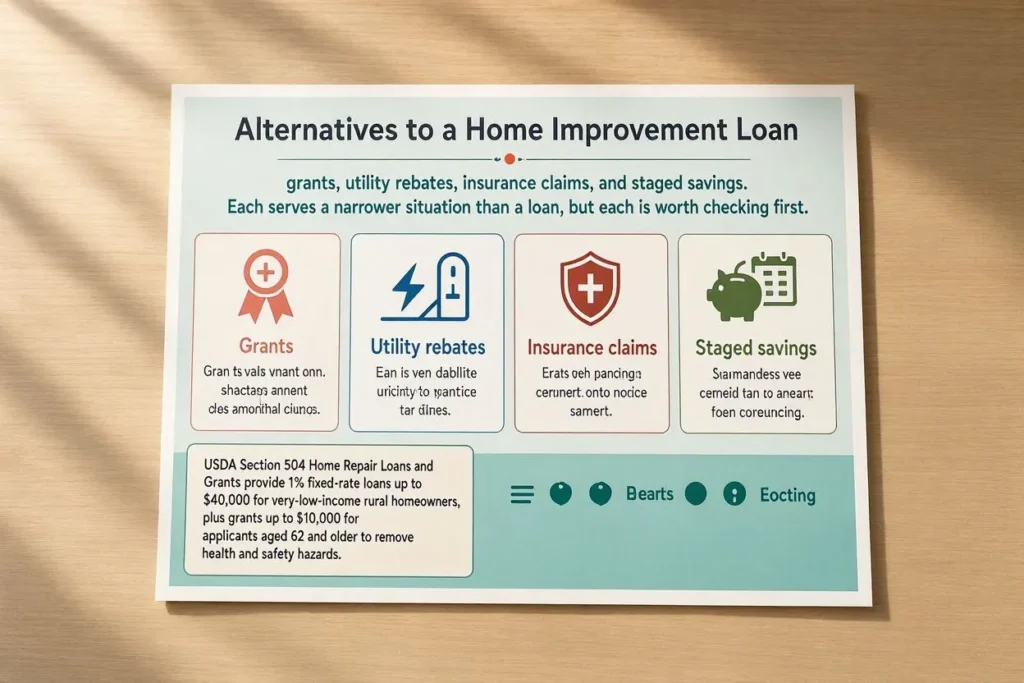
Four alternatives cost less than borrowing at market rates: grants, utility rebates, insurance claims, and staged savings. Each serves a narrower situation than a loan, but each is worth checking first.
- USDA Section 504 Home Repair Loans and Grants provide 1% fixed-rate loans up to $40,000 for very-low-income rural homeowners, plus grants up to $10,000 for applicants aged 62 and older to remove health and safety hazards (confirm current caps at rd.usda.gov, since program limits are adjusted periodically).
- Utility and state energy rebates reimburse a share of insulation, heat pump, window, and weatherization costs, with state weatherization assistance programs covering the full cost for income-qualified households.
- Homeowners insurance claims cover repairs caused by covered perils, such as storm damage to a roof, and carry no repayment obligation beyond your deductible.
- Staged savings funds non-urgent cosmetic work at zero interest, which suits a deferred bathroom refresh far better than a leaking roof.
Credit cards fill a narrow gap. A 0% introductory APR card covering 15 to 21 months works for a $6,000 project if you can genuinely pay it off inside the promotional period. The same card at 24% after the promotion expires becomes the most expensive financing option on this page.
Conclusion
Knowing how to get a home improvement loan matters less than knowing which loan to get. The seven-step sequence above exists because sequence determines price: homeowners who price the project, fix their credit report errors, and prequalify across three lender types routinely land 5 to 8 percentage points below homeowners who just accept the first offer their bank produces.
Match the product to the job. A $9,000 furnace replacement in January belongs on a personal loan funded in 48 hours. A $60,000 kitchen with a firm scope and 30% equity belongs on a home equity loan at 7.35%. A fixer-upper needing structural work belongs on a Standard 203(k) with a HUD consultant assigned from FHA’s active roster.
Federal credit unions can’t legally charge more than 18% APR on these loans, which makes membership at one, often available for a $5 share deposit, the single cheapest form of negotiating leverage available to a borrower with a credit score under 660.