AI in construction cuts project costs by 10 to 25%, reduces schedule overruns by 15%, and saves 500 to 1,000 hours per team per year. Construction is one of the least digitized major industries globally—yet that gap is closing fast. AI adoption in construction doubled between 2024 and 2026. Today, 38% of contractors report measurable business impact from AI tools, up from just 17% one year prior.
This guide covers 9 proven AI use cases, real cost and time savings backed by data, the top tools general contractors use in 2026, 5 barriers to adoption, and a practical roadmap to get your firm started. Every section is built around questions construction professionals ask before committing to AI.
What Is AI in Construction?
AI in construction means applying machine learning (ML), computer vision, natural language processing (NLP), and predictive analytics to construction planning, site management, safety, quality control, and project delivery. Construction AI tools process large datasets project schedules, site photos, sensor feeds, contract documents, weather data and surface actionable insights faster than any human team.
The architecture, engineering, and construction (AEC) sector has historically lagged behind finance, healthcare, and logistics in technology adoption. According to McKinsey, construction productivity has barely moved in 20 years while manufacturing productivity nearly doubled. AI is the primary lever to close that gap. Closing it would unlock an estimated $1.6 trillion in annual value worldwide.
The 3 core AI technologies driving construction in 2026 are:
- Machine Learning (ML): Algorithms that learn from historical project data to predict delays, cost overruns, and equipment failures
- Computer Vision: AI systems that analyze camera and drone footage to detect safety violations, track progress, and inspect quality
- Natural Language Processing (NLP): AI that reads and extracts data from contracts, RFIs, permits, and accident reports
AI in Construction: Market Size and Adoption in 2026
The global AI in construction market reached $10.7 billion in 2024 and continues to grow. Among the 27% of AEC firms currently using AI, 94% plan to increase usage in 2026. Among early adopters:
- 68% have saved at least $50,000 using AI tools (Bluebeam)
- 46% have saved 500 to 1,000 labor hours per year (Bluebeam)
- 95% of early adopters now use AI frequently across the full building lifecycle
- 61% of firms actively use AI or plan to increase investment in 2026 (AGC Survey)
The construction industry faces a projected shortage of 499,000 additional workers by 2026. AI tools that make existing workers more productive are not optional extras—they are part of the industry’s core talent and delivery strategy.
9 Proven AI Use Cases in Construction
1. AI-Powered Project Scheduling
AI scheduling tools analyze historical project data, resource availability, weather forecasts, material delivery logs, and subcontractor performance to build dynamic, real-time schedules. Traditional Gantt charts are static AI schedules update automatically when conditions change.
- Measurable result: AI-optimized scheduling cuts overall project time by 10 to 15% (PwC). On a 12-month commercial project, that means 5 to 7 weeks of schedule compression.
- Top tools: ALICE Technologies, Autodesk Construction Cloud, Procore, Microsoft Project with AI plug-ins.
2. AI Cost Estimation and Bid Analysis
AI estimation platforms process thousands of line items, historical cost databases, current material prices, and labor rate indexes to generate accurate project budgets in hours instead of weeks. Predictive analytics tools compare new bids against historical data to assess competitiveness and predict win probability.
- Measurable result: AI reduces project costs by 10 to 15% through better estimates and early error identification (Deloitte). Balfour Beatty used AI predictive analytics to hit budget targets with 94% accuracy across civil and rail projects.
- Top tools: Togal.AI, Beam AI, Procore Construction Intelligence, Autodesk Construction IQ.
3. AI Safety Monitoring on Job Sites
Computer vision systems mounted on job site cameras and drones monitor worker behavior in real time. The AI identifies 6 specific safety violations: missing hard hats, absent high-visibility vests, workers in fall zones, improper PPE (personal protective equipment) use, unauthorized equipment access, and proximity to moving machinery.
Measurable result: AI safety systems reduce on-site incidents by identifying hazards before accidents occur. By analyzing 4D BIM (building information modeling) models and construction schedules, AI flags potential process conflicts, equipment path interference, and worker exposure risks before crews begin work.
AI safety tools also integrate with wearable technology: smart hard hats, GPS vests, and biometric monitors that detect fatigue, heat stress, and fall events. This data feeds real-time dashboards for site supervisors. Proper roof inspection workflows can integrate AI-powered drone tools for elevated and hard-to-access areas.
4. Drone Inspection and Site Monitoring
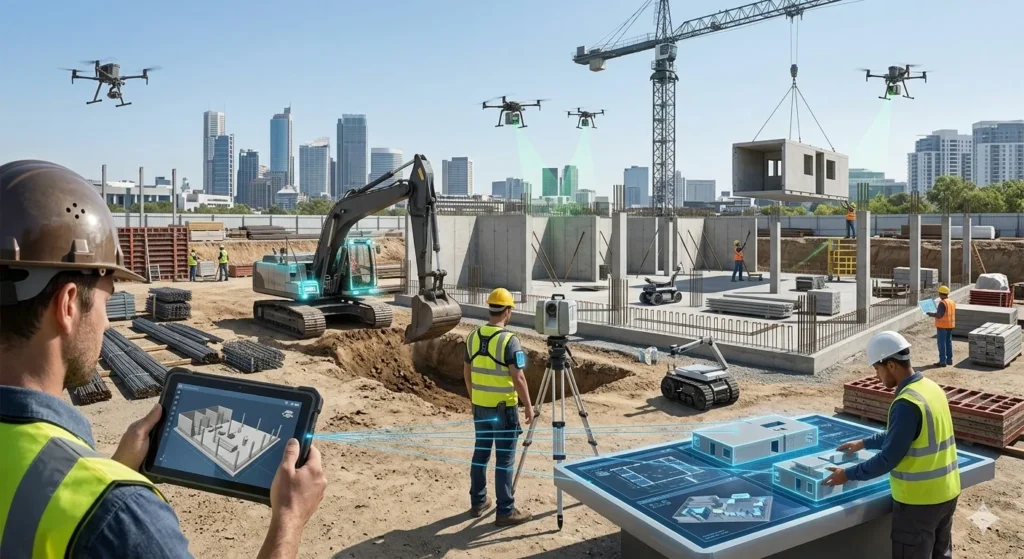
Drones equipped with LiDAR (light detection and ranging) and high-resolution cameras fly programmed routes over construction sites, capturing 3D point clouds and aerial imagery. AI software compares drone data against BIM models and project schedules to detect deviations, track progress, and flag quality issues.
Measurable result: Drones reduce inspection time by 30% and cut defect detection costs by 40% compared to manual inspection (StartUs Insights). Inspection drones achieve return on investment in under 6 months. Layout marking robots, which use drone-level positioning data, pay back in 6 to 12 months by eliminating rework.
AI drone platforms also support roof maintenance workflows by identifying membrane damage, ponding water, debris accumulation, and flashing failures without requiring workers to access the roof.
5. Predictive Equipment Maintenance
AI sensors mounted on heavy equipment—excavators, cranes, concrete pumps, compactors—monitor vibration, temperature, oil pressure, and hydraulic flow in real time. Machine learning algorithms analyze sensor patterns and predict component failures 3 to 14 days before they occur.
Measurable result: Predictive maintenance reduces unplanned equipment downtime by 20 to 30%. A single excavator breakdown on a large commercial site costs $2,000 to $10,000 per day in idle crew time, equipment rental adjustments, and schedule delays. Preventing 5 breakdowns per year saves $10,000 to $50,000 per machine.
6. AI-Assisted BIM and Generative Design
BIM (building information modeling) platforms now use AI to automate clash detection—identifying where structural, mechanical, electrical, and plumbing (MEP) systems conflict in 3D models before construction begins. Generative design AI produces multiple design options from a single set of constraints (budget, materials, site dimensions, energy targets), allowing architects and engineers to evaluate 50 to 500 design alternatives in hours.
Measurable result: BIM and digital twin integration enables timeline reductions of up to 20% (Deloitte 2026). One firm reported 25% faster completion on a multi-million-dollar office tower by identifying BIM-to-site discrepancies early using AI progress monitoring.
AI-augmented BIM also supports sustainable building materials selection by modeling the energy performance, embodied carbon, and lifecycle cost of different material combinations before construction begins.
7. AI Document Management and Contract Analysis
Construction projects generate thousands of documents: contracts, RFIs (requests for information), submittals, change orders, inspection reports, and permits. NLP-powered AI tools read, classify, and extract key clauses, deadlines, risk terms, and compliance requirements from these documents automatically.
Measurable result: AI document automation delivers a 50% reduction in time spent searching for information. AI contract review saves up to 10% of project costs by identifying unfavorable terms, missing insurance requirements, and scope gaps before signing.
Top tools: Procore, Autodesk Construction Cloud, Kofax, Luminance.
8. AI-Powered Quality Control
Computer vision systems compare real-time site photography—from drones, helmet-mounted cameras, or fixed site cameras—against BIM models and engineering drawings. The AI detects 4 common quality issues: structural deviations, incorrect material placement, missed work steps, and code violations.
Measurable result: AI quality inspection cuts rework time by 30% and reduces rework costs—which represent 5 to 15% of total project value on average. Buildots uses helmet cameras and AI to compare captured site imagery with BIM models, flagging construction errors as work progresses.
9. Autonomous Construction Equipment
Autonomous and semi-autonomous construction machines now handle repetitive, high-volume, and high-risk tasks. Robots lay up to 3,000 bricks per day (compared to 500 per day for a skilled mason). Layout robots compress field layout tasks from 5 days to 1 day (PwC). Autonomous bulldozers and graders use GPS, lidar, and AI to execute earthwork plans without a human operator in the cab.
Examples of deployed construction robots in 2026: Boston Dynamics Spot (site inspection, starts at $74,500), Dusty Robotics (floor layout, $3,000 to $5,000/month subscription), FBR Hadrian X (bricklaying), Built Robotics (autonomous heavy equipment), DroneDeploy (aerial survey, from $499/month).
AI in Construction: Benefits by Category
| Category | AI Application | Measured Impact |
| Cost | Estimation, contract review, waste reduction | 10–25% cost reduction |
| Schedule | Dynamic scheduling, delay prediction | 10–15% schedule compression |
| Safety | Computer vision, wearables, PPE monitoring | Proactive hazard identification |
| Quality | BIM clash detection, AI inspections | 30% rework time reduction |
| Productivity | Document automation, AI project management | 500–1,000 hrs saved per year |
| Labor | Autonomous robots for repetitive tasks | 3,000 bricks/day vs 500 manually |
5 Challenges of AI Adoption in Construction

1. Complexity of Implementation
Construction AI tools must integrate with existing project management software, ERP (enterprise resource planning) systems, BIM platforms, and field apps. Integration complexity is the single biggest adoption barrier in 2026, not cost. As Bluebeam CEO Usman Shuja stated: “The biggest barriers to AEC technology adoption in 2026 aren’t cost they’re complexity, culture, and connection.”
2. Data Quality and Availability
AI models are only as good as the data they train on. Many construction firms lack structured, digitized project data from past jobs. Inconsistent documentation, paper-based workflows, and fragmented data silos prevent AI tools from reaching their full potential. Firms must invest in data hygiene and digitization before or alongside AI deployment.
3. Cultural Resistance
Field crews, project managers, and estimators often resist AI tools because of unfamiliarity or fear of job displacement. The data contradicts this concern: PwC research shows wages grow approximately 2 times faster in industries most exposed to AI, because AI raises role value rather than eliminating roles. New construction job categories AI equipment operator, construction data analyst, digital twin specialist—are already emerging.
4. Unreliable Connectivity on Job Sites
AI systems like autonomous robots and real-time safety cameras require stable internet connectivity. Many construction sites—particularly in remote locations—have unreliable or no cellular coverage. Edge computing (on-site AI processing without cloud dependency) and 5G networks are reducing this barrier, but connectivity gaps persist in 2026.
5. Lack of Standardization
The AEC industry lacks standardized AI frameworks, data formats, and performance benchmarks. Different tools produce different data structures, making cross-platform integration difficult. Industry groups are developing standards, but widespread standardization is a 2027 to 2030 milestone rather than a current reality.
AI Applications in Roofing and Building Envelope
Roofing is one of the highest-value applications for AI in construction because roof failures are costly, dangerous, and often preventable. AI tools now support 4 key roofing workflows:
AI Drone Roof Inspections
AI-powered drones fly programmed routes over residential and commercial roofs, capturing thermal imagery, RGB photography, and LiDAR point clouds. The AI analyzes this data to detect membrane blisters, ponding water, damaged shingles, cracked flashing, gutter blockages, and compromised seals. A drone roof inspection covers a 10,000-square-foot commercial roof in 20 to 40 minutes—compared to 2 to 3 hours for a manual inspector. Thermal imaging identifies moisture intrusion invisible to the naked eye.
Predictive Roof Maintenance
AI platforms combine historical weather data, material age, inspection records, and local climate patterns to predict when specific roof sections will require maintenance or replacement. This shifts roof maintenance from a reactive model (fix it when it leaks) to a proactive model (address it before failure). Predictive maintenance extends average roof lifespan by 15 to 25% and prevents interior water damage that multiplies repair costs by 3 to 10 times.
AI-Assisted Roof Installation Planning
AI estimating tools calculate material quantities, labor hours, and installation sequences for complex roof installation projects. Generative design tools model different roofing system configurations—material type, slope, drainage layout, insulation thickness—and evaluate each against energy performance and cost targets. This reduces material waste and improves thermal efficiency before a single shingle or panel is installed.
AI Damage Assessment After Storms
After hail storms, high winds, or extreme weather events, AI-powered aerial imaging platforms assess roof damage across entire neighborhoods in hours. Insurers use this data for faster claims processing. Contractors use it for accurate repair scopes and material ordering. What previously required 3 to 5 days of manual inspection across 200 properties now takes 4 to 6 hours with AI drone systems.
Top AI Construction Tools in 2026
Project Management and Scheduling
- Autodesk Construction Cloud – AI-powered issue detection, clash identification, predictive risk analytics across the full project lifecycle.
- ALICE Technologies – AI scheduling platform that generates and optimizes construction schedules from thousands of sequence permutations.
- Procore – Integrated project management with AI for document processing, RFI automation, and budget forecasting.
Estimating and Bidding
- Togal.AI – Automated takeoff from PDF plans using AI. Reduces manual measurement time by 80%.
- Beam AI – AI estimating tool that extracts quantities and generates cost models from drawings and specs.
- DowntoBid – AI bid opportunity matching for GCs and specialty contractors.
Site Monitoring and Safety
- OpenSpace – 360-degree site capture using helmet-mounted cameras with AI progress tracking against BIM models.
- Buildots – Construction progress AI that compares site photos to BIM plans and flags deviations in real time.
- DroneDeploy – Aerial survey and AI inspection platform, starting at $499/month.
Robotics and Autonomous Equipment
- Boston Dynamics Spot – Four-legged inspection robot for hazardous and confined areas. Starts at $74,500.
- Dusty Robotics – Floor layout robot that prints construction plans directly on slabs. Subscription: $3,000 to $5,000/month.
- Built Robotics – AI guidance systems retrofitted onto standard excavators for autonomous operation.
AI Adoption Roadmap: Where to Start in 2027

Step 1: Identify Your Biggest Cost and Time Drain (Week 1–2)
List your top 3 recurring problems: estimating errors, schedule overruns, safety incidents, rework, document delays. Match each problem to the AI use case category that addresses it. Start with the problem that costs the most or happens most frequently.
Step 2: Audit Your Existing Data (Week 2–4)
AI tools need data to function. Audit your past 3 to 5 years of project data: schedules, cost reports, RFIs, inspection logs, incident reports. Identify what exists in digital format versus paper. The more structured data you have, the faster AI tools deliver value.
Step 3: Run a Single Pilot (Month 1–3)
Choose one AI tool that addresses your top problem. Run it on one active project in parallel with your existing process. Measure 3 specific metrics before and after: time spent on the target task, error rate, and cost impact. Do not roll out company-wide before validating results on one project.
Step 4: Train Your Team (Month 2–4)
Identify 2 to 3 internal champions—project managers, superintendents, or estimators—who will learn the tool first and train others. Field adoption depends on demonstrating that AI makes their specific job easier, not harder. Show measurable time savings within the first 30 days of use.
Step 5: Scale and Integrate (Month 4–6)
After a successful pilot, integrate the AI tool with your existing project management stack. Establish data standards for how information feeds into the AI system. Add a second AI tool targeting your next biggest problem. Review ROI at 90 days.
AI vs. Traditional Construction Methods: Direct Comparison
| Workflow | Traditional Method | AI-Enhanced Method |
| Scheduling | Static Gantt charts, updated manually | Dynamic AI schedules, auto-updating in real time |
| Estimating | Manual takeoffs: 2–5 days per bid | AI takeoffs: 2–4 hours per bid |
| Safety monitoring | Human supervisors, periodic walkthroughs | Computer vision, continuous 24/7 monitoring |
| Roof inspection | Manual inspection: 2–3 hrs per roof | AI drone: 20–40 min per roof, thermal data |
| Document review | Lawyers/PMs: days per contract | NLP AI: minutes per contract, flags key risks |
| Equipment upkeep | Reactive: repair after breakdown | Predictive: AI alerts 3–14 days before failure |
AI and Sustainable Construction
AI contributes directly to construction sustainability by optimizing material use, reducing waste, and improving energy performance. Balfour Beatty’s AI predictive analytics cut material waste by 20% across civil and rail projects. Generative design AI models energy consumption and embodied carbon across design alternatives, helping teams select sustainable building materials combinations that meet both cost and carbon targets.
AI-optimized construction schedules also reduce equipment idle time, which directly lowers fuel consumption and carbon emissions on job sites. Digital twins monitor building energy performance in real time after construction, enabling ongoing optimization that extends sustainability benefits throughout the building’s operational life.
Future of AI in Construction: 2026 to 2030
3 Trends Shaping the Next 4 Years
First: Autonomous heavy equipment for earthwork and site prep. Grading, excavation, and similar repetitive tasks are increasingly automated. Built Robotics and similar companies are already deploying AI guidance systems on standard excavators. Full autonomy for earthwork is a 2027 to 2028 milestone.
Second: AI agents as virtual project engineers. By 2027, AI assistants will answer technical questions, track daily tasks, detect safety risks, auto-generate daily reports, and process RFIs without human prompting. These agents will act as always-on project team members with access to the full project data history.
Third: Digital twin integration at scale. Every major commercial and infrastructure project will have a live digital twin by 2030. These models update in real time from site sensors, drone surveys, and AI progress monitoring giving owners, contractors, and operators a single source of truth from design through the full building lifecycle.
Conclusion
AI in construction is not a future technology—it is a present-day operational tool delivering measurable results in 2026. The 9 highest-value applications are project scheduling, cost estimation, safety monitoring, drone inspection, predictive equipment maintenance, BIM and generative design, document management, quality control, and autonomous equipment. Firms using AI report 10 to 25% cost reductions, 10 to 15% schedule compression, and 500 to 1,000 hours saved per team per year. The barrier is not cost or technology readiness it is the organizational decision to start.
Start with one problem, one tool, and one pilot project. Measure results at 90 days. Then scale to the next workflow. Construction companies that build this habit now will operate at a structural advantage over competitors still relying on purely manual processes by 2028.
For a deeper look at how advanced materials and sustainable design intersect with modern construction technology, explore our guide to sustainable building materials and learn how AI is reshaping material selection from the earliest design stage.