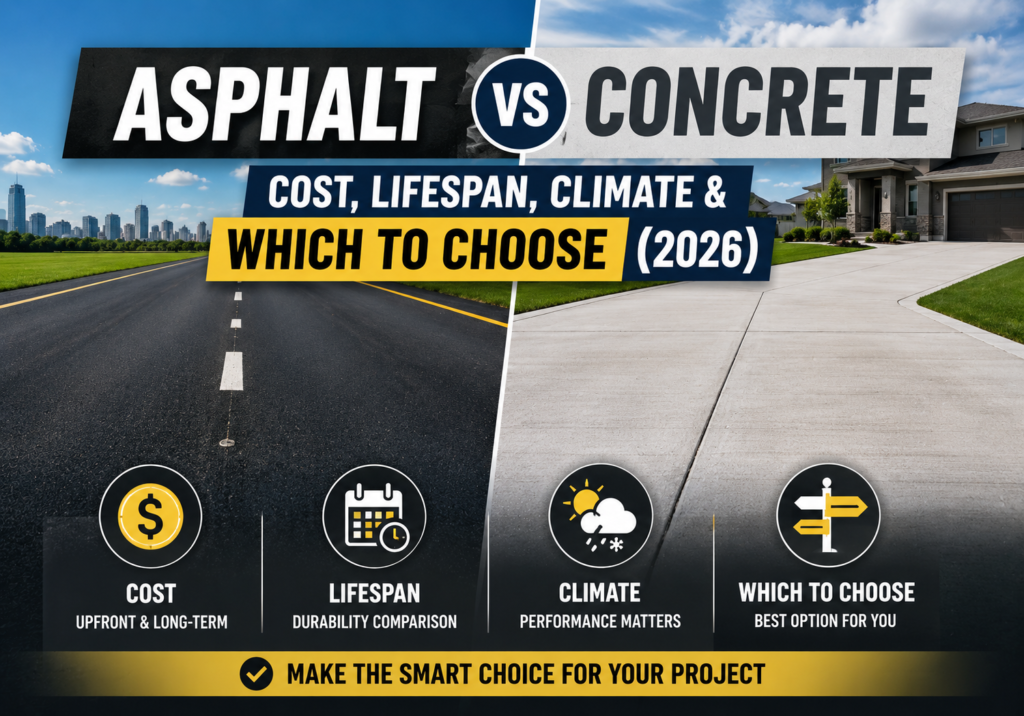
Concrete lasts 40–50 years and costs $10–$18 per square foot ($107–$194 per square meter). Asphalt lasts 20–30 years and costs $7–$13 per square foot ($75–$140 per square meter). Those two numbers decide most projects. But cost and lifespan are only 2 of 7 factors that determine which material actually works for your property.
Both materials share the same base ingredients crushed stone, sand, and gravel aggregate. What separates them is the binder. Asphalt uses bitumen, a petroleum-based binder that stays slightly flexible. Concrete uses Portland cement, a mineral binder that sets rigid and hard. That fundamental chemistry difference drives every other distinction between them how each responds to heat, cold, traffic loads, water, and time.
This guide covers all 7 decision factors: cost, lifespan, climate performance, maintenance, installation time, aesthetics, and environmental impact. It also covers one angle no competitor addresses — which material works for roofing applications including flat roof decks, parapet walls, and drainage surfaces.
Quick Comparison: Asphalt vs Concrete at a Glance
| Factor | Asphalt | Concrete |
| Installed cost | $7–$13/sq ft ($75–$140/m²) | $10–$18/sq ft ($107–$194/m²) |
| Lifespan | 20–30 years | 40–50 years |
| Compressive strength | ~3,000 PSI (20.7 MPa) | 3,000–6,000 PSI (20.7–41.4 MPa) |
| Cure time before traffic | 48–72 hours | 5–7 days |
| Cold climate performance | Excellent — flexible in freeze-thaw | Fair — cracks under repeated freeze-thaw |
| Hot climate performance | Poor — softens above 120°F (49°C) | Excellent — rigid in heat |
| Maintenance frequency | Sealcoat every 2–3 years | Seal joints every 5–7 years |
| Repair cost | Low — patch and resurface | High — sections must be cut and replaced |
| Design options | Limited — black only | High — stamped, stained, colored |
| Environmental | Recyclable (RAP); absorbs heat | Higher CO₂; reflects more light |
| Avg 20-year total cost* | $18,000–$26,000 | $14,000–$22,000 |
*20-year cost includes installation, maintenance, and one resurfacing/repair cycle for a 1,000 sq ft (92.9 m²) driveway.
1. Cost: Upfront vs Long-Term
Installation Cost
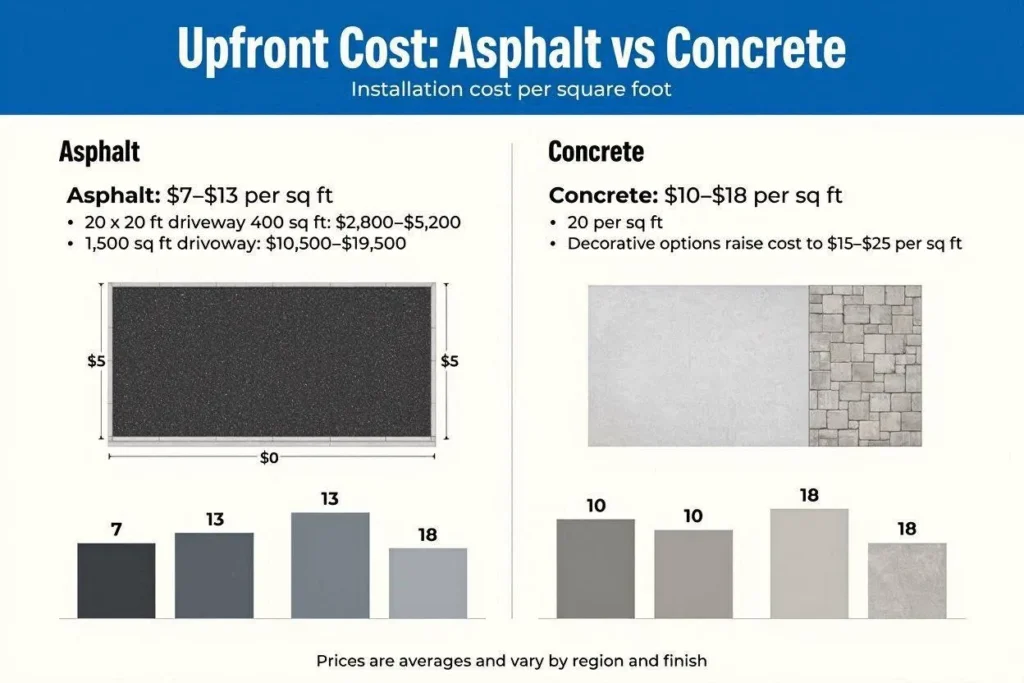
Asphalt installation averages $7–$13 per square foot ($75–$140/m²) for a standard driveway. A 20×20 foot (6×6 meter) driveway — 400 square feet (37.2 m²) — runs $2,800–$5,200. A 1,500 square foot (139.4 m²) driveway costs $10,500–$19,500.
Concrete installation averages $10–$18 per square foot ($107–$194/m²) for a basic gray finish. Decorative options — stamped patterns, staining, exposed aggregate — push costs to $15–$25 per square foot ($161–$269/m²). The same 400 square foot driveway costs $4,000–$7,200 in standard concrete.
Long-Term Cost
Asphalt requires sealcoating every 2–3 years at $0.15–$0.30 per square foot ($1.61–$3.23/m²). Over 20 years, that adds $1,200–$2,400 in maintenance for a standard driveway. Asphalt also needs full resurfacing at the 15–20 year mark, adding $3,000–$6,000.
Concrete needs joint sealing every 5–7 years at $1–$3 per linear foot ($3.28–$9.84/m). Crack repairs cost $3–$25 per square foot ($32–$269/m²) depending on severity. Concrete has lower ongoing maintenance costs — but when major repairs are needed, concrete section replacement costs 3–5 times more than equivalent asphalt patching.
Life-cycle cost analysis (LCCA): Over 30 years, concrete is usually cheaper in stable climates with mild winters. Asphalt is usually cheaper in harsh freeze-thaw climates where concrete cracks repeatedly require expensive section replacement.
2. Lifespan and Durability
Concrete lasts 40–50 years with proper joint sealing and surface maintenance. In stable climates without heavy freeze-thaw cycling, well-installed concrete reaches 50+ years. Its compressive strength of 3,000–6,000 PSI (20.7–41.4 MPa) handles heavy vehicle loads — trucks, RVs, and heavy equipment — without rutting.
Asphalt lasts 20–30 years with regular sealcoating. Without sealcoating, asphalt degrades to 15–20 years. Asphalt’s compressive strength is approximately 3,000 PSI (20.7 MPa) at standard installation depth. It handles heavy traffic volume well because the flexible surface distributes load rather than resisting it rigidly.
Asphalt fails through raveling (surface aggregate loosening), rutting (deformation under load in heat), and oxidation cracking. Concrete fails through spalling (surface flaking), efflorescence (white mineral staining), and freeze-thaw cracking. Both failure modes are repairable but require different approaches and budgets.
3. Climate Performance
Cold Climates — Asphalt Wins
Asphalt’s petroleum binder stays flexible in freezing temperatures. The surface expands and contracts with freeze-thaw cycles without fracturing. Asphalt also absorbs heat from sunlight, which accelerates snow and ice melt on driveways and parking lots — a practical advantage in northern climates.
Concrete in cold climates faces 2 problems. First, water enters micro-cracks, freezes, expands by 9% in volume, and widens the crack — a process that repeats every freeze-thaw cycle. Second, deicing salts (sodium chloride and calcium chloride) accelerate concrete surface spalling. A concrete driveway in Minnesota or Michigan without annual sealing degrades significantly faster than the same driveway in Florida.
Hot Climates — Concrete Wins
Above 120°F (49°C) surface temperature, asphalt softens. In direct sunlight in Phoenix, Las Vegas, or Houston, asphalt driveways can reach 150–170°F (65–77°C) in summer. At these temperatures, parked vehicles leave tire impressions, and foot traffic leaves marks. The bitumen binder partially liquefies and migrates to the surface, creating a sticky, oily film.
Concrete remains rigid at any surface temperature encountered in civilian applications. In extreme heat, concrete outperforms asphalt in every load-bearing and surface quality measure. Concrete also reflects significantly more solar radiation — approximately 35–40% albedo versus asphalt’s 5–10% — which reduces urban heat island effect in dense areas.
Wet Climates — Both Need Drainage
Neither material is waterproof. Both require proper sub-base grading and drainage slope — minimum 1–2% grade (1/8 inch per foot / 10.4 mm per meter) — to prevent standing water. Standing water penetrates both surfaces and accelerates failure. For properties with drainage challenges, permeable concrete or pervious asphalt are engineered options that allow water to pass through the surface into the sub-base.
Drainage performance directly affects roof-adjacent surfaces. Water pooling near a foundation or against a wall creates hydrostatic pressure that infiltrates roofline junctions, fascia, and flashing. Rainy Roofers’ roof maintenance services include assessment of all surface drainage near rooflines as part of every inspection — because ground-level water management and roof integrity are directly connected.
4. Maintenance Requirements
Asphalt Maintenance Schedule
- Year 1: Allow new asphalt to cure fully — avoid sealcoating for the first 6–12 months
- Years 1–3: Apply first sealcoat after curing (cost: $0.15–$0.30/sq ft / $1.61–$3.23/m²)
- Every 2–3 years: Reapply sealcoat to prevent UV oxidation and water infiltration
- Years 15–20: Resurfacing (overlay) extends life by 10–15 years
- As needed: Crack filling ($0.10–$0.35 per linear foot / $0.33–$1.15/m) prevents water entry
Concrete Maintenance Schedule
- Year 1: Apply penetrating sealer after full cure (28 days for full strength)
- Every 5–7 years: Reseal expansion joints to prevent water entry and freeze-thaw damage
- Every 10 years: Apply surface sealer to reduce efflorescence and surface absorption
- As needed: Crack repair with epoxy filler ($3–$25/sq ft / $32–$269/m²)
- Cold climates: Avoid chloride-based deicers — use sand or calcium magnesium acetate (CMA) instead
Concrete maintenance costs less annually but requires more expertise to execute correctly. Improper concrete crack repair using incompatible filler materials causes the repair to fail within 1–2 freeze-thaw seasons. Asphalt maintenance is more forgiving — sealcoating is DIY-accessible and patching is straightforward.
5. Installation Time
Asphalt: ready for traffic in 48–72 hours. Hot mix asphalt (HMA) is laid at 250–325°F (121–163°C), compacted by roller, and cools to a stable surface within 24 hours. Light vehicle traffic is safe at 48 hours; heavy truck traffic at 72 hours.
Concrete: requires 5–7 days before vehicle traffic. Concrete reaches approximately 70% of its rated compressive strength at 7 days and full strength at 28 days. In summer with temperatures above 70°F (21°C), light passenger vehicles can drive on concrete at 5 days. In cold weather below 50°F (10°C), curing slows significantly and the wait extends.
For commercial properties — retail lots, restaurant drive-throughs, business parking — asphalt’s 48-hour turnaround versus concrete’s 7-day closure has direct revenue implications. A business closed for a week loses 5 days of revenue. For residential driveways, the timeline difference matters less practically.
6. Aesthetics and Design Options
Asphalt installs as a uniform dark black surface. Fresh asphalt looks clean and sharp, but fades to dark gray within 2–5 years as the surface oxidizes. Decorative options are limited: basic black, stamped asphalt patterns (at significant cost), or colored sealcoats. Most homeowners get one look.
Concrete offers 4 main finish types: broom finish (standard, textured), exposed aggregate (decorative stone visible), stamped (patterns mimicking brick, stone, or tile), and stained (colored). Staining adds $2–$4 per square foot ($21.50–$43/m²). Stamping adds $5–$15 per square foot ($54–$161/m²). For properties where curb appeal or visual alignment with architecture matters, concrete is significantly more versatile.
For commercial properties targeting high-end clients — office buildings, upscale retail, hospitality — decorative concrete delivers a branded surface finish that asphalt cannot replicate at any budget.
7. Environmental Considerations
Asphalt production emits fewer CO₂ emissions per ton than concrete production. Asphalt is also fully recyclable — recycled asphalt pavement (RAP) is the most recycled material in the US by volume, with over 99% of removed asphalt reused in new pavement. A fresh asphalt driveway can contain 20–30% RAP content.
Concrete production generates approximately 0.8–1.0 kg of CO₂ per kg of product due to the calcination process in Portland cement manufacturing. Concrete cannot be directly recycled into new concrete — crushed concrete becomes aggregate or fill material. Some concrete products incorporate supplementary cementitious materials (SCMs) like fly ash or slag, which reduce the carbon footprint by 20–40%.
Both materials contribute to urban heat island effect. Asphalt absorbs more solar radiation (albedo 5–10%) and retains heat longer. Concrete reflects more radiation (albedo 35–40%) and runs 10–15°F (5.5–8.3°C) cooler. For dense urban areas and LEED (Leadership in Energy and Environmental Design) certified projects, concrete’s higher albedo contributes to heat island mitigation credits.
Asphalt vs Concrete for Roofing Applications
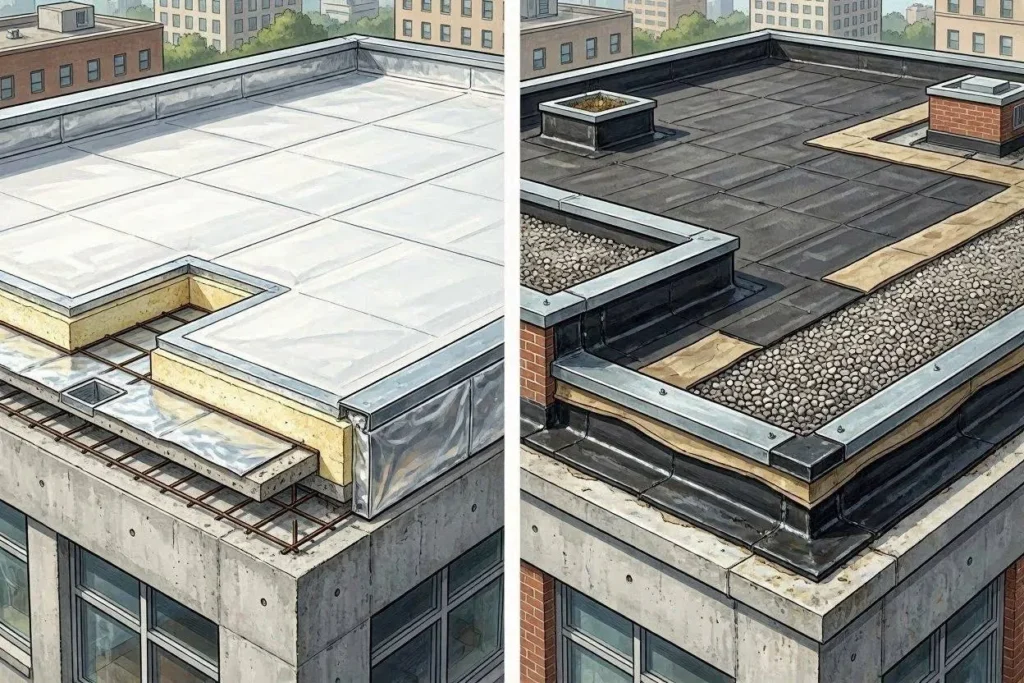
Most comparison guides cover driveways and parking lots. They skip the application where material choice directly affects structural waterproofing: flat roofs, roof decks, and elevated concrete surfaces.
Concrete Flat Roof Decks
Concrete is the structural foundation for most commercial flat roofs. The deck sits below the roofing membrane TPO, EPDM, or modified bitumen and must maintain a minimum drainage slope of 1/4 inch per foot (20.8 mm/m) to prevent ponding water. Concrete deck quality directly affects membrane adhesion, fastener pullout strength, and overall roof system performance.
Concrete deck issues surface spalling, cracks, or inadequate slope compromise every layer above. Commercial roof inspection services include concrete deck assessment as part of every membrane evaluation, because membrane failures frequently originate from deck-level problems invisible from above.
Asphalt Roofing Products
The term ‘asphalt’ covers both paving asphalt and asphalt-based roofing products. Asphalt shingles the most installed residential roofing product in North America use a glass fiber or organic mat coated in asphalt and mineral granules. Modified bitumen membranes for flat and low-slope roofs also use polymer-modified asphalt as the primary waterproofing layer.
These roofing asphalts are chemically engineered differently from paving asphalt. The polymer modification SBS (styrene-butadiene-styrene) or APP (atactic polypropylene) increases temperature resistance and flexibility range. Roof installation services using modified bitumen deliver excellent performance on low-slope surfaces where standard asphalt shingles would fail.
Parapet Walls and Surface Drainage
Parapet walls on flat-roofed buildings are typically concrete or masonry. Proper waterproofing at the parapet base, where the roof membrane terminates, is one of the highest-risk leak points in any commercial roofing system. Water that pools against a concrete parapet due to inadequate drainage slope migrates through micro-cracks and into the building envelope. Rainy Roofers’ roof repair services address parapet wall failures the majority caused by deferred drainage maintenance and cracked concrete at the membrane termination line.
For residential roof replacement projects that include a concrete substrate garage slab extensions, covered patio transitions, or low-slope sections material compatibility between the concrete deck and the roofing membrane is assessed before installation to ensure the system performs as designed.
Which Material Is Right for Your Project?
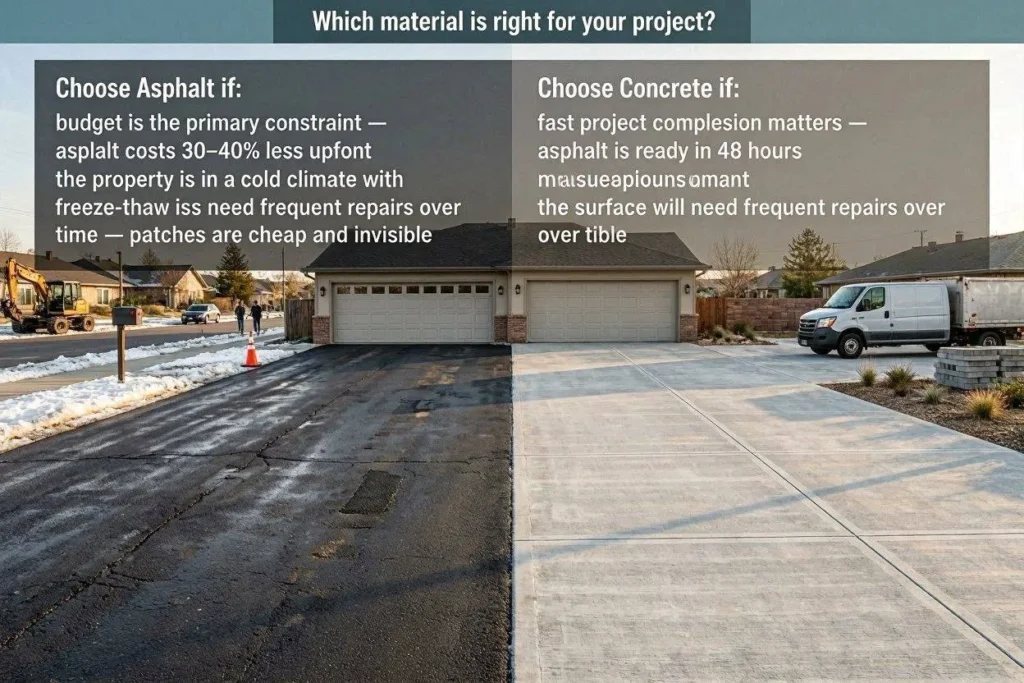
Choose Asphalt If:
- Budget is the primary constraint — asphalt costs 30–40% less upfront
- The property is in a cold climate with frequent freeze-thaw cycles
- Fast project completion matters — asphalt is ready in 48 hours
- The surface will need frequent repairs over time — asphalt patches are cheap and invisible
- The project is a long driveway or large parking lot where cost-per-square-foot accumulates quickly
Choose Concrete If:
- Long-term value matters — concrete’s 40–50 year lifespan delivers lower lifetime cost
- The property is in a hot climate with high summer temperatures
- Heavy vehicles — trucks, RVs, heavy equipment — will use the surface regularly
- Aesthetics and curb appeal are priorities — stamped and stained concrete has no asphalt equivalent
- LEED certification or urban heat island mitigation is a project requirement
- The surface is a flat roof deck, parapet wall, or structural element requiring rigid load-bearing capacity
FAQs
Is asphalt cheaper than concrete?
Yes — asphalt costs $7–$13 per square foot ($75–$140/m²) versus concrete at $10–$18 per square foot ($107–$194/m²) installed. However, asphalt’s 20–30 year lifespan versus concrete’s 40–50 years means concrete is often cheaper over the full life of the surface, particularly in stable climates.
Which lasts longer — asphalt or concrete?
Concrete lasts longer — 40–50 years versus 20–30 years for asphalt. With proper maintenance including regular joint sealing, concrete reaches 50+ years in mild climates. Asphalt requires sealcoating every 2–3 years and full resurfacing at 15–20 years to reach its upper lifespan range.
Which is better in cold weather — asphalt or concrete?
Asphalt performs better in cold climates. Its petroleum binder stays flexible through freeze-thaw cycles without fracturing. Concrete expands and contracts rigidly, which opens micro-cracks that water enters and widens with each freeze cycle. Deicing salts also accelerate concrete surface spalling in cold regions.
Can you put asphalt over concrete?
Yes — asphalt overlay on concrete is a standard practice. A 1.5–2 inch (38–51 mm) asphalt layer bonds to a concrete base and improves cold-weather performance. The concrete provides a stable rigid base while the asphalt surface handles freeze-thaw movement. The joint lines between concrete slabs must be filled before overlay to prevent reflection cracking through the asphalt surface.
How long does concrete take to cure?
Concrete reaches 70% of rated strength at 7 days and full strength at 28 days. Light vehicle traffic is safe at 5–7 days in temperatures above 50°F (10°C). Cold weather below 50°F significantly slows the hydration process and extends cure time. Never apply deicers to concrete in its first winter — the surface is still completing its strength gain.
Conclusion
The decision between asphalt and concrete is not about which material is better. It is about which material fits the specific conditions of the project.
Cold climate with a tight budget and a 500-foot driveway? Asphalt is the clear choice. Hot climate, high traffic, 30-year ownership horizon, and curb appeal matters? Concrete wins on every measure except upfront cost.
For roofing-related applications — concrete roof decks, parapet walls, surface drainage adjacent to rooflines — the material choice directly affects how water moves around and through a building. Getting the structural and surface material decisions right at ground level reduces the waterproofing burden on the roof system above it.
Contact Rainy Roofers for a professional assessment of any flat roof, concrete deck, or drainage surface connected to your roofing system. Roof maintenance begins with understanding how every surface on and around the building manages water — and that includes the driveway, the parking lot, and the concrete substrate beneath every membrane we install.