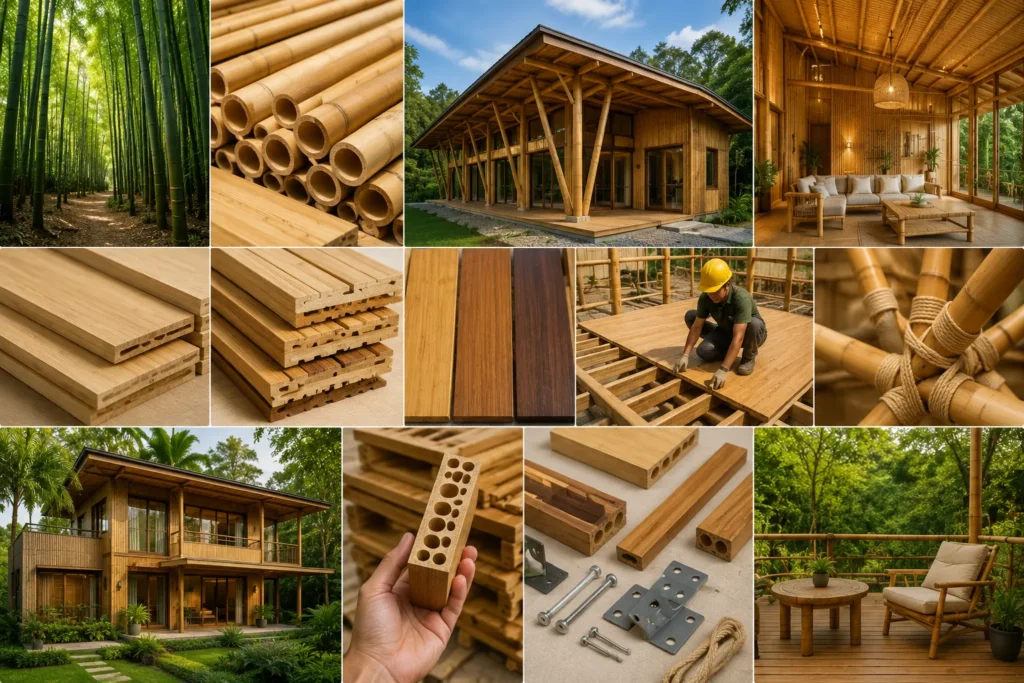
Bamboo building materials give you a renewable, high-strength alternative to timber and steel. You can source treated bamboo poles, engineered laminated beams, or woven panels for roofing, framing, and flooring projects. Bamboo building materials suit both residential and commercial construction in 2026.
What Are Bamboo Building Materials?
Bamboo building materials are construction products made from harvested bamboo culms. Builders process culms into poles, laminated beams, panels, or flooring strips. Builders use 3 primary forms: round poles, engineered laminate, and woven panels. Bamboo behaves like timber in structural framing. It grows in 3 to 5 years (1 to 1.5 meters), compared to the decades oak or maple need. The plant belongs to the Poaceae grass family, not the tree family. This explains its fast regrowth after harvest.
Bamboo covers roughly 37 million hectares (91 million acres) of land worldwide. Growth concentrates across South Asia, East Asia, the South Pacific, and Central and South America. Builders in these regions have used bamboo for over 1,000 years. China used bamboo for suspension bridges referenced in written records dating to 960 AD. Bamboo’s natural dimensions allow direct use in framing with minimal sawing or cutting. This lowers processing costs compared to milled lumber.
Manufacturers now process raw culms into a wider product range. This range includes flooring, cabinetry, structural beams, and decorative panels. Retailers including Home Depot stock laminated bamboo flooring alongside traditional hardwood. This signals the material’s shift from specialty product to mainstream option over the past 2 decades.
Why Builders Choose Bamboo Building Materials in 2026
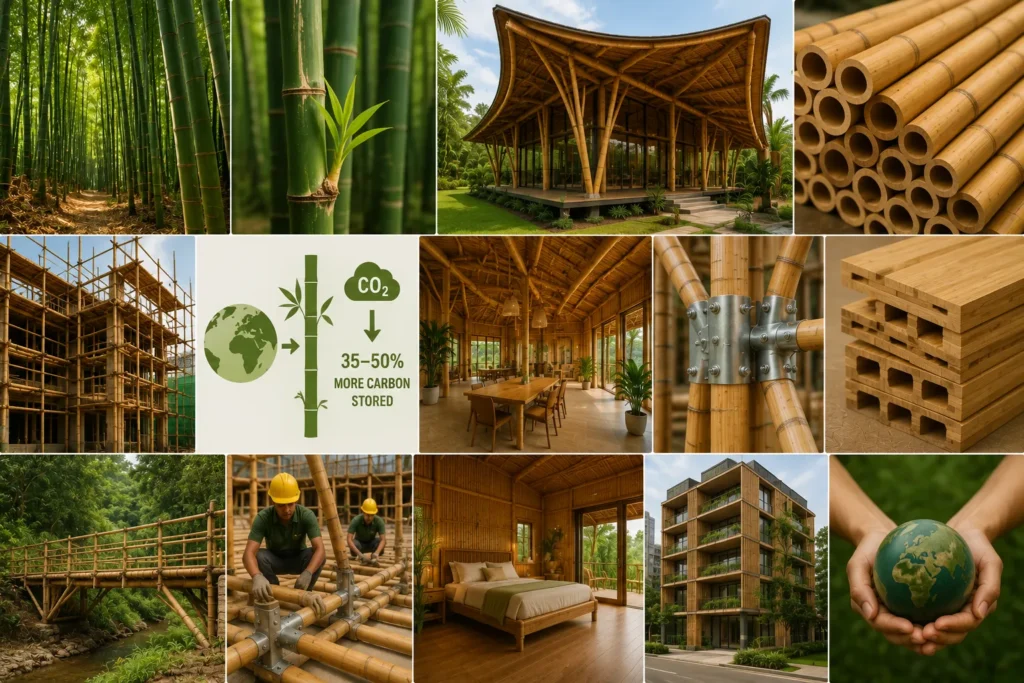
You choose bamboo building materials because the plant grows faster than timber. Bamboo also stores more carbon per acre than equivalent forest land. Bamboo sequesters 35% to 50% more carbon than like-sized timber forests. This makes bamboo attractive for builders targeting LEED credits or carbon-reduction goals.
Bamboo also acts as a pioneer plant, establishing itself in degraded or eroded land. Other crops fail to grow in these same conditions. This trait makes bamboo cultivation valuable for landscape restoration projects. Growers don’t need to compete with food agriculture for usable land. A single bamboo grove produces harvestable culms for 30 years or more. No replanting is required between harvest cycles.
Carbon Storage and Renewable Growth
Bamboo building materials regrow from the same root system after harvest. You avoid replanting cycles entirely with managed groves. A managed bamboo grove reaches harvest readiness in 3 to 5 years. Oak, maple, and beech trees need 40 to 80 years to mature. You can harvest individual culms selectively, leaving the root network intact. This selective harvest protects against soil erosion on the growing site. Well-maintained bamboo clumps produce 3 to 4 times the yield of unharvested wild clumps. Selective thinning directs more light and nutrients toward new growth.
Bamboo species grow at remarkable daily rates during the wet season. Some species record growth between 1.2 inches and 11.8 inches (3cm to 30cm) per day. This rapid growth means 1 hectare of managed bamboo supplies more material yearly than equal timber forest.
Strength-to-Weight Ratio Compared to Steel
Bamboo fibers run lengthwise through each culm, unlike the cross-grain structure of wood. This lengthwise fiber arrangement gives bamboo a strength-to-weight ratio close to mild steel. Laboratory tests on select species show tensile strengths approaching 250 N/mm². Engineers apply a safety factor of 5% to 10% of this peak value. This safety margin accounts for strength variation between species and growing conditions.
Researcher Alireza Javadian has studied bamboo’s structural potential extensively. He explains that hundreds of fibers surrounded by a lignin matrix bind together inside each culm. This fiber-and-lignin structure creates the primary load-transfer mechanism behind bamboo’s strength. The same structure also gives bamboo notable flexibility under load.
What Are the 3 Main Types of Bamboo Building Materials?
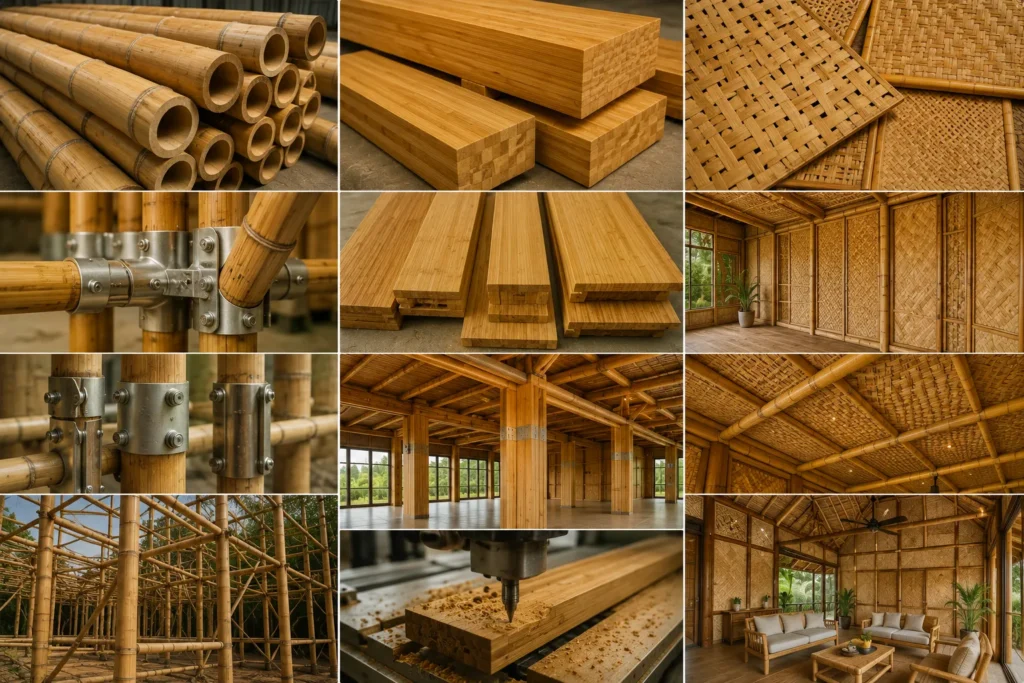
You select bamboo building materials based on 3 main categories. These categories are round pole bamboo, engineered laminated bamboo, and woven split panels. Each type of bamboo building material serves a different structural or decorative role. Most large projects combine all 3 types for different building elements.
Round Pole Bamboo
Round pole bamboo building materials keep the culm’s natural cylindrical shape and hollow core. Builders use poles 4 inches to 6 inches (10cm to 15cm) in diameter. These poles work for structural posts, beams, and scaffolding. Species including Guadua, Moso, and Asper supply most construction-grade poles. Only a few dozen of the 1,500 known bamboo species meet structural standards. Guadua dominates large-scale projects across Colombia and Latin America. Moso remains the primary structural species across China and East Asia.
Builders typically join round poles using bolted steel connectors rather than nails. Bamboo’s hollow, layered structure splits easily under direct fastener pressure. Confinement rings or steel collars at connection points prevent this longitudinal splitting. This hardware improves both strength and predictable yielding under load.
Engineered Laminated Bamboo
Engineered laminated bamboo building materials start as thin strips cut from culms. Workers plane these strips flat, then glue and press them into beams or panels. Manufacturers harvest source culms at 6 years old for optimal laminate quality. Companies including Lamboo and Widuz produce engineered bamboo for structural use. Their products serve beams, columns, and architectural millwork across the United States and Europe.
Widuz manufactures a proprietary product called BVL. This material combines 90% bamboo fiber with 10% bio-compatible binder. Company testing showed BVL could replace steel reinforcement in low-rise concrete housing. This application works for buildings up to 3 or 4 stories. Lamboo offers in-house CNC milling, molding, and custom finishing services. Architects can specify engineered bamboo the same way they specify glulam timber.
Woven and Split Bamboo Panels
Woven and split bamboo building materials form lightweight wall infill and ceiling treatments. Builders also use these panels as traditional roofing layers. Workers split culms into thin strips and weave them into mats. The Philippines calls these woven mats amakan, central to traditional bahay kubo housing. These panels allow air circulation through walls in hot, humid climates. This ventilation reduces the need for costly mechanical cooling systems.
In Latin America, builders combine split bamboo with mud or lime plaster. This technique, called bahareque, derives from wattle-and-daub construction methods. Engineered bahareque strengthens the traditional method against earthquakes and typhoons. This improved version performs better than the original vernacular technique.
How to Treat Bamboo for Construction Durability
To treat bamboo building materials for construction durability, you apply a boron-based chemical solution. This solution protects the culm against insects. You then design the structure to keep the material dry. Untreated bamboo decays within 2 to 6 years indoors. Exposed bamboo lasts less than 1 year if it contacts water directly. Decay in bamboo comes from 3 sources: beetle attack, termite attack, and fungal rot. Each decay source requires a different layer of protection.
Boron Treatment Methods
You treat bamboo building materials with a borax and boric acid mixture. A single compound, di-sodium tetraborate decahydrate, also works as treatment. Boron treatment protects bamboo against beetle and termite attack, but it does not stop rot on its own. Workers soak poles in a boron solution tank for several hours. Thicker culms require pressure treatment for deeper chemical penetration. Boron washes out of bamboo if the treated material gets repeatedly wet. Treatment alone cannot substitute for proper moisture design.
Some traditional practitioners use water soaking or smoke exposure as natural treatments. These methods offer limited beetle protection only. They show little effect against termites or fungal rot. Modern projects rely on boron, or fixed preservatives like copper azole for higher-risk uses.
Moisture Protection Design
You protect treated bamboo from rot through design choices, not chemicals alone. Elevate structural bamboo above ground level as your first step. Install damp-proof membranes at all ground contact points. Extend roof overhangs by at least 2 feet (60cm) beyond exterior walls. Apply waterproof coatings to any bamboo used in wall cladding or trim.
Engineers call this combined approach durability by design. The method requires applying both chemical treatment and design principles together. Boron treatment without proper drainage still results in eventual rot. Standing water at connection points creates conditions fungal decay needs to spread.
How Does Bamboo Compare to Timber and Steel?
Bamboo building materials compare favorably to timber in strength-to-weight ratio and growth speed. Bamboo cannot replace steel reinforcement in concrete applications, however. Bamboo provides roughly 1/30th the tensile capacity of high-yield steel rebar. Direct substitution requires 30 times more material by volume. Standard concrete sections leave no practical space for this extra volume. Bonding bamboo to concrete also requires chemical agents that raise cost. These agents carry environmental impact beyond standard steel reinforcement methods. Concrete cannot protect bamboo from fungal or termite attack the way it protects steel from corrosion.
Bamboo structures perform well in earthquakes for 2 main reasons. The first reason is light building weight throughout the structure. The second reason is flexible bolted joints that absorb seismic energy through controlled yielding. A cluster of bamboo houses survived a 7.6 magnitude earthquake in Costa Rica in 1991. Nearby wood and concrete homes sustained damage in the same event. Bamboo itself is a brittle material that cannot absorb significant energy alone. Earthquake performance comes from structural design and connection detailing, not material elasticity.
Timber retains 1 clear advantage over bamboo: established building codes. Codes exist in nearly every country for timber construction. Bamboo codes remain limited to a handful of nations. Colombia, Ecuador, Peru, India, and Bangladesh have each published national bamboo standards. The Colombian code, NSR-10 G12, is considered the most comprehensive. The International Organization for Standardization published the first global bamboo codes in 2004. These codes cover structural design and physical property testing. Adoption still lags behind timber and steel standards across most Western countries.
Quick-Reference: Bamboo Treatment and Sourcing Checklist
| Task | Timing | Method | Difficulty |
| Select species | Before sourcing | Match Guadua, Moso, or Asper to load needs | Moderate |
| Boron treatment | At harvest stage | Soak or pressure-treat with borax solution | Moderate |
| Moisture-proof design | During planning | Add overhangs, membranes, elevated footings | Moderate |
| Joint connections | During framing | Use bolted steel connectors at culm joints | High |
| Final coating | Before installation | Apply waterproof exterior sealant | Low |
What Does Bamboo Building Material Cost in 2026?
Bamboo building material costs less than steel and often less than premium timber. Pricing for bamboo building materials varies by region and processing level. Raw round poles cost the least among bamboo products. Engineered laminated beams cost more due to processing requirements. Certified structural-grade bamboo carries a premium for testing and documentation.
Construction timber prices nearly doubled since the start of the 2020s. This shift pushed many builders toward bamboo as a cost-stable alternative. Bamboo reaches harvest maturity in 3 to 5 years. Supply responds to demand faster than forestry-based timber as a result. This faster response keeps long-term price volatility lower for bamboo buyers. Domestic bamboo suppliers in the United States typically offer faster turnaround than imports. Imported poles from Asia carry higher freight costs due to weight and volume.
Budget for 3 separate cost categories when planning a bamboo building materials project. These categories are raw material, treatment, and connection hardware. Boron treatment adds a modest cost per pole. This cost prevents far larger replacement costs from untreated decay later. Steel bolted connectors add cost compared to traditional lashed bamboo joints. This hardware provides the predictable structural performance modern building codes require. Request current quotes from regional suppliers before finalizing your budget.
Where Is Bamboo Used in Modern Construction?
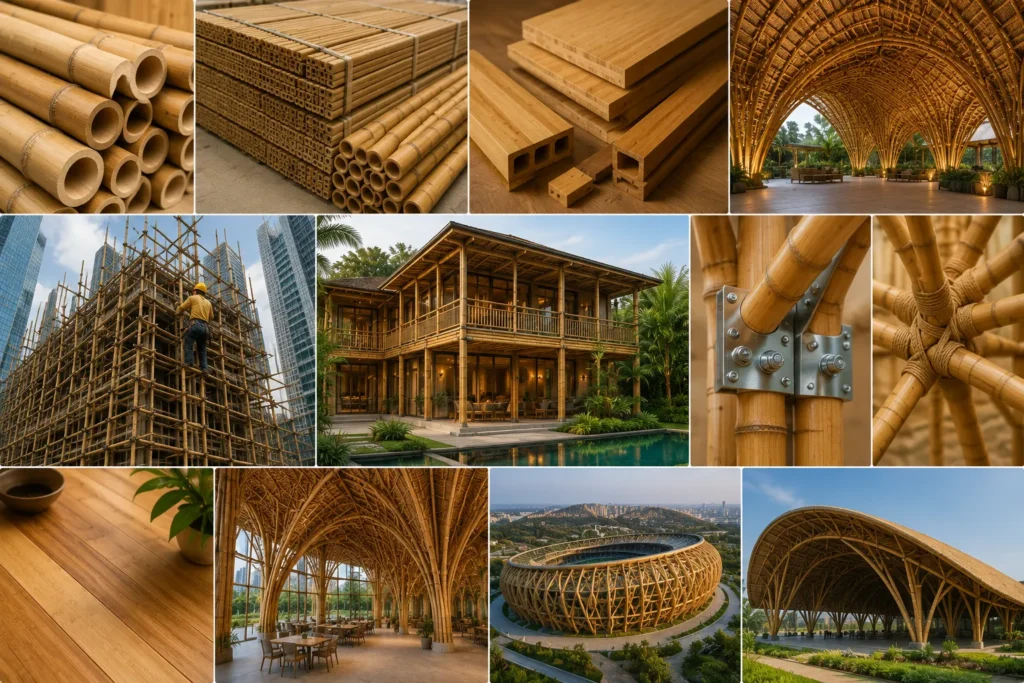
Builders use bamboo building materials in scaffolding, housing, flooring, and large-span structures. Hong Kong still permits bamboo scaffolding on skyscraper projects today. Mainland China banned the practice for buildings taller than 6 stories.
Architects including Vo Trong Nghia in Vietnam built large-scale public structures from engineered bamboo. Simon Velez in Colombia achieved similar large-scale results with bamboo design. Their work includes the Vietnam pavilion at the 2015 Milan Expo. Vo Trong Nghia has called bamboo the green steel of the 21st century. This phrase now circulates widely across the sustainable architecture industry. The Panyaden International School in Thailand uses prefabricated bamboo trusses for its sports hall. These trusses span more than 17 meters (56 feet) across the building. Chiangmai Life Architects designed the structure with inspiration from a lotus flower.
The India Pavilion at the 2010 Shanghai Expo remains 1 of the most ambitious bamboo projects. The structure formed the world’s largest bamboo dome, roughly 34 meters (112 feet) in diameter. Builders used 30 kilometers (19 miles) of bamboo across the entire structure. Workers joined the bamboo with reinforcement bars and concrete mortar. Steel piles and ring beams supported the finished dome. In Pakistan, architect Yasmeen Lari has applied bamboo and mud brick construction at scale. Her flood-resistant housing program targets 1 million homes built through this method.
Universities in Brazil have studied bamboo structural applications for decades. The Pontifical Catholic University of Rio de Janeiro leads this research, spanning over 40 years. Their work covers tensegrity structures, bamboo bicycles, and pavilion systems.
For roofing applications, bamboo performs best as a structural substrate or decorative layer. Bamboo rarely serves as the primary weatherproofing surface on modern roofs. Homeowners comparing material options often pair bamboo framing with asphalt, tile, or metal roofing. These conventional materials handle the weatherproof top layer effectively.
If you’re planning a full roof system upgrade, our team provides expert roofing installation services for material projects.
You also reduce long-term costs through consistent roof maintenance services, regardless of which material you choose. Every roofing system requires inspection to catch early decay or water damage.
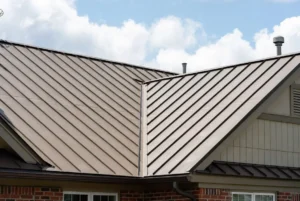
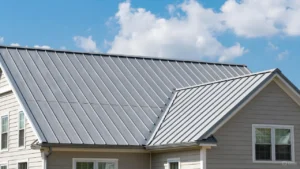
For homeowners deciding between bamboo-influenced designs and conventional materials, a metal roof installation remains a durable comparison point. Metal systems offer 40 to 70 years of service life, compared to bamboo’s shorter unprotected lifespan.
Conclusion
Bamboo building materials offer a renewable, cost-stable option for framing, flooring, and structural projects in 2026. Success with bamboo building materials depends on selecting the right species, applying boron treatment, and designing for moisture control. If your project involves a full roof system rather than standalone bamboo elements, contact Rainy Roofers for a free estimate. Our licensed team helps you choose materials built to handle your local climate.