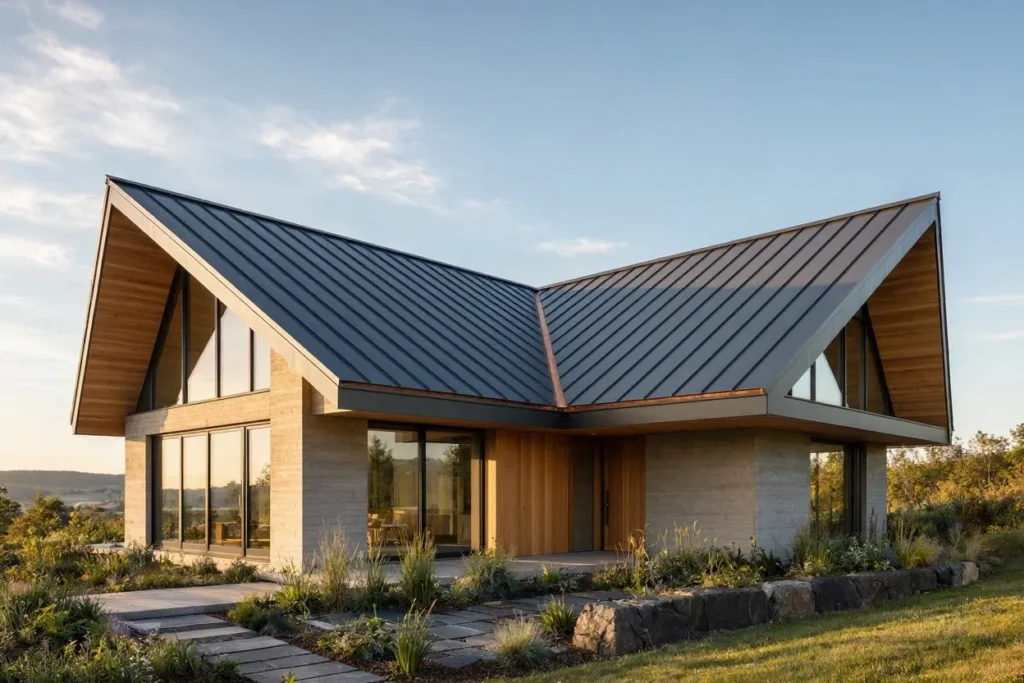
A butterfly roof is an inverted roof form that slopes two roof surfaces down to a central valley, sending rainwater to the middle of the building instead of the outer edges. A butterfly roof delivers tall walls, large windows, and easy rainwater capture, and it stays dry only with a correctly sized valley drain and a separate overflow.
Key Takeaways
- A butterfly roof is a V-shaped roof whose two surfaces slope down to a central valley, the reverse of a gable roof.
- Le Corbusier designed the first butterfly roof in 1930 for Maison Errazuriz in Chile, and William Krisel made the butterfly roof a Palm Springs signature starting in 1957.
- The International Residential Code (IRC), Section R903.4.1, requires a secondary overflow drain or scupper wherever walls or parapets would trap water if the main roof drain clogged.
- Angi lists a new butterfly roof at $7,000 to $18,000, close to its $7,000 to $20,000 range for a gable roof.
- Asphalt shingles need a slope of at least 2:12 (about 17 percent) under IRC R905.2.2, so low-pitch butterfly roofs use standing-seam metal or membranes rated down to 1/4:12 (2 percent).
- Butterfly roofs perform best in dry, mild climates, and homes in heavy-snow regions need an engineer to check snow drifting in the valley under the ASCE 7 load standard.
What Is a Butterfly Roof?
A butterfly roof is a V-shaped roof in which two roof planes slope down from the outer walls to a low valley near the middle, the reverse of a gable roof. The butterfly roof takes its name from the raised-wing outline, and roofers also call the form a V roof or an inverted gable roof.
A gable roof peaks at a central ridge and sheds water off both eaves. A butterfly roof does the opposite: the roof collects all rain in the valley and releases it at one or two points, usually through a scupper or downspout at the valley ends, according to the Wikipedia entry on the butterfly roof. Raising the outer walls also makes room for clerestory windows, which admit daylight without giving up privacy.
Symmetrical and Asymmetrical Butterfly Roof Design
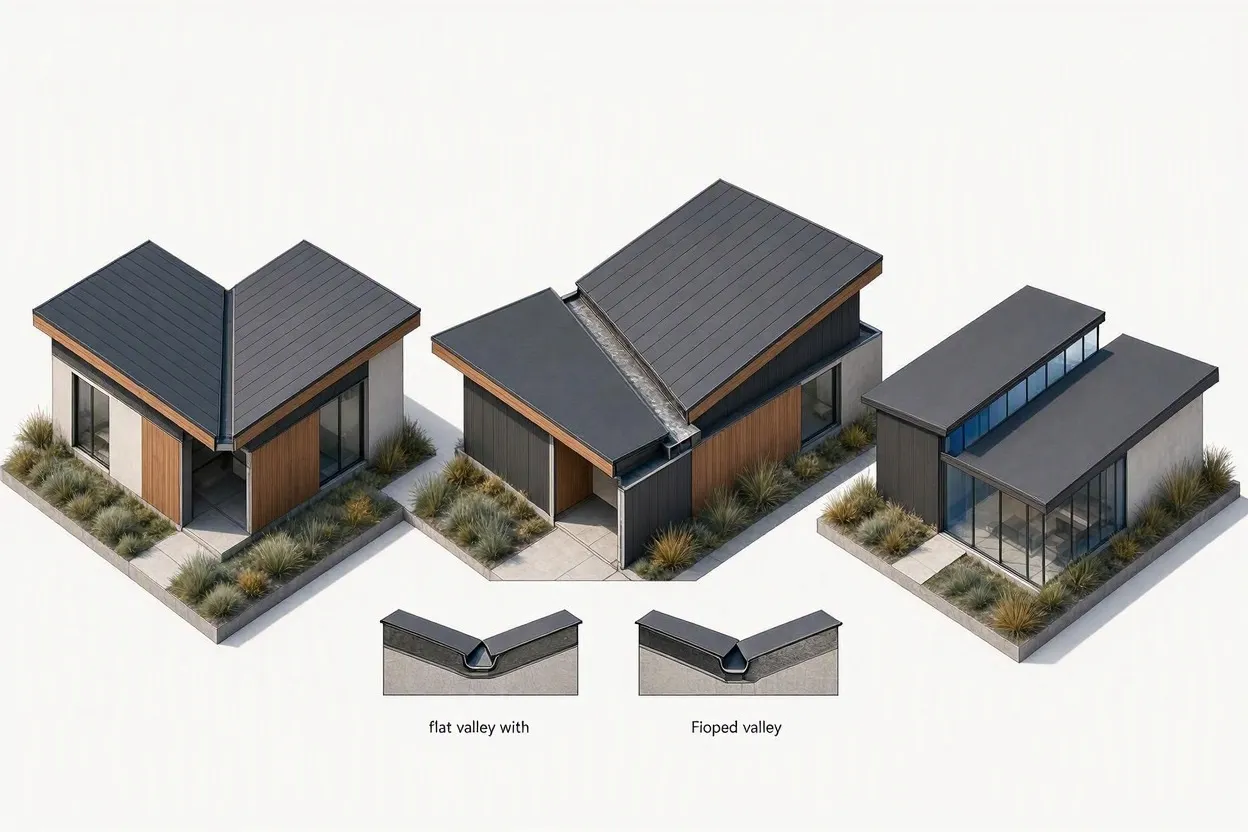
A symmetrical butterfly roof places the valley at the center so both wings match, and an asymmetrical butterfly roof shifts the valley off-center so one wing runs longer and higher. Le Corbusier’s 1930 design placed the valley about one-third of the way along the house, as Stillwater Dwellings describes it.
The valley itself takes one of two shapes. A flat valley uses a roof cricket, a small raised ridge, to steer water toward the valley ends. A sloped valley tilts the whole roof toward one end so water runs to a single outlet.
Butterfly Roof or Two Skillion Roofs?
Two skillion roofs that slope toward each other look like a butterfly roof, but the two planes stop short and leave a vertical gap between them. Houzz points out that this gap holds a clerestory window, a strip of glass that lights the middle of the house. A true butterfly roof joins both planes in one shared valley.
Who Invented the Butterfly Roof?
Le Corbusier, the Swiss-French architect, designed the first butterfly roof in 1930 for Maison Errazuriz, a vacation house planned for Chile that was never built. William Krisel and Dan Palmer did not invent the butterfly roof, but the two architects popularized it on nearly 2,000 Palm Springs houses starting in 1957.
Palm Springs owns the butterfly roof story because of the Alexander Construction Company tract that Krisel designed. Historian Alan Hess described that tract as the largest Modernist housing subdivision in the United States, and Krisel himself confirmed that he popularized the form without originating it. ArchDaily reports that the success of the Palm Springs work led to commissions for more than 30,000 homes across Southern California.
| Year | Architect | Project | Location |
| 1930 | Le Corbusier | Maison Errazuriz (never built) | Zapallar, Chile |
| 1933 | Antonin Raymond | Summer house, published in Architectural Record in 1934 | Karuizawa, Japan |
| 1943 | Oscar Niemeyer | Pampulha Yacht Club | Belo Horizonte, Brazil |
| 1945 | Marcel Breuer | Geller House | Long Island, New York |
| 1950 | Joseph Eichler | Atherwood housing tract | Redwood City, California |
| 1957 | William Krisel and Dan Palmer | Twin Palms neighborhood, Alexander tract | Palm Springs, California |
Butterfly roofs became rare on new American homes by the 1970s, according to the Eichler Network. The revival since then includes Michelle Kaufmann’s prefabricated Sunset Breezehouse, the curved wings of Pritzker Prize winner Glenn Murcutt, and an Aidlin Darling Design home in Hillsborough, California, where the wings hide the solar panels. In the United Kingdom, a related Georgian and Victorian form called the London roof hides the same inverted pitch behind a parapet wall.
How Does Butterfly Roof Drainage Work?
Butterfly roof drainage works by sloping both wings into one central valley, which carries water to a scupper, an internal drain, or a downspout at one or both valley ends. A butterfly roof needs a primary outlet sized for local rainfall plus a separate overflow set higher, because one clogged outlet backs water up inside the valley.
When the primary outlet clogs, water rises in the valley until it reaches the next lowest exit, which is often a flashing seam or a window sill. Standing water also adds weight. Section 1611 of the International Building Code (IBC) requires every part of a roof to carry the rainwater that collects on it, and IIBEC warns that inadequate drainage leads to structural damage and, in the worst cases, roof collapse.
Butterfly roof drainage diagram showing water flowing from the wings to a central valley, a primary scupper, and an overflow set 2 inches higher
Water leaves through the primary outlet while it stays clear; a clogged outlet lets water rise 2 inches (51 millimeters) to the overflow, which discharges separately.
Does a Butterfly Roof Need Gutters?
No, a butterfly roof does not need perimeter gutters, because no water runs off the outer eaves. A butterfly roof still needs a drainage system at the valley: a valley or box gutter, outlets at the valley ends, and downspouts, a rain barrel, or a cistern to receive the water.
Some design sites describe the butterfly roof as gutter-free and leave the reader there. That description skips the drains that do the gutter’s job, and those drains decide whether the roof stays dry.
What US Building Codes Require at the Valley
IRC Section R903.4 requires roof drains at each low point of any roof that does not drain over its edges. Section R903.4.1 adds a secondary overflow wherever walls or parapets would trap water if the primary drain backed up, and a butterfly valley that ends against walls meets that condition.
The overflow rules in IRC R903.4.1 set 3 dimensions:
- Overflow drains match the size of the roof drains, with the inlet 2 inches (51 millimeters) above the low point of the roof.
- Overflow scuppers measure 3 times the size of the roof drains, with an opening at least 4 inches (102 millimeters) high.
- Overflow outlets discharge to an approved location and stay separate from the primary drain lines.
Larger and commercial buildings follow the matching rules in Section 1108 of the International Plumbing Code (IPC) and the rain load rules in IBC Section 1611. A roof surface that slopes at least 1/4 inch per foot (about 21 millimeters per meter) toward free drainage avoids the ponding-instability check, according to IIBEC. Cities amend these sections, and Topeka, Kansas, for example, rewrote R903.4.1 in its local code, so the local building department has the final word.
Do Butterfly Roofs Leak?
Yes, a butterfly roof leaks when its valley drainage fails, because a butterfly roof sends every gallon of rain to one low line. Butterfly roof leaks start at the valley, the outlets, and the joints where the wings meet walls and windows, so those points need the best materials and the most frequent inspections.
Angi notes that butterfly roofs collect debris easily and suffer puncture damage, and Atomic Ranch points to debris caught in the V as a drainage problem. Fixing a leak starts with clearing the outlet and testing the overflow, then moves to the membrane.
The 5 Most Common Butterfly Roof Leak Points
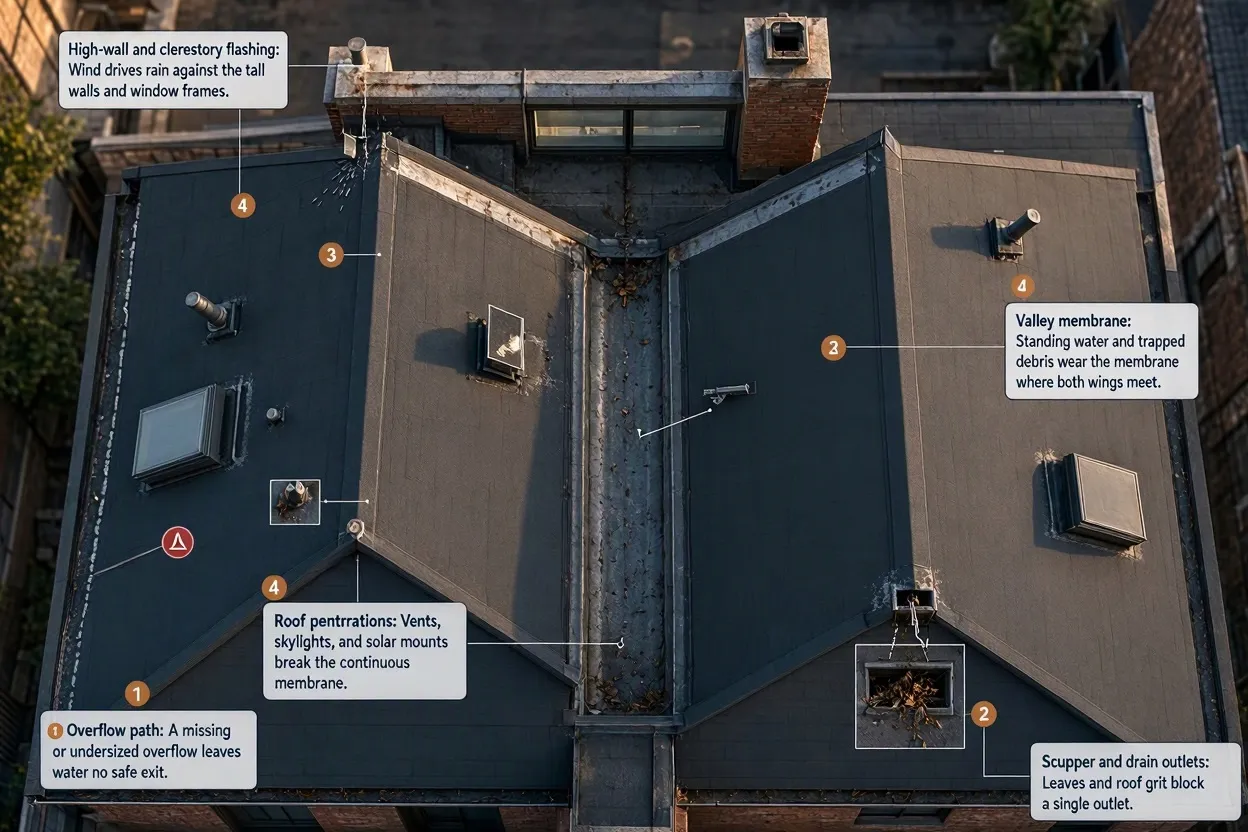
- Valley membrane: Standing water and trapped debris wear the membrane where both wings meet.
- Scupper and drain outlets: Leaves and roof grit block a single outlet.
- High-wall and clerestory flashing: Wind drives rain against the tall walls and window frames.
- Roof penetrations: Vents, skylights, and solar mounts break the continuous membrane.
- Overflow path: A missing or undersized overflow leaves water no safe exit.
What Are the Pros and Cons of a Butterfly Roof?
The main pros of a butterfly roof are tall outer walls for clerestory windows, one collection point for rainwater, and wing planes that suit solar panels. The main cons of a butterfly roof are higher maintenance, a single valley that concentrates leak risk, and little or no attic space.
| Pros | Cons |
| Tall outer walls that hold clerestory windows and bring in daylight | Higher maintenance, rated “high” by Roof Maxx and “frequent” by Angi |
| A central valley that feeds rainwater to one barrel or cistern | A single valley where one clog or failed seam sends water inside |
| Angled wings that carry solar panels | Little or no attic space under the inverted pitch |
| A strong mid-century modern look | Complex framing that needs professional structural design |
| Good performance in strong winds, according to Angi | Debris and snow that collect in the V and add weight |
A butterfly roof suits a homeowner in a dry or mild climate who values daylight and rainwater harvesting and who budgets for regular drain cleaning. A butterfly roof is a poor match for a homeowner who wants a fit-and-forget roof or a storage attic.
Is a Butterfly Roof Better Than a Gable Roof?
It depends: a butterfly roof beats a gable roof for daylight, rainwater collection, and modern design in a dry climate, while a gable roof wins for heavy rain, heavy snow, attic space, and low upkeep. The 3 deciding factors are local climate, the maintenance budget, and whether daylight matters more than attic storage.
| Roof type | Where water goes | New roof cost, USD (Angi) | Upkeep | Best climate | Attic space |
| Butterfly | Into a central valley, then out through scuppers or downspouts | $7,000 to $18,000 | High (Roof Maxx) | Hot and dry; areas without heavy rain or snow | Little or none |
| Gable | Off both eaves into perimeter gutters | $7,000 to $20,000 | Moderate (Roof Maxx) | Temperate and snowy | Ample |
| Flat | Across a near-level deck to drains or scuppers | $8,000 to $26,000 | Frequent (Angi) | Dry or urban; poor in heavy rain, snow, or ice | None, but usable rooftop space |
| Skillion | Off one low edge into a single gutter | $6,000 to $12,000 | Frequent gutter cleaning (Angi) | Sheds snow, ice, and rain well | Little or none |
Cost figures come from Angi’s roof types guide, updated July 9, 2026. Upkeep and climate ratings come from that guide and from the Roof Maxx roof styles comparison.
What Materials Work Best for Butterfly Roofing?
The best materials for butterfly roofing are standing-seam metal and continuous membranes such as EPDM, TPO, PVC, and modified bitumen, because the low wings and the valley hold water longer than a steep roof does. The IRC allows standing-seam metal and EPDM membranes down to a slope of 1/4 inch per foot, or 2 percent.
| Material | IRC minimum slope | IRC section | Where it fits on a butterfly roof |
| Standing-seam metal | 1/4:12 (2 percent) | R905.10.2 | Wings at any pitch; raised seams sit above running water |
| EPDM and other thermoset single-ply membranes | 1/4:12 (2 percent) | R905.12.1 | Valley and low wings |
| Built-up roofing | 1/4:12 (2 percent) | R905.9.1 | Valley and low wings |
| Liquid-applied roofing | 1/4:12 (2 percent) | R905.15.1 | Valley details, outlets, and penetrations |
| Lapped metal panels with lap sealant | 1/2:12 (4 percent) | R905.10.2 | Low wings, not the valley |
| Metal shingles | 3:12 (25 percent) | R905.4.2 | Steep wings only |
| Asphalt shingles | 2:12 (17 percent) | R905.2.2 | Wings at 2:12 or steeper, never the valley |
| Slate shingles | 4:12 (33 percent) | R905.6.2 | Steep wings only |
Slope minimums come from the IRC sections listed, as summarized by Building Code Trainer. Thermoplastic membranes such as TPO and PVC carry their own IRC slope rule [VERIFY: IRC R905.13 minimum slope].
Can You Use Asphalt Shingles on a Butterfly Roof?
Yes, asphalt shingles work on butterfly roof wings with a slope of 2:12 or steeper, and wings between 2:12 and 4:12 need double underlayment under IRC R905.2.2. Asphalt shingles cannot cover a flat valley, because a flat valley falls below the 2:12 minimum, so the valley needs a membrane or a metal liner.
Several design sites list shingles and roofing felt as general butterfly roof options without naming the slope limit. That slope limit pushes any butterfly roof with low wings toward metal or membrane from wing to valley.
Are Butterfly Roofs Good in Snow and Heavy Rain?
No, a butterfly roof is not a good default for heavy snow or heavy rain, because the V shape gathers snow and water in the one place that drains the roof. A butterfly roof works in those climates only with an engineered valley, oversized outlets, and framing checked for drifted snow under ASCE 7.
ASCE 7 is the structural load standard published by the American Society of Civil Engineers (ASCE), and Chapter 7 of the 2022 edition covers snow. Roof snow drifts account for roughly 75 percent of all snow-related roof damage, according to ASCE’s guide to the ASCE 7-22 snow provisions. Engineers on the ASCE Collaborate forum treat a deep roof valley as a snow trap that needs its own load case. Low-slope roofs in areas with a ground snow load of 20 pounds per square foot (98 kilograms per square meter) or less are also checked for a rain-on-snow surcharge, as the Calcs.com ASCE 7-22 calculator notes.
| US region | Main challenge | Verdict | Design must-haves |
| Desert Southwest (Palm Springs, Tucson) | Intense sun and heat | Yes, strong fit | UV-resistant membrane, outlets screened from windblown debris |
| Coastal California | Dry summers, wet winters | Yes, good fit | Cistern or barrel sized for winter storms |
| Pacific Northwest | Long wet season, leaf fall | Conditional | Oversized outlets, leaf screens, overflow at every valley end |
| Southeast and Gulf Coast | Intense storms and hurricanes | Conditional | Drains sized to the local design rainfall rate in IBC Figure 1611.1 |
| Northeast, Midwest, and Rockies | Snow drifts and freeze-thaw cycles | Caution | Engineered drift and rain-on-snow loads, steeper wings, overflow above the valley |
The Chautauqua Butterfly House by Stephen Sparn Architects in Boulder, Colorado, shows that a butterfly roof is buildable in snow country, as Architizer documents. Angi still lists the butterfly roof as best for areas without heavy rain or snow.
How Much Does a Butterfly Roof Cost?
A new butterfly roof costs $7,000 to $18,000 in the United States, according to Angi’s roof types guide updated July 9, 2026. Roof Maxx prices a butterfly roof at $10 to $20 per square foot, about $108 to $215 per square meter, compared with $6 to $9 per square foot for a gable roof.
The two sources measure cost differently. Angi reports total project ranges, while Roof Maxx reports installed cost per square foot, so the per-square-foot premium shows up more clearly in the Roof Maxx figures. A written quote for a specific house is the only reliable price, because roof area, wing pitch, and drainage design change the total.
What Drives the Butterfly Roof Price Premium
The butterfly roof premium comes from 5 cost drivers that a gable roof avoids:
- Low-slope materials: membranes or standing-seam metal replace the cheaper asphalt shingles.
- Valley drainage: a box gutter, scuppers, downspouts, and the code-required overflow add parts and labor.
- Structural design: framing at the low center carries the weight of water and snow.
- Specialist labor: a roofer experienced with butterfly roofs charges for that skill.
- Tall walls and glazing: clerestory windows add window and flashing cost.
Can You Put Solar Panels on a Butterfly Roof?
Yes, solar panels mount well on a butterfly roof, because each wing forms one flat plane, and in the United States the wing facing south receives the most sun. Angi names the butterfly roof as a strong choice for homeowners who want to install solar panels or collect rainwater.
Every solar mount is a roof penetration, so each mount needs flashing approved by the membrane or metal manufacturer. Aidlin Darling Design used the wings of a LEED Platinum, zero-net-energy home in Hillsborough, California, to hide the panels from view, according to the Eichler Network.
Rainwater harvesting follows simple arithmetic. One inch of rain on 1,000 square feet of roof yields about 623 gallons, which equals about 2,360 liters from 25.4 millimeters of rain on 92.9 square meters. Richard Meier’s Neugebauer House in Naples, Florida, uses a stone-paneled rain screen on its butterfly roof to drain and harvest rainwater, as Architizer describes. State rules on rainwater collection vary, so check with the state water agency before installing a cistern.
How Do You Maintain a Butterfly Roof?
Maintain a butterfly roof by keeping the valley and every outlet clear, testing the overflow, and inspecting the membrane and wall flashing at least twice a year, in spring and fall. Book a professional butterfly roof inspection after any major storm too, because one blocked outlet puts the whole roof at risk.
- Clear leaves and grit from the valley and every outlet.
- Run a garden hose into the valley and confirm the water reaches the outlet without pooling.
- Check the overflow drain or scupper for blockage.
- Inspect the valley membrane for blisters, splits, and open seams.
- Inspect the flashing at the high walls, clerestory windows, and roof penetrations.
- Check downspouts, rain barrels, and cisterns for blockage.
- Hire a roofer experienced with butterfly roofs for any repair on the membrane.
Angi advises that a roofer experienced with the butterfly style handle regular maintenance, and Property Investments UK notes that much of a butterfly roof stays hidden from view, which makes damage hard to spot.
What Should You Check Before Buying a Butterfly Roof House?
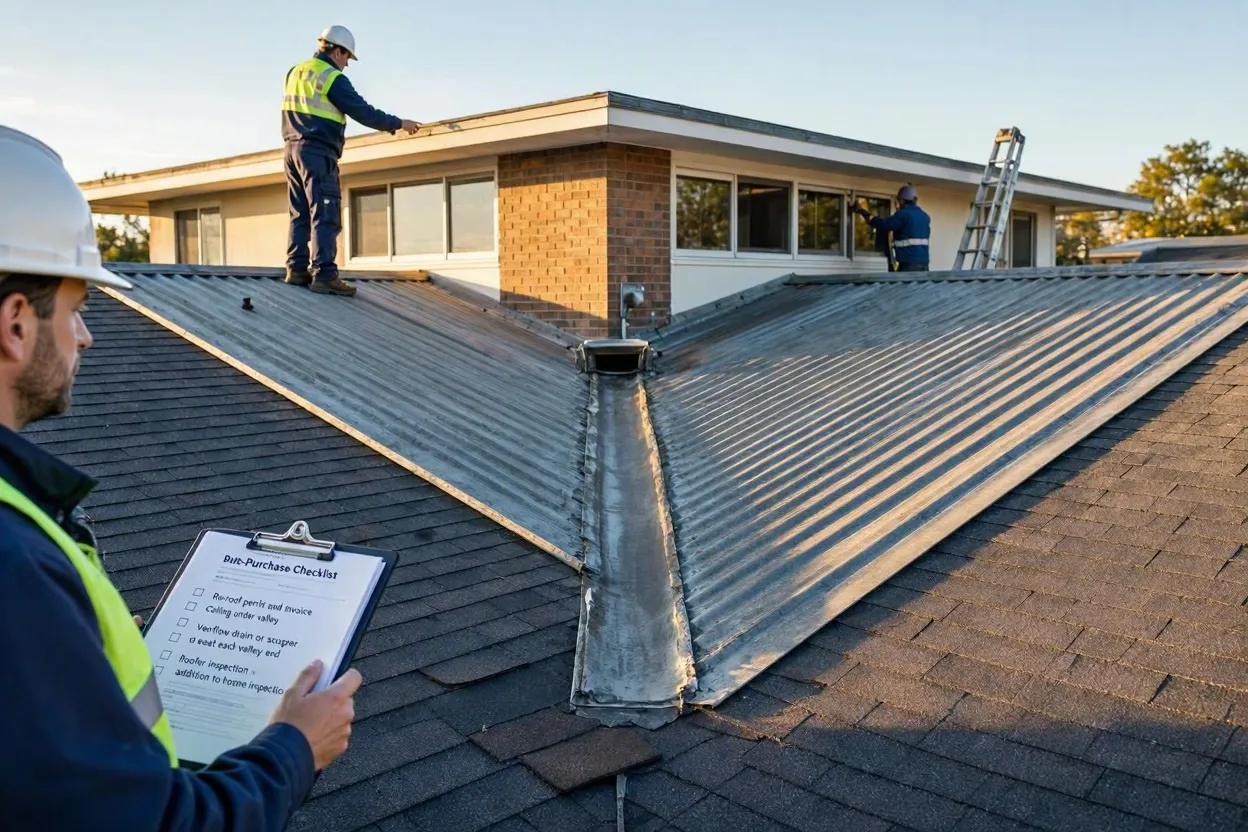
Before buying a butterfly roof house, check the age and type of the roof covering, the condition of the valley, the number and size of the outlets, and whether an overflow exists. Ask the home inspector to report water stains below the valley and the high walls, because those stains show where the butterfly roof has already leaked.
Roof Maxx puts butterfly roof lifespan at 30 to 50 years, so a butterfly house roof from the 1950s or 1960s has already passed at least one replacement cycle. Use this pre-purchase checklist:
- Ask for the re-roof permit and invoice that show the current covering and installation date.
- Look for ceiling and wall stains under the valley and around clerestory windows.
- Confirm an overflow drain or scupper at each valley end that meets a wall.
- Check for shingles on wings flatter than 2:12, which the IRC does not allow.
- Request a roofer’s inspection in addition to the general home inspection.
FAQs
Where are butterfly roofs most common?
Palm Springs and greater Southern California hold the largest concentration, thanks to William Krisel’s tracts. Newer butterfly-roofed homes also stand in the Berkeley Hills, Manhattan Beach, Tucson, and Decatur, Georgia, according to the Eichler Network.
Is a V roof the same as a butterfly roof?
Yes. “V roof” and “inverted gable roof” are alternate names for one form: two planes falling inward to a shared low line.
How long does a butterfly roof last?
Roof Maxx estimates 30 to 50 years. Service life depends on the covering, the pitch of each wing, and how often someone clears the outlets.
Can you add a butterfly roof to an existing house?
Yes, through an addition or a reroof with new framing. Get a structural engineer and a building permit first, since the low center shifts weight onto interior beams or walls.
Does a butterfly roof have an attic?
No. The inverted pitch leaves little room above the ceiling, so the design trades storage space for vaulted interiors and taller windows.
Conclusion
Butterfly roof design is moving from mid-century nostalgia toward performance, with wings that carry solar arrays and valleys that feed cisterns. As states adopt the 2024 IBC, which references ASCE 7-22, butterfly roofing in snow and storm regions will rest on clearer drift and rain-load math, and better-documented drainage will follow.
The next butterfly roof house on your street will succeed or fail at the valley. Plan the outlets, the overflow, and the covering before the framing goes up, and the roof will deliver the light and water savings that made Krisel’s Palm Springs homes famous.