
Concrete takes 28 days to reach full cure strength. But that single number does not tell the whole story. You can walk on fresh concrete after 24 hours. Vehicles can cross it after 7 days. Structural loads need the full 28-day mark. Knowing those 3 milestones prevents surface damage, cracking, and costly do-overs on driveways, slabs, and foundations.
This guide covers every variable that shifts those timelines temperature, mix design, thickness, curing method with clear charts and practical advice rooted in ACI (American Concrete Institute) standards.
1. Concrete Curing vs. Drying They Are Not the Same
Most homeowners use “curing” and “drying” as if they mean the same thing. They do not.
Drying is moisture evaporating from the surface. Curing is a chemical process — water reacting with cement particles (hydration) to form calcium silicate hydrate crystals that give concrete its strength.
If water evaporates too fast before hydration completes, the chemical reaction stops early. The result: weaker concrete, surface crazing (fine crack networks), and reduced freeze-thaw resistance. That is why contractors keep fresh concrete damp rather than letting it dry quickly.
Proper curing can make concrete 50% stronger compared to uncured concrete — a significant structural difference confirmed by Concrete Network research.
2. The 3-Stage Concrete Curing Timeline
Stage 1 — Initial Set (1 to 6 Hours)
Initial set occurs 1 to 2 hours after placement. Concrete begins hardening but can still be finished. Final set follows at 4 to 6 hours — concrete is fully rigid and cannot be reworked.
During this window, protect the surface from foot traffic, rain, and direct sun. A damaged surface at this stage cannot be repaired by adding more concrete on top.
Stage 2 — Early Strength Gain (24 Hours to 7 Days)
Strength increases rapidly in the first 3 to 7 days. At 24 hours, concrete reaches 20 to 30% of design strength — enough for careful foot traffic. At 7 days, it hits 60 to 70% — enough for vehicles.
The ACI 308 guide describes this as the critical curing window. Moisture loss during these early days permanently reduces final strength because the hydration reaction cannot restart once interrupted.
Stage 3 — Full Cure (28 Days)
28 days is the engineering benchmark for full concrete strength. The concrete reaches 90 to 100% of its design compressive strength, measured in psi or MPa per ASTM C39 testing standards.
Note: concrete technically continues gaining strength beyond 28 days, but the gains become negligible for practical construction purposes.
| Time After Pour | Strength Reached | What It Can Handle |
| 1–2 hours | Initial set | No traffic, finishing operations only |
| 4–6 hours | Final set | No traffic at all |
| 24–48 hours | 20–30% | Light foot traffic only |
| 7 days | 60–70% | Vehicles, light construction equipment |
| 14 days | ~85% | Most construction activities |
| 28 days | 90–100% | Full structural loads, heavy vehicles |
3. Concrete Curing Time by Application
Concrete Driveway Curing Time
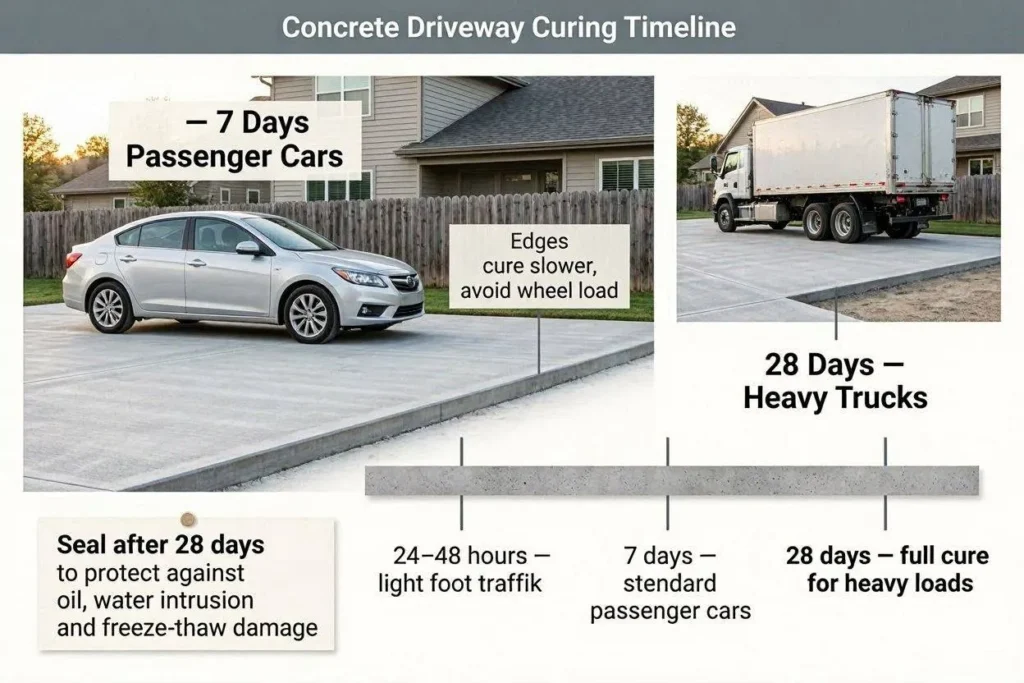
A concrete driveway takes 7 days before vehicles can park on it and 28 days before it handles heavy trucks. Standard passenger cars can use it after one week, but stay off the edges — they cure slower and can chip.
Seal the surface after the full 28-day cure to protect against oil, water intrusion, and freeze-thaw cycles that damage unsealed driveways in cold climates.
Concrete Slab Curing Time
A concrete slab (4-inch or 6-inch) is safe for foot traffic after 48 hours and ready for heavy loads after 7 to 14 days. The 28-day benchmark applies for permanent fixtures, machinery, or structural connections.
Thicker slabs retain more heat from hydration, which can accelerate surface cure but create temperature differentials between the surface and core — a cause of internal cracking if not managed.
Concrete Foundation Curing Time
Foundation concrete needs the full 28-day cure before backfilling or applying structural loads. Rushing this step is one of the most expensive mistakes in residential construction — a compromised foundation affects walls, flooring, and alignment for the life of the building.
If your roof or exterior is being worked on during or after a foundation pour, coordinate schedules carefully. Construction vibration near fresh concrete within the first 48 hours can disrupt the setting process.
Concrete Sidewalk Curing Time
Sidewalk concrete is safe for foot traffic after 24 to 48 hours. Cyclists and light equipment need 7 days. Keep pets off for at least 48 hours — their claws can mark the surface during early cure.
Concrete Patio Curing Time
A concrete patio follows the same timeline as a slab — foot traffic at 48 hours, furniture after 7 days, full load capacity at 28 days.
| Application | Foot Traffic | Vehicle/Heavy Load | Full Cure |
| Driveway | 48 hours | 7–10 days | 28 days |
| Slab (4″–6″) | 48 hours | 7–14 days | 28 days |
| Foundation | 48 hours | Not applicable | 28 days (before backfill) |
| Sidewalk | 24–48 hours | 7 days | 28 days |
| Patio | 48 hours | 7 days | 28 days |
| Pool deck | 48–72 hours | 7 days | 28 days |
4. Factors That Directly Affect Concrete Curing Time
Factor 1 — Temperature
Ideal curing temperature is 50°F to 77°F (10°C to 25°C). Below 40°F (4°C), hydration slows dramatically. Below 32°F (0°C), water in the mix freezes — halting hydration permanently and causing internal expansion damage.
Above 90°F (32°C), moisture evaporates faster than hydration can use it. Surface cracking and reduced final strength follow. The ACI recommends active measures when temperatures fall outside the ideal range.
Factor 2 — Water-to-Cement Ratio (w/c)
A lower water-to-cement ratio produces denser, stronger concrete but demands more careful moisture management during curing. Most standard mixes use 15 to 20% water by weight. High w/c mixes cure faster initially but produce weaker concrete with higher porosity.
Factor 3 — Cement Type
Portland cement types cure at different rates:
| Cement Type | External Cure Duration |
| Standard Portland (Type I) | 7 days |
| High-strength Portland (Type III) | 3–5 days |
| Sulfate-resistant (Type V) | 10 days |
| Low-heat Portland (Type IV) | 14 days |
| High-sulfate resistant | 14–28 days |
| Blended cement (fly ash) | 10–14 days |
Source: ACI 308 Guide to External Curing of Concrete.
Factor 4 — Admixtures
Accelerators shorten curing time in cold weather. Retarders slow setting in hot weather to prevent premature surface hardening. Chemical admixtures do not eliminate the need for proper moisture and temperature management — they adjust the reaction speed within those conditions.
Factor 5 — Humidity and Wind
Low humidity and wind both accelerate surface moisture loss. When evaporation exceeds 0.2 lb per square foot per hour, plastic shrinkage cracking becomes a real risk. Evaporation retardants sprayed on the surface before finishing form a thin membrane that reduces moisture loss without interfering with finishing operations.
Factor 6 — Slab Thickness
Slab thickness does not change the 28-day cure benchmark, but it does affect heat retention. A 6-inch slab holds more hydration heat than a 2-inch slab which can accelerate internal strength gain. However, thicker slabs with uneven internal temperatures are more prone to thermal cracking if curing is not managed.
5. Concrete Curing Methods
Method 1 — Water Curing
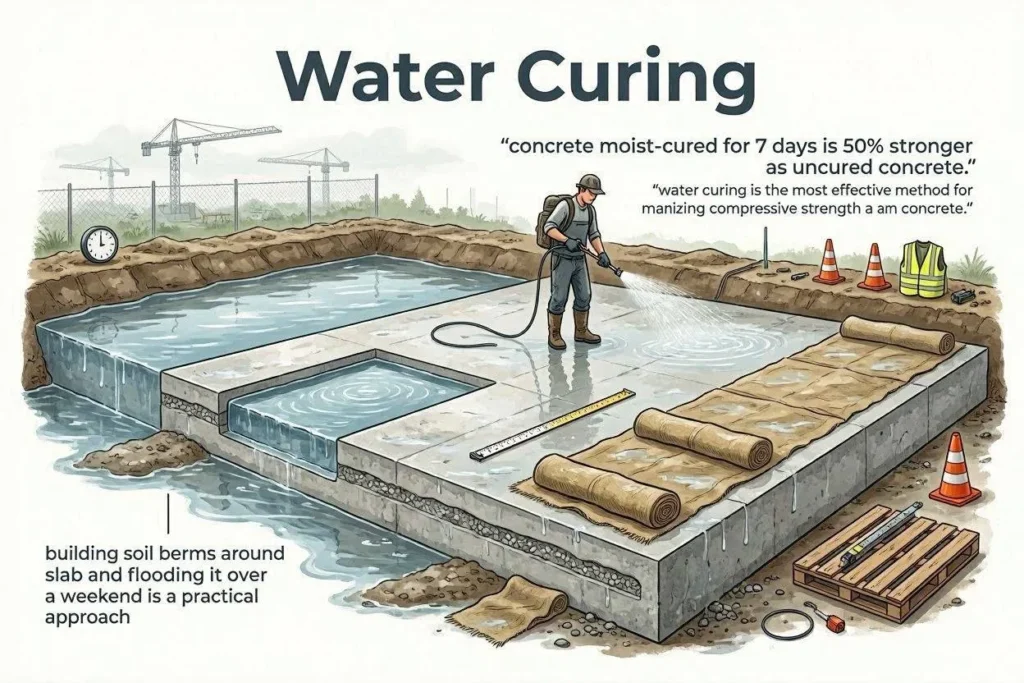
Water curing is the most effective method for maximizing compressive strength. It involves keeping the concrete continuously wet through ponding, spraying, or wet coverings (burlap, canvas, hessian).
Concrete moist-cured for 7 days is 50% stronger than uncured concrete. Building soil berms around a slab and flooding it over a weekend is a practical approach that gets most of the benefit without extended schedule impact.
Method 2 — Membrane Curing (Curing Compounds)
Liquid curing compounds acrylic or wax-based are sprayed on the surface after finishing. They form a seal that traps moisture inside, eliminating the need for continuous re-wetting. ASTM C309 governs compound specifications.
Membrane curing is the most common method on large commercial projects because it requires no ongoing labor. Limitation: the compound must be fully cured before applying any surface coatings or sealers.
Method 3 — Curing Blankets (for Cold Weather)
Concrete curing blankets maintain hydration temperature when ambient conditions drop below 40°F. They insulate the slab, trapping the heat generated by the hydration reaction. Specialized electric curing blankets cure concrete 2.8 times faster than standard insulated blankets according to manufacturer testing.
ACI 306 compliance for cold-weather concreting requires maintaining concrete temperature above 40°F for the first 48 to 72 hours after placement.
Method 4 — Steam Curing
Steam curing accelerates strength gain by applying controlled heat (around 150°F / 65°C) and moisture simultaneously. It is used for precast concrete elements, structural beams, and projects requiring high early strength — not typical residential slabs.
A concrete mix steam-cured for 24 hours can reach strength levels that normally take 28 days of standard curing.
6. Curing Concrete in Cold Weather
Cold weather concreting begins when ambient temperature falls below 40°F (4°C). Below this threshold, the hydration process slows significantly. Below 32°F (0°C), water in the mix freezes and hydration stops permanently — the concrete will never reach design strength.
Risks of Cold Weather Curing
- Freezing before initial set destroys structural integrity
- Extended set time doubles from 4–6 hours to 8–12 hours in near-freezing conditions
- Full cure at cold temperatures can take 45 days instead of 28
- Freeze-thaw cycles before full cure cause surface spalling and internal cracking
Cold Weather Solutions
- Use heated water and aggregates in the mix to raise initial concrete temperature
- Add accelerator admixtures to speed hydration in cold conditions
- Cover slabs with insulating blankets immediately after finishing
- Build heated enclosures for pours during freezing temperatures
- Monitor concrete core temperature 4 times daily using thermocouples
- Pour during the warmest part of the day — typically 10 a.m. to 2 p.m.
For homes with active roof repair or replacement work happening during winter, coordinate concrete pours around roofing schedules. Falling debris or foot traffic on fresh concrete during cold curing is a common source of surface damage.
7. Curing Concrete in Hot Weather
Hot weather curing begins when ambient temperature exceeds 90°F (32°C) or when conditions create an evaporation rate above 0.2 lb/ft²/hr. High heat accelerates the hydration reaction which sounds beneficial but creates problems.
Risks of Hot Weather Curing
- Rapid moisture loss causes plastic shrinkage cracking within hours of pour
- Accelerated setting reduces workability — finishing must happen faster
- Surface moisture evaporates before internal hydration completes — final strength is permanently reduced
- High early strength paired with lower long-term strength is common in unchecked hot pours
Hot Weather Solutions
- Schedule pours in early morning to avoid peak heat
- Use chilled water or ice in the mix to lower initial concrete temperature
- Apply evaporation retardant spray immediately after screeding
- Use retarder admixtures to slow initial set and extend workability window
- Begin wet curing immediately after finishing — do not wait
- Shade the pour area if possible
8. What Happens When Concrete Does Not Cure Properly
Skipping proper curing is not neutral — it actively damages the finished slab. The 4 most common consequences:
| Problem | Cause | Result |
| Surface crazing | Rapid moisture loss in first 48 hours | Network of fine cracks — structural weakness begins |
| Plastic shrinkage cracking | Evaporation exceeds bleed water rate | Cracks visible within hours of pour |
| Reduced strength (30–50% below design) | Hydration interrupted prematurely | Slab fails under loads it was designed to handle |
| Dusting surface | Low surface strength from poor early curing | Surface powder — abrasion resistance is destroyed |
| Scaling and spalling | Freeze-thaw damage on under-cured slab | Concrete surface flakes off in sheets |
Improperly cured concrete foundations directly affect every system above them — including your roofline, fascia, and drainage systems. A cracked or settled foundation throws rooflines out of alignment, accelerates water intrusion, and shortens roof system lifespan.
9. Concrete Curing Time Chart — Quick Reference
| Condition | Initial Set | 7-Day Strength | Full Cure |
| Ideal temp (50–77°F), wet curing | 4–6 hours | 75% | 28 days |
| Hot weather (90°F+), no shade | 2–3 hours | 65% (risk of cracking) | 25–30 days |
| Cold weather (40–50°F) | 6–10 hours | 50–60% | 35–42 days |
| Near-freezing (32–40°F) | 12–18 hours | 30–40% | 45+ days |
| Below freezing (under 32°F) | Indefinite / damage risk | N/A | Will not cure properly |
| Accelerated (Type III cement + admixtures) | 2–4 hours | 85–90% | 7–14 days |
10. Common Concrete Curing Mistakes
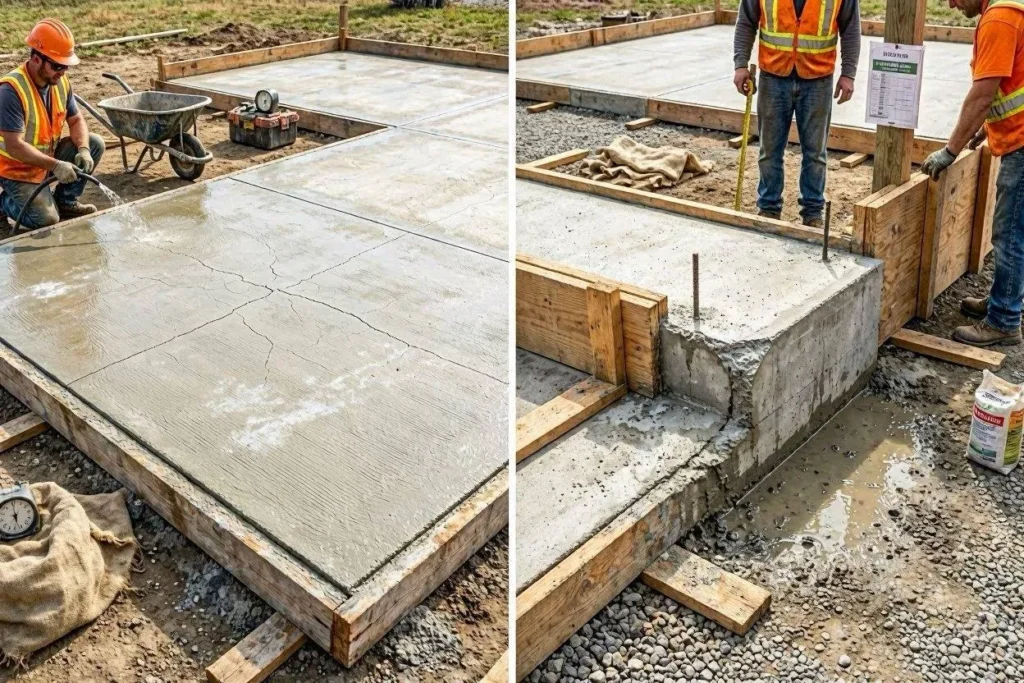
Mistake 1 — Watering Too Late
Begin moist curing as soon as the surface can support foot traffic without damage — typically within 4 to 8 hours of finishing. Waiting until the next morning means 12 to 16 hours of unprotected curing on the most vulnerable day.
Mistake 2 — Removing Forms Too Early
Remove formwork only after concrete reaches sufficient strength to support its own weight — typically 7 days for standard mixes. Early form removal on vertical elements causes surface damage and can crack the pour.
Mistake 3 — Confusing Surface Hardness with Cure Completion
Concrete feels hard to the touch within 24 to 48 hours. That surface hardness is not cure completion. Internal hydration continues for weeks, and loads applied before 28 days introduce stress the concrete is not yet designed to handle.
Mistake 4 — Wet Curing Without Keeping It Continuously Wet
Intermittent wetting — wet one hour, dry the next — is worse than no curing at all in some conditions. The wet-dry cycles cause surface tension and cracking. If continuous wet curing is not practical, use a curing compound instead.
Mistake 5 — Ignoring Weather Forecasts
A concrete pour timed against a cold snap or heat wave creates preventable problems. Check forecasts 48 to 72 hours ahead. If your roofing project and concrete work are happening simultaneously, coordinate around weather windows — both processes are sensitive to temperature extremes during installation.
FAQs
How long does concrete take to cure?
Concrete reaches full cure strength at 28 days. Before that: foot traffic after 24 to 48 hours, vehicles after 7 days, structural loads after 28 days.
Can you walk on concrete after 24 hours?
Yes — carefully. At 24 hours, concrete is at 20 to 30% strength. Light foot traffic is acceptable. Avoid concentrated point loads (heels, furniture legs, tools) until 48 hours minimum.
How long does a concrete driveway need to cure before driving on it?
7 to 10 days for standard passenger vehicles. Heavy trucks and construction equipment need the full 28 days.
Does cold weather stop concrete from curing?
Below 40°F, curing slows significantly. Below 32°F, it stops entirely — the water in the mix freezes before hydration completes. Use insulating blankets, heated enclosures, or accelerators when temperatures drop below 40°F.
Does watering concrete help it cure?
Yes. Keeping the surface damp prevents premature moisture loss. Concrete moist-cured for 7 days is 50% stronger than concrete left to dry naturally. Spray the surface 2 to 4 times daily or use wet burlap covered with plastic sheeting.
Final Word
Concrete curing time is not a single number it is a process with 3 clear milestones, 6 variables, and specific actions required at each stage. The 28-day rule is the engineering standard because that is when hydration is complete enough to support full design loads safely.
Shortcuts before 28 days cost more to repair than they save in time. Proper curing — keeping moisture in, temperature stable, and loads off — is the difference between concrete that lasts 50 years and concrete that develops problems before the first winter.
If your project involves roof replacement or construction activity alongside concrete work, coordinate timelines carefully. Both processes are temperature-sensitive during initial installation, and getting the sequencing right protects both investments.