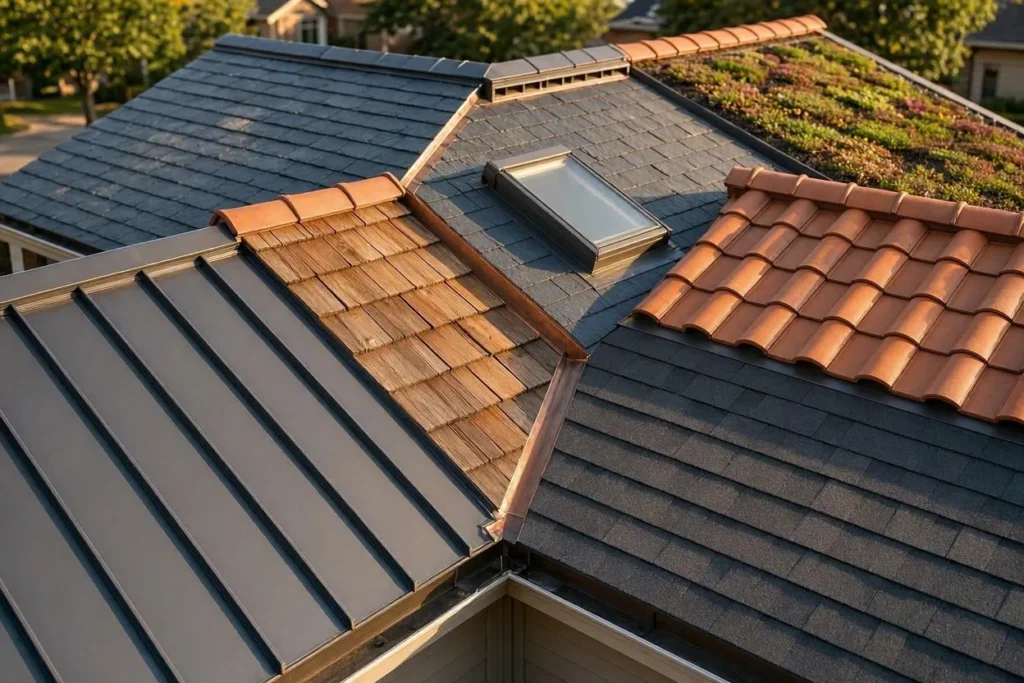
The best cool roofing materials reflect at least 65% of sunlight and release absorbed heat efficiently, keeping roof surfaces up to 31°C (55°F) cooler than standard dark roofing. White membranes, cool-colored shingles, coated metal, and certain tiles all qualify, and the right pick depends on your roof slope, local climate, and building code. This guide breaks down every major type of cool roofing material, what they cost, which standards apply in the US and Australia, and how to choose one that actually earns its keep.
What Are Cool Roofing Materials?
Cool roofing materials are roof coverings engineered to reflect solar energy and release absorbed heat rather than trap it inside the building. A traditional dark roof can hit 150°F (65°C) on a sunny afternoon. A cool roof, built from the same basic categories, membrane, shingle, tile, metal, or coating, stays dramatically lower because its surface is designed around two measurable properties: solar reflectance and thermal emittance.
Manufacturers don’t just paint a roof white and call it done. Cool roofing materials go through third-party testing, usually by the Cool Roof Rating Council (CRRC) in the US, before they can carry an ENERGY STAR label or meet a building code’s reflectance threshold. That testing matters. It’s the difference between a marketing claim and a roof that performs the way it’s supposed to for years, not just on day one.
How Do Cool Roofing Materials Work?
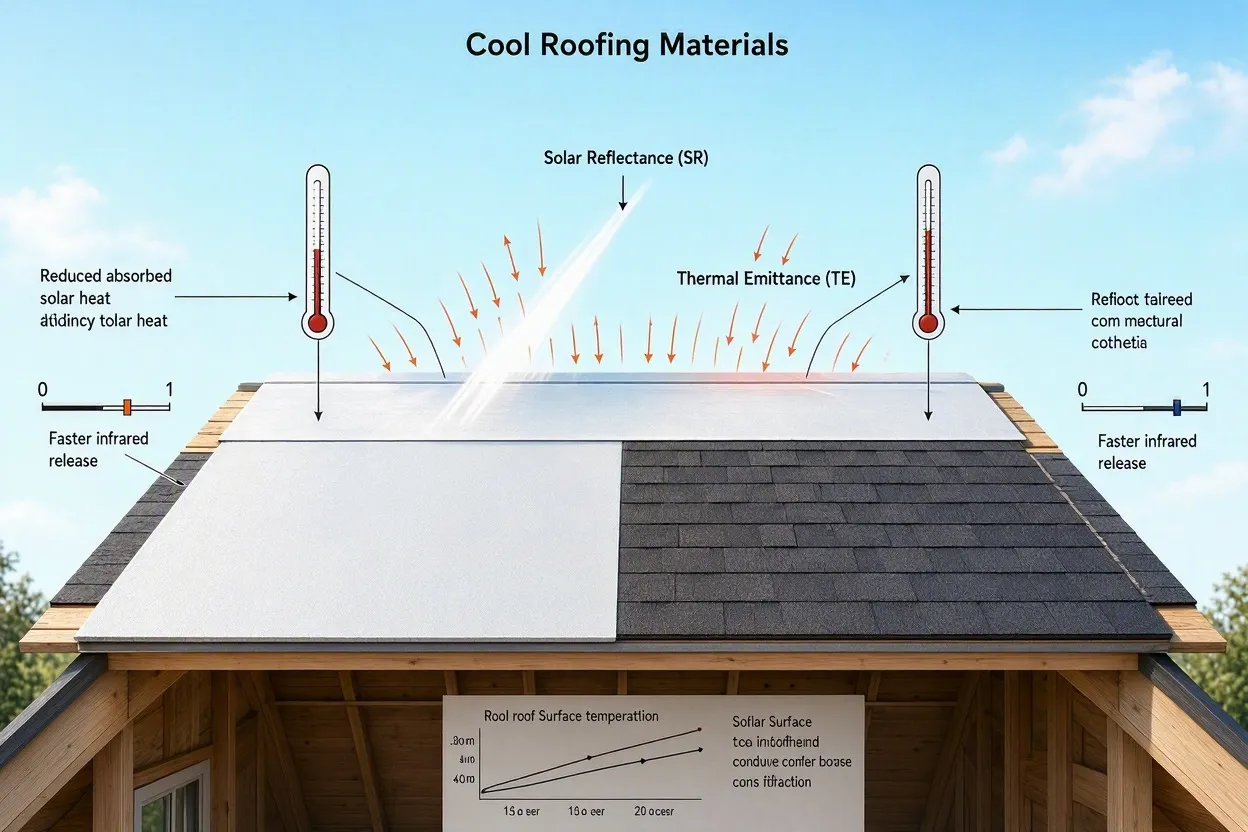
Cool roofing materials work by combining high solar reflectance (SR) with high thermal emittance (TE), two separate properties measured on a 0 to 1 scale. Together, these two properties determine how much solar heat gain a roof absorbs and how fast it releases that heat again.
- Solar reflectance (SR), also called albedo, measures how much sunlight bounces off the roof surface instead of being absorbed.
- Thermal emittance (TE) measures how efficiently the roof sheds the heat it does absorb, radiating it back into the sky rather than conducting it down into the attic.
Here’s the part most homeowners miss: these two properties don’t respond to the same slice of sunlight. Roughly half of solar energy arrives as invisible near-infrared (NIR) radiation, not visible light. That’s why “cool-colored” dark shingles exist. A charcoal-gray shingle formulated with reflective pigments can bounce back much of the invisible NIR spectrum while still looking dark to the eye, so a roof doesn’t have to be painted white to qualify as cool.
Reflectance percentage translates directly into roof surface temperature, and the gap is easy to see side by side:
| Roof Surface | Solar Reflectance | Surface Temperature vs. Less-Reflective Comparison |
| Clean white roof | 80% | About 31°C (55°F) cooler than a gray roof reflecting 20% |
| Cool-colored roof | 35% | About 12°C (22°F) cooler than a similar-looking roof reflecting 10% |
That’s a measurable, repeatable drop in roof surface temperature, not a marketing estimate, and it’s the number you should compare across any two products you’re considering.
Types of Cool Roofing Materials
Seven material categories dominate the cool roofing market: reflective membranes, cool-colored shingles, metal, coatings, tile, green roofs, and misting systems. Each suits a different roof slope, budget, and climate, so picking one means matching the material to your building rather than chasing the highest reflectance number alone.
None of these categories is inherently “better” in isolation. A membrane rated at 85% reflectance still underperforms a lower-rated tile if it’s installed on the wrong slope or in a climate where the tile’s thermal mass matters more than raw reflectance. Manufacturers publish reflectance and emittance figures for a reason: they let a contractor or homeowner compare products within the same category, not across unrelated ones. Keep that distinction in mind while reading through the seven types below.
| Material Type | Typical Solar Reflectance | Best Roof Slope | Relative Cost | Typical Lifespan |
| White/Reflective Membrane (PVC, EPDM, TPO) | 60% to 85% | Flat / low-slope (≤2:12) | Moderate to high | 20 to 30 years |
| Cool-Colored Asphalt Shingles | 25% to 40% | Steep-slope | Low to moderate | 20 to 25 years |
| Metal Roofing (coated) | 30% to 70% | Steep-slope | Moderate to high | 40 to 70 years |
| Cool Roof Coatings (elastomeric/cementitious) | 20% to 70%+ (post-coating) | Flat / low-slope | Low | 10 to 15 years (recoat interval) |
| Cool Tile (clay/concrete) | 30% to 60% | Steep-slope | High | 40 to 50+ years |
| Green Roof | Not reflectance-rated (evapotranspirative cooling) | Flat / low-slope | High | 30 to 40 years (membrane below) |
| Roof Misting System | Not reflectance-rated (evaporative cooling) | Any (retrofit add-on) | Low to moderate | 10 to 15 years (equipment) |
White and Reflective Membranes
Single-ply membranes are the standard choice for flat and low-slope roofs, the kind found on most commercial buildings and many modern homes. Polyvinyl chloride (PVC), ethylene propylene diene monomer (EPDM), and thermoplastic polyolefin (TPO) are the three common types, and reflectance is built into the material rather than applied as a separate coating. No extra surfacing is needed once the membrane is installed. That’s a real advantage for buildings where maintenance crews rarely visit the roof.
Cool-Colored Asphalt Shingles
Standard on the vast majority of US homes, asphalt shingles now come in cool-colored versions that use specially formulated granules. These granules reflect near-infrared light while keeping the traditional shingle look homeowners expect, brown, green, or weathered wood tones included. Reflectance runs lower than white membrane options, typically in the 25% to 40% range, but the familiar appearance keeps adoption high in residential neighborhoods with strict aesthetic rules.
Metal Roofing
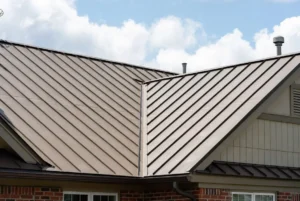
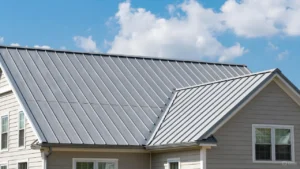
Unpainted metal starts out naturally reflective, though it holds onto absorbed heat longer because its thermal emittance runs low on its own. Factory-applied cool coatings fix that gap, and coated metal roofs now qualify for cool roof ratings in most US states and several Australian jurisdictions. Metal performs best on steep-sloped roofs; on flat roofs it receives more direct sun exposure throughout the day, which works against the material’s natural strengths.
Cool Roof Coatings
If a roof already exists and full replacement isn’t in the budget, a coating offers the fastest path to cool roof performance. Two types dominate: elastomeric coatings, which double as a watertight membrane, and cementitious coatings, applied over roofing that’s already waterproofed. Sprayed, rolled, or brushed on, these coatings can lift an old roof’s reflectance from under 20% to over 70% in a single weekend project.
Cool Tile
Clay and concrete tiles carry natural reflective properties that vary by clay source and firing process. Manufacturers also produce cool-colored tile using the same infrared-reflective pigment technology found in cool shingles, available in earth tones that suit both US Southwestern architecture and Australian coastal builds. Tile costs more upfront than shingles, but its lifespan, often 50 years or longer, changes the cost math considerably.
Green Roofs
Not technically a cool roofing material in the reflectance-and-emittance sense, a green roof still delivers comparable cooling through a different mechanism: evapotranspiration. Plants pull moisture from soil and release it through their leaves, cooling the surrounding air as they do. Rooftop gardens also cut stormwater runoff, a benefit no other material on this list offers, which is why several Australian councils now credit green roofs toward stormwater compliance separately from heat performance.
Roof Misting Systems
A misting system doesn’t replace the roofing material at all; it cools the existing surface by spraying a thin layer of water that evaporates and pulls heat away. Setups range from a garden hose on a mist nozzle to a fully automated system with a built-in thermostat and 360-degree nozzles. It’s a retrofit option rather than a long-term material choice, useful for industrial buildings where reroofing isn’t practical in the near term.
Cool Roofing Materials for Different Climates: USA and Australia
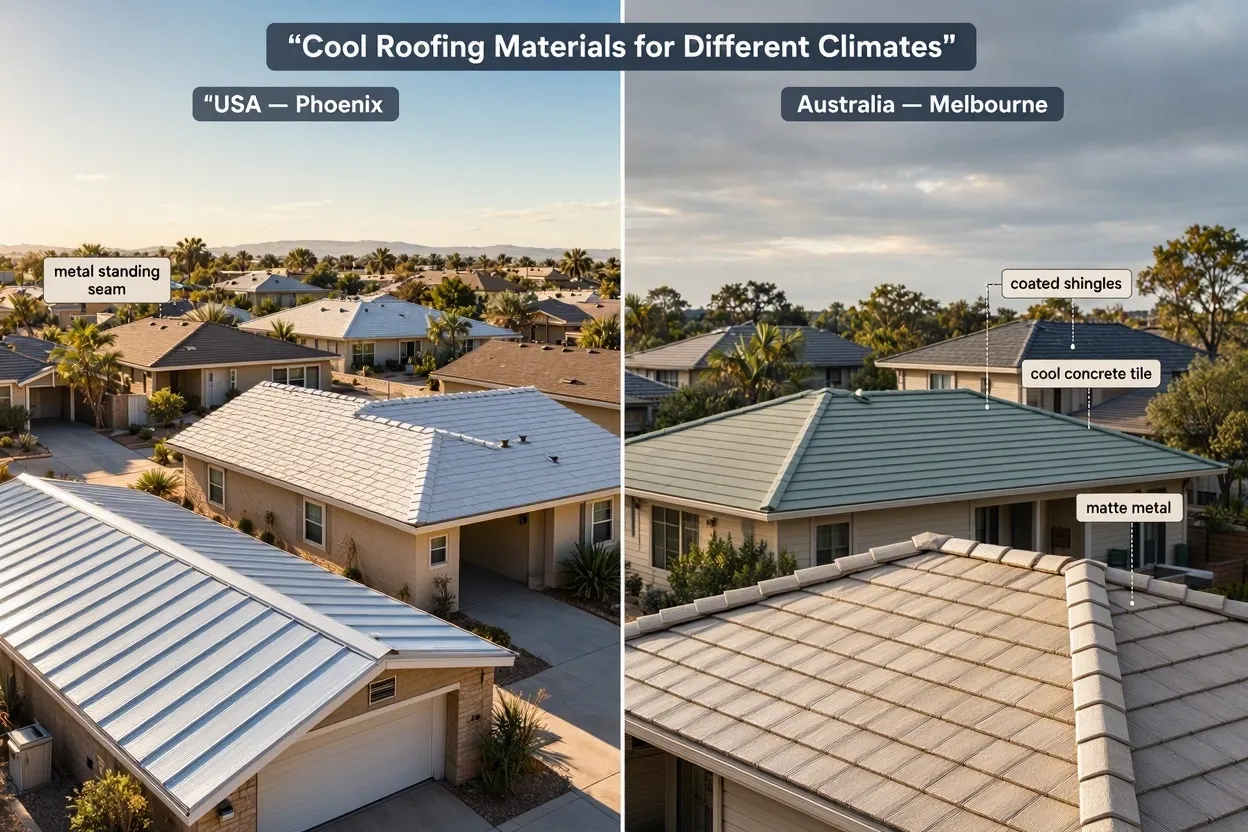
Cool roofing materials perform best in hot, sunny climates with year-round cooling demand, though the specific product and code requirements shift depending on whether you’re building in the US or Australia. Climate zone determines both the payoff and the winter trade-off, so the calculation looks different in Phoenix than it does in Melbourne.
In the US, cool roofing materials save the most in the South and Southwest, in states like Arizona, Texas, and Florida, where air conditioning runs nearly year-round. California’s Title 24 code sets minimum reflectance and emittance values, Los Angeles adds its own cool roof ordinance for new homes, and northern states see a smaller net gain since winter heating offsets part of the summer savings.
In Australia, tropical states like Queensland and the Northern Territory make cool roofing materials close to an automatic win, since cooling dominates energy use nearly year-round, while Victoria and Tasmania face more balanced seasons that call for weighing reflectance and thermal emittance together. The National Construction Code (NCC) sets baseline thermal requirements nationwide, the Nationwide House Energy Rating Scheme (NatHERS) rates homes on a 0 to 10 star scale that factors in roof performance, and properties in a Bushfire Attack Level (BAL) zone, from BAL-LOW up to BAL-FZ, need roofing that meets fire-resistance rules alongside reflectance, a requirement with no real US equivalent.
Cool Roofing Materials Cost and Return on Investment
Cool roofing materials typically cost 10% to 20% more upfront than standard equivalents, though the premium narrows or disappears once energy savings and extended roof life are factored in. A cool coating on an existing flat roof sits at the low end since no tear-off is required; a full cool tile replacement sits at the high end.
Air conditioning savings scale with building height:
- Single-story building: cooling costs drop by roughly 50%
- Two-story building: cooling costs drop by roughly 25%
- Five-story building: cooling costs drop by roughly 10%
Taller buildings carry less roof area relative to total wall and window exposure, so the reflectance payoff shrinks with each added story. A self-applied coating with no labor cost often pays for itself within three years on a small residential roof.
Two other factors change the math:
- Longevity: cooler roofs degrade slower, since heat accelerates the breakdown of asphalt binders, membrane seams, and protective coatings, extending service life by several years in some cases.
- Resale and rebates: a documented CRRC rating or NatHERS-relevant record supports a stronger resale pitch in hot-climate markets, and US utility rebates or Australian council incentives can shorten the payback window by a year or more.
Standards and Certifications for Cool Roofing Materials
In the US, look for CRRC ratings and ENERGY STAR certification; in Australia, check NatHERS compliance and the relevant state building code before buying. Neither market treats “reflective” as a self-certifying claim, and that’s a good thing for buyers trying to compare products on equal footing.
In the US, the Cool Roof Rating Council (CRRC) tests products for initial performance and again after three years of outdoor weathering, since dirt, algae, and UV exposure all degrade reflectance over time, then publishes results to a searchable Rated Roof Products Directory under the ANSI/CRRC S100 Standard. LEED (Leadership in Energy and Environmental Design) certification adds heat island credits for commercial developers, while ENERGY STAR gives homeowners a simpler, single-symbol shortcut instead of raw SR and TE figures.
In Australia, the NCC and state-level energy codes set the baseline, with NatHERS providing a whole-home rating that includes roof material as one input among several. No single Australian body mirrors the CRRC’s product-specific testing and public directory, a genuine gap in the local market, so Australian buyers often cross-reference US CRRC ratings for imported products alongside local NCC compliance documentation.
Benefits and Drawbacks of Cool Roofing Materials
Cool roofing materials lower indoor temperatures, cut cooling costs, and extend roof lifespan, but they carry a winter heating trade-off and, on low-rise buildings, occasional glare complaints from neighbors. Weighing both sides gives a clearer picture than a benefits-only list.
| Benefits | Drawbacks |
| Improves indoor comfort in buildings without air conditioning by lowering interior temperature directly, rather than relying on mechanical cooling | Adds a winter heating penalty in cold climates, since the same reflectance that blocks summer heat also blocks passive solar warmth |
| Cuts energy bills in air-conditioned buildings and eases strain on the electrical grid during peak summer afternoons, lowering brownout risk | Penalty stays small relative to summer savings across most of the continental US, per Lawrence Berkeley National Laboratory’s Heat Island Group, but is worth checking in genuinely cold northern climates |
| Reduces the urban heat island (UHI) effect at a city scale, where dense urban areas run several degrees hotter than surrounding rural land | Can cause glare on low-rise buildings, bothering occupants of taller neighboring structures; a cool-colored, non-white option usually resolves it without giving up much reflectance |
How to Choose the Right Cool Roofing Material
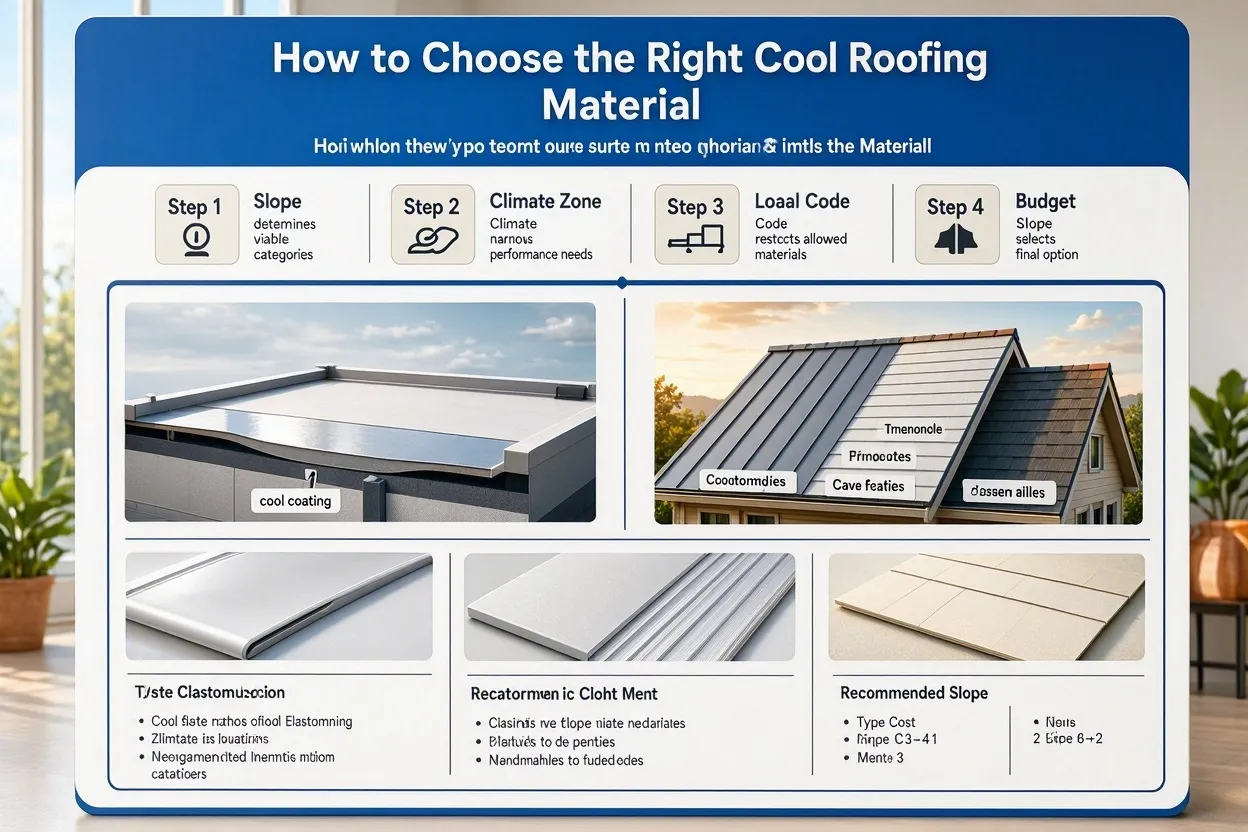
To choose the right cool roofing material, match the product to your roof’s slope first, then filter by climate zone, local code requirements, and budget in that order. Slope determines which categories are even viable; climate and code narrow the field further; budget makes the final call among what’s left.
Flat and low-slope roofs, generally under a 2:12 pitch (roughly 9.5 degrees from horizontal), suit membranes, coatings, and built-up systems, while steep-sloped roofs, the kind found on most detached homes, work better with shingles, tile, or metal. Forcing a flat-roof material onto a steep pitch usually costs more in labor and voids manufacturer warranties. From there, check climate and code: a homeowner in Texas or Queensland chasing maximum savings should prioritize the highest available reflectance, while a homeowner in a milder climate might land on a cool-colored product instead of pure white, and codes like California’s Title 24 or Australian state equivalents can set the minimum regardless of preference.
Budget decides what’s left. Coatings offer the lowest entry cost for existing roofs, and cool-colored shingles sit in the middle range. Membrane, metal, and tile options cost more upfront but often win on lifecycle cost once savings are factored in. Get quotes from at least two licensed contractors, confirm the product’s CRRC rating or NatHERS-relevant documentation, and ask about the three-year aged reflectance number, since that figure predicts long-term performance better than the initial rating.
Conclusion
Cool roofing materials aren’t a single product; they’re a category that spans membranes, shingles, metal, coatings, tile, and even vegetation, each suited to a different roof and climate. The clearest path forward starts with your roof’s slope, moves through your local climate and code requirements, and ends with a budget decision among whichever options survive that filter. Reflectance and emittance numbers give you an objective way to compare products head to head, and third-party ratings from the CRRC or compliance with NatHERS and NCC standards confirm those numbers hold up over time rather than fading after one season. Get the slope, climate, and certification right, and the material choice that’s left will almost always be the correct one.