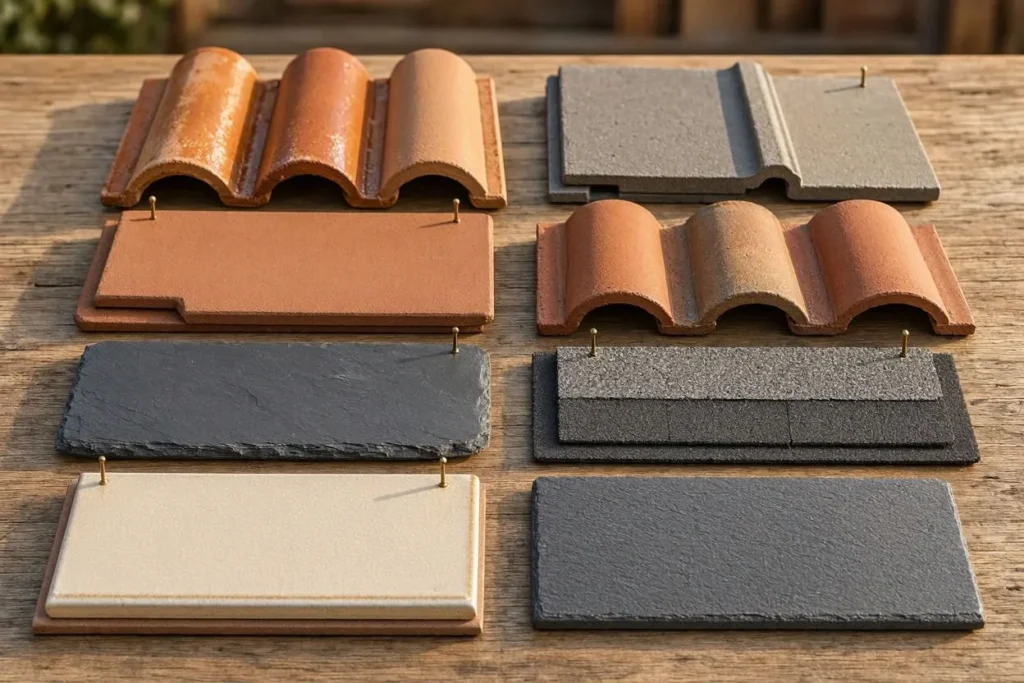
The different types of roof tiles split into 2 groups: materials (clay, concrete, natural slate, fibre cement, metal, composite, stone and solar) and styles, also called profiles (plain, pantile, Roman, Spanish, barrel and flat interlocking).
Concrete interlocking tiles are the cheapest mainstream pick at £40-£70 per m² fitted in the UK and 9-18 per sq ft installed in the US. Slate costs more. It also outlasts everything else on this list, with good Welsh slate passing 100 years on a well-built roof.
Picking between roofing tiles types comes down to 4 checks: roof pitch, the load your rafters can carry, budget and local planning rules. Below you’ll find every one of those kinds of roof tiles for UK and US homes, with names, costs, weights and pitch limits laid side by side.
How Do Roof Tiles Work?
Roof tiles work by overlapping, so rainwater runs off one tile onto the face of the tile below and never reaches the timber underneath. Each tile hangs on horizontal timber battens by 2 small lugs called nibs. Nails or clips then hold it down against wind uplift.
Overlap takes 2 forms. On a plain-tiled or slated roof, every point sits under at least 2 layers and often 3, which roofers call double lap. Interlocking tiles work differently: side channels and weather bars lock each tile to its neighbour, so a single layer keeps the water out. A plain-tiled roof needs about 60 tiles per m² (5.6 per sq ft). Large interlocking tiles cover it with around 10.
Beneath the tiles, a membrane catches any wind-driven rain that gets past them. UK roofs use a breathable underlay draped over the rafters, while US tile roofs sit on underlayment over solid decking, and the International Residential Code (IRC) Section R905.3 demands a double layer on slopes between 2.5:12 and 4:12.
A tiled roof has 4 working layers:
- Rafters or trusses carry the weight.
- Underlay or underlayment drains stray water to the gutter.
- Battens or decking give each tile a fixing point.
- Tiles shed the rain.
Fixing rules vary by site. In the UK, British Standard (BS) 5534 sets how many tiles need nails or clips, and exposed coastal roofs need far more of them than sheltered inland ones.
What Are Roof Tiles Called? Common Roof Tiles Types, Names and Uses
Roof tiles are named by their shape and their job: plain tiles, pantiles, Roman tiles, interlocking tiles, slates, Spanish tiles and barrel tiles cover the main slopes, while ridge, hip, valley and verge tiles finish the edges. Brands add product names on top, such as Marley Edgemere or Sandtoft 20/20. Your roofer’s quote, though, will use the generic names below.
| Tile name | What it looks like | Where you’ll see it |
| Plain tile | Small flat rectangle, 265 x 165 mm (10.4 x 6.5 in), slight camber | Southern and central England |
| Pantile | S-shaped wave laid in straight columns | England’s east coast, Scotland |
| Double Roman | Flat pan with 2 rolls per tile | UK housing estates, South West England |
| Interlocking tile | Large flat or profiled tile with side locks | UK new builds and extensions |
| Slate | Thin, flat sheet of split stone or a slate-look copy | Wales, Scotland, northern England, US Northeast |
| Spanish tile (S-tile) | One-piece S curve with a high profile | Florida, Arizona, California |
| Barrel tile (Mission) | Half-cylinders laid as pan and cover | California, US Southwest |
| Shake-look tile | Flat concrete tile textured like split cedar | US West, wildfire-prone areas |
| Ridge tile | Half-round or angled cap along the apex | Every pitched roof |
| Hip tile | Cap over the sloping external corners | Hipped roofs |
| Valley tile | Curved tile lining an internal corner | Roofs where 2 slopes meet |
| Verge tile | Edge unit or tile-and-a-half at the gable | Gable ends |
The plain tile’s size traces back to a charter of 1477 under King Edward IV, and most UK plain tiles still follow it.
Roof Tile Materials: 8 Types of Tile Roofing Material
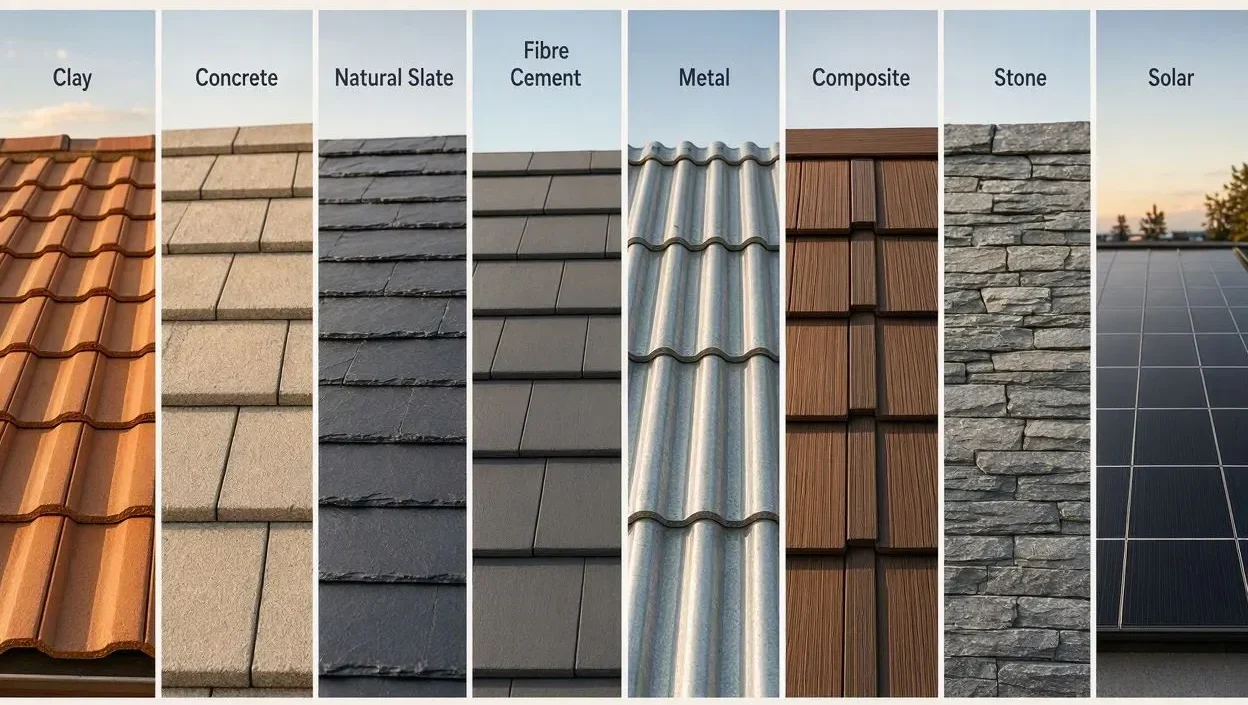
The 8 main roof tile materials are clay, concrete, natural slate, fibre cement, metal, composite, stone and solar. Concrete leads UK volume housing with roughly 48% of installations. Across the US Sun Belt, clay and concrete split most tile roofs between them.
Clay Roof Tiles
Clay tiles last 60-100+ years and hold their colour for life, because the colour is fired through the body of the tile rather than coated on. Building Research Establishment (BRE) testing found 60-year-old clay tiles still beating minimum strength requirements. Options run from handmade tiles, each one slightly irregular, to machine-made interlocking pantiles rated down to 15°. Weight is the drawback. A clay plain tile roof carries about 65-75 kg/m² (13.3-15.4 lb/sq ft).
UK clay tiles meet BS EN 1304, and US clay tiles are graded for freeze-thaw exposure under ASTM C1167. Expect £60-£100 per m² fitted in the UK, or 11-22 per sq ft installed in the US.
Concrete Roof Tiles
Concrete tiles are the cheapest mainstream roof tile at £40-£70 per m² in the UK and 9-18 per sq ft in the US, with a typical lifespan of 40-60 years. Sand and cement form the body. A surface coating supplies the colour, and that coating fades over the decades, leaving a grey core visible wherever a tile chips. Standard interlocking concrete tiles weigh 40-50 kg/m² (8.2-10.2 lb/sq ft), while US lightweight versions drop to around 5-7 lb/sq ft (24-34 kg/m²) for roofs that can’t take full weight.
Types of concrete roof tiles come in 5 common profiles:
- Plain concrete tiles, sized to match clay plain tiles
- Interlocking flat tiles, including slate-look designs with thin leading edges
- Double Roman tiles, with 2 rolls per unit
- Pantiles, in single and double widths
- Spanish, barrel and shake-look tiles, the main US formats
UK concrete tiles follow BS EN 490. US products are tested to ASTM C1492.
Natural Slate
Natural slate is the longest-lasting roof covering, with Welsh and Cumbrian slate passing 100 years and quality Spanish slate lasting 50 years or more. Quarried rock is split by hand into thin sheets, then nailed or hooked to battens in a double-lapped pattern. At 25-35 kg/m² (5.1-7.2 lb/sq ft), slate weighs less than a concrete plain tile roof. Price is the catch. UK slate roofs run £80-£140 per m² fitted, and US installs cost 15-35+ per sq ft. BS EN 12326 sets the quality grades for slate sold in the UK and Europe.
Fibre Cement Slates
Fibre cement slates cost less than natural slate and weigh about 18-22 kg/m² (3.7-4.5 lb/sq ft), but they last 30-50 years instead of a century. Each slate is cement reinforced with cellulose or synthetic fibres, pressed to the same thickness as natural slate. Colour dulls with age. That makes them a better fit for budget re-roofs and new builds than for period homes.
Metal Roof Tiles
Metal roof tiles are the lightest tile option at about 6-7 kg/m² (1.2-1.4 lb/sq ft), and stone-coated steel versions last 40-70 years. Pressed steel panels copy the look of pantiles or cedar shakes, and a stone-chip coating quietens rain noise. Many US products carry a UL 2218 Class 4 hail rating, the top impact grade, which can trim insurance premiums in hail-prone states such as Texas and Colorado. One weak spot needs care: cut edges rust unless the installer seals them. Budget £90-£150 per m² in the UK and 12-30 per sq ft in the US.
Composite and Plastic Roof Tiles
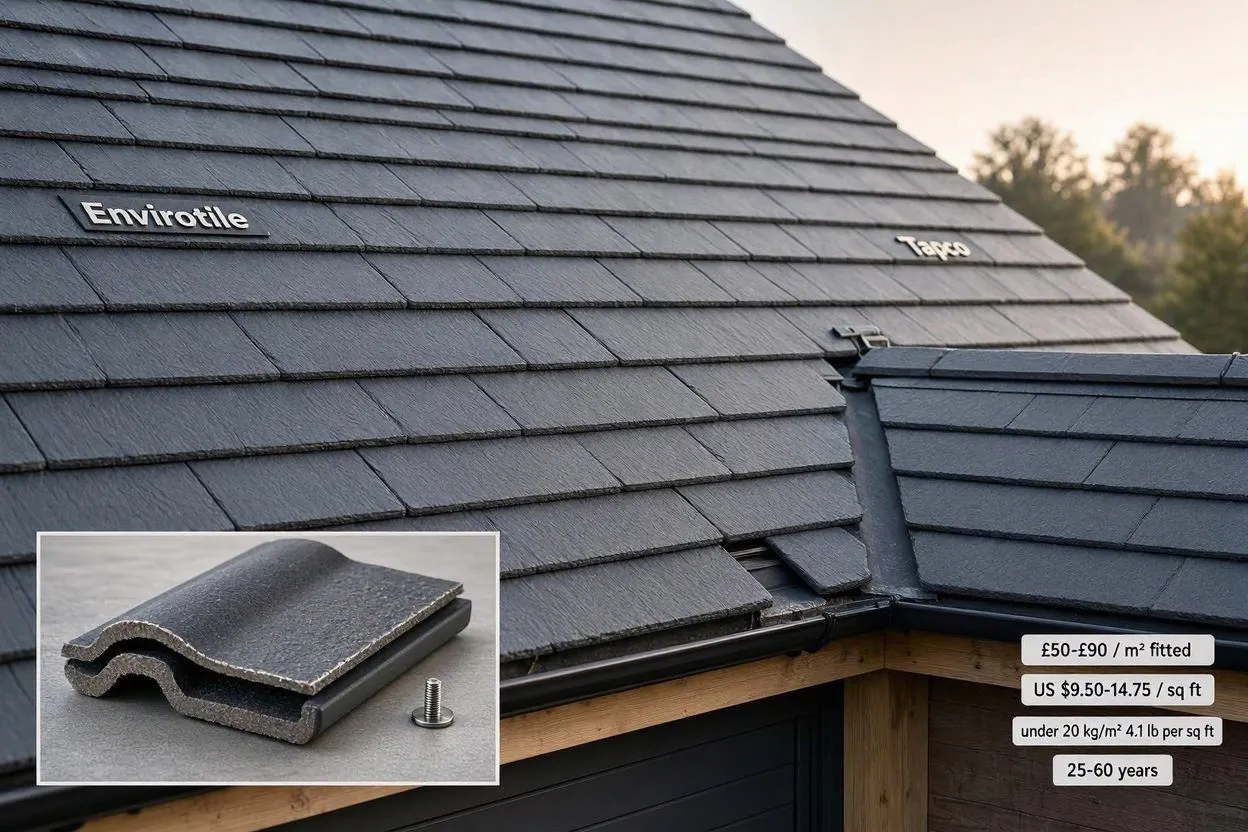
Composite and plastic roof tiles weigh under 20 kg/m² (4.1 lb/sq ft) and fit roofs as shallow as 12.5°, with lifespans of 25-60 years depending on the product. Most are moulded from recycled polymers or blended with mineral filler to copy slate. Products such as Envirotile and Tapco interlock fast, which suits garages and timber-frame extensions. UK prices sit at £50-£90 per m² fitted; US composite tiles average 9.50-14.75 per sq ft. Guarantees run shorter than on clay or slate, so read the warranty terms before you order.
Stone Slates
Stone slates are thick, split sandstone or limestone tiles found on historic buildings, and planners usually insist on them when a listed roof in their home region needs repair. Collyweston slates come from Northamptonshire, and Horsham stone comes from West Sussex. They’re heavier than clay plain tiles. Courses shrink as they rise, with the largest slates at the eaves and the smallest near the ridge, a pattern called diminishing courses. Few roofers still fix them, so expect specialist rates and long lead times.
Solar Roof Tiles
Solar roof tiles replace standard tiles with photovoltaic (PV) units that generate electricity for 25-30 years, while the roof around them lasts 60+. Marley’s SolarTile, for example, fits pitches from 20° to 60° and carries a 25-year panel efficiency guarantee. Because the units sit flush with clay or concrete tiles instead of being bolted above them, wind load drops and nesting birds stay out. Cost per watt runs higher than rack-mounted panels. Payback depends on your electricity tariff.
Roof Tile Styles: 5 Common Profiles and Designs
The 5 common roof tile styles are plain tiles, pantiles, Roman tiles, Spanish and barrel tiles, and flat interlocking tiles. Most profiles come in more than one material, so roof tiles design and material are 2 separate decisions. A double Roman, for instance, is sold in both clay and concrete.
Plain Tiles
Plain tiles are small, flat, double-lapped tiles that need a steep roof, with most products rated from 35° to 40°. Around 60 of them cover each m² (5.6 per sq ft), which is why a plain-tiled roof takes longer to lay. Handmade clay versions cost a premium and show the maker’s variations. Machine-made “handcrafted” tiles copy that irregular look for less money. For shallower extensions, interlocking plain-look tiles such as the Sandtoft 20/20 cut the count to about 20 per m² and work down to 15°.
Pantiles
Pantiles are S-shaped tiles laid in straight vertical columns, giving the rippled roofline common along England’s east coast from Lincolnshire to Yorkshire. Dutch trade brought them over centuries ago. Traditional clay pantiles are fixed-gauge and need an experienced installer. Later designs made the job quicker: concrete double pantiles arrived in the 1960s and clay double pantiles in 2008, each covering the width of 2 single tiles.
Roman Tiles
Roman tiles have a flat pan with a rounded roll along one side, and the double Roman, with 2 rolls per tile, is the version found on most UK homes. Concrete double Romans install from 22.5°. Single Romans are rarer now, though Sandtoft brought one back as the Tempest 44. In the South West, clay double Romans such as the Bridgwater still match the local vernacular.
Spanish and Barrel Tiles
Spanish tiles (S-tiles) are one-piece S curves, while barrel tiles are 2-piece half-cylinders laid as a pan and cover, and both define roofs across Florida and the US Southwest. Their high profile channels runoff quickly and lets air move under the tiles, a real advantage in hot climates. US installs cost about 12-15 per sq ft for Spanish tiles and 14-20 for Mission barrel. The IRC sets a minimum slope of 2.5:12 (about 12°) for clay and concrete tile.
Flat Interlocking and Slate-Look Tiles
Flat interlocking tiles give a clean, modern roof and suit the lowest pitches of any tile, with some concrete products rated from 12.5°. Marley’s Mendip 12.5 covers pitches between 12.5° and 15°. Slate-look tiles such as the Edgemere start at 17.5°, using thin leading edges to copy natural slate at a fraction of its weight. US makers texture flat concrete tiles to look like cedar shake too, a popular swap for real wood in wildfire zones because tile carries a Class A fire rating.
Different Types of Roof Tiles Compared
Concrete is the cheapest of the different types of roof tiles, and natural slate is the longest-lasting. Metal weighs least by a wide margin, at roughly a tenth of the load of a clay plain tile roof.
Installed cost by material
| Material | UK cost, fitted (per m²) | US cost, installed (per sq ft) |
| Concrete | £40-£70 | 9-18 |
| Composite / synthetic | £50-£90 | 9.50-14.75 |
| Clay | £60-£100 | 11-22 |
| Natural slate | £80-£140 | 15-35+ |
| Metal (stone-coated steel) | £90-£150 | 12-30 |
One m² equals 10.76 sq ft. US roofers quote by the square, which is 100 sq ft (9.29 m²).
Weight, lifespan and pitch by tile type
| Tile type | Weight (kg/m²) | Weight (lb/sq ft) | Lifespan (years) | Minimum pitch (UK) |
| Clay plain | 65-75 | 13.3-15.4 | 60-100+ | 30°-40° |
| Clay interlocking | 40-50 | 8.2-10.2 | 60-100 | 15° |
| Concrete plain | 75-80 | 15.4-16.4 | 40-60 | 35° |
| Concrete interlocking | 40-50 | 8.2-10.2 | 40-60 | 12.5°-25° |
| Natural slate | 25-35 | 5.1-7.2 | 50-150 | 20°-30° |
| Fibre cement slate | 18-22 | 3.7-4.5 | 30-50 | 20°-30° |
| Composite / plastic | 10-20 | 2.0-4.1 | 25-60 | 12.5°-22° |
| Metal (stone-coated) | 6-7 | 1.2-1.4 | 40-70 | 12°-15° |
Weights are typical figures. Your manufacturer’s datasheet gives the exact load for a specific product. US clay and concrete tile roofs need a minimum slope of 2.5:12 (about 12°), with double underlayment up to 4:12 (about 18°).
How to Choose the Right Roof Tile
To choose the right roof tile, match its minimum pitch to your roof and confirm your structure can carry its weight, then balance budget against lifespan and planning rules. Work through these 6 checks in order:
- Measure your roof pitch. Plain tiles need 35° or more, while specialist interlocking concrete tiles go down to 12.5°. In the US, any clay or concrete tile needs at least 2.5:12.
- Check the structural load. Swapping concrete interlocking tiles for clay plain tiles adds about 25 kg/m² (5 lb/sq ft), so get a structural engineer’s sign-off before moving to a heavier tile.
- Compare lifetime cost. A £60 per m² clay roof lasting 80 years works out cheaper per year than a £45 per m² concrete roof replaced at 45 years.
- Match your climate. Frost-prone regions need freeze-thaw rated tiles, such as ASTM C1167 Grade 1 clay in the northern US, and hail belts favour UL 2218 Class 4 products.
- Read local rules. Listed buildings and conservation areas in the UK often require like-for-like materials, and US homeowners associations (HOAs) frequently restrict tile colour and profile.
- Look along your street. Pantiles belong on the Lincolnshire coast and Welsh slate belongs in Snowdonia, and matching local roofs helps with both resale and planning approval.
Most UK re-roofs with a similar-looking tile need no planning application. Like-for-like replacement counts as permitted development, unless an Article 4 direction removes that right in your area.
How to Identify the Tiles on Your Roof
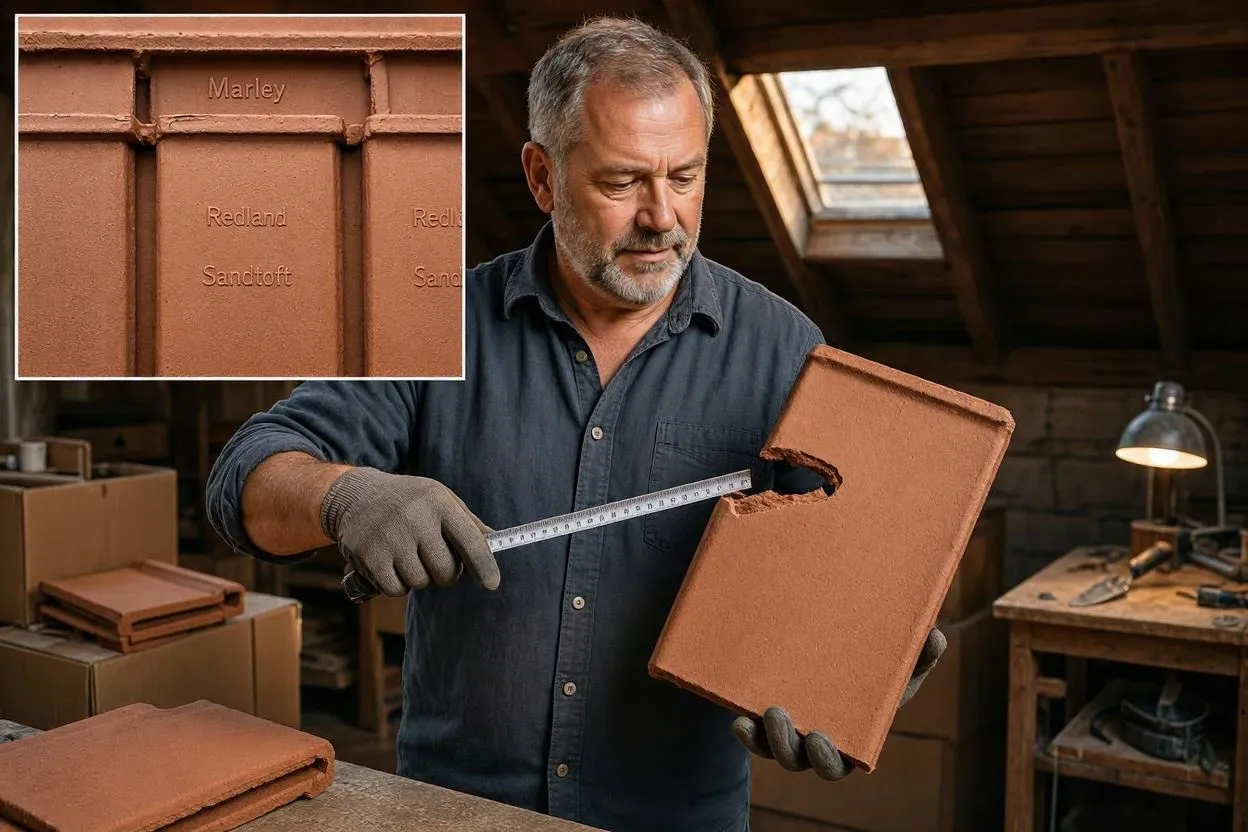
To identify your roof tiles, check the underside for a stamped maker’s name, then measure one tile and inspect a broken edge. A spare tile left in the loft or garage makes the easiest sample.
- Look for a stamp. Most modern UK tiles carry the maker’s name, such as Marley, Redland or Sandtoft, moulded into the back.
- Measure the tile. A 265 x 165 mm (10.4 x 6.5 in) tile is a plain tile, and 420 x 330 mm (16.5 x 13 in) is a common large-format interlocking size.
- Inspect a broken edge. Clay shows one colour right through, while concrete reveals a grey, sandy core.
- Split a chipped piece. Natural slate flakes into thin layers along its grain.
- Tap the tile. Slate rings with a clear note, whereas plastic and composite tiles sound dull and feel noticeably light.
Roofers source reclaimed tiles or borrow tiles from a hidden rear slope when your original tile is out of production, which keeps the front elevation matching. Reclaimed tiles often cost more than new ones. For small repairs, replacing up to 5 tiles averages about £170 in the UK when no scaffolding is needed.
FAQs
What is the longest-lasting type of roof tile?
Natural slate lasts longest. Welsh and Cumbrian slates regularly pass 100 years. Clay comes next at 60-100 years with little upkeep, while concrete averages 40-60.
Are clay roof tiles better than concrete?
Yes, for lifespan and colour. Clay keeps its fired finish and outlasts concrete by decades. Concrete still wins on price, running roughly £20-£30 less per m² to fit.
Can I put heavier tiles on my existing roof?
No, not without a structural check. Moving from lightweight tiles to clay plain tiles loads the rafters far more heavily. An engineer confirms whether reinforcement is needed before any work begins.
Do I need planning permission to change roof tiles?
No, in most UK cases. Like-for-like re-roofing counts as permitted development. Listed buildings and conservation areas are the exceptions, and US homeowners associations often set their own rules.
What kinds of roof tiles work on a low-pitch roof?
Interlocking concrete, stone-coated metal and composite tiles handle low pitches best. Certain concrete products are rated from 12.5°, whereas plain tiles and slate demand far steeper slopes.
Conclusion
The right choice among the different types of roof tiles starts with your roof pitch and structural capacity, and budget and looks settle the rest. Concrete interlocking tiles keep upfront costs lowest. Clay and natural slate cost more on day one but pay it back over 60-100+ years, while metal and composite tiles solve weight problems on older or lighter structures. Get at least 3 written quotes before you commit. In the UK, check that the roofer is registered with the National Federation of Roofing Contractors (NFRC) or its CompetentRoofer scheme; in the US, ask whether the crew installs to the Tile Roofing Industry Alliance (TRI) installation manual.