Geothermal heating and cooling systems extract heat from the earth’s stable underground temperature to heat and cool your home, cutting energy bills by 30–60% compared to conventional HVAC systems. A ground-source heat pump (GSHP) achieves a Coefficient of Performance (COP) of 3.0–5.0 meaning every 1 unit of electricity produces 3–5 units of heating energy, versus a gas furnace’s COP of 0.8–0.98.
Geothermal systems cost $10,000–$30,000 installed, qualify for a 30% federal tax credit under IRA Section 25D through 2033, and last 25 years for the indoor unit and 50+ years for the ground loop. This guide explains how the system works, which loop type fits your property, and how to calculate your payback period before signing any contract.
How Geothermal Heating and Cooling Systems Work
A geothermal system transfers heat between your home and the earth using 3 core components: a ground loop, a heat pump unit, and a heat distribution system. The ground loop circulates a water-antifreeze solution through buried pipes. The heat pump extracts heat from that solution in winter and deposits heat into it in summer.
The earth maintains a constant temperature of 45–75°F (7–24°C) at depths of 6–300 feet (1.8–91 meters) depending on geographic location. This stable temperature far warmer than outdoor air in winter and far cooler in summer — gives geothermal systems their efficiency advantage over air-source heat pumps that must work against extreme air temperatures.
The 3-component process works as follows in heating mode:
- Ground loop: Fluid at 32–40°F (0–4°C) circulates through buried pipes and absorbs heat from 50°F (10°C) soil
- Heat pump: A refrigerant circuit concentrates that low-grade heat into high-grade heat at 90–120°F (32–49°C)
- Distribution: Forced-air ductwork or hydronic radiant floor panels deliver warm air or warm water to every room
4 Types of Geothermal Loop Systems Compared
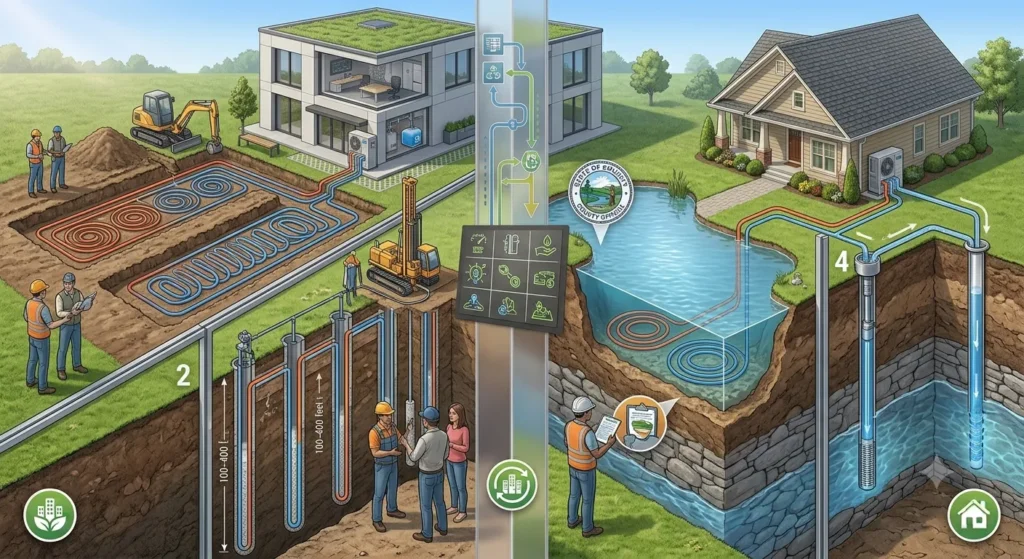
To install the right geothermal system, match the loop type to your property’s land area, soil type, and groundwater access. The 4 loop configurations are horizontal, vertical, pond/lake, and open-loop.

Horizontal Closed-Loop: Best for Properties with 0.5+ Acres
Horizontal loops run pipes at 4–6 feet (1.2–1.8 m) depth in trenches 100–400 feet (30–122 m) long. Each ton of heating and cooling capacity requires 400–600 linear feet (122–183 m) of pipe. A 3-ton system needs 1,200–1,800 feet (366–549 m) of trench, requiring at least 0.5 acres (0.2 hectares) of undisturbed land.
Horizontal loops cost $10,000–$20,000 for a 3-ton residential system. Installation uses standard trenching equipment — no specialized drilling required. Horizontal loops work best in soil with a thermal conductivity above 0.8 W/(m·K), which includes clay, loam, and moist sandy soils. Rocky or dry sandy soils conduct heat poorly and require longer pipe runs.
Vertical Closed-Loop: Best for Limited Land Area
Vertical loops drill boreholes 100–400 feet (30–122 m) deep and insert a U-tube pipe loop into each borehole. A 3-ton residential system needs 3–5 boreholes, each 4–6 inches (10–15 cm) in diameter and spaced 15–20 feet (4.6–6.1 m) apart to prevent thermal interference.
Vertical systems cost $15,000–$30,000 due to the drilling cost of $15–$25 per linear foot ($49–$82 per linear meter). They suit suburban lots smaller than 0.25 acres (0.1 hectares), and the driller fills each borehole with thermally conductive grout typically bentonite or cement-sand mix — to maximize heat transfer between soil and pipe.
Pond and Lake Loop: The Lowest-Cost Option
Pond loops submerge coiled pipes in a body of water at least 8 feet (2.4 m) deep. Water has 25 times the thermal conductivity of soil, making pond loops the most efficient closed-loop configuration. A 3-ton system requires a pond of at least 1/2 acre (0.2 hectares) at adequate depth.
Installation cost runs $7,000–$12,000 for a 3-ton system — the lowest loop installation cost available — because no drilling or extensive trenching is needed. Verify water rights and local regulations with your county before selecting a pond loop; some states restrict heat exchange equipment in natural water bodies.
Open-Loop System: Using Groundwater Directly
Open-loop systems pump groundwater from a well directly through the heat pump at 50–60°F (10–16°C) year-round, then discharge it to a return well or surface drainage. Open-loop systems achieve COP values of 4.0–6.0 — the highest of all configurations because groundwater is warmer and more consistent than soil-loop fluid.
Open-loop systems require a well producing at least 3 gallons per minute (11.4 liters per minute) per ton of system capacity, and water must test below 75 parts per million iron to prevent scaling in the heat exchanger. State-level permits for groundwater extraction apply in most U.S. jurisdictions.
Geothermal Loop Systems: Quick-Reference Comparison Table
Compare all 4 geothermal loop configurations by land requirement, installation cost, ideal soil/water condition, and typical COP.
| Loop Type | Land Needed | Install Cost (3-Ton) | Typical COP | Best Condition |
| Horizontal Closed | 0.5+ acres (0.2+ ha) | $10,000–$20,000 | 3.0–4.5 | Clay or loam soil |
| Vertical Closed | Any lot size | $15,000–$30,000 | 3.5–5.0 | Urban / small lot |
| Pond / Lake Loop | Water body on property | $7,000–$12,000 | 4.0–5.5 | Natural pond ≥ 8 ft deep |
| Open Loop | Well access required | $5,000–$10,000 + well | 4.0–6.0 | Clean groundwater well |
How to Determine If Your Home Qualifies for Geothermal Heating and Cooling
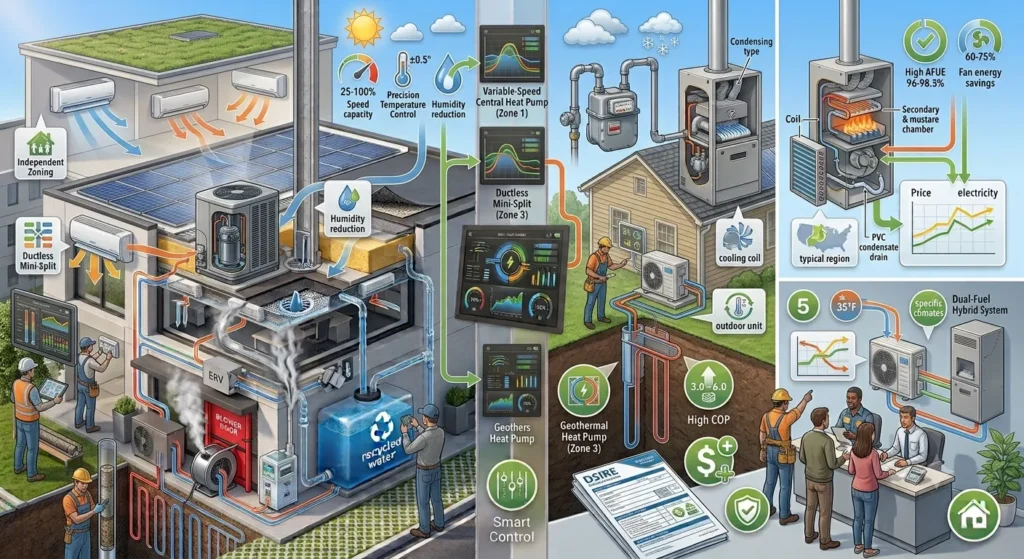
To determine if your home qualifies for geothermal heating and cooling, complete 4 assessments before contacting an installer.
Step 1: Building Load Calculation
Request a Manual J load calculation from a licensed HVAC engineer. The calculation determines the heating and cooling capacity your home needs in BTUs per hour. The average U.S. home requires 24,000–48,000 BTU/hr (2–4 tons) of capacity. Oversizing a geothermal system by more than 10% wastes capital; undersizing causes comfort problems in extreme weather.
Your roof directly affects building load poor insulation or a dark, low-SRI roof increases cooling demand by 15–25%. A roof inspection services assessment before sizing a geothermal system ensures the load calculation reflects actual heat transfer rates through your roof assembly, preventing an oversized and over-budget system.
Step 2: Soil or Water Assessment
Hire an International Ground Source Heat Pump Association (IGSHPA)-certified installer to conduct a soil thermal conductivity test for closed-loop systems or a water quality test for open-loop systems. Soil conductivity below 0.6 W/(m·K) requires longer pipe runs and increases cost by 20–30%.
Step 3: Land and Drilling Access
Confirm that drilling equipment typically a truck-mounted rotary drill 30 feet (9.1 m) long and 10 feet (3 m) wide can access the installation zone. Trees, utility lines, and setback requirements from property lines (typically 10 feet / 3 m) reduce the usable installation area. Obtain all utility locates before drilling begins.
What Does Geothermal Heating and Cooling Cost in 2026?
A complete residential geothermal system costs $10,000–$30,000 installed, covering the ground loop, heat pump unit, ductwork modifications, and electrical connections. The 30% IRA Section 25D tax credit reduces that range to $7,000–$21,000 net cost after credit.
Operating costs average $400–$800 per year for a 2,000 sq ft (186 sq m) home in Climate Zone 5, versus $1,200–$2,400 for a gas furnace and central air conditioner combination. The annual savings of $800–$1,600 produce a payback period of 5–10 years on a typical installation.
Geothermal systems also reduce water heating costs through a desuperheater a heat-recovery device built into the heat pump that captures waste heat during the cooling cycle and preheats domestic hot water at zero additional operating cost. A desuperheater reduces water heating bills by 25–50% in summer months.
Maintaining your roof in top condition also impacts geothermal system efficiency a leaking or poorly insulated roof increases the building heat load, forcing the heat pump to run longer and consume more electricity. Annual residential roof maintenance protects both the roof and the geothermal system’s efficiency over time.
Geothermal vs. Air Source Heat Pump: Which Is Better?
Geothermal systems outperform air-source heat pumps on 3 key metrics: COP at extreme temperatures, lifespan, and operating noise. Air-source heat pumps outperform geothermal on upfront cost and installation speed.
At outdoor temperatures below 20°F (-7°C), air-source heat pump COP drops to 1.5–2.0 as the unit struggles to extract heat from cold air. A geothermal system maintains COP 3.0–4.5 at the same outdoor temperature because ground temperature remains 45–55°F (7–13°C) regardless of surface weather.
Air-source heat pumps cost $5,000–$15,000 installed and last 15–20 years. Geothermal systems cost $10,000–$30,000 but last 25+ years for the indoor unit and 50+ years for the buried loop producing a lower total cost over a 30-year ownership period in most climate zones.
Geothermal indoor units operate at 45–60 decibels (dB) comparable to a household refrigerator. Air-source heat pump outdoor compressors reach 60–75 dB. For homeowners with units near bedroom windows or patio spaces, geothermal eliminates outdoor noise entirely since no outdoor unit exists.
Conclusion
Geothermal heating and cooling delivers the lowest operating cost of any residential HVAC technology in 2026, with COP values of 3.0–6.0, a 30% federal tax credit, and ground loops lasting 50+ years. Vertical systems suit any lot size; horizontal systems minimize drilling cost on larger properties.
Before sizing a geothermal system, address your roof’s thermal performance. A poorly insulated or damaged roof increases your building load and forces your heat pump to work harder, raising operating costs. Contact Rainy Roofers to assess your roof’s insulation and energy efficiency before your HVAC contractor runs the Manual J calculation. A tight, well-insulated roof shrinks your required system size and reduces upfront geothermal installation cost.