
Most homeowners waste thousands of dollars on materials that harm indoor air quality, spike energy bills, and fail within 15 years. Green building materials solve all 3 problems at once.
The 15 best green building materials for USA homes in 2026 are cross-laminated timber (CLT), bamboo, hempcrete, cork, recycled steel, fly ash concrete, reclaimed wood, adobe brick, low-emissivity (Low-E) glass, sheep wool insulation, mycelium panels, straw bale, recycled glass tile, aerogel insulation, and zero volatile organic compound (VOC) paint.
What Are Green Building Materials?
Green building materials are construction products made from renewable, recycled, or low-impact resources that reduce energy use, carbon emissions, and indoor air pollution. A material qualifies as green when it meets at least one of these 4 criteria:
- Sourced from rapidly renewable resources (bamboo regenerates in 3–5 years vs. 60 years for oak)
- Contains recycled content (fly ash concrete uses 30–60% industrial waste)
- Produces zero or near-zero VOC emissions during and after installation
- Delivers measurably better thermal performance than conventional alternatives
The U.S. Green Building Council (USGBC) tracks these standards through the Leadership in Energy and Environmental Design (LEED) certification system. Over 105,000 LEED-certified projects now exist across the United States as of 2026.
Why Green Building Materials Matter in 2026
Buildings account for 39% of total U.S. carbon emissions — more than transportation or industry. The construction sector alone generates 11% of global CO2 through embodied carbon, the emissions locked into materials before a building is even occupied.
3 things changed in 2026 that make green materials more practical than ever:
Cost parity. Hempcrete now costs $2.25–$3.50 per sq ft installed — within 15% of standard concrete. Five years ago, the gap was 40%.
Federal incentives. The Inflation Reduction Act (IRA) extended tax credits through 2032 for energy-efficient building upgrades, covering insulation, windows, and HVAC systems.
Contractor availability. Over 47,000 LEED-accredited professionals now work across the USA, meaning certified installers are available in every major metro area.
15 Best Green Building Materials (With Real 2026 Cost Data)
1. Cross-Laminated Timber (CLT)
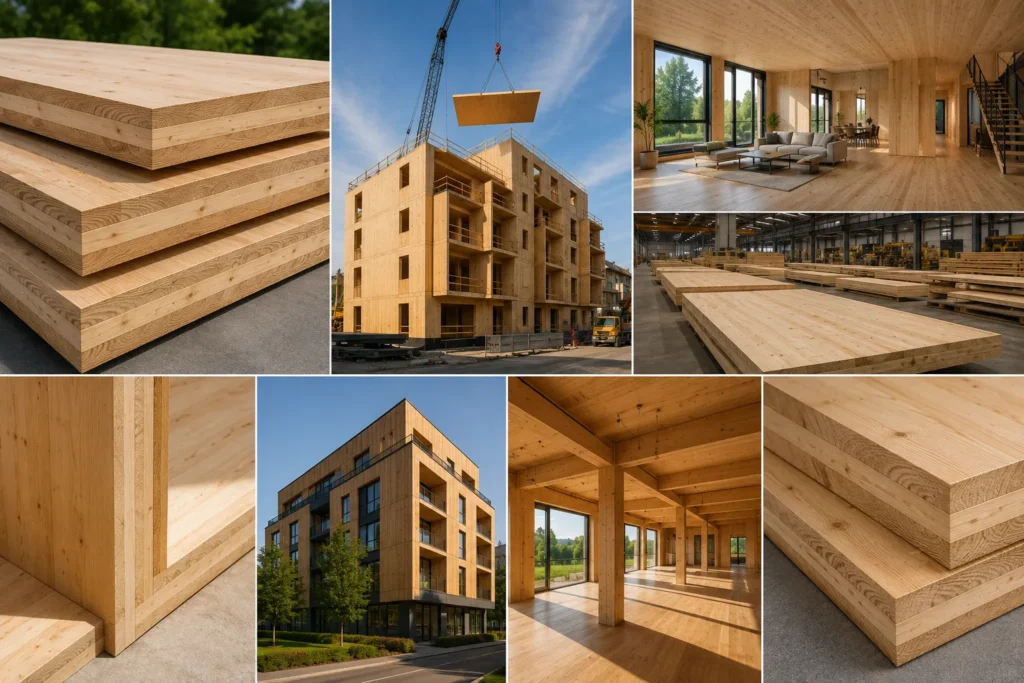
CLT stores 1 ton of CO2 per cubic meter of wood while delivering structural strength comparable to reinforced concrete. Builders use CLT panels for walls, floors, and roofs in buildings up to 18 stories tall. CLT sequesters carbon rather than releasing it — the only mainstream structural material with a net negative carbon footprint.
- Cost: $4–$9 per sq ft ($43–$97 per m²)
- Lifespan: 80–100 years with proper moisture management
- LEED points: Up to 4 points under Materials & Resources
- Best for: Residential structures, mid-rise commercial buildings
CLT requires a char-resistant coating in buildings over 3 stories per the 2021 International Building Code (IBC).
2. Bamboo Flooring
Bamboo reaches full structural maturity in 3–5 years — 20 times faster to replenish than oak hardwood. Strand-woven bamboo achieves a Janka hardness rating of 3,000–3,500 lbf (13,344–15,568 N), harder than most domestic hardwoods.
- Cost: $3–$8 per sq ft ($32–$86 per m²) installed
- Lifespan: 25–30 years
- VOC concern: Check for formaldehyde-free adhesives — some budget brands still use urea-formaldehyde binders
- Best for: Living rooms, bedrooms, light commercial spaces
Bamboo expands 1–3% with sustained moisture exposure — avoid bamboo in bathrooms or areas with standing water.
3. Hempcrete
Hempcrete reduces a wall’s embodied carbon by 40–80% compared to standard concrete blocks. Hempcrete is a mixture of hemp hurd (the woody core of the hemp plant), hydraulic lime, and water. Builders use hempcrete as insulating infill within a structural timber frame — hempcrete is not load-bearing.
- Cost: $2.25–$3.50 per sq ft ($24–$38 per m²) installed
- R-value: R-2.5 per inch (RSI-0.17 per cm)
- Lifespan: 50–100 years, improving as hempcrete mineralizes over time
- Best for: Wall infill in timber-framed homes, retrofit insulation
Hempcrete is legal in all 50 U.S. states following the 2018 Farm Bill, which legalized industrial hemp cultivation nationwide.
4. Cork Insulation
Cork delivers an R-value of 3.6–4.2 per inch (RSI-0.25–0.29 per cm), outperforming standard fiberglass batts at equal thickness. Cork comes from Quercus suber (cork oak) bark, harvested every 9 years without cutting the tree down.
- Cost: $0.50–$2.00 per sq ft ($5.38–$21.53 per m²)
- Weight: 4–7 oz per sq ft (120–210 g per 0.09 m²)
- Mold resistance: Suberin in cork cell walls naturally repels mold, mildew, and insects
- Best for: Wall insulation, floor underlayment, roof decking
80% of global cork production comes from Portugal and Spain — U.S. buyers should factor in 3–6 week shipping lead times for large orders.
5. Recycled Steel
Recycled steel carries 25–75% less embodied carbon than virgin steel, depending on the electric arc furnace (EAF) process used. The American steel industry currently recycles 98% of all structural steel from demolished buildings.
- Cost: $1.50–$4.00 per linear ft ($4.92–$13.12 per linear meter) for framing
- Tensile strength: 36,000–50,000 psi (248–345 MPa)
- Fire resistance: Class A — does not burn or spread flame
- Best for: Structural framing, roofing, rebar reinforcement
Steel framing homes cost 10–15% less to insure than wood-frame homes because steel is non-combustible.
6. Fly Ash Concrete
Fly ash concrete uses 30–60% less Portland cement, cutting CO2 emissions by 15–30% per cubic yard. Fly ash is a byproduct of coal combustion captured from power plant emissions — using fly ash diverts industrial waste from landfills.
- Cost: $90–$130 per cubic yard ($118–$170 per cubic meter) — 5–10% cheaper than standard concrete
- Compressive strength: 4,000–6,000 psi (27.6–41.4 MPa) at 28 days
- Durability: Higher sulfate resistance and lower permeability than standard concrete
- Best for: Foundations, driveways, concrete slabs
Fly ash concrete takes 15–20% longer to cure than standard concrete in climates below 40°F (4.4°C).
7. Reclaimed Wood
Reclaimed wood carries zero new embodied carbon because reclaimed wood repurposes timber already cut decades ago. Old-growth reclaimed Douglas fir, heart pine, and barn oak are denser and more stable than new-growth equivalents.
- Cost: $5–$15 per sq ft ($54–$161 per m²) for flooring
- Lifespan: 50–100+ years already demonstrated
- Best for: Flooring, accent walls, furniture, ceiling beams
Always test reclaimed wood for lead paint (pre-1978 stock) before installation. A lead swab test costs $3–$8 at any hardware store.
8. Adobe Brick
Adobe brick provides thermal mass of 30–40 BTU per sq ft per °F (170–227 kJ per m² per °C), stabilizing indoor temperatures without mechanical heating or cooling. Adobe works best in climates with large day-to-night temperature swings — common across Arizona, New Mexico, and Texas.
- Cost: $0.30–$1.00 per brick; $8–$15 per sq ft ($86–$161 per m²) installed
- Compressive strength: 300–500 psi (2.1–3.4 MPa)
- Insurance: Most carriers classify adobe as masonry construction — lower premiums than wood frame
- Best for: Dry climates with under 20 inches (508mm) of annual rainfall
Adobe requires a stucco or lime plaster finish coat to protect adobe walls against water erosion.
9. Low-Emissivity (Low-E) Glass
Low-E glass reduces heat transfer through windows by 30–50% compared to single-pane clear glass. A metallic oxide coating on Low-E glass reflects infrared heat while allowing visible light through.
- Cost: $350–$900 per window installed (double-pane Low-E)
- U-factor: 0.20–0.30 (lower = better insulation; single-pane = 1.0)
- Solar Heat Gain Coefficient (SHGC): 0.25–0.40 for most U.S. climates
- IRA tax credit: 30% federal tax credit up to $600 per year
- Best for: All new construction; priority retrofit for south- and west-facing windows
Pair Low-E glass with thermally broken aluminum or fiberglass frames to eliminate the most common source of window heat loss.
10. Sheep Wool Insulation
Sheep wool absorbs and releases moisture without losing thermal performance, making sheep wool the best insulation choice for humid climates. Wool fibers hold up to 35% of their weight in moisture while maintaining R-values.
- Cost: $1.00–$2.50 per sq ft ($10.76–$26.91 per m²)
- R-value: R-3.5–4.3 per inch (RSI-0.24–0.30 per cm)
- Air quality: Lanolin in wool fibers absorbs formaldehyde, nitrogen dioxide, and sulfur dioxide from indoor air
- Fire resistance: Wool self-extinguishes — does not drip or spread flame
- Best for: Wall cavities, attic insulation in coastal or high-humidity regions
Sheep wool costs 20–40% more than fiberglass batts upfront but lasts 50+ years, while fiberglass loses R-value by 20–40% within 15 years.
11. Mycelium Panels
Mycelium panels achieve compressive strength of 30–60 psi (207–414 kPa) using zero petroleum-based binders. Mycelium panels grow from fungal root networks bonded to agricultural waste like corn husks or hemp stalks. Ecovative Design, based in New York, manufactures mycelium panels commercially for U.S. buyers.
- Cost: $2–$6 per sq ft ($21.53–$64.58 per m²) — prices dropping 15% annually
- Weight: 1–2 oz per sq ft (30–60 g per 0.09 m²) — lightest panel available
- Thermal performance: R-3 to R-4 per inch depending on density
- Best for: Non-load-bearing interior insulation, acoustic tiles
Mycelium panels are 100% home compostable at end of life — the only mainstream panel material with this property.
12. Straw Bale
Straw bale walls achieve R-30 to R-35 per wall assembly — nearly double the R-19 standard for 2×6 wood-framed walls. Builders compress wheat, rice, or rye straw into bales, then finish with lime plaster inside and out.
- Cost: $3–$7 per sq ft ($32–$75 per m²) owner-build; $10–$20 with contractor labor
- Fire resistance: Lime-plastered straw bale achieves 2-hour fire ratings in ASTM E119 testing
- Sound reduction: 40–50 decibels (dB)
- Best for: Owner-builder projects, rural construction, passive house designs
California, Texas, and Arizona have established straw bale residential building codes — check local requirements before design.
13. Recycled Glass Tile
Recycled glass tile production uses 40% less energy than manufacturing new glass tile from raw silica. Manufacturers melt post-consumer glass bottles and windows into tiles with no loss in strength or appearance.
- Cost: $8–$25 per sq ft ($86–$269 per m²) installed
- Durability: Mohs hardness 5–6 (harder than porcelain at 4–5)
- VOC emissions: Zero
- Best for: Kitchen backsplash, bathroom tile, countertops, pool tile
Recycled glass tile reduces related water pollution by 50% and air pollution by 20% compared to virgin glass production.
14. Aerogel Insulation
Aerogel delivers R-10 per inch (RSI-0.70 per cm) — the highest R-value per inch of any commercial insulation. Aerogel is 95% air by volume, making aerogel the world’s lowest-density solid material.
- Cost: $2.00–$5.00 per sq ft ($21.53–$53.82 per m²) for blanket form
- Thickness efficiency: 10mm (0.39 inches) of aerogel equals 90mm (3.54 inches) of standard fiberglass
- Best for: Retrofit projects where wall cavity depth is limited, urban renovations
Aerogel costs 5–10x more than fiberglass but requires 80–90% less wall thickness — a major advantage where square footage is expensive.
15. Zero-VOC Paint
Zero-VOC paint contains fewer than 5 grams per liter (g/L) of volatile organic compounds, versus 150–400 g/L in conventional interior paints. VOCs from standard paint cause headaches, dizziness, and respiratory irritation in 30% of occupants within the first 6 months of application.
- Cost: $40–$80 per gallon ($10.57–$21.13 per liter) — within $5–$15 of conventional paint
- Top USA brands: AFM Safecoat, ECOS Paints, Behr Premium Plus
- LEED points: Up to 1 point under Indoor Environmental Quality (IEQ)
- Best for: All interior surfaces — mandatory for nurseries, schools, and healthcare buildings
Look for Greenguard Gold certification — the strictest indoor air quality standard available in the USA.
Green Building Materials Cost Comparison (2026)
| Material | Cost per sq ft | R-Value per inch | Carbon Impact | Lifespan |
| CLT | $4–$9 | Structural | Negative (-1 ton CO2/m³) | 80–100 yrs |
| Bamboo Flooring | $3–$8 | Flooring | Very Low | 25–30 yrs |
| Hempcrete | $2.25–$3.50 | R-2.5 | -80% vs. concrete | 50–100 yrs |
| Cork Insulation | $0.50–$2.00 | R-3.6–4.2 | Near Zero | 50+ yrs |
| Recycled Steel | $1.50–$4.00/lf | Structural | -75% vs. virgin steel | 100+ yrs |
| Fly Ash Concrete | $90–$130/yd³ | Structural | -30% vs. standard | 50–75 yrs |
| Reclaimed Wood | $5–$15 | Structural | Zero new carbon | 50–100+ yrs |
| Aerogel | $2.00–$5.00 | R-10 | Low | 30+ yrs |
| Sheep Wool | $1.00–$2.50 | R-3.5–4.3 | Very Low | 50+ yrs |
| Low-E Glass | $350–$900/window | Glazing | Low | 20–30 yrs |
| Straw Bale | $3–$7 | R-2.4 (R-30+ assembly) | Near Zero | 50–100 yrs |
| Zero-VOC Paint | $40–$80/gal | N/A | Low | 7–10 yrs |
Federal Tax Credits for Green Building Materials in 2026
The IRA provides 3 direct tax credits relevant to green building materials:
- Energy Efficient Home Improvement Credit (Section 25C) — covers 30% of qualifying improvement costs, up to:
- Insulation and air sealing: $1,200 per year
- Windows and skylights: $600 per year
- Exterior doors: $500 per year
- Heat pumps: $2,000 per year
- Residential Clean Energy Credit (Section 48) — covers 30% of solar, wind, and geothermal systems with no dollar cap through 2032.
- New Energy Efficient Home Credit (Section 45L) — builders earn $2,500 per ENERGY STAR home, or $5,000 per zero-energy ready home.
File IRS Form 5695 with your federal return to claim these credits. Keep all receipts and manufacturer certification statements.
How to Choose the Right Green Material for Your Climate Zone
The U.S. Department of Energy (DOE) divides the country into 8 climate zones:
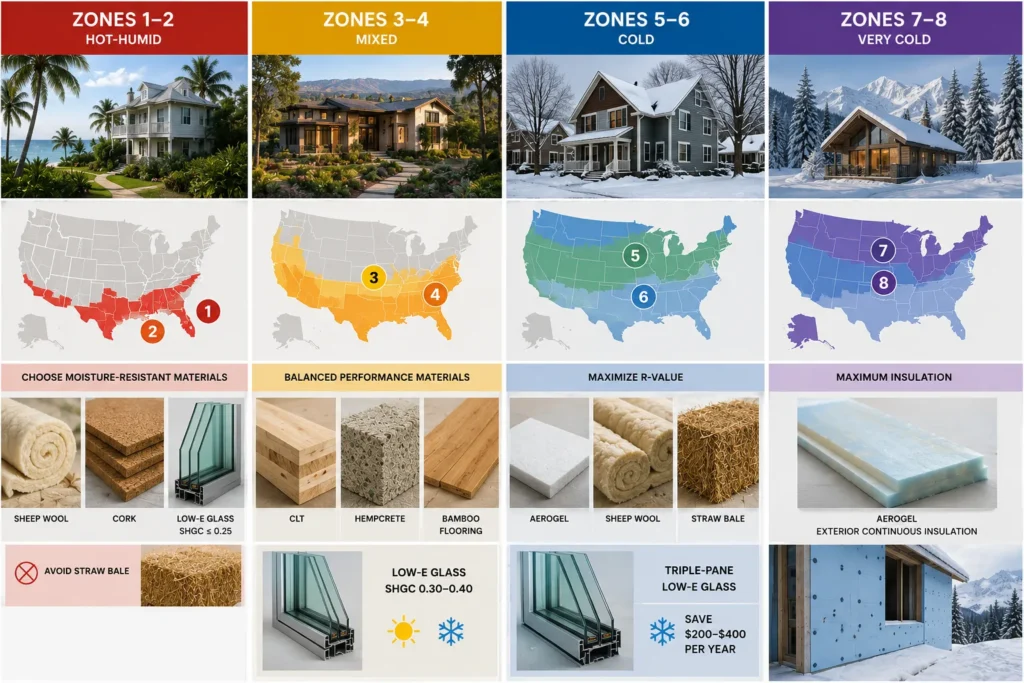
Zones 1–2 (Hot-Humid: Florida, Louisiana, South Texas) — Choose moisture-resistant materials: sheep wool, cork, and Low-E glass with SHGC of 0.25 or below. Avoid straw bale — high humidity causes mold risk without exceptional moisture detailing.
Zones 3–4 (Mixed: California, Virginia, North Carolina) — CLT, hempcrete, and bamboo flooring all perform reliably. Low-E glass with SHGC of 0.30–0.40 balances solar gain in winter with cooling load in summer.
Zones 5–6 (Cold: Illinois, Minnesota, New York) — Maximize R-value. Aerogel, sheep wool, and straw bale assemblies deliver the highest thermal resistance. Triple-pane Low-E glass saves $200–$400 per year in heating costs in Zone 6.
Zones 7–8 (Very Cold: Alaska, Northern Minnesota) — Use aerogel for exterior continuous insulation. Avoid cork outdoors — cork degrades faster below -20°F (-28.9°C) with freeze-thaw cycling.
LEED Certification: Which Materials Qualify
LEED assigns points across 9 categories. Green building materials contribute in 3 main areas:
Materials & Resources (MR) — up to 13 points
- Recycled content (fly ash concrete, recycled steel): 1–2 points
- Regionally sourced materials within 500 miles (805 km): 1–2 points
- Rapidly renewable materials (bamboo, cork, wool): 1 point
- FSC-certified wood (CLT, reclaimed wood): 1 point
Indoor Environmental Quality (IEQ) — up to 16 points
- Zero-VOC paint and finishes: 1 point
- Low-emitting adhesives and sealants: 1 point
Energy & Atmosphere (EA) — up to 33 points
- High-performance insulation (sheep wool, aerogel) contributes to energy model points
A LEED-certified home saves 30–50% on energy costs compared to a code-minimum home, per USGBC data.
5 Mistakes Buyers Make When Choosing Sustainable Materials
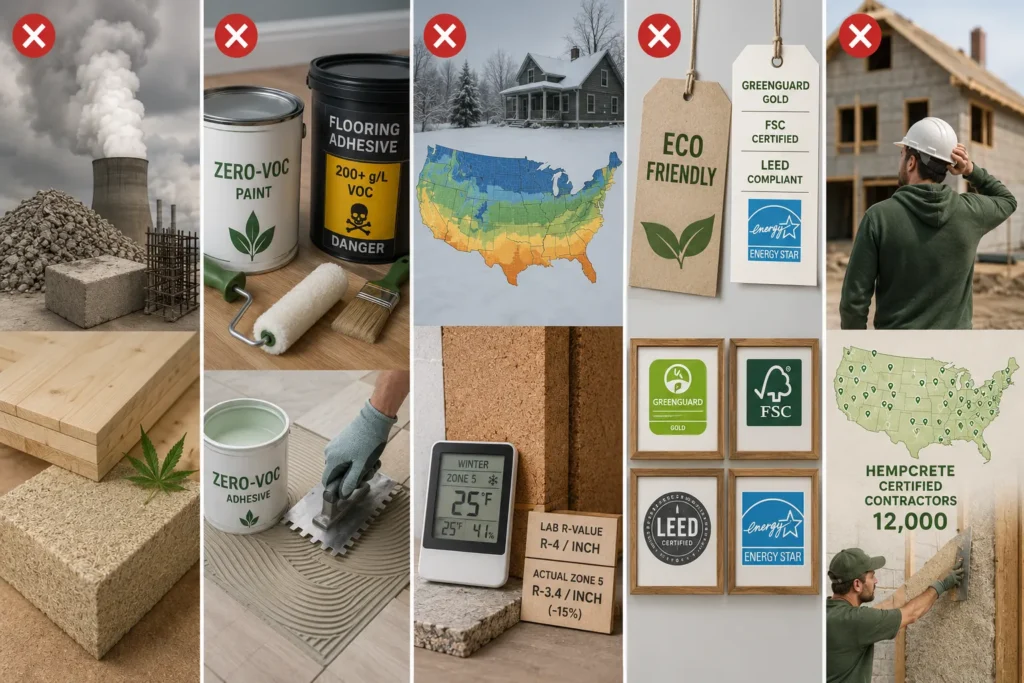
- Ignoring embodied carbon. Most buyers focus on monthly energy bills and ignore CO2 released during manufacturing. Standard concrete emits 0.9 lbs of CO2 per lb of material (0.9 kg per kg). CLT and hempcrete have near-zero embodied carbon.
- Choosing zero-VOC paint but toxic adhesives. Zero-VOC paint means nothing when flooring adhesives off-gas 200+ g/L of VOCs for 6 months. Specify zero-VOC or water-based adhesives across every material layer.
- Skipping climate zone research. Cork performs at R-4 per inch in a controlled lab. In Zone 5 winters with daily freeze-thaw cycles, performance drops 10–15%. Match materials to your actual climate.
- Paying a premium for green labels without third-party certification. “Eco-friendly” is a marketing claim. Greenguard Gold, FSC, LEED, and Energy Star are third-party verified. Only pay a premium for certified products.
- Underestimating installation complexity. Only 12,000 hempcrete-certified contractors operate in the USA in 2026. Budget 15–20% more for labor when your material requires specialist installation.
Conclusion
Green building materials are no longer a niche choice reserved for eco-conscious early adopters — they are the practical, cost-effective standard for U.S. homeowners in 2026. With materials like fly ash concrete undercutting conventional concrete on price, zero-VOC paint matching conventional options dollar for dollar, and federal tax credits returning up to $3,500 annually through 2032, the financial case is as strong as the environmental one.
The 15 materials covered in this guide span every budget, climate zone, and project type. Whether you are pouring a foundation, insulating an attic, or simply repainting a living room, at least one green alternative outperforms its conventional counterpart on cost, durability, or both.
The key is matching material to context. Aerogel belongs in tight urban retrofits. Straw bale excels in rural owner-builds. Sheep wool outperforms fiberglass in humid coastal climates. Adobe brick stabilizes temperatures across the desert Southwest without mechanical intervention. No single material wins everywhere — but for every project, a smarter option exists.
Start with the three highest-impact, lowest-barrier changes: zero-VOC paint, fly ash concrete, and Low-E glass. Then work with a LEED-accredited professional to layer in structural and insulation upgrades that compound your savings year over year. The homes built and renovated with these materials today will outperform, outlast, and out-sell their conventional counterparts for decades to come.