Indoor air carries two to five times more pollutants than outdoor air, according to the EPA. Fixing that rarely requires a renovation. Here’s how to improve air quality in home settings by cutting pollution at the source, ventilating, filtering, and controlling humidity, in that order of impact, starting with the fastest fix.
What affects indoor air quality in a home

Four things determine indoor air quality: pollution sources, ventilation rate, humidity, and filtration. Pollution sources include gas stoves, new furniture, and cleaning products that off-gas VOCs into enclosed rooms. Ventilation rate is how often indoor air exchanges with outdoor air. A poorly sealed 1980s home might exchange air every 30 minutes; a newly built, energy-efficient home can go hours without a full exchange. Humidity above 50% encourages mold and dust mites. Below 30%, it dries out mucous membranes and makes you more susceptible to airborne viruses. Filtration efficiency comes down to what filter is in the HVAC system and how often it gets changed.
A 2021 study in Environmental Research Letters linked elevated indoor PM2.5 and carbon dioxide to lower cognitive performance in office workers. Balance one of these factors without the others and pollutant levels climb anyway.
Source control: the fastest fix
Removing pollution at the source works faster than filtering or ventilating around it. Smoking and vaping indoors releases particulates that settle into upholstery and carpet fibers for weeks after a single session, so both should happen outside, no exceptions. Scented candles, air fresheners, and wax warmers add VOCs rather than removing odors. Soap and water actually outperform most commercial air fresheners at eliminating smells.
Furniture polish, chlorine bleach, and ammonia rank among the worst offenders. Mixing bleach and ammonia produces toxic chloramine gas, a documented cause of ER visits, so keep them far apart. Look for cleaning products labeled “low-VOC” or “no added fragrance” instead. New carpet, mattresses, and pressed-wood furniture off-gas formaldehyde for the first several weeks after purchase, so crack a window during that window if you can.
Ventilation strategies that work
Opening windows for 10 to 15 minutes a day dilutes indoor pollutants faster than any filter can remove them. Cross-ventilation, opening windows on opposite sides of the home, moves air through a space in minutes instead of hours. If the local AQI reads above 100, though, keep windows closed and let filtration do the work instead; outdoor pollution at that level outweighs the benefit of fresh air.
Exhaust fans in the bathroom and kitchen matter more than most people think. A range hood that vents outdoors pulls cooking particulates out of the house; one that just recirculates does almost nothing for particulate matter. Gas stoves release meaningfully more nitrogen dioxide and fine particulates than electric burners do, so running the range fan during every cooking session isn’t optional if you have a gas stove.
Air filtration: MERV and HEPA explained
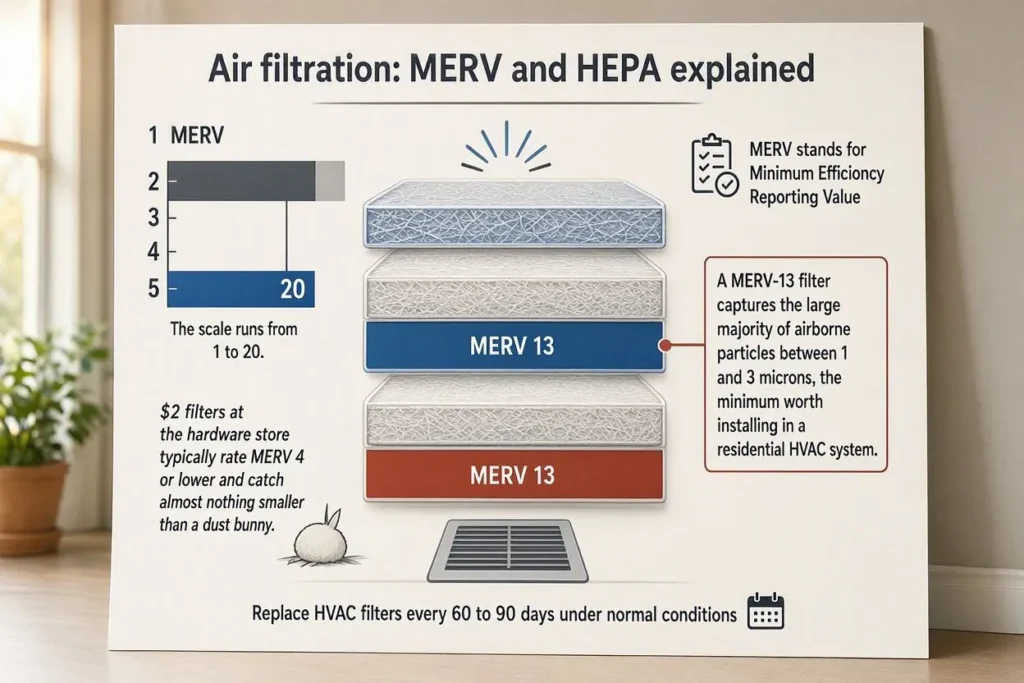
A MERV-13 filter captures the large majority of airborne particles between 1 and 3 microns, the minimum worth installing in a residential HVAC system. MERV stands for Minimum Efficiency Reporting Value, and the scale runs from 1 to 20. Those $2 filters at the hardware store typically rate MERV 4 or lower and catch almost nothing smaller than a dust bunny.
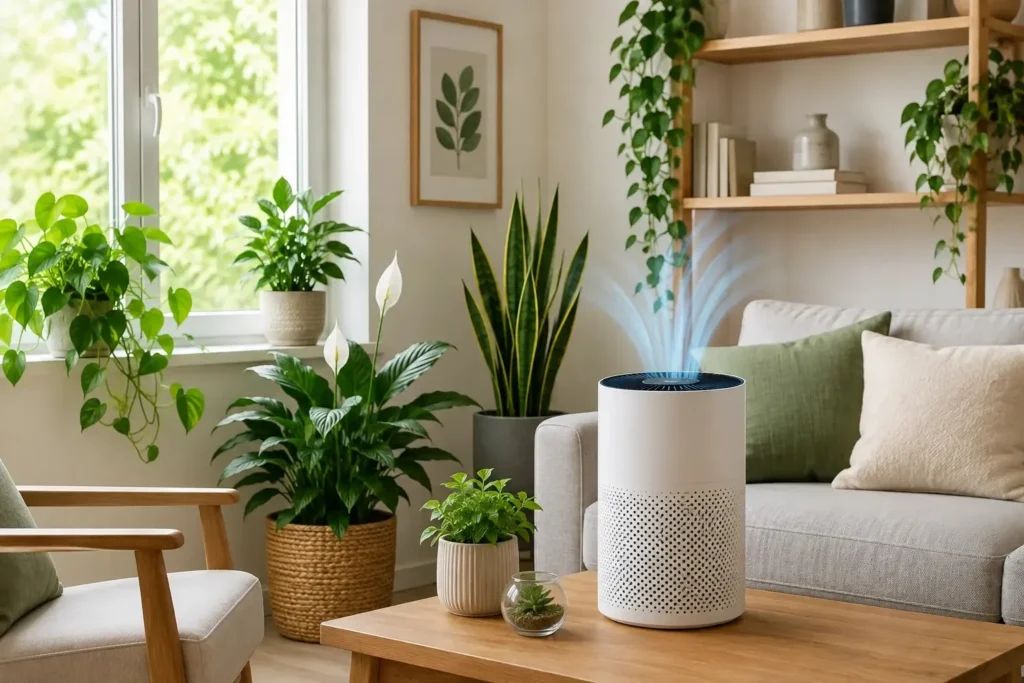
Replace HVAC filters every 60 to 90 days under normal conditions, or every 30 to 45 days if you have pets or you’re in a high-pollen season. Portable HEPA air cleaners work well for single rooms. Look for a Clean Air Delivery Rate (CADR) rated for a room at least 20% larger than the space it’ll actually serve. A 300-square-foot bedroom needs a purifier rated around 250 CADR or higher to cycle the air multiple times an hour.
Humidity control for mold and dust mites
Keep indoor relative humidity between 30% and 50% to prevent both mold growth and dust mite proliferation. Mold spores can germinate within 24 to 48 hours on a damp surface, so any leak or spill needs attention that same day.
A whole-house dehumidifier handles humid climates better than portable units since it treats the whole home rather than one room. If winter humidity drops below 30%, a humidifier helps with static electricity and respiratory dryness, though pushing past 50% just creates the opposite problem. Bathrooms need the most attention: run the exhaust fan for 20 minutes after every shower to clear steam before it condenses on the walls and ceiling.
Radon testing and carbon monoxide safety
Yes, every home needs a radon test. Radon is the second-leading cause of lung cancer in the U.S. after smoking, and the EPA estimates it causes around 21,000 lung cancer deaths a year. It’s a colorless, odorless radioactive gas that seeps up through foundation cracks from the soil below, and testing is the only way to catch it. A short-term charcoal canister kit costs under $20 and gives results within a few days.
If levels come back above 4 picocuries per liter (the EPA’s action threshold), a licensed radon mitigation contractor can install a sub-slab depressurization system that cuts concentrations by up to 99%. Carbon monoxide is a separate, faster-acting risk. Install a detector on every level of the home, especially near sleeping areas, and swap the batteries once a year regardless of what the low-battery chirp tells you.
What to do about wildfire smoke
Sealing the home and running a HEPA air cleaner on high protects indoor air better than anything else during a smoke event. Close all windows and doors the moment the local AQI crosses into “unhealthy for sensitive groups,” around AQI 101. Set the HVAC to recirculate rather than pull in outside air, and switch to a MERV-13 filter or higher if the system can handle the added resistance.
During the 2023 Canadian wildfire smoke events, several cities across the northeastern U.S. saw AQI readings climb well into the hazardous range for multiple days in a row. Households that sealed early and ran portable HEPA units generally fared better on indoor air quality than those relying on central air alone. Skip vacuuming or frying food during heavy smoke, since both stir up particulates that a sealed home would otherwise keep down.
Energy recovery ventilators for airtight homes
An energy recovery ventilator (ERV) solves a problem that comes with modern, airtight construction. Newer homes built to current energy codes seal so well that natural air leakage no longer provides enough fresh air, which traps CO2, VOCs, and humidity indoors. An ERV brings in fresh outdoor air while exhausting stale indoor air, transferring heat and moisture between the two streams so the system isn’t wasting energy in the process.
A heat recovery ventilator (HRV) does something similar but skips the humidity transfer, which suits already-humid climates better. If a home was built or majorly renovated after 2015 under a tighter energy code, an ERV or HRV closes a ventilation gap that opening windows alone can’t fix in winter.
Duct cleaning: when it’s worth it
Duct cleaning earns its cost in specific situations: visible mold, a rodent infestation, or heavy post-renovation dust. It’s not routine maintenance. The National Air Duct Cleaners Association and the EPA both note there’s no proven link between duct cleaning and preventing health problems absent an actual contamination issue.
A professional cleaning typically runs a few hundred dollars for an average home (get a couple of local quotes, since pricing varies by region) and takes two to four hours. If you’ve had recent flooring or drywall work done, dust from that project probably settled inside the ductwork, and cleaning before the next heating season makes sense. Skip it if the only reason is a vague feeling that the ducts “probably need it.”
Smart air quality monitors and where to put them
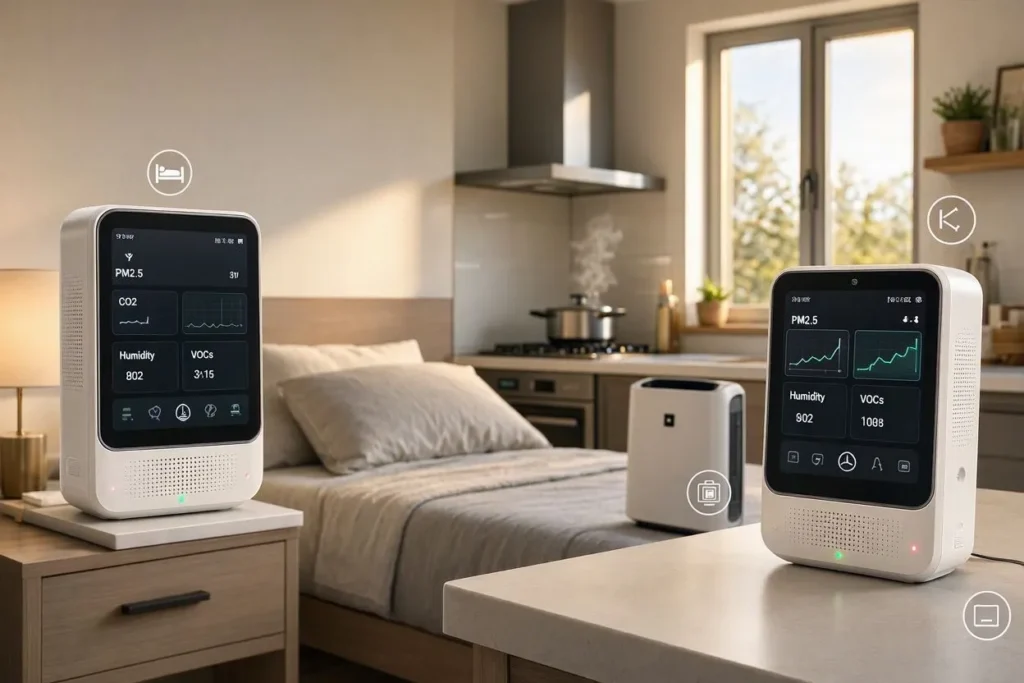
A monitor placed at breathing height in a main living area gives the most accurate readings. Devices tracking PM2.5, CO2, humidity, and VOCs in real time let you see which specific action, opening a window, running a purifier, adjusting humidity, actually moves the numbers.
Put one monitor in the bedroom and one in the kitchen or living room. These two spaces tend to show the widest swings: cooking spikes PM2.5 in the kitchen, while a closed bedroom door overnight can push CO2 above 1,000 ppm by morning. Keep monitors away from windows, vents, and exterior doors, since drafts skew short-term readings and hide the room’s actual baseline.
Do houseplants actually help?
Not really. Houseplants make a negligible difference in real-world indoor air quality despite the popular belief. The often-cited 1989 NASA Clean Air Study tested plants in sealed lab chambers, nothing like an actual home with open doors and constant air movement. A 2019 review in the Journal of Exposure Science and Environmental Epidemiology found you’d need dozens to hundreds of plants per square meter of floor space to match the air-cleaning power of basic mechanical ventilation.
Plants still add humidity, some visual warmth, and a small mood boost, which is reason enough to keep them around. Just don’t let them replace filtration or ventilation as an actual strategy.
Conclusion
Improving air quality in a home comes down to four things you can actually control: cutting pollution at the source, moving stale air out, filtering what’s left, and keeping humidity in the 30% to 50% range. None of this requires a contractor for the basics. A MERV-13 filter, a $20 radon test kit, and the habit of running the range hood cover most of what damages indoor air day to day.
Homes with sealed, energy-efficient construction need one more layer: an ERV or HRV, since the airtight walls that save on heating bills also trap the pollutants a leaky older home would vent out on its own. Test first, fix the specific problem you find, and skip the guessing.