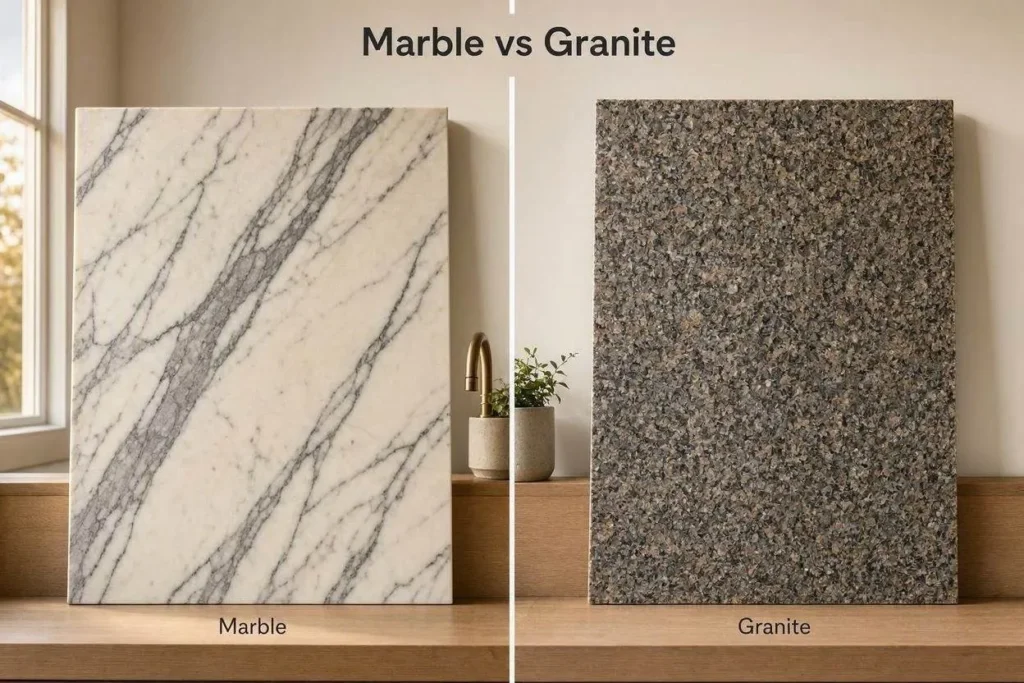
Granite forms from cooled magma and ranks 6 to 7 on the Mohs hardness scale. Marble forms from metamorphosed limestone and only reaches 3 to 5. That ten-point gap is the reason almost every other difference between these two stones exists. Granite is built from quartz, feldspar, and mica, which is what gives it that speckled, granular look. Marble is mostly calcite, and that’s where the smooth, veined surface you see in kitchens, bathrooms, and hotel lobbies comes from. Homeowners in St. Louis and in Portland, Maine, ask fabricators some version of the same question every week: which stone survives a busy kitchen without losing its shine? Geology answers that before aesthetics even get a say.
Fabricators hear this comparison from nearly every remodeling client, whether the project is a $3,000 vanity top or a $30,000 whole-kitchen overhaul. Marble vs granite rarely comes down to price alone. How a household actually cooks, how tolerant they are of upkeep, and how long they plan to stay in the home usually matter more than what’s printed on the slab’s price tag.
This guide walks through geology, looks, durability, cost, and room-by-room picks, so the decision rests on how these stones actually behave rather than how they look under showroom lighting.
How Marble and Granite Form
Granite crystallizes underground from molten magma over millions of years. Marble forms when heat and pressure recrystallize limestone into something denser. Geologists call granite an igneous rock (formed by cooling magma) and marble a metamorphic one (transformed by heat and pressure from existing rock). Vermont quarries produce Danby Marble, which resists water better than the classic Carrara marble shipped in from Italy. A block of Alaska White granite pulled from a Wisconsin quarry won’t carry the same flecking as Black Galaxy granite sourced from India, even though both start from a similar mineral recipe. Formation is also why hardness differs so much: granite’s crystal structure locks into place under extreme heat, while marble’s calcite crystals stay comparatively soft even after the metamorphic process is done.
Where Does the Stone in Your Countertop Come From?
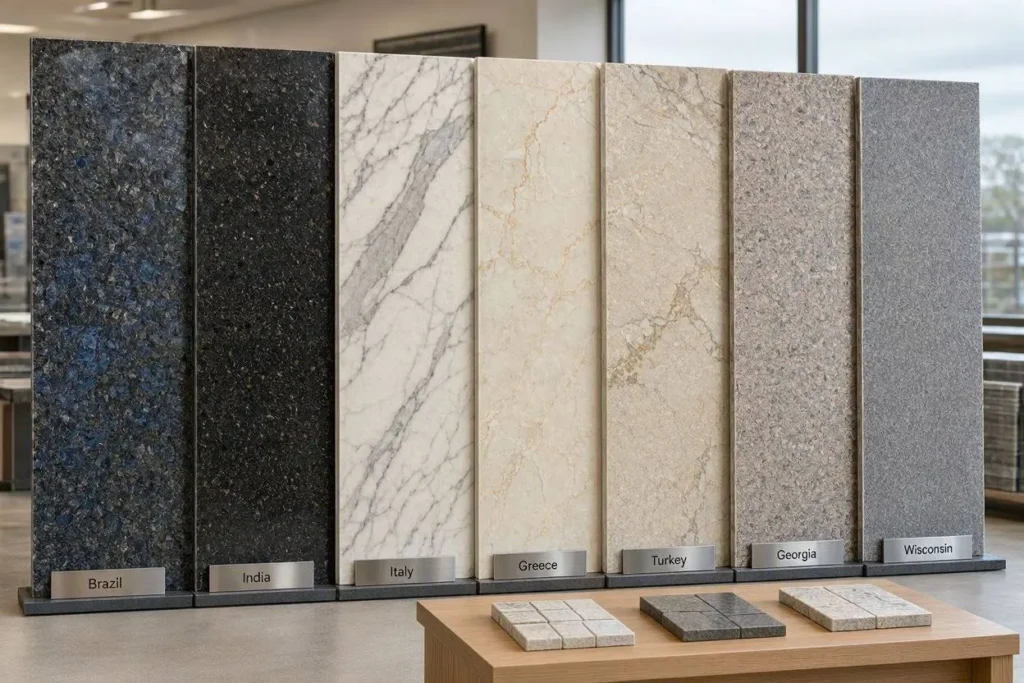
Most granite sold in the US comes from Brazil, India, and domestic quarries in states like Georgia and Wisconsin. Premium marble typically ships from Italy, Greece, and Turkey. Country of origin affects both price and what colors are even available. Carrara marble from Tuscany carries that soft grey-on-white veining that’s defined Italian architecture for centuries. Domestic granite often costs less simply because it travels a shorter distance to get to you. A fabricator sourcing Black Galaxy granite from Andhra Pradesh, India, is paying import fees and eating longer lead times that a Georgia quarry never has to deal with. If you want to verify sourcing claims, ask your fabricator for a slab’s country-of-origin documentation before you sign anything.
Appearance and Aesthetics
Marble gives you a wider range of color and veining. Granite gives you consistency, a speckled pattern that hides wear better in high-traffic spots. Granite’s mineral flecks come in white, grey, black, red, blue, and green, spread fairly evenly across the slab. Marble veining runs in irregular, wavy lines through backgrounds of white, grey, black, pink, green, or beige, and no two slabs look quite alike because nature doesn’t repeat itself exactly. If you want a large kitchen island to look uniform from end to end, granite delivers that in a way marble simply can’t. Designers still reach for marble on statement walls and waterfall countertop edges, where the veining is meant to be the focal point rather than background texture.
Durability and Hardness
Granite wins here, plain and simple. A 6-to-7 Mohs score against marble’s 3-to-5 means granite shrugs off scratches and chips that would mark up marble in daily use. (For reference, the Mohs scale runs 1 to 10, with talc at the bottom and diamond at the top.) Drag a steak knife across unprotected marble and you’ll see the mark. Do the same to granite and it barely registers. That said, granite isn’t invincible. It can still chip near sink cutouts or unsupported overhangs, and both stones can crack under a heavy direct impact, though granite takes a lot more force to get there. Marble has its own kind of resilience, actually: small scratches and chips tend to blend into its natural veining more easily than they would into granite’s uniform speckle.
Porosity, Stains, and Sealing
Marble is more porous, so it stains more easily and needs sealing more often. Porosity is basically how fast a stone soaks up a spill before it sets into a permanent mark, and marble loses that race. Red wine, coffee, tomato sauce, citrus juice: any of these can etch or stain unsealed marble within minutes. Granite’s denser structure buys you more time, though sealed granite still isn’t fully stain-proof. Fabricators generally recommend resealing granite every one to three years, depending on the sealer, while marble needs it every six to twelve months. Want to check if your seal is still holding? Pour a little water on the surface. If it beads up instead of soaking in within 10 to 15 minutes, you’re good.
Heat Resistance
Both stones handle heat up to roughly 350°F (177°C), but granite deals with direct contact from hot cookware more reliably. Its density spreads heat evenly across the surface, which cuts down the risk of scorching in one spot. Marble absorbs heat differently, and can discolor or even crack near the contact point if a hot pan lands on it without a trivet underneath. If your household regularly sets pots straight from the stove onto the counter, granite handles that habit with a lot less long-term risk. Interestingly, pastry chefs love marble for the opposite reason: it stays cool to the touch, which makes it a favorite surface for rolling dough or tempering chocolate. Neither stone should take extended direct contact with anything above 350°F, no matter how hard it is.
Maintenance and Cleaning
Granite is the lower-maintenance stone day to day. Mild soap and water does the job. Marble wants pH-neutral cleaners and spills wiped up fast, because abrasive scrubbers and acidic products will dull its polish and etch the surface in a single use. Granite tolerates a much wider range of household cleaners without visible damage, though it’s still smart to skip bleach and ammonia-based formulas long term. A homeowner who wipes granite down twice a week with dish soap will keep it looking new for years. Marble owners live by a stricter routine: blot spills immediately, don’t let water sit, and never reach for a vinegar-based cleaner, since the acid reacts directly with calcium carbonate. Neglect shows up faster on marble than on granite, but with consistent care, both stones perform well for decades.
Cost Comparison
Granite typically runs $40 to $100 per square foot ($430 to $1,076 per square meter) installed. Marble runs $50 to $150 per square foot ($538 to $1,614 per square meter). So granite is usually the more budget-friendly pick, though slab rarity moves prices around more than the base material category does. A rare imported granite color can easily cost more than a common domestic marble, and vice versa. Installation labor, edge profile, and slab thickness all add to the final number regardless of which stone you pick. For a typical 30-square-foot kitchen island, choosing granite over marble at comparable quality tends to save somewhere between $300 and $1,500. Resale value and long-term maintenance costs still factor into the total cost of ownership over a 10- to 20-year span, so the sticker price shouldn’t be the only thing driving the decision.
Which Holds Its Value at Resale?
Granite generally has broader resale appeal, mostly because more buyers associate it with low maintenance and don’t want to inherit marble’s care routine. Real estate agents in most US markets say granite kitchens rarely raise objections during a showing. Marble kitchens, on the other hand, sometimes prompt questions about staining history or upkeep, especially in homes where the counters already show visible etching. Regional appraiser data cited by realtors on a 2025 mid-range Ohio renovation showed granite countertops recouping a higher percentage of their cost at resale than a comparable marble installation in the same neighborhood. That said, marble still commands a premium in luxury markets, where buyers expect natural veining as a signal of a high-end finish. Local market norms matter more than any universal rule here, so it’s worth asking a local appraiser what buyers actually expect in your specific price bracket.
Marble vs Granite for Bathroom Vanities
Bathrooms see far less acid exposure than kitchens, and lighter daily wear overall, which is exactly why marble works so well for vanities. Toothpaste, soap, and water are about all a vanity top has to deal with, none of which etch marble the way citrus or wine would in a kitchen. Granite still performs well here and costs less on average, which makes it the practical call for rental properties or budget remodels. In a $500,000-plus home, the primary bathroom more often than not features a marble vanity, since buyers at that price point associate marble with a finished, high-end look. Powder rooms and guest bathrooms see less daily traffic than a primary bath, so they tolerate marble’s higher-maintenance needs without many complaints.
Marble vs Granite for Kitchen Countertops
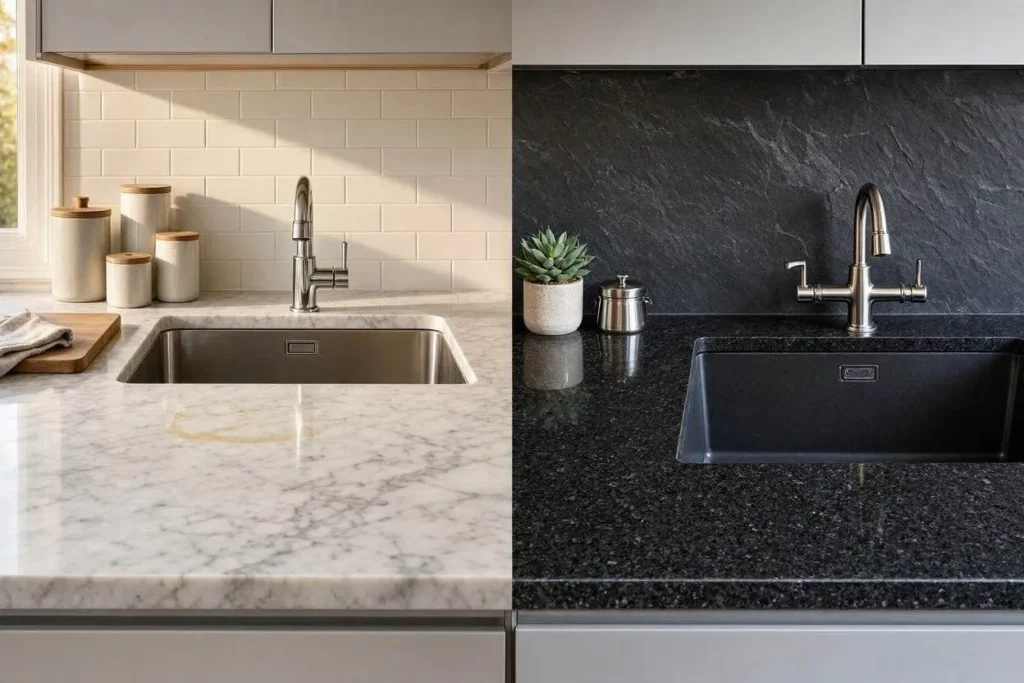
Granite is the better fit for most kitchen countertops because it resists the acid, heat, and daily wear that come standard with food prep. Lemon juice, wine, tomato sauce: these are everyday kitchen ingredients, and they’ll etch unsealed marble on contact. Granite shrugs off the same spills long enough for someone to actually wipe them up before any damage sets in. That said, marble kitchen countertops still work fine for households that don’t cook much, or that are fine with the patina marble develops over time. Some homeowners split the difference: a bakery-style marble slab set into one section of the island, granite everywhere else, giving cooks a dedicated cool surface for dough without exposing the whole counter to etching risk. Danby Marble from Vermont narrows the maintenance gap a bit, since it absorbs less water than classic Carrara, but it still falls short of granite on scratch resistance.
Marble vs Granite for Flooring
Marble is the better call for formal flooring in low-traffic rooms. Granite holds up better underfoot in entryways, kitchens, and outdoor spaces that see heavy use. Marble tile develops a soft polish over time that a lot of designers like for living rooms, foyers, and bathrooms. Granite flooring shrugs off grit, foot traffic, and moisture in mudrooms, patios, and commercial lobbies without losing its finish. A restaurant entryway logging 500-plus footsteps a day will wear marble tile down faster than it would granite in the same spot. Both stones feel cool underfoot, so radiant heating pairs well with either one in colder climates. Slip resistance actually comes down more to the surface finish than the stone itself: honed marble and honed granite both offer better traction than the polished versions of either.
Marble vs Granite vs Quartz: Where Engineered Stone Fits
Quartz gives you a non-porous, low-maintenance alternative to both natural stones, though it can’t match either one’s heat resistance. Engineered quartz is roughly 90 percent ground natural quartz mixed with polyester resin, and that formula resists staining better than sealed granite or marble does. The tradeoff is that resin can scorch or discolor when a hot pan sits directly on it, which isn’t a failure mode granite deals with. A lot of homeowners who want marble’s look without the maintenance end up choosing quartz slabs manufactured with printed veining patterns instead. Natural marble and granite still beat quartz on heat tolerance and long-term resale value in higher-end markets, where buyers specifically want natural stone over anything engineered. It really comes down to priorities: quartz for low maintenance, granite for heat and scratch resistance, marble for aesthetic range. Warranties split along the same lines, too. Most quartz manufacturers offer 10- to 15-year limited warranties, while granite and marble fabricators rarely warranty the stone itself past installation workmanship, since natural variation isn’t considered a defect.
Is Granite Radioactive? Addressing the Radon Myth
No, and this one comes up constantly. Some granite varieties do contain trace amounts of uranium, which decays into radon gas over time. But the EPA has found that radon emissions from granite countertops fall far below hazardous levels in virtually every case tested. If a home has a radon problem, it’s almost always soil gas coming in through the foundation, not the countertops. A home radon test kit costs under $30 and settles the question directly, which beats guessing based on countertop material.
How to Choose Between Marble and Granite: A Decision Checklist
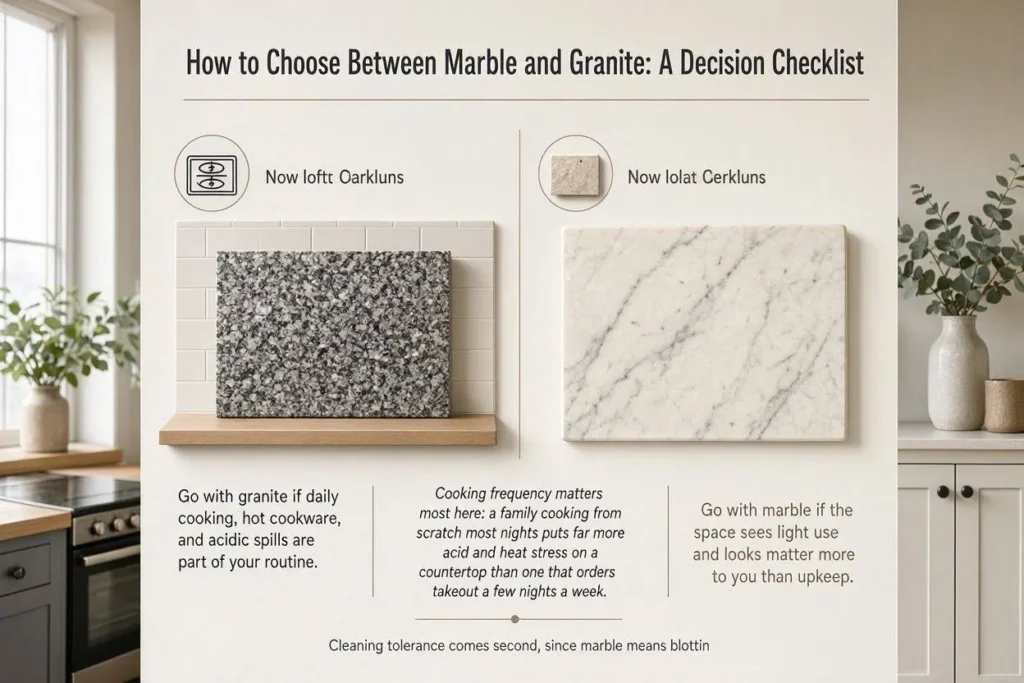
Go with granite if daily cooking, hot cookware, and acidic spills are part of your routine. Go with marble if the space sees light use and looks matter more to you than upkeep. Cooking frequency matters most here: a family cooking from scratch most nights puts far more acid and heat stress on a countertop than one that orders takeout a few nights a week. Cleaning tolerance comes second, since marble means blotting spills within minutes, not hours. Budget comes third: granite runs $40 to $100 per square foot against marble’s $50 to $150. And for outdoor or semi-outdoor installations, climate matters too, since granite’s freeze-thaw resistance beats marble’s in colder states like Maine, Minnesota, and Wisconsin. A fabricator who actually walks through your kitchen or bathroom, rather than just showing you slabs in a showroom, will catch use-pattern details a general comparison never could.
Which Is Better: Marble or Granite?
Granite wins on durability, heat resistance, stain resistance, and cost. Marble wins on aesthetic range, and the kind of long-term visual character that comes with natural veining. Kitchens that see daily cooking and hot cookware favor granite’s practical strengths. Bathrooms, accent walls, and low-traffic formal spaces let marble’s veining do its thing without the wear that would shorten its life. A fabricator with Natural Stone Institute accreditation (an industry credential that verifies proper stone handling and installation standards) can help match a slab to how your household actually lives, not just how it looks in a showroom. Budget, maintenance tolerance, and room function matter more than which stone photographs better. There’s no single universal winner in the marble vs granite debate. It comes down to matching the material to how a household actually uses the space day to day.
Conclusion
Marble vs granite really comes down to three things: how the space gets used, how much upkeep a household will actually keep up with, and how much you value veining variation over a consistent, repeating pattern. Granite fits busy kitchens, outdoor installations, and budget-conscious renovations where scratch resistance and low maintenance matter most. Marble fits bathrooms, accent features, and formal spaces where the veining and color depth justify a more demanding care routine. A fabricator who inspects the actual room, asks about cooking habits, and knows the local resale trends will give you a better recommendation than any general comparison chart ever could. Both stones have been showing up in kitchens, floors, and public buildings for centuries, and neither one is going anywhere in 2026. The right slab is the one that fits how the room actually gets used, not the one that looks best under showroom lights.