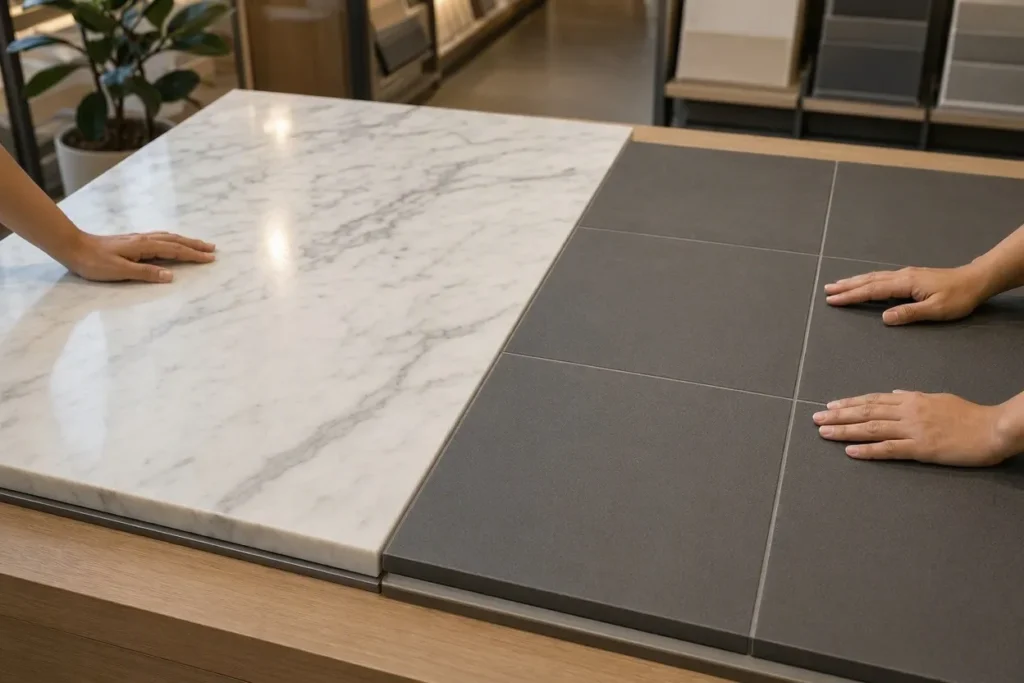
Picking a floor sounds simple until you’re standing in a showroom staring at a Calacatta slab on one side and a stack of porcelain samples on the other. Natural stone flooring and manufactured tile solve the same problem, a durable, attractive surface underfoot, but they get there through completely different materials, price points, and upkeep routines. Marble is quarried stone with veining no two slabs shared. Porcelain and ceramic tile are man-made products built for consistency, water resistance, and a lower bill.
This guide breaks down the real natural stone vs man-made differences in durability, stain resistance, maintenance, installation cost, and room-by-room performance, so the choice comes down to your budget and your floor plan instead of guesswork.
Marble vs Tiles
Tiles win on durability, cost, and maintenance. Marble wins on natural beauty and long-term resale appeal in luxury homes. Porcelain and ceramic tile resist scratches, water, and stains better than marble in daily use, and they cost roughly half as much to install. Marble carries something no printed surface fully replicates, though: the veining runs through the stone itself, not across the top of it. Choose tile for kitchens, bathrooms, and high-traffic hallways. Pick marble for formal living rooms, primary bathrooms, and any space where the goal is visual impact over practicality.
The rest of this guide gets into why, with real cost figures, hardness ratings, and room-by-room recommendations for US homeowners.
| Factor | Marble | Tiles |
| Hardness | 3 to 4 (Mohs scale) | PEI rating of 4 to 5 |
| Cost installed | $10 to $40 per sq ft | $5 to $25 per sq ft |
| Stain resistance | Low; etches from acids | High; resists most spills |
| Maintenance | Reseal every 6 to 12 months | Sweep, mop, seal grout yearly |
| Lifespan | 25+ years with sealing | 10 to 20 years |
| Best rooms | Formal living rooms, primary bedrooms | Kitchens, bathrooms, mudrooms |
| Resale impact | Higher in luxury homes ($700K+) | Strong return relative to cost |
What Is Marble Made Of?
Marble is a natural metamorphic rock formed when limestone (or, in some deposits, dolomite) gets exposed to intense heat and pressure deep underground. That process converts calcium carbonate into interlocking calcite crystals over millions of years, giving the stone its distinctive crystalline structure. The veins running through a marble slab aren’t decoration. They’re impurities, iron oxide, clay, whatever got trapped during formation, and marble veining is exactly why no two slabs look alike.
Popular varieties sold in the US include:
- Carrara: light gray with soft veining, quarried in Italy.
- Calacatta: bright white with bold, dramatic veins.
- Emperador: a rich brown stone from Spain and Turkey.
Price varies by variety, but they all react to acid and scratching about the same way, since the underlying mineral is calcite (or dolomite) no matter the color.
What Are Tiles Made Of?
Tiles are manufactured by firing clay, silicates, feldspar, and other minerals at temperatures between 2,000°F and 2,400°F. That controlled process gives every tile the same thickness, color, and glaze, a consistency natural stone simply can’t offer. Ceramic and porcelain tile sold for US flooring use is typically tested against ANSI A137.1, the national tile standard manufacturers use to certify quality and performance.
Three tile types cover most US home improvement projects:
- Ceramic tile: red or white clay fired at lower heat, best for walls and low-traffic floors.
- Porcelain tile: denser, fired hotter, with water absorption below 0.5%, which makes it the go-to for kitchens and bathrooms. (In Europe this same dense, low-absorption product is often called gres tile or gres porcellanato; it’s the same category by a different name.)
- Vitrified tile: fired at the highest heat of the three, nearly non-porous with a glass-like surface. Less common in the US, but gaining ground.
There’s also marble-look tile, which uses digital printing to replicate marble veining on a porcelain or ceramic base. It gets you roughly 80% of marble’s appearance at about 30% of the cost, which is exactly why it keeps coming up in the marble vs tiles debate.
Durability Comparison: Marble vs Tiles
Porcelain tile outlasts marble in daily wear. It scores higher on hardness and holds up better under impact. Marble sits at 3 to 4 on the Mohs hardness scale, while porcelain tile earns a PEI rating of 4 or 5, the same scale used to certify scratch resistant flooring for commercial kitchens and airports.
Drop a cast-iron skillet on marble and you’re likely looking at a chip or a crack. Drop it on PEI-5 porcelain and you’ll probably just get a scuff. Marble can last 25+ years with proper sealing (some historic installations have held up for over a century), while tile typically runs 10 to 20 years, usually swapped out for style rather than actual failure. The two materials get graded on different scales, Mohs for marble, PEI for tile, but either way tile comes out ahead on scratch resistance.
Flooring Maintenance: Marble vs Tiles
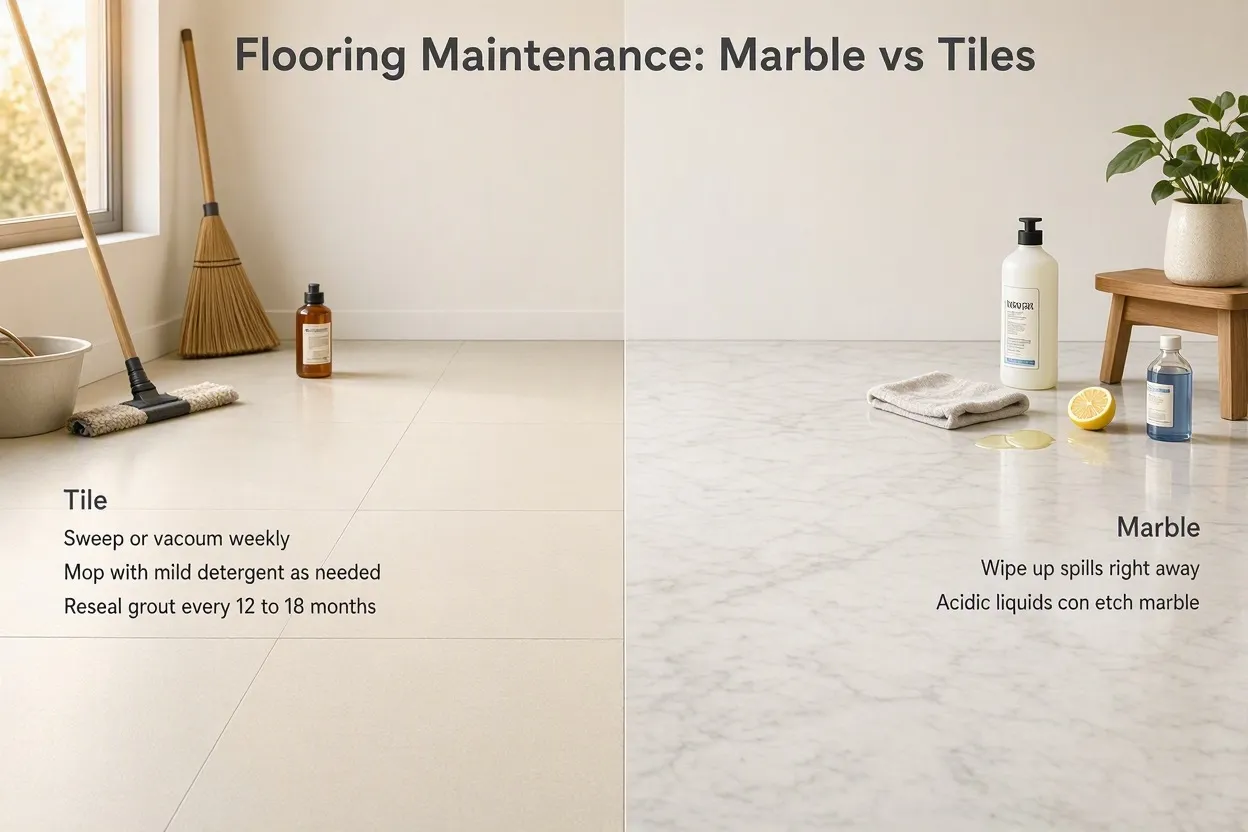
Tile needs far less upkeep than marble, since its surface doesn’t absorb liquid or react to acid. Marble’s natural porosity means it needs a real routine; tile mostly just needs regular cleaning.
For tile: sweep or vacuum weekly, mop with mild detergent as needed, and stay on top of grout maintenance by resealing the grout lines every 12 to 18 months. That’s it.
Marble asks for more. Wipe up spills right away, since acidic liquids like coffee, wine, and citrus etch the calcite surface within minutes. Marble sealing frequency should run every 6 to 12 months to keep moisture from soaking into its porosity, then a polish every few years to restore the shine as the surface wears. The tile flooring maintenance routine costs nothing beyond basic cleaning supplies. Marble’s routine adds recurring sealing and polishing costs that tile owners never have to think about.
Stain Resistance and Porosity
Yes, marble stains and etches far more easily than tile. Its natural porosity lets liquids and acids soak into the stone. Marble’s water absorption rate runs high enough that an unsealed slab can develop a permanent watermark from something as simple as a wet glass left out overnight. Tile porosity sits at the opposite end of the spectrum: porcelain’s water absorption stays below 0.5%, and standard ceramic stays under 3%, so both shrug off the same spill without a trace.
Kitchens make the difference obvious. A splash of lemon juice or balsamic vinegar on unsealed marble causes visible acid-etching, a dull spot within 5 to 10 minutes. The same splash on glazed porcelain wipes away with a damp cloth and leaves nothing behind. That one fact probably drives more marble vs tiles kitchen decisions than everything else in this guide combined.
Flooring Cost Comparison: Marble vs Tiles
Tile costs roughly 40% to 60% less than marble at standard installed pricing in the US. Ceramic and porcelain tile installation runs $5 to $25 per square foot including materials and labor, according to 2026 pricing data from Angi and HomeGuide. Marble runs $10 to $40 per square foot for the same scope, with common Carrara landing around $13 to $25 per square foot and premium Calacatta reaching $25 to $60.
Put real numbers behind that for a 250-square-foot room: tile typically totals $1,250 to $6,250, while marble runs $2,500 to $10,000 for the identical space. That gap widens if the subfloor needs leveling first, since marble is rigid enough to crack over an uneven base while tile tolerates minor imperfections just fine. Flooring installation labor cost accounts for a lot of that gap, since marble simply takes longer to set. Then there’s the ongoing cost: resealing marble every year adds $200 to $500 per visit for professional service, an expense tile owners never have to budget for.
Installation Difficulty
Marble takes more skill and more time to install than tile, mostly because it’s heavier, more brittle, and far less forgiving of subfloor flaws. A professional installer will spend extra hours leveling the subfloor to within 1/8 inch over 10 feet, since any dip risks cracking the slab under foot traffic. Cutting it requires a wet saw with a diamond blade so the stone doesn’t shatter along its natural fault lines.
Tile moves faster. Standard porcelain and ceramic cut cleanly with a manual tile cutter or angle grinder, and most installers finish a 250-square-foot room in a day or two. The same room in marble commonly stretches to three or four days once you factor in subfloor prep, precise cutting, and sealing. If you’re thinking DIY, lean tile: porcelain is realistic for an experienced do-it-yourselfer, while marble almost always calls for a licensed contractor.
Design and Finish Options
Tile offers more design variety than marble, since manufacturers can print any pattern, color, or texture onto a consistent base. Wood-look planks, geometric patterns, hexagons, subway tile, all from the same production line, giving homeowners hundreds of combinations that marble’s natural limitations can’t match.
But marble has something tile can’t fake: genuine uniqueness. Every slab carries veining formed over geologic time, so a marble floor never repeats itself the way a printed pattern does across a large room. Marble comes in three main finishes: polished (highly reflective), honed (matte, softer underfoot), and tumbled (textured, rounded edges). Tile spans glazed, unglazed, matte, and high-gloss. Architects and interior designers often reach for polished marble specifically when a client wants a floor that reads as custom rather than off-the-shelf, since a manufactured product structurally can’t replicate that one-of-a-kind veining.
Best Rooms for Marble vs Tiles
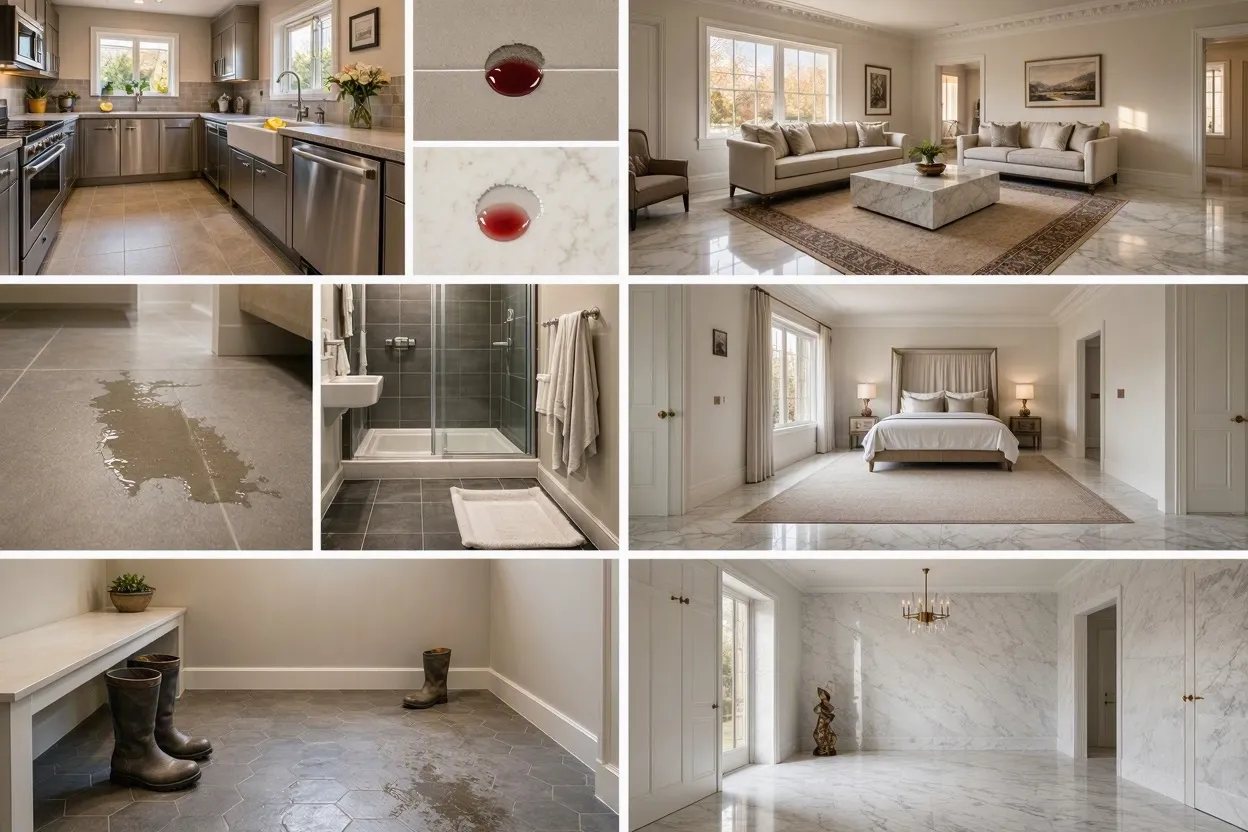
Tile works better for kitchens, bathrooms, mudrooms, and any high-moisture or high-traffic space. Marble suits formal living rooms, primary bedrooms, and low-traffic entryways built for visual impact.
- Kitchens: Tile is the better flooring for kitchens, since acidic spills like lemon, wine, and tomato sauce etch unsealed marble within minutes. (Marble still shows up plenty as a kitchen countertop, just less often underfoot.)
- Bathrooms: Same logic applies to floors and shower surrounds, where moisture exposure and the slip-resistance ratings tile can hit with textured finishes make it the safer flooring for bathrooms.
- Primary bedrooms: Marble, where foot traffic stays light and the material’s cool, elegant surface adds a hotel-suite feel.
- Formal living rooms and entryways: Marble, since these spaces prioritize appearance and see less daily wear than a kitchen or mudroom.
- Staircases: Tile, usually, for the added slip resistance on treads; marble staircases exist in high-end homes but need textured or honed finishes to stay safe underfoot.
- Mudrooms, laundry rooms, and basements: Tile. These spaces handle dirt, water, and dropped objects daily, and marble’s porosity makes it vulnerable to moisture rising up through concrete slabs below grade.
Which Handles US Climates Better?
Porcelain tile handles US climate extremes better than marble, especially in regions with freeze-thaw cycles or heavy humidity. Its water absorption stays under 0.5%, so there’s almost nothing trapped to freeze and expand, a common failure point in Northeast and Midwest winters. Marble’s higher porosity lets moisture soak in instead, which makes it a weak choice for unheated sunrooms, three-season porches, or exterior use in cold states like Minnesota, Michigan, or Maine.
Radiant floor heating works fine under either material. Both conduct heat well, though marble warms up slower and holds heat longer because it’s denser. Tile is generally considered the best flooring for humid climates like Florida, Louisiana, and coastal Texas, for any room without reliable climate control, since marble’s porosity lets ambient moisture in where tile’s near-zero absorption keeps it out.
Resale Value and Sustainability
Marble typically adds more resale value in luxury and mid-to-high-end homes, while tile delivers a stronger return relative to its lower upfront cost in most standard resale markets. Natural stone tends to read as a premium upgrade in listings above $700,000, particularly in kitchens and primary bathrooms, while in the mid-market, resale value tends to hinge more on installation quality than on material prestige.
Tile also edges out marble on eco-friendly flooring credentials. Quarrying marble is energy-intensive and usually involves shipping from Italy, Spain, or Turkey, plus it generates heavy stone waste during cutting. Many US and European tile manufacturers now use recycled content and closed-loop water systems in production, recycled content that can also count toward green-building certifications like LEED on larger projects, which gives tile a modest edge among eco-friendly building materials, even though neither option is exactly renewable.
A Few Other Flooring Materials You’ll Hear About
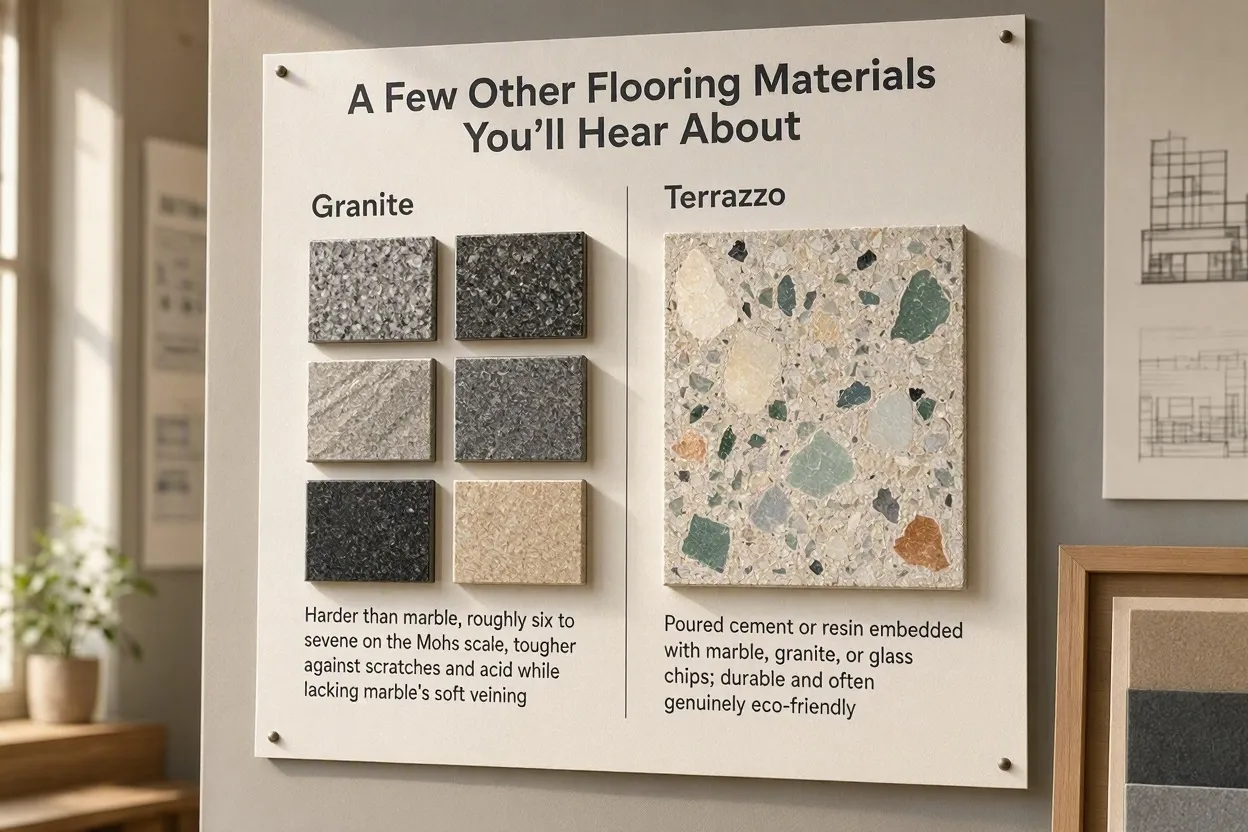
Marble and tile are the two defaults for most US homes, but a few relatives come up often enough to know by name.
- Granite: harder than marble (roughly 6 to 7 on the Mohs scale) and tougher against scratches and acid, just without marble’s soft veining.
- Terrazzo: poured cement or resin embedded with marble, granite, or glass chips. Durable, and one of the more genuinely eco-friendly building materials around, since it’s often made largely from recycled stone waste.
- Engineered quartz: mostly ground quartz crystal (typically over 90%) bound with resin. Popular for countertops, rarely used underfoot, since UV exposure can degrade the resin over time.
- Terra cotta and quarry tile: both dense, fired-clay options, common in rustic interiors and commercial kitchens, respectively.
- Glass tile: shows up mostly as a backsplash rather than flooring, since it gets slippery underfoot.
- Onyx: a softer, translucent cousin of marble, typically reserved for backlit accent walls rather than floors.
You’ll occasionally see marble or tile discussed for building facades and exterior elevations too, though most experts steer both away from exterior use without a stone specifically rated for it.
Which Should You Choose?
Choose tile if budget, low maintenance, and moisture resistance matter more to you than having a one-of-a-kind natural surface. Choose marble if long-term visual impact and resale value in a luxury listing outweigh the higher cost and upkeep. Budget-conscious renovators, growing families, and anyone tiling a kitchen or bathroom will get more practical value out of porcelain or ceramic. Homeowners renovating a formal space in a high-end property, or anyone who likes knowing their floor will never look exactly like another one, will probably find the added cost worth it.
A hybrid approach works for plenty of people, too. Marble accent tiles or a marble-topped kitchen island paired with porcelain floor tile throughout the rest of the room gets you the visual appeal of natural stone while keeping daily maintenance and long-term durability firmly in tile’s favor.
Conclusion
Marble vs tiles comes down to a trade between practicality and prestige. Tile costs less, lasts longer under daily wear, and demands almost no upkeep. Marble delivers a natural, one-of-a-kind surface that no manufactured product fully replicates. A kitchen renovation on a $15,000 budget points toward porcelain tile without much debate. A formal entryway in a home built to sell above $1 million might justify the extra cost of a Calacatta slab. Match the material to the room’s traffic, moisture exposure, and the resale bracket of the property, and the right answer becomes obvious well before the flooring quote arrives.