
No — a new roof on your primary home is not tax deductible in 2026. The IRS classifies roof replacement as a capital improvement. Capital improvements are not deductible in the year you pay for them. They do, however, increase your home’s cost basis, which reduces taxable capital gains when you sell.
There are 4 situations where a new roof does create real tax savings: a rental property, a home office, a federally declared disaster loss, and commercial buildings. Each works differently — this guide covers all 4 clearly.
The 2026 rules also changed significantly. The federal energy-efficient home improvement credit (Section 25C) — which previously covered qualifying metal and asphalt roofs up to $1,200 — was eliminated by the One Big Beautiful Bill Act signed in July 2025. It no longer applies to roofs installed in 2026.
New Roof Tax Deduction: Quick Answer by Property Type
| Property Type | Tax Benefit Available? | How It Works |
| Primary residence | No direct deduction | Adds to cost basis — saves at sale |
| Rental property | Yes — depreciation | Deduct over 27.5 years (MACRS) |
| Home office | Yes — partial deduction | % of roof cost = business sq ft % |
| Commercial property | Yes — depreciation | Deduct over 39 years; Section 179D may apply |
| Federally declared disaster | Yes — casualty loss | Deduct unreimbursed loss on Schedule A |
Primary Residence: No Deduction, But Your Cost Basis Grows
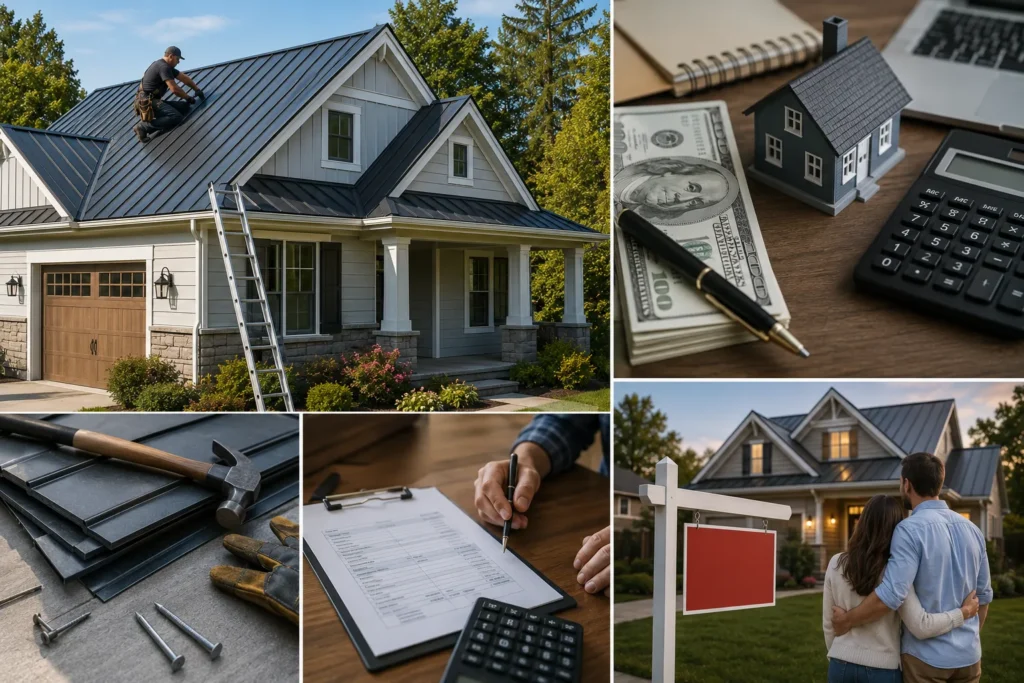
When you replace the roof on your primary home, the IRS treats the full cost as a capital improvement under IRC Section 263. You cannot deduct it on your tax return for the year you pay.
What does happen: the cost is added to your home’s adjusted cost basis. Cost basis is your original purchase price plus all documented capital improvements. A higher basis means a smaller taxable gain when you eventually sell.
Example: How Cost Basis Saves You Money at Sale
You bought your home for $300,000. You replaced the roof for $18,000. Your adjusted cost basis becomes $318,000. If you later sell for $600,000, your gain is $282,000 — not $300,000. That $18,000 difference avoids capital gains tax at sale.
For most married couples filing jointly, the first $500,000 of home sale profit is excluded from capital gains tax under Section 121. For single filers, the exclusion is $250,000. If your gain falls under those thresholds, the cost basis benefit may not matter. But for high-appreciation markets — California, New York, the Pacific Northwest — documenting every capital improvement is essential.
Keep every invoice, permit, and contractor receipt permanently. You need these records when you sell, not when you replace the roof.
Planning a full roof replacement? Our roof replacement services page covers what to expect from inspection through installation.
Rental Property Roof: Deductible Through Depreciation
A new roof on a rental property is tax deductible — but not all at once. The IRS requires you to depreciate the cost over the useful life of the asset. For residential rental property, that period is 27.5 years under the Modified Accelerated Cost Recovery System (MACRS). For commercial property, the period is 39 years.
How the Math Works
A $20,000 roof on a residential rental property produces an annual depreciation deduction of approximately $727 per year ($20,000 ÷ 27.5). You report this deduction on Schedule E of Form 1040 alongside your rental income and other expenses.
Depreciation begins in the month the roof is placed in service, using the IRS mid-month convention. For a roof installed in March, you get 9.5 months of depreciation in year one.
| Roof Cost | Property Type | Depreciation Period | Annual Deduction |
| $15,000 | Residential rental | 27.5 years | ~$545/year |
| $20,000 | Residential rental | 27.5 years | ~$727/year |
| $30,000 | Residential rental | 27.5 years | ~$1,091/year |
| $20,000 | Commercial property | 39 years | ~$513/year |
| $40,000 | Commercial property | 39 years | ~$1,026/year |
Repair vs. Capital Improvement on Rental Property
Not every roofing expense is a capital improvement. The distinction changes how you deduct the cost:
- Capital improvement (depreciated over 27.5 years): Full roof replacement, adding new roof layers, installing a new roofing system on a new addition.
- Repair (deductible in the current year): Patching a section of damaged shingles, sealing a localized leak, replacing a few broken tiles. Repairs restore the existing condition — they do not improve or extend it.
If you replace the entire roof, it is a capital improvement regardless of condition. If you fix 4 shingles after a storm, it is a repair. Repairs on rental property are fully deductible in the year paid, with no depreciation schedule required.
Disposing of the Old Roof
When you replace a rental roof, the undepreciated value of the old roof can be written off in the year of replacement. If you originally depreciated the old roof as a separate asset, you take the remaining book value as a loss in the year the old roof is retired. Work with your CPA to capture this deduction — it is commonly missed.
Home Office: Deduct the Business Percentage of Your Roof
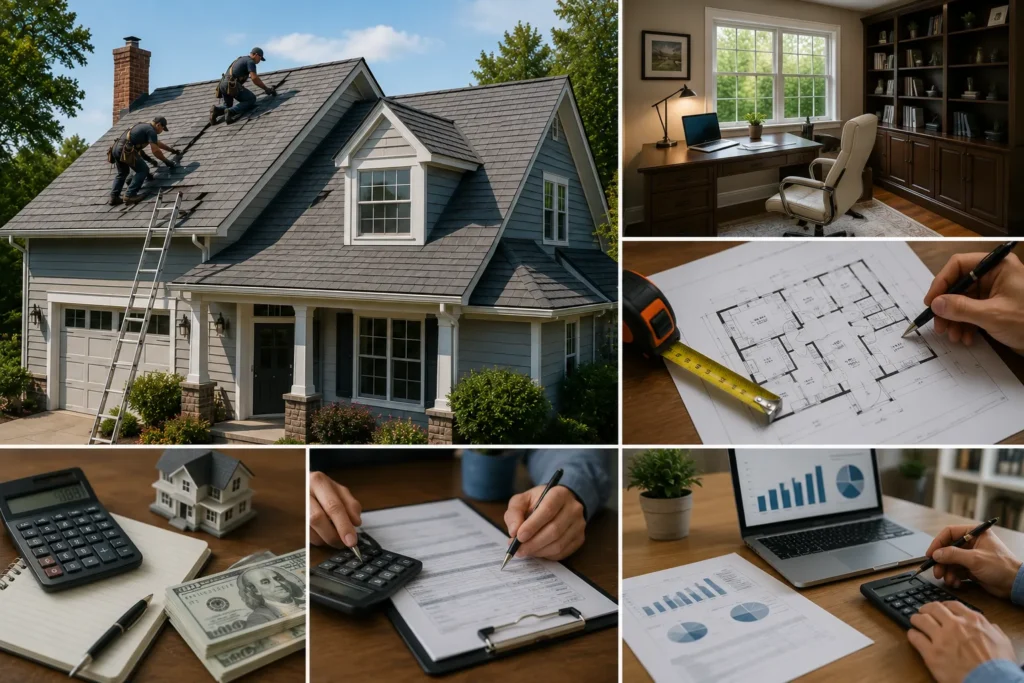
If part of your primary home is used regularly and exclusively as your principal place of business, you can deduct a proportional share of the roof replacement cost.
How to Calculate the Home Office Percentage
- Measure your dedicated office space in square feet.
- Divide by your home’s total square footage.
- Apply that percentage to the full roof replacement cost.
- Depreciate the resulting amount over 39 years (home offices use the nonresidential real property schedule).
Home Office Roof Deduction Example
Your home is 2,000 sq ft total. Your dedicated office is 200 sq ft — 10% of the total. You replace the roof for $25,000. Your deductible basis is $2,500 (10% of $25,000), depreciated over 39 years at approximately $64 per year.
That is a modest annual deduction. But it is a real one — and it compounds over time if you use a home office consistently.
IRS Requirements for the Home Office Deduction
- The space must be used regularly and exclusively for business. A spare bedroom that doubles as a guest room does not qualify.
- It must be your principal place of business — where you conduct most of your work, meet clients, or manage administrative tasks.
- You claim it on IRS Form 8829 (Expenses for Business Use of Home) attached to Schedule C.
Energy-Efficient Roof Tax Credits in 2026: What Changed
The federal energy-efficient home improvement credit (Section 25C) no longer applies to roofs installed in 2026. The One Big Beautiful Bill Act, signed July 4, 2025, eliminated this credit for all qualifying improvements placed in service after December 31, 2025.
Under the previous rules (through 2025), homeowners could claim up to $1,200 per year for qualifying metal roofs with pigmented coatings and asphalt roofs with cooling granules rated by ENERGY STAR. That window is closed for 2026 installations.
What Still Applies for Roofs Installed in 2025
If you replaced your roof in 2025 with a qualifying ENERGY STAR product and haven’t filed your 2025 tax return yet, the Section 25C credit of up to $1,200 still applies. File IRS Form 5695 and include the Qualified Manufacturer Identification Number (QMID) for the product.
Roofing installed on or after January 1, 2026 does not qualify for this credit under current law.
| Credit / Deduction | Status in 2026 | Notes |
| Section 25C (energy-efficient roof) | Eliminated | Ended Dec 31, 2025 via OBBB |
| Section 25D (residential solar) | Eliminated | Ended Dec 31, 2025 via OBBB |
| Section 179D (commercial energy) | Active through mid-2026 | Commercial buildings only |
| Rental depreciation (MACRS) | Active — no change | 27.5 yrs residential, 39 yrs commercial |
| Home office deduction | Active — no change | Proportional to office square footage |
| Casualty loss deduction | Active for declared disasters | Requires federally declared disaster |
Solar Roofing and Tax Credits in 2026
The residential solar Investment Tax Credit (ITC) under Section 25D expired December 31, 2025. Homeowners who purchase and own a solar roofing system installed after that date receive no federal tax credit directly.
One pathway remains: third-party ownership structures — solar leases and Power Purchase Agreements (PPAs). Under these arrangements, a financing company owns the system and claims the commercial ITC (Section 48E) through end of 2027. The savings pass to you through lower monthly rates.
If you installed solar roofing in 2025 and haven’t filed yet, the 30% credit applies. File Form 5695 with your 2025 return.
Considering a metal roof with energy-efficient properties? Our metal roofing installation team can advise on qualifying products and current incentives in your state.
Commercial Roof Tax Deduction: Section 179D
Commercial building owners have a separate option: Section 179D, the Energy Efficient Commercial Buildings Deduction. This allows a deduction for energy-efficiency improvements to commercial buildings, including roofing systems that meet specific performance thresholds.
Section 179D is available for qualifying commercial properties under current IRS guidance through projects that begin construction by June 30, 2026. The deduction amount varies based on energy savings achieved versus a reference building. A tax advisor and a qualified energy auditor must certify the project.
Standard commercial roof depreciation without Section 179D follows the 39-year MACRS schedule. A $40,000 commercial roof produces approximately $1,026 per year in depreciation deductions filed on the business return.
Casualty Loss Deduction: When a Damaged Roof IS Deductible
If your roof is damaged or destroyed by a federally declared disaster — hurricane, wildfire, flood, tornado, or earthquake — you may claim a casualty loss deduction on your federal return.
The deductible amount is the unreimbursed portion of your loss after insurance pays out. The loss is subject to a $100 per-event floor and a 10% of adjusted gross income (AGI) threshold, meaning only losses exceeding 10% of your AGI are deductible.
3 requirements to qualify:
- The loss must result from a sudden, unexpected event — not gradual wear or routine deterioration.
- The event must be in a federally declared disaster area (search current declarations at disasterassistance.gov)
- The loss must be unreimbursed by insurance or other compensation.
Document the loss with contractor estimates, insurance adjuster reports, before-and-after photos, and the FEMA disaster declaration number. File using IRS Form 4684 (Casualties and Thefts) and see IRS Publication 547 for full guidance.
Storm damage often requires fast action. Our roof maintenance and inspection team provides documented assessments that support insurance and IRS casualty loss claims.
Repair vs. Full Replacement: Different Tax Treatment
The IRS distinguishes between a repair (restores current condition) and a capital improvement (adds value, extends useful life, or adapts the property to new use). This distinction matters because the tax treatment is different:
| Work Type | IRS Classification | Primary Home | Rental Property |
| Full roof replacement | Capital improvement | No deduction (adds to basis) | Depreciate over 27.5 years |
| Repair 6 damaged shingles | Repair | Not deductible | Fully deductible current year |
| Patch a leak | Repair | Not deductible | Fully deductible current year |
| Add roof insulation layer | Capital improvement | No deduction (adds to basis) | Depreciate over 27.5 years |
| Replace flashing only | Repair | Not deductible | Fully deductible current year |
What Records to Keep for Roof Tax Purposes
Whether or not you can deduct your new roof this year, proper documentation protects you at sale, during an audit, or when filing a casualty loss claim. Keep these records permanently:
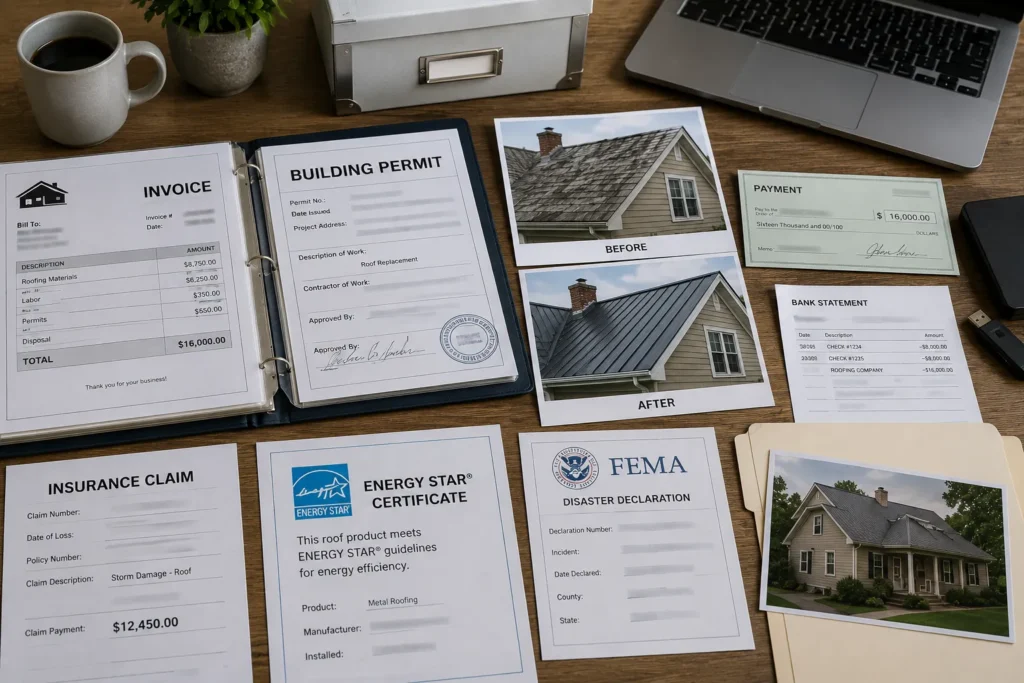
- Contractor invoices and final bills showing total cost, materials, and labor breakdown
- Building permits showing work type and municipality approval
- Before and after photos of the roof condition
- Proof of payment — checks, bank statements, or credit card records
- Insurance claims and payouts if the roof replacement followed storm damage
- Energy Star certification for qualifying metal or asphalt roofs installed through 2025
- FEMA disaster declaration number for casualty loss claims
Store copies in a dedicated home improvement folder — physical and digital. The IRS can audit home sale basis claims years after the roof was installed.
State-Level Tax Credits for Roofing: Check Your State
While federal energy roofing credits ended in 2026, several US states maintain their own programs. These vary widely by state and change regularly. Common state incentives include:
- Property tax abatements for energy-efficient improvements
- Sales tax exemptions on qualifying roofing materials
- State income tax credits for green building improvements
- Rebate programs through state utilities for cool roofs and metal roofing
Check your state energy office or your state’s department of revenue website for current programs. A licensed tax professional in your state is the most reliable source for what applies to your specific situation in 2026.