Quartz wins on stain resistance and low maintenance. Granite wins on heat resistance and natural uniqueness. Neither one beats the other outright. The right pick depends on how a household cooks, how much upkeep it’s willing to do, and how much budget flexibility exists for premium slabs. Sear steaks weekly and set hot pans straight on the counter? You’ll get more out of granite. Want wipe-and-go cleanup and a guaranteed colour match across a 12-foot island? Quartz is the better bet.
This guide breaks down cost, durability, maintenance, environmental impact, and resale value with exact figures, not vague ranges, so the comparison actually holds up under a real remodel budget.
What’s the Real Difference Between Quartz and Granite?
Granite is a mined natural stone. Quartz is an engineered composite. Granite forms underground over millions of years and gets cut from slabs quarried in places like Brazil, India, and Italy, so every slab carries its own veining and mineral variation. Quartz countertops are manufactured from roughly 90% to 93% crushed quartz crystal bound with polyester resin and pigment, which gives fabricators a level of color control that raw stone just can’t offer.
That difference shows up on installation day. A 10-foot granite island might need a fabricator to hand-select and match veining across two or three slabs. A quartz island the same size ships with a predictable, repeatable pattern from the same production batch.
Quartz vs. Granite Cost: Which Is Cheaper?
Granite costs less at the low end, but quartz pricing stays more predictable. National installed pricing runs $50 to $200 per square foot for quartz and $75 to $225 per square foot for granite, according to aggregated 2026 remodeling data. In the Atlanta metro market specifically, quartz averages $105 to $185 per square foot installed, while granite ranges from $95 to $225. That spread widens fast once a homeowner picks an exotic color or a complex edge profile.
What Drives the Final Price
Three things drive the final number more than the base material choice does:
- Slab thickness — 3cm slabs cost more than standard 2cm, across both materials
- Edge profile complexity — bullnose and eased edges cost less than ogee or waterfall edges
- Sink cutouts and seams — each one adds fabrication labor on top of the per-square-foot rate
A 30-square-foot kitchen island in mid-grade quartz runs roughly $3,150 to $5,550 installed at national averages. The same island in mid-grade granite runs $2,850 to $6,750. Granite’s wider spread just reflects how much color rarity swings the price.
Which Is More Durable: Quartz or Granite?
Both materials hold up for decades of daily kitchen use, but they fail differently. Granite resists scratching better than quartz, and it can actually dull a knife blade dragged across it, yet it chips more easily at thin edges and corners. Quartz resists chipping and cracking better than granite because the resin binder absorbs impact. Drop a cast-iron pan on a granite counter from countertop height, though, and it’s less likely to crack than quartz would be under the same hit.
Neither material needs replacing inside a normal 15-to-25-year renovation cycle. The real difference is where the damage shows up, not whether it shows up.
Heat Resistance: Which Countertop Handles Hot Pans Better?
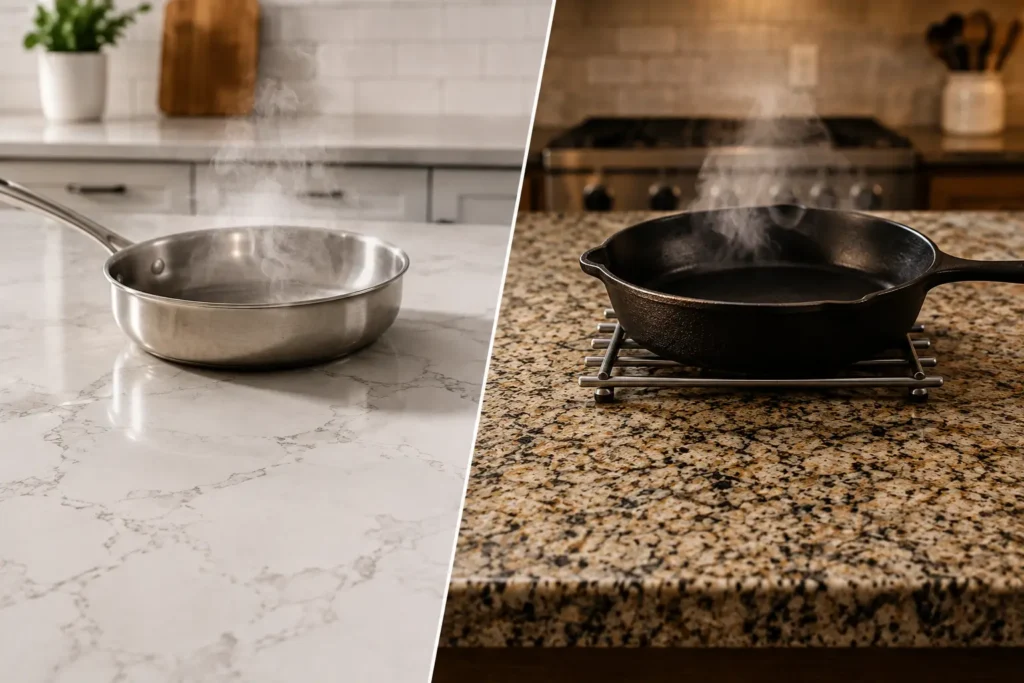
Granite, by a wide margin. It withstands direct contact with cookware up to roughly 1,200°F without damage, since the stone formed under extreme geological heat and pressure to begin with. Quartz starts to discolor or crack around 300°F, well below the surface temperature of a cast-iron skillet straight off a burner.
A trivet solves the quartz problem completely. Skip one long enough, though, and you’ll watch quartz degrade in a way granite simply won’t.
Stain Resistance and Everyday Maintenance
Quartz resists stains better than granite, and it never needs sealing. The non-porous resin surface blocks red wine, olive oil, and coffee from soaking in, so a spill wiped up within a few hours leaves no mark. Granite is porous by nature and needs resealing every one to two years to hold onto that same stain resistance. Skip the schedule, and an unsealed granite counter will soak up a red wine spill left overnight.
Daily cleaning takes the same five minutes on either surface: mild soap, warm water, and a soft cloth. The maintenance gap isn’t in the wipe-down. It’s in the annual sealing step that granite requires and quartz skips entirely.
Quartz vs. Quartzite: These Are Not the Same Material
Despite the near-identical name, quartz and quartzite are different materials. Quartz is engineered stone made from crushed crystal and resin, as described above. Quartzite is a 100% natural metamorphic rock formed when sandstone gets compressed under heat and pressure, and chemically it’s closer to granite than to manufactured quartz.
Quartzite typically costs more than either one, often $100 to $200 per square foot, because it combines granite’s heat resistance with a harder, denser structure. A homeowner searching “quartz countertops” while actually picturing natural veining and heat tolerance is often looking for quartzite instead, and mixing the two up at the design-center stage tends to cause budget surprises later.
Appearance and Color Selection
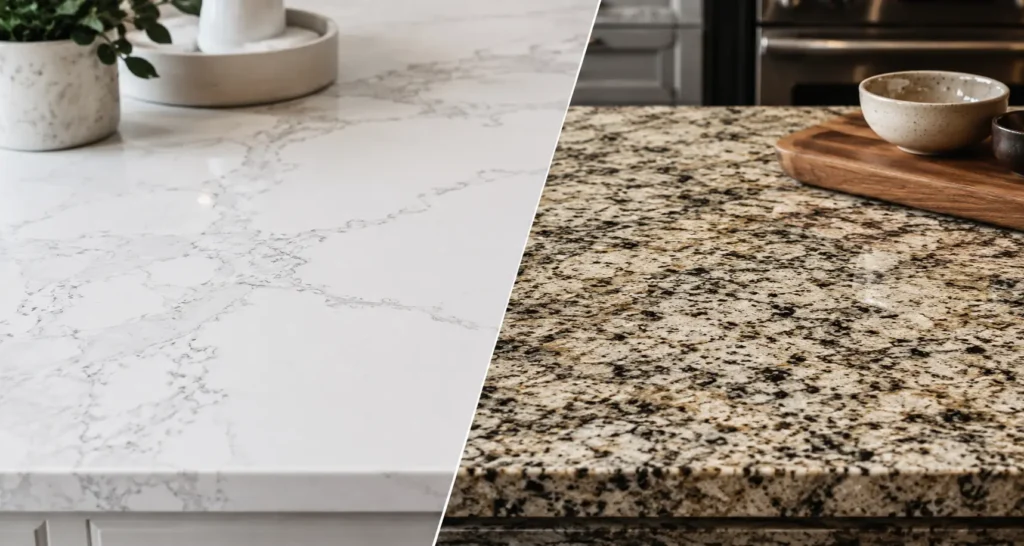
Granite offers unmatched natural variation. Quartz offers guaranteed consistency. Granite’s colors come from mineral content at the quarry site and range from subtle beige and gray to bold blue, green, and red tones, with veining that makes every slab one of a kind. Quartz manufacturers control pigment during production, so a homeowner can order the exact same white-with-gray-veining pattern for a kitchen island, a bathroom vanity, and a wet bar three years apart.
Finish options (polished, honed, leathered) apply to both materials about equally. One small note: a honed finish shows fingerprints more readily on quartz than on granite, since the resin surface has a slightly different light-reflective quality than raw stone.
Environmental Impact and Indoor Air Quality
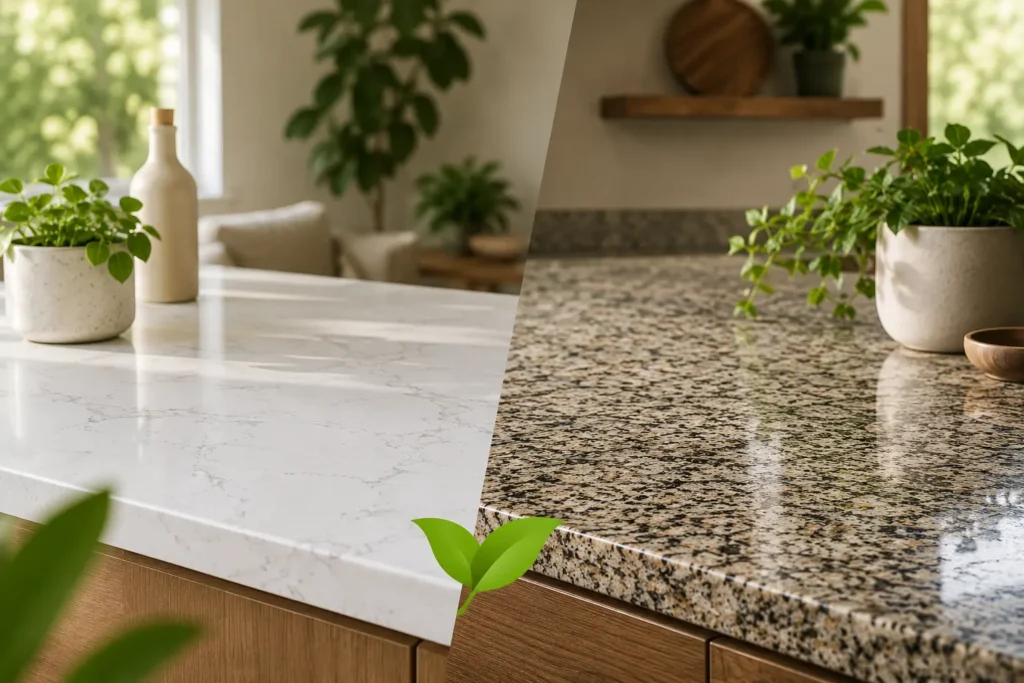
Granite carries a heavier carbon footprint from quarrying and transport. Quartz raises different sustainability questions as a manufactured product. Granite gets extracted in massive slabs, often overseas, then shipped by container ship and truck, a process that burns through significant fuel before installation even begins. Quartz production uses crushed stone waste from other industries and sometimes incorporates recycled material, which cuts the need for new quarrying, but the finished product isn’t biodegradable and some manufacturing processes involve chemical binders.
One indoor air quality point worth flagging: granite can emit trace levels of radon, a naturally occurring radioactive gas, depending on the mineral content of a given slab. The EPA notes that radon emissions from granite countertops are generally too low to pose a measurable health risk, though homeowners with specific concerns can request radon testing on a slab before installation. Quartz, as a non-porous manufactured surface, doesn’t carry this consideration at all.
Warranty Comparison: What’s Actually Covered
Quartz manufacturers typically back their products with longer warranties than granite fabricators do. Brands like Silestone and Caesarstone commonly offer 10-to-15-year or limited lifetime warranties covering material defects. Granite, being a natural product, usually comes with only an installer’s workmanship warranty, typically one to five years, since no manufacturer stands behind a stone formed by geology rather than a factory process.
This gap matters most if you’re planning to stay in a home long-term. A cracked quartz seam discovered in year eight may still fall under a manufacturer warranty. The same crack in granite depends entirely on what the original fabricator agreed to cover.
Can You Use Quartz or Granite Outdoors?
Granite works outdoors. Quartz generally doesn’t. Granite’s mineral makeup holds up to direct sunlight, temperature swings, and moisture without degrading, which is why it’s a standard choice for outdoor kitchens and grill islands. Quartz’s resin binder breaks down under prolonged UV exposure, causing discoloration, yellowing, or warping within a few years outdoors, worth knowing given how many outdoor kitchen builds are happening in 2026.
A handful of manufacturers now make UV-stabilized outdoor lines, so this isn’t an absolute rule. But a standard indoor-rated quartz slab installed on a patio will show visible wear inside two to three summers in most US climates.
Resale Value: Which Adds More to a Home?
Both materials increase resale value, and neither consistently outperforms the other across markets. Granite appeals to buyers seeking traditional, natural-stone luxury and performs well in markets where that aesthetic dominates local listings. Quartz appeals to buyers who want move-in-ready, low-maintenance finishes, and it tends to test well with younger buyers touring homes through online listings first.
Appraisers and real estate agents generally treat both as premium upgrades over laminate or tile, adding comparable value as long as the rest of the kitchen matches the quality level of the countertop.
Quartz vs. Granite: Quick Comparison Table
| Factor | Quartz | Granite |
| Material type | Engineered (90–93% crushed quartz + resin) | Natural, quarried stone |
| Cost per sq ft (installed) | $50–$200 | $75–$225 |
| Heat resistance | Up to ~300°F | Up to ~1,200°F |
| Sealing required | Never | Every 1–2 years |
| Stain resistance | High (non-porous) | Moderate (needs sealing) |
| Scratch resistance | High | Very high |
| Chip resistance | Very high | Moderate |
| Outdoor use | Not recommended (standard lines) | Suitable |
| Typical warranty | 10–15 years to limited lifetime | 1–5 years (workmanship only) |
| Color consistency | Uniform, repeatable | Unique per slab |
| Radon consideration | None | Trace levels possible, low risk per EPA |
Which Countertop Should You Choose?
Choose quartz for low-maintenance, color-consistent kitchens. Choose granite for heat-heavy cooking and natural stone character. If you grill indoors, bake often, or set pots straight from the stovetop onto the counter, granite’s heat tolerance pays off in daily use. If you’d rather never seal anything, want guaranteed stain resistance, and need an exact color match across a large kitchen, quartz is the smarter pick.
Budget rarely settles this on its own, since the two materials overlap heavily in price at the mid-range. In most kitchens, the deciding factor comes down to cooking habits and how much annual maintenance you’re actually willing to do, not which material costs a few dollars less per square foot.
Conclusion
The quartz vs granite choice rarely comes down to price, since both materials land in the same $50–$225 per square foot range depending on brand, colour, and edge complexity. Granite wins for households that cook with high heat and want one-of-a-kind veining. Quartz wins for households that want zero sealing and guaranteed color matching across a large kitchen. Match the material to your actual cooking habits and maintenance tolerance, and either stone holds up for decades.