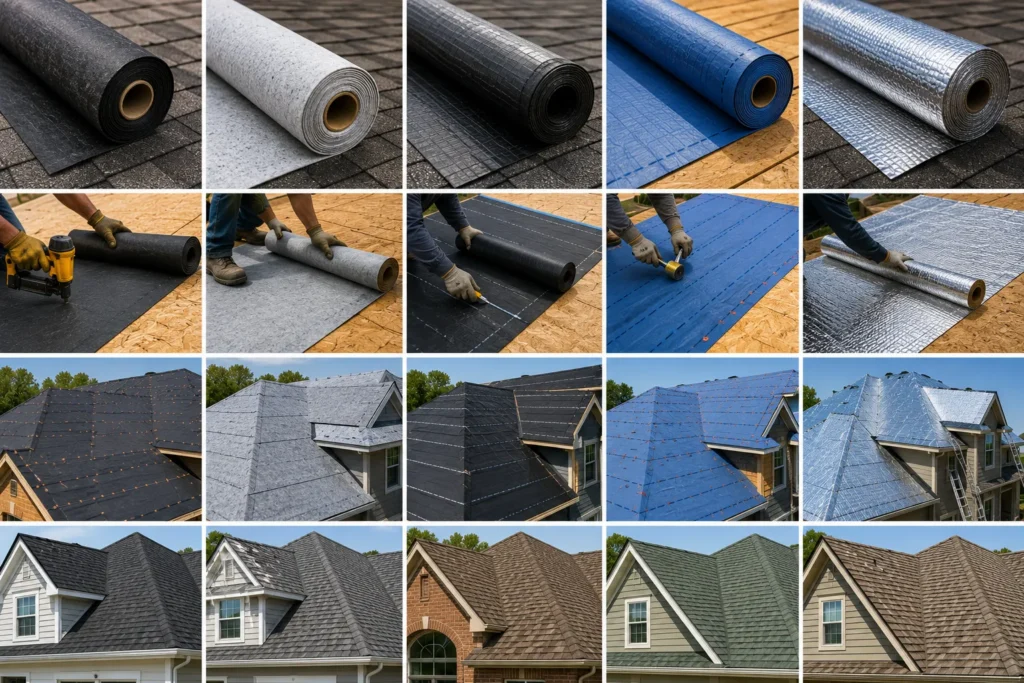
Roof underlayment is a water-resistant or waterproof barrier installed directly on your roof deck, beneath all outer roofing materials. You need it to protect your plywood or oriented strand board (OSB) decking from wind-driven rain, ice dams, and moisture that bypasses shingles or panels.
3 primary types exist: asphalt-saturated felt, synthetic, and rubberized asphalt (self-adhering). Each type carries different costs, lifespans, and minimum pitch requirements. Choosing the wrong type voids manufacturer warranties and can fail local building inspections under IBC Chapter 15.
What Roof Underlayment Does and Why Every Roof Needs It
Roof underlayment acts as a secondary moisture barrier between the roof deck and the outer roofing material. Shingles, metal panels, and tiles are water-shedding not fully waterproof. Wind forces water up through shingle laps. Nails and fastener holes create penetration points. The underlayment stops water at all 3 entry points before it reaches the wood deck.
Without underlayment, plywood decking exposed to moisture rots in 3 to 5 years. Rot spreads to rafters and structural supports, turning a $200 (£157) repair into a $5,000 (£3,940) structural replacement. Every major building code in the United States — including IBC Chapter 15 and IRC R905 — requires at least 1 layer of underlayment on any pitched roof.
4 Functions Underlayment Performs on Every Roof
- Moisture barrier: Stops wind-driven rain from reaching the OSB or plywood deck during storms.
- Temporary weather protection: Shields the deck between the time decking is laid and shingles are installed, which can span days or weeks.
- Ice dam backup: Ice and water shield variants prevent meltwater from backing up under shingles at the eave line in freezing climates.
- Fire resistance: Class A-rated underlayments resist burning embers in wildfire-prone regions and meet local fire code requirements.
When Building Codes Require Underlayment
IBC Chapter 15 mandates underlayment on all roof slopes above 2:12 for asphalt shingles. Most synthetic underlayments are approved for slopes as low as 3:12 when installed with 50% overlap. Below 3:12, building code requires full coverage with a peel-and-stick membrane — standard felt does not meet code on low-slope roofs. Cold climates also require ice and water shield from the eave edge to at least 24 inches (61 cm) inside the exterior wall line per IRC R905.2.7.1.
3 Types of Roof Underlayment: Materials, Performance, and Cost
The 3 types of roof underlayment differ in base material, water resistance, tear strength, and cost per square foot. Select the type based on your roof pitch, climate zone, outer roofing material, and project budget.
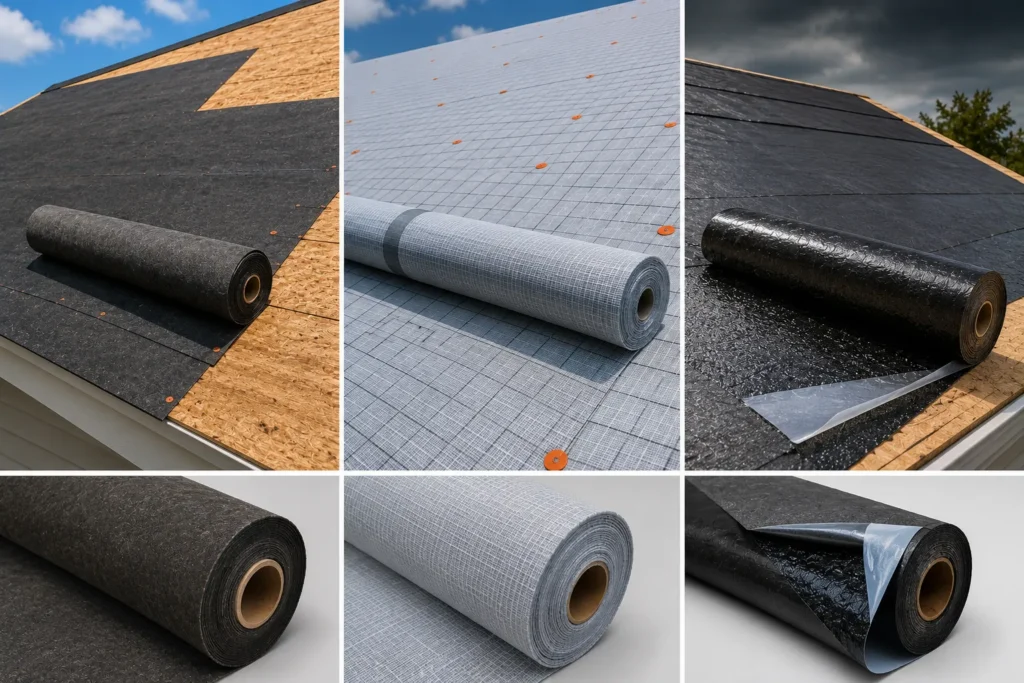
Type 1 — Asphalt-Saturated Felt (No. 15 and No. 30)
Asphalt-saturated felt is the oldest type of roof underlayment. It uses paper or fiberglass mat saturated in asphalt, available in 2 standard weights: No. 15 felt at 15 lbs per 100 sq ft (0.73 kg per sq m) and No. 30 felt at 30 lbs per 100 sq ft (1.46 kg per sq m). No. 30 felt resists tearing and water infiltration better than No. 15 and is the NRCA-recommended minimum for steep-slope applications.
Material cost runs $0.05 to $0.45 per sq ft ($0.54 to $4.84 per sq m), making felt the lowest-cost option at purchase. A roll of No. 30 felt covers 200 sq ft (18.6 sq m) and weighs 50 to 65 lbs (22.7 to 29.5 kg). A 2,700 sq ft (250.8 sq m) roof needs 14 rolls of No. 30 felt versus just 3 rolls of synthetic. Labor time and trip count are higher with felt, which increases total installed cost.
Felt absorbs water when wet and wrinkles, which reduces its effectiveness and creates an uneven nailing surface for shingles. UV exposure degrades felt within hours — installers must cover felt immediately after laying it. Felt lifespan runs 12 to 25 years, shorter than synthetic in every climate.
Type 2 — Synthetic Underlayment (Polypropylene and Polyethylene)
Synthetic underlayment uses woven or cross-laminated polypropylene or polyethylene polymers. It is 4 to 5 times lighter than felt at 2 to 4 lbs per roofing square (0.10 to 0.20 kg per sq m) and resists tearing 5 to 10 times better. A single synthetic roll covers 1,000 sq ft (92.9 sq m), reducing seam count and installation time.
Material cost runs $0.15 to $0.70 per sq ft ($1.61 to $7.53 per sq m), depending on warranty rating. 25-year non-adhesive products (such as Sharkskin Comp and GAF Feltbuster) cost $0.15 to $0.20 per sq ft. 50-year non-adhesive products (such as Sharkskin Ultra and Owens Corning WeatherLock) cost $0.20 to $0.25 per sq ft. 50-year self-adhering synthetic (such as Sharkskin Ultra SA and Grace Tri-Flex) cost $0.55 to $0.65 per sq ft.
Synthetic withstands UV exposure for up to 6 months before shingle installation, unlike felt which degrades within hours. The non-slip surface texture keeps workers safe on slopes above 5:12 in wet conditions. Synthetic underlayment is the standard specification for most residential roofing projects in 2026.
Type 3 — Rubberized Asphalt (Peel-and-Stick / Self-Adhering)
Rubberized asphalt underlayment is a self-adhering, peel-and-stick membrane with an asphalt-rubber compound bonded to a polyester or fiberglass carrier. It is the only fully waterproof underlayment type — it seals around nails and fasteners as they penetrate the membrane, eliminating puncture leak points. Material cost runs $0.65 to $1.20 per sq ft ($7.00 to $12.92 per sq m). Installed cost reaches $1.80 to $3.00 per sq ft ($19.38 to $32.29 per sq m) due to slower application and surface preparation requirements.
Rubberized asphalt can remain exposed for 90 to 180 days without degrading under UV exposure. It is the specified underlayment for metal roofing in high-wind zones, under slate and clay tile, and for full-coverage ice dam protection. The Metal Roofing Alliance (MRA) specifies a minimum vapor permeability of 15 perms for underlayment under metal panels. Standard rubberized asphalt runs below 1 perm, so pair rubberized asphalt at eaves and valleys with high-perm synthetic on the field area of metal roofs.
Roof Underlayment Quick-Reference: Cost, Lifespan, and Best Use
The table below compares all 7 underlayment configurations across 6 key decision factors. Use material cost for budget planning and installed cost for contractor quote comparison.
| Underlayment Type | Material Cost/sq ft | Installed Cost/sq ft | Lifespan | UV Exposure Limit | Best For |
| No. 15 Felt | $0.05–$0.25 | $0.70–$1.10 | 12–20 years | Hours only | Budget asphalt shingle roofs in mild climates |
| No. 30 Felt | $0.08–0.45 | $0.80–$1.25 | 15–25 years | Hours only | Steep-slope asphalt shingle roofs on a budget |
| Synthetic (25-yr) | $0.15–$0.20 | $0.85–$1.40 | 25–35 years | Up to 6 months | Standard residential: shingles, tile, metal |
| Synthetic (50-yr) | $0.20–$0.25 | $0.95–$1.60 | 35–50 years | Up to 6 months | Premium residential: metal, slate, tile |
| Self-Adhered Synthetic | $0.55–$0.65 | $1.20–$2.00 | 40–50 years | Up to 6 months | High-wind zones, coastal, Wind Zone III |
| Ice & Water Shield | $0.65–$1.05 | $1.50–$2.50 | 50+ years | 30–90 days | Eaves, valleys, penetrations in cold climates |
| Rubberized Asphalt | $0.75–$1.20 | $1.80–$3.00 | 50+ years | 90–180 days | Metal roofs, extreme weather, low slopes |
How to Select Roof Underlayment by Climate and Roof Type
Underlayment selection depends on 4 variables: climate zone, roof pitch, outer roofing material, and project budget. Using the wrong product for your climate or material type causes premature failure regardless of installation quality.
Cold Climates with Snow and Ice Dams
Cold climates defined as regions with heating degree days above 4,000 require ice and water shield at every eave. Install ice and water shield from the eave edge to a point 24 inches (61 cm) inside the exterior wall line. In regions with heavy snowfall above 30 inches (76.2 cm) annually, extend ice and water shield up the full eave overhang plus 3 ft (91.4 cm) past the wall. Cover the field area with 50-year synthetic underlayment. Install ice and water shield in all valleys and around all penetrations regardless of climate zone.
Hot and Humid Climates
Hot climates above 90°F (32.2°C) require underlayment with a temperature rating above 260°F (126.7°C) to prevent softening under metal panels and dark shingles. Synthetic underlayments rated for high-heat applications — such as Epilay Platinium and VaproShield WrapShield — resist softening and adhesive failure in extreme heat. Felt underlayment degrades faster in high heat and humidity due to volatile compounds in the asphalt saturant evaporating over 5 to 10 years, leaving the paper backing unprotected.
High-Wind and Coastal Zones
Wind Zone III coastal areas require self-adhering synthetic or rubberized asphalt underlayment rated for sustained winds above 130 mph (209 km/h). Standard felt tears at wind speeds above 45 mph (72 km/h) during installation and before shingles cover it. Self-adhered products such as Sharkskin Ultra SA and Grace Vycor Plus bond directly to the deck, eliminating wind uplift at seams. A standing seam metal roof in a coastal zone requires self-adhered underlayment at all eaves, rakes, and valleys plus high-perm synthetic on the field.
Metal Roofing: Vapor Permeability Matters
Metal roofing traps condensation between the panel and the deck when underlayment vapor permeability is too low. The Metal Roofing Alliance specifies minimum 15 perms vapor permeability for all underlayment under metal panels. High-perm products (Grace Tri-Flex at 30+ perms and Titanium UDL50 at 20+ perms) allow moisture vapor to escape, preventing condensation-driven deck rot. Using ice and water shield (0.05 to 0.5 perms) over more than 25% of a metal roof field area traps moisture and causes structural damage within 5 to 10 years.
For flat or low-slope roofs where EPDM or TPO membranes replace shingles entirely, a separate underlayment is not required the membrane system is the waterproofing layer. See the rubber roofing cost guide for full membrane system specifications.
How to Install Roof Underlayment Step by Step
To install roof underlayment, start at the lowest roof edge and work upward in horizontal courses. Each course overlaps the one below it so water drains over seams, not under them.
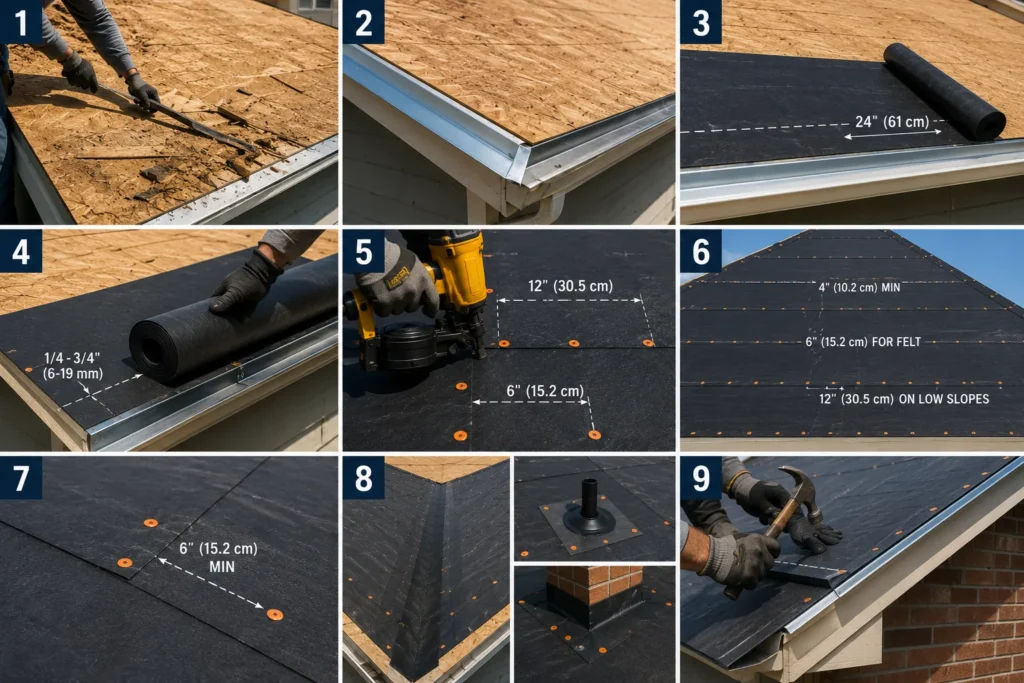
- Prepare the deck: Remove all nails, splinters, and debris. Replace any rotted OSB or plywood sections before rolling out underlayment.
- Install drip edge at eaves: Set the metal drip edge along the eave before any underlayment. Rake drip edge installs after underlayment.
- Lay ice and water shield at eaves: In cold climates, install ice and water shield first, running it 24 inches (61 cm) past the interior wall line.
- Start the first underlayment course: Position the roll at the eave with a 1/4 to 3/4 inch (6–19 mm) overhang past the drip edge to direct water into gutters.
- Fasten with cap nails: Drive 1-inch cap nails every 12 inches (30.5 cm) along the top edge and every 6 inches (15.2 cm) at seams. Use a pneumatic cap nailer for synthetic underlayment.
- Overlap subsequent courses: Overlap synthetic underlayment by a minimum 4 inches (10.2 cm) Use 6 inches (15.2 cm) for felt and 12 inches (30.5 cm) on low slopes below 4:12.
- Overlap vertical end laps: At roll ends, overlap a minimum 6 inches (15.2 cm) for all underlayment types.
- Cover valleys and penetrations: Install ice and water shield in all valleys and around chimneys, pipe vents, and skylights before underlayment reaches those areas.
- Install rake drip edge: Set the rake drip edge over the underlayment on the gable ends. Nail through the drip edge into the fascia.
Overlap Requirements by Slope
Slope determines minimum horizontal overlap. On slopes 4:12 and above, 4 inches (10.2 cm) minimum horizontal overlap applies to synthetic underlayment. On slopes below 4:12, increase horizontal overlap to 12 inches (30.5 cm) for all underlayment types. Self-adhering products require only 2 inches (5.1 cm) because the adhesive creates a watertight seal at the seam.
Gable roofs with standard pitches follow the same overlap rules. For complex roof types — hip roofs, dormers, and mansard designs — treat each roof plane independently and install ice and water shield at every valley intersection. Read the gable roof pitch guide for pitch-specific detailing on gable roof planes.
5 Common Underlayment Installation Mistakes
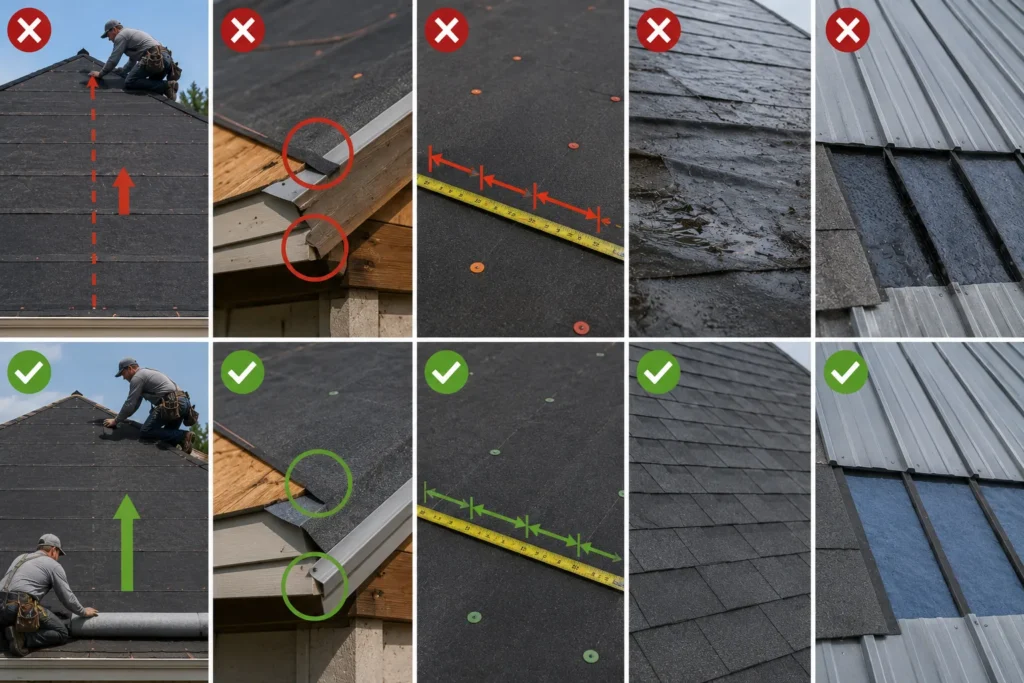
- Starting at the wrong edge: Always start at the eave (bottom) and work upward. Starting at the ridge creates reverse laps that funnel water under seams.
- Skipping drip edge sequence: Eave drip edge must go under underlayment. Rake drip edge must go over underlayment. Reversing either creates a leak path.
- Using insufficient fasteners: Felt paper with nails spaced more than 12 inches (30.5 cm) apart lifts in wind gusts above 20 mph (32.2 km/h) before shingles arrive.
- Leaving felt exposed overnight: A single rain event saturates felt, causing wrinkling and loss of water resistance within hours. Cover felt the same day.
- Wrong vapor perm product under metal: Ice and water shield under the full field of a metal roof traps moisture. Use high-perm synthetic on the field and reserve ice and water shield for edges and valleys only.
Roof Underlayment Cost Breakdown for 2026
Total underlayment replacement cost ranges from $1,100 to $9,000 for a full residential roof, or $0.75 to $4.00 per sq ft ($8.07 to $43.06 per sq m) installed. The 4 main cost variables are underlayment type, roof size, slope complexity, and local labor rates.
Material Costs by Type
- 15 felt: $0.05 to $0.25 per sq ft ($0.54 to $2.69 per sq m) for materials only.
- 30 felt: $0.08 to $0.45 per sq ft ($0.86 to $4.84 per sq m) for materials only.
- 25-year synthetic: $0.15 to $0.20 per sq ft ($1.61 to $2.15 per sq m) for materials only.
- 50-year synthetic: $0.20 to $0.25 per sq ft ($2.15 to $2.69 per sq m) for materials only.
- Self-adhered synthetic: $0.55 to $0.65 per sq ft ($5.92 to $7.00 per sq m) for materials only.
- Ice and water shield: $0.65 to $1.05 per sq ft ($7.00 to $11.30 per sq m) for materials only.
- Rubberized asphalt: $0.75 to $1.20 per sq ft ($8.07 to $12.92 per sq m) for materials only.
How Slope Affects Total Cost
Roof slope raises underlayment cost in 2 ways: surface area and labor. A 12:12 pitch roof carries a 1.414 pitch multiplier, meaning a 2,000 sq ft (185.8 sq m) footprint produces 2,828 sq ft (262.8 sq m) of actual roof surface. Labor costs rise 25 to 40% on slopes above 8:12 because crews need harnesses, roof jacks, and extended setup time. A 1,500 sq ft (139.4 sq m) footprint with a 6:12 pitch uses 1,677 sq ft (155.8 sq m) of underlayment. The same footprint at 9:12 uses 1,875 sq ft (174.2 sq m) — 198 sq ft (18.4 sq m) more material.
For a full roof replacement including underlayment and materials on a 2,000 sq ft (185.8 sq m) roof:
- Budget (No. 15 felt): $1,500 to $2,200 total installed.
- Mid-range (synthetic): $2,800 to $4,500 total installed.
- Premium (self-adhered + ice shield): $4,500 to $9,000 total installed.
Roof Underlayment Lifespan and Warranty Comparison
Underlayment lifespan depends on material type, UV exposure time, and climate. Felt underlayment lasts 12 to 25 years under normal conditions but degrades in 5 to 10 years in high-heat or high-humidity climates. Standard synthetic underlayment lasts 25 to 35 years. Premium self-adhering synthetic and rubberized asphalt products last 40 to 50+ years, matching or exceeding the shingles or metal panels above them. Products like Sharkskin Comp carry 30-year limited warranties. Sharkskin Ultra SA and Epilay ProtecTite Platinum carry 40-year limited warranties.
Most shingle manufacturers including GAF, Owens Corning, and CertainTeed require compatible synthetic underlayment to validate the full system warranty. Installing GAF Timberline HDZ shingles over felt instead of GAF FeltBuster synthetic underlayment voids the System Plus and Silver Pledge warranty coverage. Check the shingle manufacturer’s current installation manual before purchasing underlayment.
Choose the Right Underlayment Before You Order Any Roofing Material
Roof underlayment protects your deck from the day installers unroll it until the day the roof comes down for replacement decades later. No. 15 and No. 30 felt fit budget projects in mild climates. 25-year and 50-year synthetic products fit standard residential roofs in most climates. Self-adhering rubberized asphalt fits metal roofing, coastal zones, and any roof section that pools water or faces ice dam risk.
Match the underlayment to your climate zone first, then to your outer roofing material, then to your budget. A $200 to $300 upgrade from felt to synthetic on a 2,000 sq ft (185.8 sq m) roof buys 20 to 30 years of additional lifespan and keeps the shingle manufacturer warranty intact. Skipping that upgrade and losing the warranty costs 10 to 15 times more in out-of-pocket repair expenses over the same period.