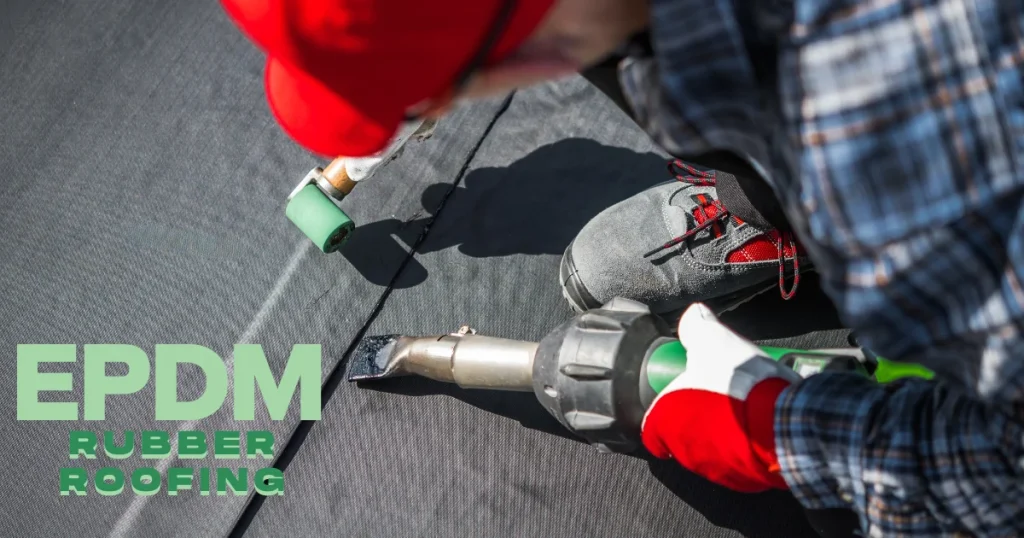
EPDM rubber roofing installation is one of the most reliable ways to waterproof a flat or low-slope roof — delivering 20 to 50+ years of performance when done correctly. Whether you’re tackling a garage, shed, house extension, or commercial flat roof, this complete guide walks you through every phase of the process: from surface prep and adhesive types to seam sealing, edge trims, and common mistakes to avoid.
We’ve analyzed the top-ranking guides, GSC search data, and real-world installation experience to give you the most thorough, up-to-date resource on EPDM roofing installation available online.
What Is EPDM Roofing? (And Why It Dominates Flat Roofs)
EPDM stands for Ethylene Propylene Diene Monomer — a high-performance synthetic rubber membrane engineered specifically for flat and low-slope roofing. Originally developed as a pond liner, it found its way onto rooftops in the early 1970s and has remained the industry standard for rubber roofing ever since.
Key reasons EPDM is the preferred flat roofing material:
- Lifespan of 20–50+ years with proper installation and maintenance
- Exceptional UV, ozone, and weathering resistance — no additional coating required
- Flexible down to –49°F and heat-stable up to 300°F without cracking
- Lightweight — no structural load concerns unlike ballasted systems
- Available in single-piece sheets up to 50 feet wide — eliminating seams on most residential roofs
- Both black (heat-absorbing) and white (heat-reflective) options for energy efficiency
- DIY-friendly with the right EPDM rubber roof kit and proper guidance
| Feature | EPDM | TPO | Modified Bitumen |
|---|---|---|---|
| Lifespan | 20–50+ years | 15–30 years | 10–20 years |
| UV Resistance | Excellent | Good | Moderate |
| DIY Friendly | Yes | No (heat weld) | Limited |
| Cost (per sq ft) | $3–$6 DIY / $6–$14 pro | $4–$7 DIY / $7–$14 pro | $3–$6 pro only |
| Available in white? | Yes | Yes | No |
| Temperature range | -49°F to 300°F | -40°F to 275°F | -20°F to 220°F |
EPDM vs TPO vs Modified Bitumen — comparative overview
Tools & Materials You Need Before Starting
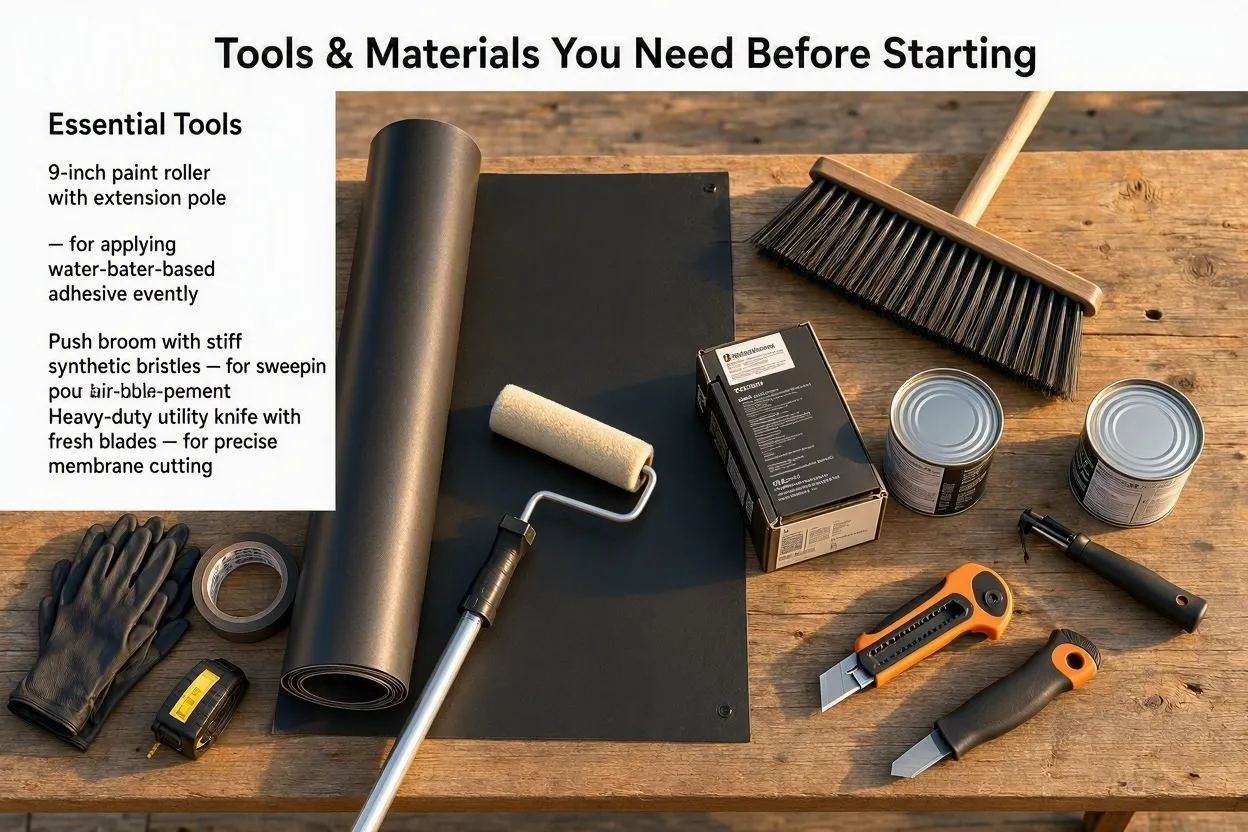
Gathering everything before you start prevents costly mid-job delays. Most quality EPDM rubber roof kits include the membrane and primary adhesives — but you’ll still need these tools:
Essential Tools
- 9-inch paint roller with extension pole — for applying water-based adhesive evenly
- Push broom with stiff synthetic bristles — for sweeping out air bubbles post-placement
- Heavy-duty utility knife with fresh blades — for precise membrane cuts
- Seam roller / hand roller — for molecular bonding at laps and seam tape
- Chalk line — for straight alignment during layout
- Tape measure and straightedge
- Safety equipment: non-slip footwear, knee pads, work gloves, fall protection for pitched surrounds
Materials Checklist
- EPDM membrane — 60 mil for residential, 90 mil for commercial or high foot-traffic roofs
- Water-based deck adhesive — covers 15–20 m² per 5-litre container
- Contact adhesive (solvent-based) — for perimeter 150mm band and all vertical upstands
- EPDM seam tape (self-adhesive, minimum 3″ width) — for joining multiple sheets
- EPDM primer — applied before seam tape and termination bars for maximum adhesion
- Termination bars (aluminum) — with polypins every 6 inches for wind uplift resistance
- Edge trims: kerb trim, drip/gutter trim, corner trim
- EPDM caulk/lap sealant — for waterproofing behind termination bars
- OSB3 or plywood replacement boards — if substrate repair is needed
- Overboard membrane — if going over existing roof without full tear-off
Phase 1: Surface Preparation — The Most Critical Step
Poor surface preparation is responsible for the overwhelming majority of premature EPDM failures. The substrate must be structurally sound, bone dry, clean, and smooth before any adhesive is applied.
Step-by-Step Surface Prep Process
- Clear all debris: Sweep away leaves, dirt, nails, screws, and any protruding sharp objects. Sharp debris is the leading cause of membrane punctures during installation.
- Inspect the deck: Check plywood or OSB3 thoroughly for rot, delamination, damp spots, or soft areas. Press firmly across all sections — soft spots indicate hidden moisture damage.
- Replace damaged boards: Any compromised decking sections must be replaced now. Using new OSB3 at minimum 18mm thickness is standard for residential applications.
- Remove old roofing material: Strip away any residual bitumen felt, asphalt, or old membrane. If full removal isn’t possible, install a compatible overboarding layer instead.
- Fill gaps and level: Fill cracks wider than 6mm with appropriate filler compound. The surface must be smooth — even small protrusions can damage the membrane under foot traffic or thermal movement.
- Moisture check: The deck must be completely dry. Use a moisture meter if in doubt — readings above 19% indicate unsafe moisture levels. Trapped moisture vaporizes under the membrane and creates blisters that destroy adhesion.
- Clean with solvent: For metal or concrete substrates, wipe down with a compatible cleaning solvent to remove oils, grease, or contaminants that would prevent adhesion.
Phase 2: Step-by-Step EPDM Rubber Roofing Installation
STEP 2 : Apply Water-Based Adhesive to the Deck
Fold back exactly half the membrane to expose half the deck. Pour water-based adhesive and spread evenly with your 9-inch roller in 2-metre manageable sections. Leave a 150mm unglued border around all perimeter edges — this zone gets contact adhesive later. Apply adhesive only to the deck (not the membrane) for water-based systems. The adhesive should remain wet and milky-white when you lay the membrane — if it starts to skin over, work faster or reduce section size. In temperatures above 25°C, work in smaller sections as drying accelerates significantly.
STEP 3: Lay Membrane & Remove Air Bubbles
With adhesive still wet and tacky, carefully fold the membrane back into position over the bonded half of the deck. Avoid dragging — lift and place to prevent stretching. Immediately work with your push broom using firm, overlapping strokes from the centre outward to the edges. This mechanical action removes trapped air pockets and forces the rubber into full contact with the adhesive. Do not stretch the membrane during this phase — stress at seams leads to premature tearing. Repeat the entire process for the second half: fold back, apply adhesive, position, broom thoroughly.
STEP4 : Bond Perimeter & Vertical Upstands with Contact Adhesive
Apply contact adhesive (solvent-based) to both the 150mm deck perimeter AND the corresponding membrane underside. Use a brush for even coverage — thin and even beats thick and lumpy. Wait until both surfaces are touch-dry with no wet spots (test with knuckle — should feel slightly tacky but not stick aggressively). Bring both surfaces together precisely — contact adhesive bonds instantly on contact with zero repositioning opportunity. Press firmly and roll with your seam roller. Carry this same two-sided contact adhesive technique up all vertical upstands and parapet walls.
Phase 3: Creating Watertight Seams (Multi-Sheet Roofs)
For roofs wider than 50 feet, or any project requiring multiple EPDM sheets, proper seam construction is essential. Seams are statistically the most common failure point on any single-ply membrane roof — but when done correctly, they’re virtually indestructible.
Seam Installation Process
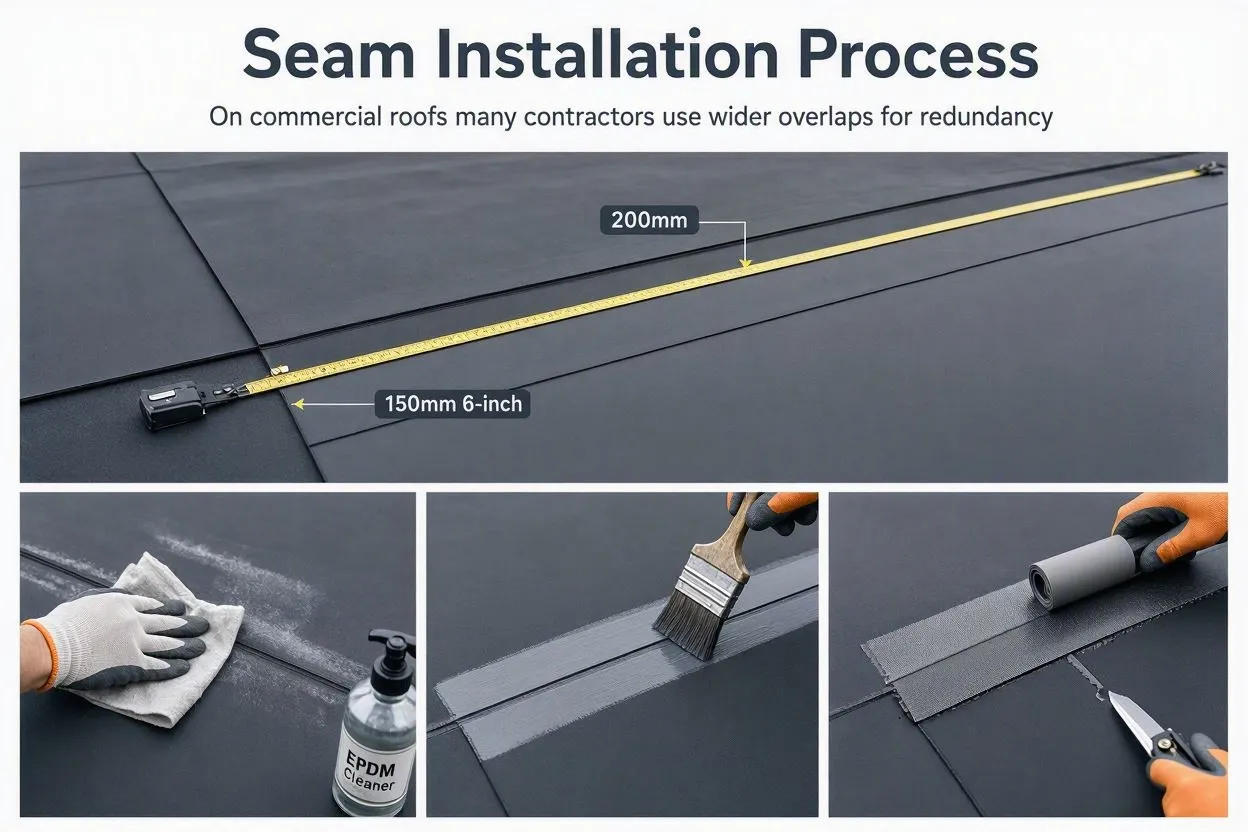
- Overlap measurement: Ensure a minimum 150mm (6-inch) overlap between adjacent sheets. On commercial roofs, many contractors use 200mm for added redundancy.
- Surface cleaning: Wipe both mating surfaces with EPDM cleaner/primer using a clean lint-free cloth. All dust, oils, and surface bloom must be removed for the tape to bond properly.
- Primer application: Apply EPDM-specific seam primer to both overlap surfaces using a brush or applicator pad. Work primer slightly beyond the tape area. Allow to dry until tacky — typically 10–15 minutes at 20°C.
- Apply seam tape: Peel back the release liner on self-adhesive seam tape and apply to the primed bottom sheet. Roll firmly with a hand roller from the centre outward, maintaining uniform pressure.
- Fold top sheet down: Remove the top release liner and carefully position the upper membrane onto the tape. Avoid wrinkles — smooth from the centre outward.
- Roll for molecular bonding: Use a weighted seam roller with firm, overlapping strokes across the entire seam width. This compression step creates the chemical bond that makes the seam as strong as the membrane itself.
- Apply lap sealant: Run a bead of EPDM lap sealant along the exposed tape edge to prevent water tracking beneath the seam. Tool smooth with a wet finger.
Phase 4: Edge Trims, Termination Bars & Finishing Details
The finishing phase determines how the roof performs in wind uplift, weather exposure, and long-term edge sealing. Do not rush through these details.
Termination Bars
Fasten aluminum termination bars along all roof edges using polypins or screws at maximum 6-inch (150mm) intervals. Apply a continuous bead of EPDM caulk or lap sealant under the bar before fastening — this creates a secondary waterproof barrier behind the mechanical fixing. Termination bars prevent wind from getting beneath the membrane edge and are the primary defense against wind uplift failure.
Edge Trim Types & Uses
| Trim Type | Location | Function |
|---|---|---|
| Kerb / Upstand Trim | Where roof meets wall or parapet | Directs water back onto roof deck, away from wall junction |
| Drip / Gutter Trim | Front roof edge above gutter | Channels rainwater cleanly into gutters without overspill |
| Corner Trim | External corners of roof | Seals vulnerable 90° corners — membrane folded into ‘pig’s ear’ shape |
| Ridge Cap Trim | Apex of low-slope roofs | Seals the topmost ridge where two roof faces meet |
‘Pig’s Ear’ Corner Folding Technique
External and internal corners are the most leak-prone points on any rubber roof. At each corner, fold the membrane into a neat ‘pig’s ear’ — a pleated, overlapping fold that lies flat against the corner face. Apply contact adhesive to both the folded membrane and the substrate before pressing together. Finish with a corner trim strip and lap sealant bead for maximum waterproofing. This technique, when done correctly, makes corners the strongest part of the whole installation.
What You Need Before Installing EPDM Rubber Roofing
Gather EPDM membrane in 60 mil thickness for residential applications. Water-based deck adhesive covers 15-20 square meters per 5-liter container. Contact adhesive handles perimeters and upstands.
Essential tools include a 9-inch paint roller, push broom with stiff bristles, heavy-duty utility knife, termination bars, seam tape, EPDM primer, and edge trims (kerb, gutter, drip styles). Most quality EPDM rubber roof kits bundle everything together.
ClassicBond and Firestone dominate the market with proven 50+ year lifespans. Calculate your roof area, then add 10% overhang for proper edge sealing. Single-piece membranes eliminate seams for roofs under 50 feet wide.
Surface Preparation (Critical First Step)
Sweep away debris, dust, nails, and protruding screws meticulously. Sharp objects puncture membranes—I learned this the hard way in 2010. The substrate must be completely dry; trapped moisture vaporizes and creates blisters.
Check plywood or OSB3 for rot or damage. Replace compromised sections now. Remove residual bitumen from old roofs or install overboarding. Poor substrate preparation causes 90% of premature failures.
Sealing Edges and Installing Trims
Fasten termination bars every 6 inches along edges using polypins. These aluminum strips secure the membrane against wind uplift. Apply EPDM caulk underneath before fastening for additional waterproofing.
Install kerb edge trim to deflect water back onto roof surface. Drip trim directs runoff into gutters cleanly. Corner trims require folding membrane into “pig’s ear” shapes—a technique preventing leaks at vulnerable points.
Creating Watertight Seams
Single-piece membranes are preferable when possible. Larger projects require joining sheets with 150mm minimum overlap. Clean both surfaces thoroughly with manufacturer-approved primer.
Let the primer dry until tacky—usually 10-15 minutes. Apply seam tape between sections, remove backing, then press top membrane firmly. Roll with a hand roller for molecular bonding preventing water infiltration.
Never use splicing adhesive—seam tape creates stronger waterproof joints. I switched 10 years ago without a single callback since.
EPDM Roofing Adhesive: Choosing the Right Type for Each Zone
One of the most common — and expensive — mistakes in rubber roof installation is using the wrong adhesive in the wrong location. There are two distinct adhesive types for EPDM, and they’re not interchangeable.
| Adhesive Type | Application Method | Where to Use | Where NOT to Use |
|---|---|---|---|
| Water-Based Deck Adhesive | One-sided (deck only) | Horizontal deck surfaces, main field area | Walls, upstands, vertical surfaces |
| Contact Adhesive (Solvent) | Two-sided (both surfaces) | Perimeter 150mm band, upstands, walls, metal, concrete | Main deck field area — too fast-drying for large areas |
| EPDM Seam Tape | Self-adhesive | Joining two membrane sheets (150mm+ overlap) | Do not substitute with contact adhesive for seam joining |
| Lap Sealant / Caulk | Applied by brush/finger | Edge of seam tape, behind termination bars, around penetrations | Do not use as primary adhesive for membrane bonding |
EPDM Roof Installation Cost: 2026 Pricing Guide
Understanding cost expectations helps homeowners and contractors budget accurately and evaluate contractor quotes.
| Installation Type | Cost per Sq Ft | 1,000 Sq Ft Total | Notes |
|---|---|---|---|
| DIY — 45 mil EPDM | $3–$4 | $3,000–$4,000 | Moderate climates, light foot traffic only |
| DIY — 60 mil EPDM | $4–$6 | $4,000–$6,000 | Standard residential — recommended thickness |
| Professional — 60 mil | $6–$10 | $6,000–$10,000 | Includes labor, warranty, clean-up |
| Professional — 90 mil | $9–$14 | $9,000–$14,000 | Commercial, high foot traffic, harsh climates |
| Commercial — large-scale | $5–$9 | Varies | Economies of scale reduce per-unit cost |
Cost variables that significantly impact final pricing include roof accessibility and complexity (dormers, penetrations, parapets), local labor rates (costs are notably higher in Northeast US cities vs. South or Midwest), tear-off of existing roofing material, insulation board installation, and regional disposal fees.
For comparison: a professional EPDM installation typically costs 30–50% less than a TPO system installed by the same contractor, and lasts just as long — making it the superior value choice for most flat roof applications.
7 Most Common EPDM Installation Mistakes (And How to Avoid Them)
After analyzing hundreds of failed EPDM installations, these are the failure patterns that appear most frequently:
- Skipping the membrane relaxation phase — Causes permanent thermal-stress wrinkles. Always allow 30–90 minutes depending on temperature.
- Installing in cold weather (below 4°C) — Water-based adhesive won’t cure properly. Bond looks fine initially but fails within weeks.
- Stretching the membrane during placement — Creates internal stress at seams and perimeter. Lift and place; never drag.
- Using wrong adhesive type — Water-based on walls, contact adhesive on the main deck field. Both are mistakes that generate callbacks.
- Insufficient edge overhang — Less than 100mm at edges makes proper trim installation impossible and leaves the perimeter vulnerable.
- Rushing seam tape application without primer — Primer dramatically increases long-term tape adhesion, especially in temperature-cycling climates.
- Using old or mismatched adhesives — Expired adhesive or adhesive from a different manufacturer than the membrane can compromise system compatibility and void warranties.
Maintenance Schedule for Maximum EPDM Lifespan
EPDM is among the most low-maintenance roofing systems available — but ‘low maintenance’ doesn’t mean ‘no maintenance’. A simple annual routine dramatically extends service life.
| Maintenance Task | Frequency | Why It Matters |
|---|---|---|
| Full visual inspection | Twice yearly (spring/fall) | Catch seam separation, surface cuts, or blister development early |
| Clear debris (leaves, branches) | After every storm / monthly | Sharp debris punctures membrane; debris traps moisture |
| Check termination bars | Annually | Thermal expansion can loosen fasteners over years |
| Inspect penetration flashings | Annually | HVAC vents, pipes, and skylights are common leak entry points |
| Clean surface | Annually | Use mild detergent and water — never petroleum-based cleaners |
| Patch small punctures | Immediately when found | Small repairs (minutes) vs. ignored damage (roof replacement) |
| Check for ponding water | After heavy rain | Ponding exceeding 48 hours accelerates seam fatigue |
Black vs. White EPDM: Climate Considerations
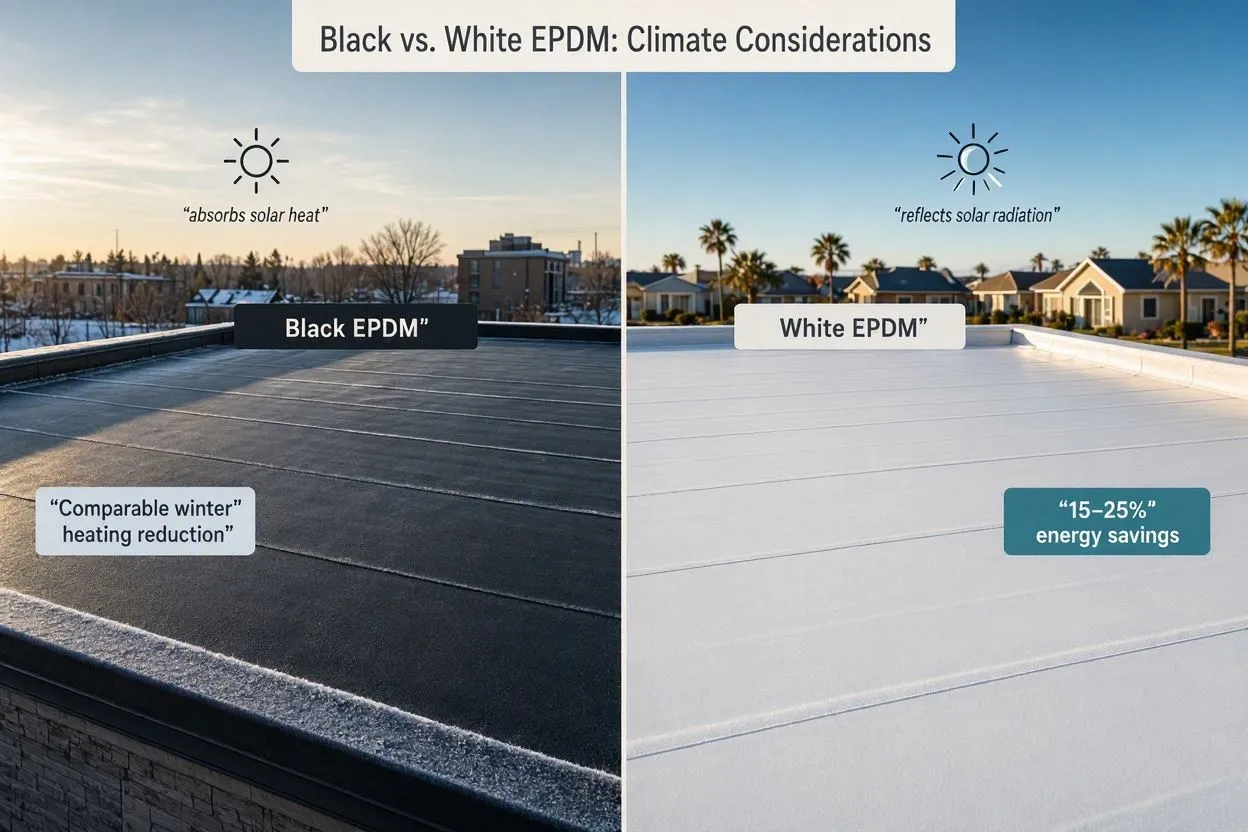
Black EPDM absorbs solar heat — beneficial in cold climates where passive heating reduces winter energy costs. White EPDM reflects solar radiation — ideal for warm climates and commercial buildings where cooling load reduction is the priority. Energy savings from white EPDM in southern US climates can reach 15–25% on cooling bills. Black EPDM in northern climates can reduce winter heating load by a comparable margin. Some manufacturers offer a white coating applied over black EPDM as a retrofit option.
Conclusion
Installing EPDM rubber roofing isn’t complicated, but it doesn’t forgive shortcuts. A clean, dry, smooth surface is the foundation everything else depends on. Use the right adhesive in the right spot, give the membrane time to relax before you bond it, and take your time on seams and edges, since that’s where almost every leak starts. Get those things right and you’ll have a roof that lasts 20 to 50 years with barely any upkeep.
If your roof has a lot of penetrations, odd angles, or it’s a commercial job, it’s worth bringing in a certified installer so your warranty stays valid and the work meets code. Rainy Roofers installs EPDM rubber roofing across the US.