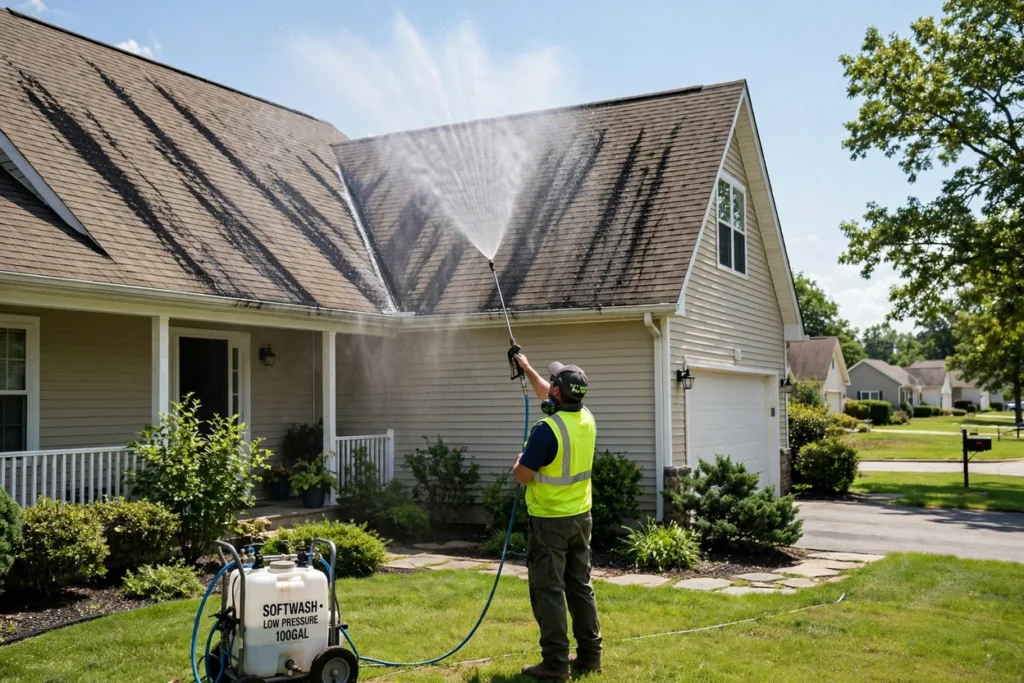
Soft wash roof cleaning is a low-pressure roof cleaning method that kills algae, moss and lichen with a sodium hypochlorite solution instead of high-pressure water. That solution does the real work. It sits on the shingles and breaks down the growth at the root, after which a gentle rinse carries it away while the protective granules and the roof surface stay intact.
Key Takeaways
- Soft wash roof cleaning uses a diluted sodium hypochlorite solution, water and a surfactant, applied at low pressure, to kill roof algae, moss and lichen.
- The Asphalt Roofing Manufacturers Association (ARMA) recommends low-pressure cleaning with a diluted bleach solution and warns that pressure washing can damage asphalt shingles.
- Soft wash roof cleaning cost depends on roof size, pitch, stories, growth severity and region. No verified national average price is available.
- Pre-wetting plants, diverting downspouts and rinsing everything after treatment prevent most runoff damage to shrubs, lawns and flower beds.
- Zinc or copper strips installed near the ridge slow algae and moss regrowth after a soft wash.
- Most homeowners should hire a trained roof cleaning contractor for steep, tall or heavily infested roofs because of fall and chemical risks.
What Is Soft Wash Roof Cleaning?
Soft wash roof cleaning is a chemical-first roof washing method that applies a diluted sodium hypochlorite solution at low pressure, lets the solution kill organic growth, and then rinses it off gently. Black streaks come off this way. So do moss and lichen, on asphalt shingle, tile, slate and metal roofs alike, and the protective granules stay on the surface instead of being blasted away.
You’ll also hear contractors call this method roof soft washing or roof soft cleaning. Same process. Under any of those names, the cleaning solution does the heavy lifting while water pressure stays close to what a garden hose puts out.
The point is to kill the organism. Stripping its visible stain isn’t enough, since growth killed at the root comes back more slowly than growth that’s only been scraped or blasted off the surface.
What Causes Black Streaks on a Roof
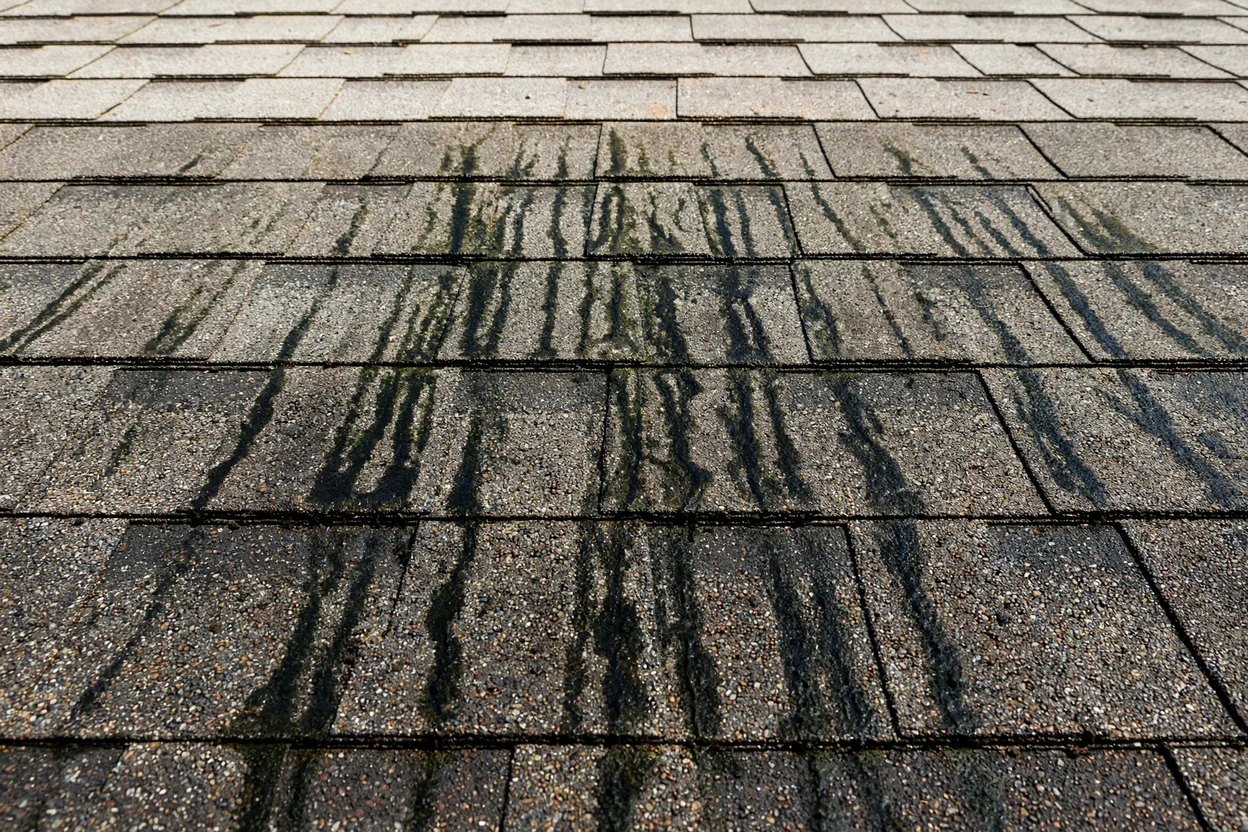
Black streaks on a roof are usually colonies of Gloeocapsa magma, a cyanobacterium often called roof algae. Its spores travel. Wind and wildlife carry them from one roof to the next, which explains why streaking so often spreads across an entire neighborhood instead of staying on one house.
Gloeocapsa magma needs two things. Moisture keeps the cyanobacterium alive, and the limestone filler found in many asphalt shingles gives it a steady food source. To shield itself from ultraviolet (UV) light, the organism builds a dark protective coating, and that coating shows up as the black or dark-brown streaks homeowners notice.
Shade makes it worse. North-facing and shaded slopes stay damp longer, so they usually carry the heaviest streaking. Algae shows up most often in humid regions such as the Southeast and the Gulf Coast, while the Pacific Northwest and the Northeast battle heavy moss growth.
How the Cleaning Solution Works
A soft wash solution has three basic parts. This table lists each ingredient alongside the job it does and a short note on how it behaves on the roof.
| Ingredient | Role | Notes |
|---|---|---|
| Sodium hypochlorite | Kills algae, moss and lichen | The active ingredient in chlorine bleach |
| Water | Dilutes the solution | Strength varies by growth type |
| Surfactant | Helps solution cling and spread | Extends dwell time on sloped roofs |
Sodium hypochlorite oxidizes cell structures, breaking down algae along with moss and lichen. The surfactant lowers surface tension, so the mix clings to the shingles rather than running straight off the roof and into the gutters. Some pro blends go further. They add an odor-masking additive to cut the chlorine smell.
Soft Wash vs Pressure Wash: Which Is Better for a Roof?
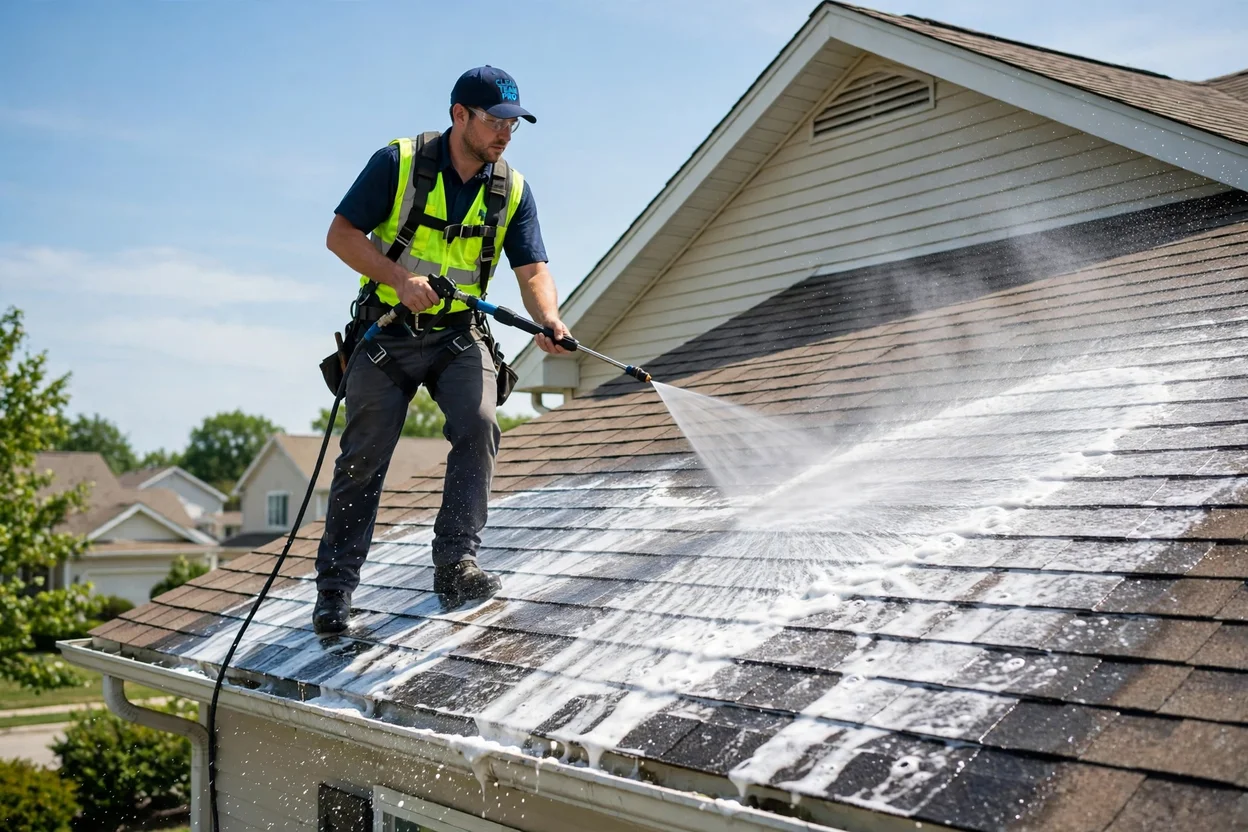
Soft washing is better for a roof than pressure washing because soft washing kills growth with a cleaning solution at low pressure, while pressure washing removes growth with force that can strip shingle granules. Pressure washers can exceed 2,000 pounds per square inch (psi), about 138 bar. Shingles can’t take that. Force at that level can tear shingles and knock granules loose, and it can also drive water underneath the roofing materials.
Side by side, the gap is clear. This table compares soft washing and pressure washing across the factors that matter most for keeping a roof in good shape.
| Factor | Soft Wash | Pressure Wash |
|---|---|---|
| Cleaning Force | Solution does the work | High-pressure water does the work |
| Shingle Granule Loss | Minimal when done correctly | High risk |
| Kills Growth at Root | Yes | No, mostly removes visible growth |
| Regrowth Speed | Slower | Faster |
| ARMA Position | Matches low-pressure guidance | Warned against for shingles |
| Plant Risk | Runoff needs management | Lower chemical risk |
Pressure washing isn’t useless, though, and it still earns its place on concrete driveways, sidewalks and some patios around the house. Roofs are different. For every common roofing material, soft washing wins.
Is Soft Washing Safe for Asphalt Shingles?
Yes, soft washing is safe for asphalt shingles when the solution is diluted correctly, applied at low pressure and rinsed thoroughly. ARMA recommends cleaning roof algae with a diluted chlorine bleach solution applied through a low-pressure sprayer, followed by a low-pressure rinse. Pressure washing is another story. The same group warns that it can damage asphalt shingles.
Asphalt shingles are the most common roofing material in the USA, which means this guidance applies to most American homes. Granules are the key. The surface granules on each shingle block UV light and add fire resistance, and keeping them in place is the main reason the cleaning method matters.
Three mistakes cause most shingle problems during cleaning:
- Using a solution so strong that it discolors shingles or harms nearby surfaces.
- Letting the solution dry on the roof in direct sun before rinsing.
- Walking on wet, treated shingles, which scuffs granules and creates a serious fall risk.
Shingle Warranty Considerations
Every shingle warranty has its own terms, so read the maintenance and cleaning sections of yours before anyone touches the roof. Check the source. GAF, Owens Corning and CertainTeed each post their warranty documents on their websites.
Many newer shingles carry algae-resistant granules that contain copper. GAF StainGuard is one example. Owens Corning StreakGuard and CertainTeed StreakFighter are others, and these product lines come with separate algae protection terms, so some homeowners who spot streaks on these shingles have a warranty claim to file before paying for cleaning.
Hold on to every invoice that lists the cleaning method, the solution used and the pressure level, since that paperwork can settle a warranty question that comes up later. Paper trails matter.
Which Roof Types Can Be Soft Washed?
Most US roof types can be soft washed, including asphalt shingle, concrete tile, clay tile, slate and metal, while cedar shake roofs need an adjusted, gentler cleaning solution. Material changes the recipe. Solution strength, dwell time and the rinse process all shift from one roof type to the next, and a trained operator plans around each material’s specific risk before spraying.
Roofs differ. This table compares soft wash suitability, solution notes and the main risk for each common roof type found on US homes.
| Roof Type | Soft Wash Suitable | Solution Notes | Main Risk |
|---|---|---|---|
| Asphalt Shingle | Yes | Diluted sodium hypochlorite plus surfactant | Granule loss from foot traffic |
| Concrete Tile | Yes | Stronger mix for heavy moss | Cracked tiles if walked on |
| Clay Tile | Yes | Low pressure and thorough rinse | Brittle tiles crack underfoot |
| Slate | Yes | Gentle mix, rinse fully | Slate breaks under foot traffic |
| Metal | Yes | Rinse thoroughly to limit corrosion | Coating damage, very slippery surface |
| Cedar Shake | With changes | Many pros use oxygen-based cleaners | Bleach can damage wood fibers |
Cedar shake roofs deserve extra caution. Strong chlorine solutions can lighten the wood and break down its fibers, which is why many cedar specialists switch to an oxygen-based cleaner such as sodium percarbonate.
Metal roofs clean up easily. Leftover chlorine is the catch, though, because it can attack certain coatings and metals when the rinse isn’t thorough enough to wash it all away. A full rinse plus a check with the coating manufacturer heads off most problems.
How Much Does Soft Wash Roof Cleaning Cost?
Soft wash roof cleaning cost depends on roof size, roof pitch, number of stories, growth severity and local labor rates, and no verified national average price is available. Shop around. Request at least three written quotes from local roof cleaning contractors, and make sure each one states the square footage, solution type, plant protection steps and any re-treatment guarantee.
Pricing models vary. Most contractors charge by roof square footage or a flat job rate, though small roofs may hit a minimum charge, so comparing quotes on the same basis is the easiest way to avoid surprises.
Factors That Raise the Price
Several variables move the price. This table lists the factors that change soft wash roof cleaning cost, along with the reason each one pushes a quote up or down.
| Cost Factor | Effect on Price | Why |
|---|---|---|
| Roof Square Footage | Higher with larger roofs | More solution, water and labor |
| Roof Pitch | Higher on steep roofs | Slower work and extra safety gear |
| Number of Stories | Higher on taller homes | Longer ladders and fall protection |
| Growth Severity | Higher for lichen and thick moss | Stronger mix, manual removal, retreatment |
| Roof Material | Higher for cedar and tile | Specialty solutions and careful technique |
| Region | Varies by local labor rates | Labor and insurance costs differ by state |
| Access | Higher with tight or steep lots | Equipment placement takes longer |
Ask whether the quote covers gutter flushing, downspout protection and moss scraping. Not every crew includes them. Some contractors fold those extras into the base price, while others list each one as a separate charge on the final invoice.
Cleaning vs Replacement Value
Cleaning costs far less than replacing a roof, and it deals with moss that holds moisture against the roofing materials. That matters. Thick moss can lift shingle edges and trap water underneath, so getting rid of it protects the roof itself and not just its appearance.
No verified figure is available for how many years cleaning adds to a roof’s life. Other gains are easier to name. Curb appeal improves, and growth that holds moisture on the roof comes off along with the stains, while the inspection that goes with the job catches damaged shingles early.
How to Soft Wash a Roof
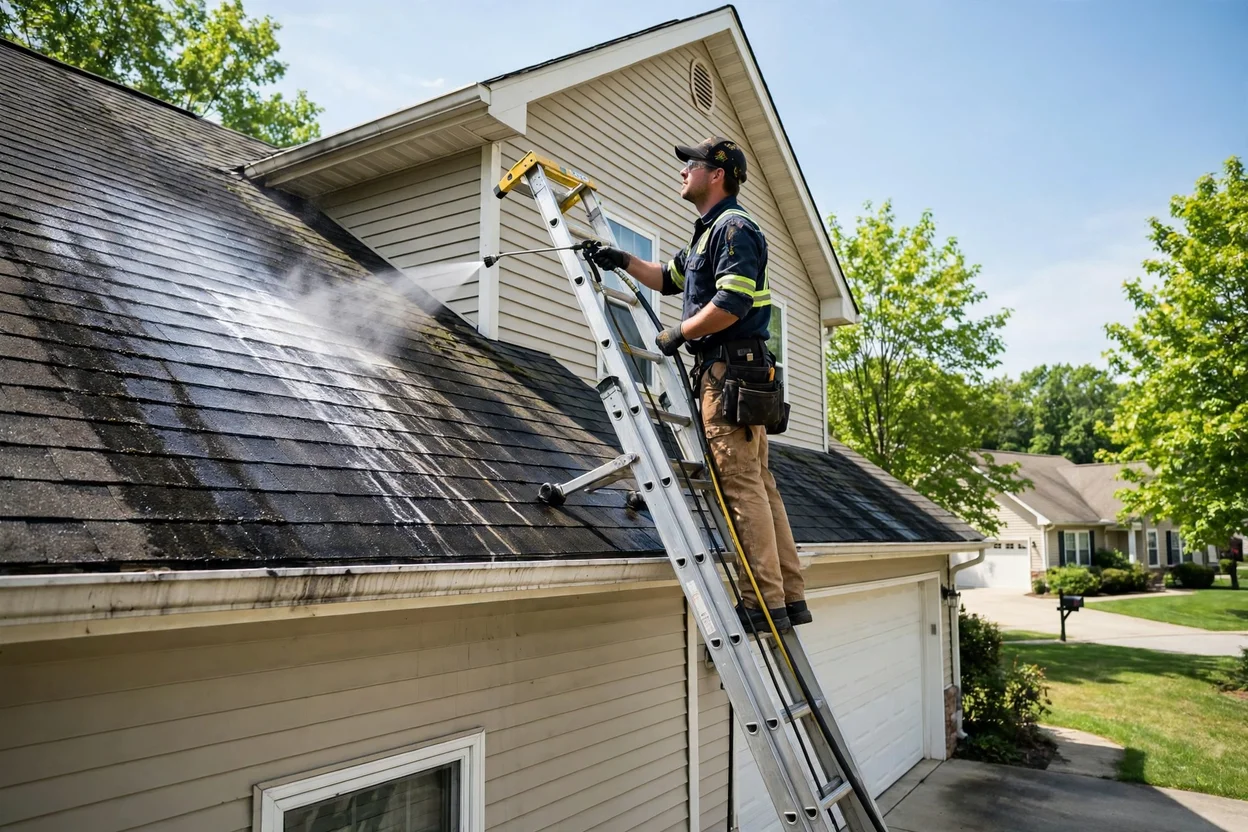
To soft wash a roof, protect plants and drains, mix a sodium hypochlorite solution with a surfactant, apply it at low pressure from the bottom up, let it dwell, and rinse at low pressure. Stay off the roof itself. Most homeowners should work from a ladder or the ground and bring in a professional for any steep or multi-story roof.
Gear and Supplies
Gather this equipment before starting:
- A low-pressure pump sprayer or a dedicated soft wash system
- Sodium hypochlorite solution, either pool-grade liquid chlorine or a labeled roof cleaner
- A surfactant made for soft washing
- A garden hose with a spray nozzle
- Plastic sheeting or breathable tarps for delicate plants
- Chemical-resistant gloves, safety goggles and long sleeves
- A sturdy extension ladder with a stabilizer, plus a fall-arrest harness for any roof access
- Shoes with non-slip soles
Pool supply stores carry chlorine products, and home improvement retailers such as The Home Depot and Lowe’s stock them as well. Read every product label.
Step-By-Step Process
Follow these steps in order for a safe DIY soft wash on a single-story, low-pitch roof:
- Check the weather and choose a cool, overcast, calm day with no rain expected for several hours.
- Close windows and doors, and move cars, patio furniture and pets away from the house.
- Soak all plants, shrubs and grass near the house with plain water.
- Cover delicate plants with plastic sheeting or tarps.
- Redirect downspouts away from flower beds, or place buckets under them to catch runoff.
- Mix the sodium hypochlorite solution and surfactant according to the product label.
- Test the solution on a small, low section of roof and watch for discoloration.
- Spray the solution from the bottom of the roof upward so it coats evenly without streaking.
- Let the solution dwell for the time listed on the label, and keep the surface from drying in sun.
- Rinse the roof with low-pressure water from the top down.
- Rinse plants, siding, walkways and the lawn again with plain water.
- Remove covers from plants once the rinse water has drained.
Solution Strength and Dwell Time
No verified universal soft wash mix ratio exists, because the right strength depends on the product, the growth type and the roof material. Follow the cleaner’s label first.
Light algae streaks call for a weaker mix than thick moss or lichen. Cedar needs another chemistry altogether. Before the whole roof gets treated, a small test patch shows whether the chosen strength actually works on that surface and that growth.
Dwell time is how long the solution stays on the roof before rinsing. Cut it short and living growth survives. The opposite mistake causes trouble too, because letting the solution dry in the sun can leave residue behind and raises the risk of discoloration.
How Do You Protect Plants During Roof Washing?
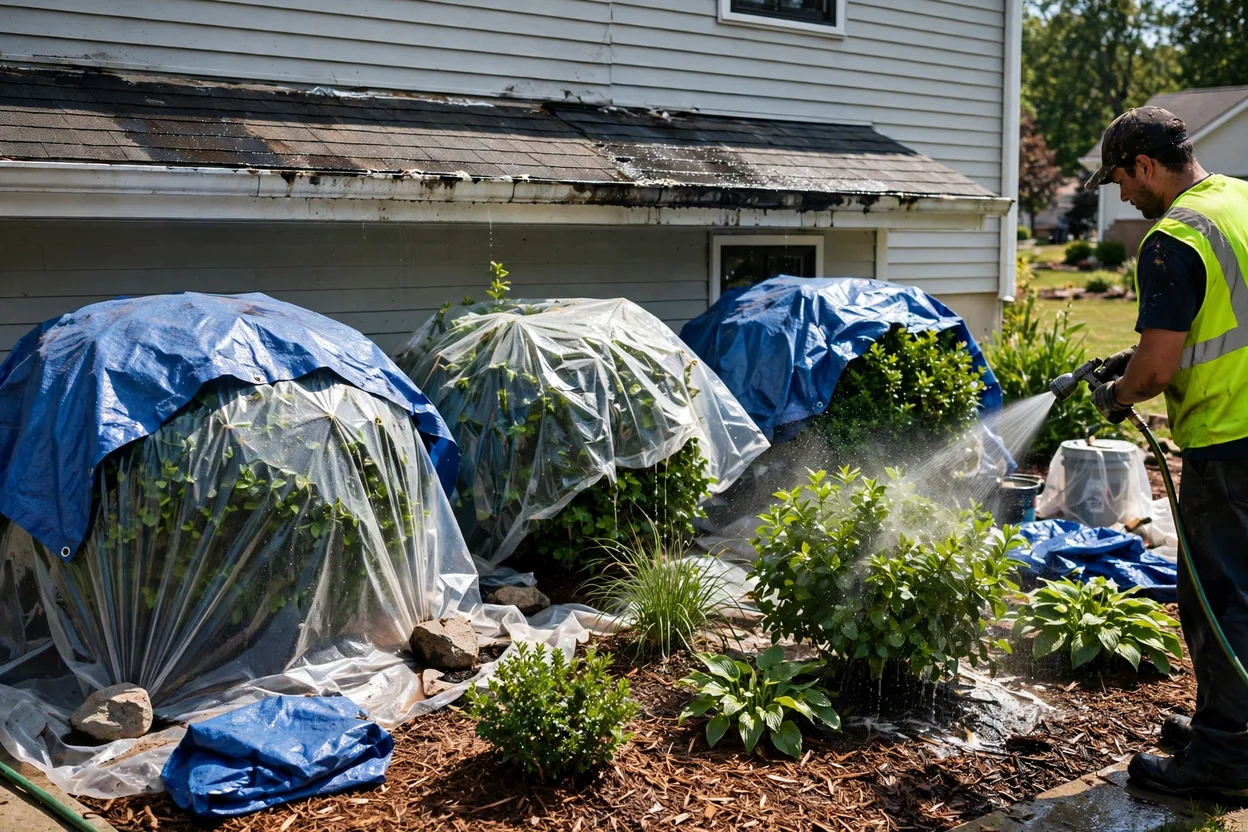
Protect plants during roof washing by soaking them with plain water before treatment, covering delicate plants, redirecting downspouts and rinsing everything again after the roof is rinsed. Pre-wet plants absorb less chlorine solution. Quick dilution of the rinse runoff does the rest, keeping most shrubs, flower beds and lawns healthy through the whole job.
Follow these steps to manage runoff:
- Water all plants, grass and garden beds near the roofline before spraying.
- Cover delicate or valuable plants with breathable tarps or plastic sheeting for the shortest time possible.
- Attach downspout diverters or catch buckets so concentrated runoff misses plant roots.
- Keep a second hose running near the foundation to dilute drips during application.
- Rinse plants, soil and grass thoroughly after the roof rinse.
- Uncover plants promptly so they do not overheat under plastic.
Sodium hypochlorite breaks down quickly in sunlight and soil. Concentrated drips still burn leaves, though. Water features, fish ponds and vegetable gardens need more than a rinse, so give them full protection or hire a contractor who runs a runoff recovery system.
Does Soft Washing Kill Moss and Lichen?
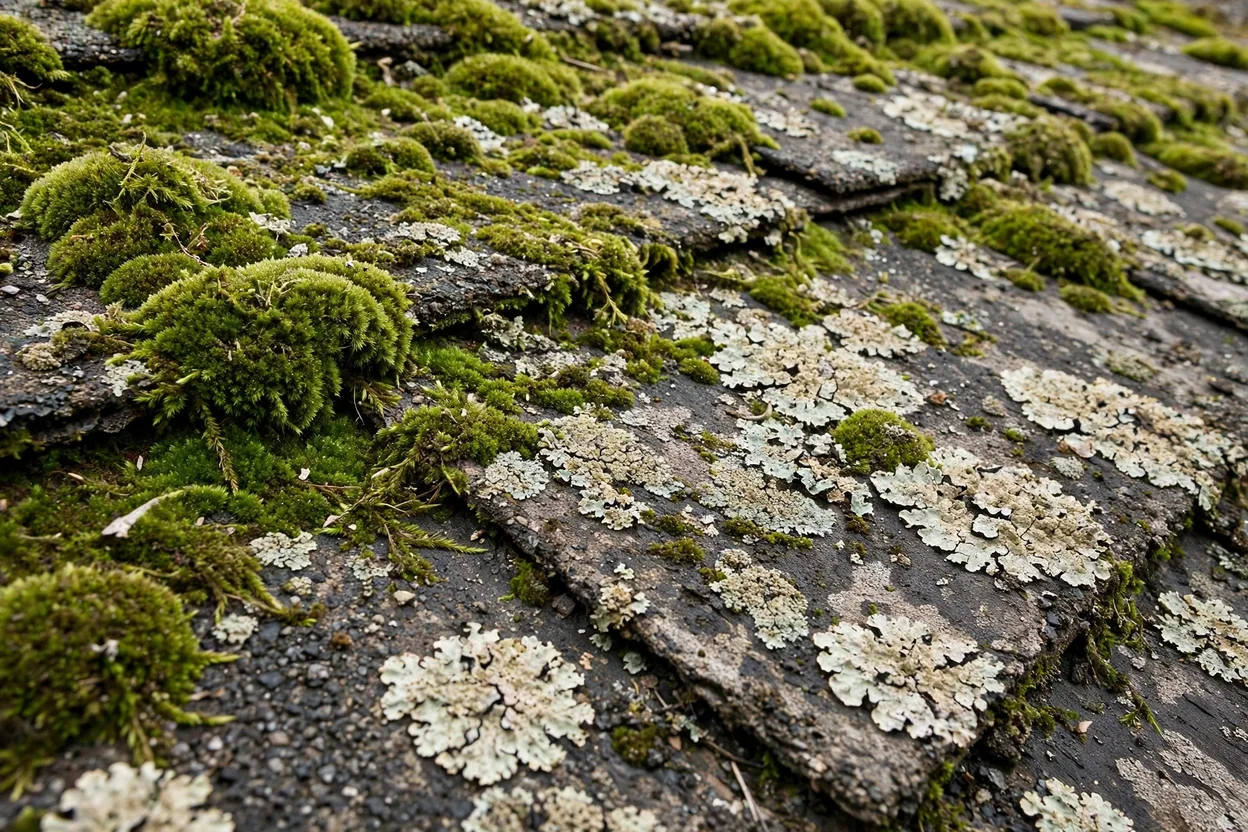
Yes, soft washing kills moss and lichen, but dead moss often needs gentle manual removal, and dead lichen can take weeks of rain to release from the roof surface. Results come at different speeds. Roof algae streaks usually lighten fast, while lichen grips the roof tightly and clears more slowly than any other common growth.
Moss removal works best in two stages. The soft wash kills the moss, and a soft brush or plastic scraper then lifts off thick clumps without tearing shingles. Never use a metal scraper or a stiff wire brush on asphalt shingles.
Lichen removal tests patience. Because lichen anchors deeply to the roof surface, its dead remains can stay visible for a while after treatment, and rain gradually washes them away. Don’t try to scrape lichen off by force, because that damages shingles.
Timelines vary. Use this table to set expectations, since it compares how each growth type responds to a soft wash and what follow-up it usually needs.
| Growth Type | Response to Soft Wash | Follow-Up Needed |
|---|---|---|
| Algae Streaks | Fades quickly | Rarely |
| Moss | Dies, then loosens | Gentle brushing of thick clumps |
| Lichen | Dies, releases slowly | Rain over following weeks |
Should You DIY or Hire a Roof Cleaning Contractor?
Most homeowners should hire a trained roof cleaning contractor because roof work combines fall risk, slippery chemical-coated surfaces and plant damage risk, while DIY fits only low, single-story roofs with light algae. Professional crews come prepared. They carry fall protection along with calibrated soft wash systems, plus insurance that covers property damage if something goes wrong on the job.
Weigh the tradeoffs first. This table compares DIY and professional soft washing on each factor that tends to drive the decision for a typical homeowner.
| Factor | DIY | Professional |
|---|---|---|
| Best For | Single-story, low-pitch roofs | Steep, tall or heavily infested roofs |
| Equipment | Pump sprayer and hose | Calibrated soft wash system |
| Fall Safety | Homeowner risk | Harnesses and OSHA-trained crews |
| Solution Control | Label guidance only | Mixes tuned to growth and material |
| Plant Protection | Manual and slower | Standard procedure |
| Insurance | Homeowner policy only | Contractor liability coverage |
The Occupational Safety and Health Administration (OSHA) sets fall protection rules for professional roofing work. Those rules don’t apply to homeowners. Without that oversight, DIY roof access carries real danger, and a single slip from a ladder or a slick, treated slope can end in a serious fall.
Questions to Ask a Contractor
Ask every roof cleaning contractor these questions before signing:
- Do you carry general liability insurance, and can you send a certificate?
- Which cleaning solution do you use, and how do you adjust strength for my roof type?
- How do you protect plants, downspouts and water features?
- Do you walk on the roof, and what fall protection does your crew use?
- Does your price include a re-treatment if growth remains?
- Has anyone on your crew completed industry training, such as programs from the Roof Cleaning Institute of America (RCIA)?
How Long Does a Soft Wash Last?
A soft wash keeps a roof clean until airborne algae spores and moss recolonize the surface, and the length of that clean period depends on shade, humidity and regional climate, with no verified national figure available. Location makes a big difference. Sunny roofs in dry climates stay clean longer than shaded roofs in humid or rainy climates, where damp conditions let spores settle back in.
Regional climate shifts the timeline. Humid Southeast states favor fast algae regrowth, while shaded roofs in the Pacific Northwest and the Northeast tend to favor moss. Dry Southwest roofs see less organic growth.
How to Slow Algae Regrowth
Use these methods to keep a roof clean longer after soft washing:
- Install zinc or copper strips near the ridge so rain carries metal ions down the roof.
- Trim overhanging tree branches to add sun and airflow.
- Clean gutters regularly so debris and moisture do not sit on roof edges.
- Choose algae-resistant asphalt shingles when the roof is replaced.
- Schedule a light maintenance treatment when the first streaks reappear.
Zinc and copper strips protect best close to the strip itself, and the effect weakens the farther down the slope you go. Roof length matters. On a very long roof run, a single strip at the ridge offers less benefit.
Frequently Asked Questions
How Often Should a Roof Be Soft Washed?
Soft wash a roof whenever visible streaks, moss or lichen come back. Climate sets the pace, and shaded roofs in humid or rainy regions need cleaning more often than sunny roofs in dry regions do. No verified national interval exists.
Do Zinc Strips Reduce How Often You Clean?
Yes. Each time it rains, water carries zinc ions from the strip across the roof surface, and those ions discourage algae and moss from taking hold. Protection is strongest just below the strip and fades farther down the slope.
Will Rain Remove Leftover Stains After a Soft Wash?
Yes. Dead algae and lichen often keep loosening for weeks after treatment. Normal rainfall rinses much of the remaining residue, so roofs frequently look cleaner a month after the wash than on the first day.
Is Household Bleach the Same as Soft Wash Solution?
No. Household bleach contains sodium hypochlorite at a lower concentration and lacks a roof-grade surfactant. Soft wash solutions combine sodium hypochlorite, water and surfactant so the mix clings to sloped roofs and dwells long enough.
Should You Walk on a Roof During Soft Washing?
No. Treated roofs become extremely slippery, and foot traffic also scuffs shingle granules and cracks tile or slate. Work from a ladder with a stabilizer instead, or hire a crew that comes equipped with fall-arrest systems for any section a ladder can’t reach.
Conclusion
Soft washing is set to remain the standard approach to roof cleaning in the USA because it matches manufacturer guidance and protects the shingles most American homes rely on. Algae-resistant shingle lines will keep expanding. Existing roofs still need safe cleaning, though, and homeowners who pair a professional soft wash with zinc or copper strips and good gutter care can keep black streaks from returning quickly.
Your next step is simple. From the ground, inspect the roof and note the growth type, then request written quotes that spell out solution, pressure and plant protection.
Sources
Each source below is publicly available. These organizations and manufacturers publish the guidance, warranty documents and safety rules referenced throughout this article on their own websites.
- Asphalt Roofing Manufacturers Association (ARMA), technical guidance on algae and roof cleaning: https://www.asphaltroofing.org/
- GAF, shingle product and warranty information, including StainGuard lines: https://www.gaf.com/
- Owens Corning Roofing, shingle product and warranty information, including StreakGuard: https://www.owenscorning.com/