
Sustainable insulation materials reduce roof heat transfer while using renewable, recycled, or low-carbon inputs. The 7 top options in 2026 are cellulose, sheep wool, wood fiber, hemp fiber, recycled denim, polyisocyanurate (polyiso), and cork — each with distinct R-values, costs, and climate profiles.
Your roof accounts for up to 25% of total building heat loss in winter, according to the U.S. Department of Energy (DOE). Choosing the right sustainable insulation material cuts that loss and lowers your energy bills by 10–25% over the roof’s lifetime. This guide compares each material by thermal performance, cost, and installation requirements so you choose confidently.
What Makes Roof Insulation Sustainable?
Sustainable roof insulation meets 3 criteria: low embodied carbon during production, renewable or recycled source materials, and recyclability or biodegradability at end of life. Standard fiberglass insulation fails all 3 — its production emits high levels of greenhouse gases, it relies on virgin silica, and it ends up in landfill.
The key measurement for comparing insulation performance is the R-value — a number rating a material’s thermal resistance per inch of thickness. A higher R-value means better insulation per inch. Most U.S. climate zones require a minimum R-38 (roughly 10–12 inches / 25–30 cm of batts) for attics under the 2021 International Energy Conservation Code (IECC).
Sustainable materials differ from conventional options in 4 key ways:
- Source: renewable crops, recycled waste, or post-consumer products
- Production: lower energy consumption and fewer toxic chemical inputs
- Performance: R-values between 3.2 and 7.0 per inch across eco-friendly types
- End of life: compostable, biodegradable, or fully recyclable material streams
7 Sustainable Insulation Materials for Roofs Compared
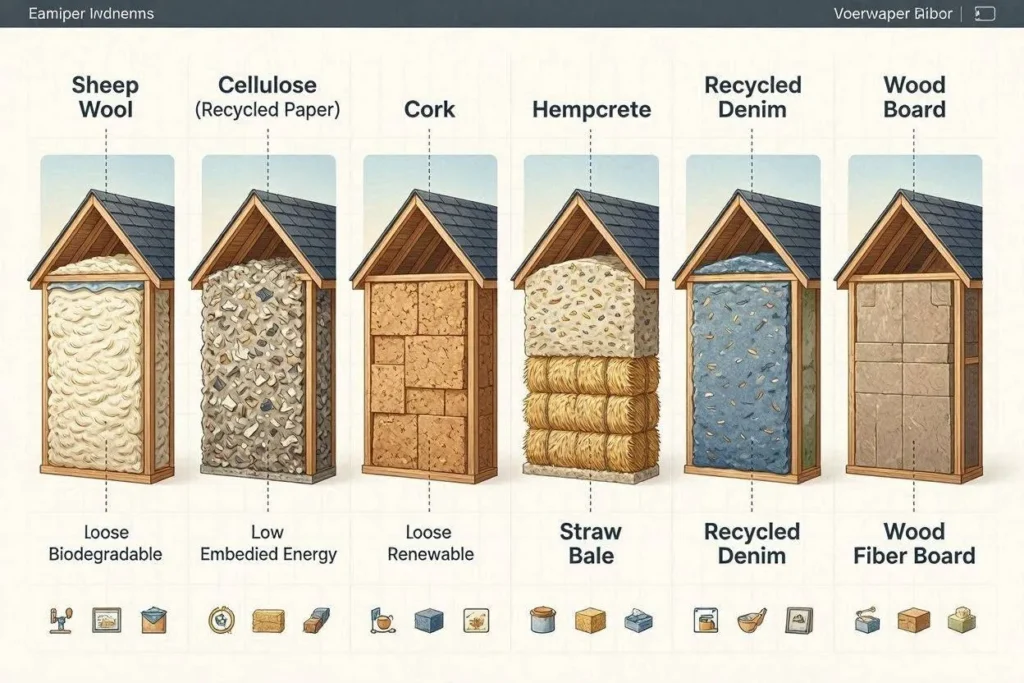
Each of the 7 sustainable insulation materials below works differently across roof types, climates, and budgets. Review the R-value, source, and installation format before selecting.
1. Cellulose Insulation: The Highest Recycled Content Option
Cellulose insulation contains 80–85% post-consumer recycled paper by weight, making it the highest recycled content option in roofing. It delivers an R-value of 3.2–3.8 per inch and costs $0.30–$0.60 per square foot installed.
Blown-in cellulose fills irregular cavities and gaps better than batt insulation. A standard R-38 attic requirement needs 10–12 inches (25–30 cm) of loose-fill cellulose. Cellulose manufacturers treat the paper with borate compounds — sodium borate and ammonium sulfate — to resist fire and pests. Cellulose does absorb moisture, so pair it with a 6-mil polyethylene vapor barrier in humid climates.
2. Sheep Wool Insulation: The Best Natural Moisture Manager
Sheep wool insulation, sold under brands like Thermafleece CosyWool, achieves R-3.5 to R-3.8 per inch and manages moisture without losing thermal effectiveness. Wool fibers absorb up to 35% of their weight in moisture and release it without degrading.
Install sheep wool batts between roof rafters at a minimum depth of 6 inches (15 cm) for R-21 and 10 inches (25 cm) for R-38. Sheep wool is fully biodegradable and compostable at end of life. The material suits pitched residential roofs in all 8 U.S. climate zones and costs $1.00–$2.00 per square foot.
3. Wood Fiber Insulation: The Carbon-Storing Board Option
Wood fiber insulation, such as SteicoFlex batts, stores carbon rather than emitting it — each kilogram of wood fiber sequesters approximately 1.8 kg of CO2. Wood fiber delivers R-3.7 to R-4.0 per inch and comes as flexible batts or rigid boards.
Rigid wood fiber boards work well on flat roofs and green roof assemblies. Install boards in 2 offset layers to eliminate thermal bridging — a heat flow path through uninsulated structural elements. A 4-inch (10 cm) rigid board delivers approximately R-16. Wood fiber is fully recyclable and non-toxic, improving indoor air quality for workers during installation.
4. Hemp Fiber Insulation: The Fast-Renewable Option
Hemp grows to harvest in 90–120 days, making hemp fiber insulation the fastest renewable source material on this list. Products like EKOLUTION Hemp Fibre Insulation deliver R-3.5 per inch, are biodegradable, and contain no toxic flame retardants.
Hemp batts install between rafters identically to fiberglass batts, cutting to size with a sharp utility knife. A 5.5-inch (14 cm) batt achieves R-19, suitable for conditioned attic spaces in Climate Zones 1–3. Hemp’s low embodied carbon — estimated at 0.8 kg CO2 per kg of product — makes hemp fiber one of the most climate-friendly insulation choices available in 2026.
5. Recycled Denim Insulation: The Indoor Air Quality Champion
Recycled denim insulation uses post-consumer cotton denim — primarily manufacturing off-cuts and worn jeans — to produce R-3.4 to R-3.8 per inch batts. Brands like UltraTouch Denim Insulation treat cotton with a borate-based fire retardant that the EPA classifies as non-toxic.
Recycled denim insulation releases no formaldehyde or volatile organic compounds (VOCs), making it the safest insulation for households with children or allergy sufferers. It costs $0.90–$1.50 per square foot. Install denim batts between rafters or ceiling joists at 8 inches (20 cm) for R-30 performance.
6. Polyisocyanurate (Polyiso) Rigid Board: The Highest R-Value per Inch
Polyiso delivers R-5.6 to R-7.0 per inch — the highest thermal resistance per inch of any sustainable roof insulation. GAF EnergyGuard Polyiso and Firestone ISO 95+ are widely used on commercial flat roofs. Polyiso achieves a Global Warming Potential (GWP) 50% lower than XPS (extruded polystyrene) when manufactured with hydrocarbon blowing agents.
Flat roof assemblies typically require 3 inches (7.6 cm) of polyiso for R-20 and 5 inches (12.7 cm) for R-35. The metal roof installation process often includes polyiso boards under standing-seam panels for a complete thermal assembly. Note that polyiso’s R-value drops by up to 20% at temperatures below 20°F (-7°C), so specify thicker boards in cold climates.
7. Cork Insulation: The Acoustic and Thermal Hybrid
Cork comes from the bark of Quercus suber oak trees, harvested without felling the tree every 9 years. Cork insulation delivers R-3.6 to R-4.0 per inch and adds significant acoustic dampening — reducing airborne sound transmission by up to 10 dB compared to fiberglass batts of equal thickness.
Cork boards suit both flat and pitched roofs and cost $1.50–$3.00 per square foot. Install 3-inch (7.6 cm) boards as a continuous layer above the roof deck, then cover with a waterproofing membrane. Cork naturally resists mold, insects, and fire without added chemical treatments, giving it a 50-year effective lifespan.
Sustainable Roof Insulation: Quick-Reference Comparison Table
Use this table to compare all 7 sustainable insulation materials by R-value, material source, cost, and installation format at a glance.
| Material | R-Value per Inch | Cost per Sq Ft | Install Format |
| Cellulose | 3.2–3.8 | $0.30–$0.60 | Blown-in loose fill |
| Sheep Wool | 3.5–3.8 | $1.00–$2.00 | Batts between rafters |
| Wood Fiber | 3.7–4.0 | $0.80–$1.50 | Batts or rigid boards |
| Hemp Fiber | 3.5 | $0.70–$1.20 | Batts between rafters |
| Recycled Denim | 3.4–3.8 | $0.90–$1.50 | Batts between rafters |
| Polyiso Board | 5.6–7.0 | $1.20–$2.50 | Rigid boards, flat roofs |
| Cork Board | 3.6–4.0 | $1.50–$3.00 | Rigid boards, any roof type |
How to Choose the Right Sustainable Insulation Material for Your Roof
To choose the right sustainable insulation material, match the material’s strengths to your roof type, climate zone, and budget.
Matching Material to Roof Type: Pitched vs. Flat
Pitched roofs with rafter bays accept batts — sheep wool, hemp, recycled denim, and cellulose all fit standard 16-inch (40 cm) or 24-inch (60 cm) rafter spacing. Flat roofs require rigid boards — polyiso and cork work best because batts compress under roofing membranes and lose thermal performance.
Green roof assemblies (roofs with vegetation) need rigid boards with high compressive strength. Wood fiber rigid boards and cork boards both carry a compressive strength above 100 kPa, sufficient for a lightweight sedum green roof system. A residential roof replacement project gives you the best opportunity to upgrade insulation depth, since the existing decking is already exposed.
Matching Material to Climate Zone
Hot climates (DOE Climate Zones 1–3) benefit most from cellulose and hemp — both have low embodied carbon and perform well above 70°F (21°C). Cold climates (Zones 5–8) need higher R-values per inch; polyiso and wood fiber boards deliver the thermal resistance needed without excessive material thickness.
Humid climates (Zones 2A and 3A) demand vapor-open materials. Sheep wool and wood fiber both allow moisture to pass through and dry out, preventing mold growth inside the roof assembly. Cellulose in humid climates requires a vapor barrier on the warm side.
What Are the Environmental Benefits of Sustainable Insulation Materials?
Sustainable insulation materials deliver 3 measurable environmental benefits: lower embodied carbon, reduced operational energy, and end-of-life recyclability or compostability.
Embodied carbon — the CO2 emitted during raw material extraction, manufacturing, and transport — for cellulose insulation sits at approximately 0.5 kg CO2 per kg of product. Fiberglass produces 1.5 kg CO2 per kg. Hemp and sheep wool both sequester carbon in their fibers, producing negative or near-zero embodied carbon at the point of manufacture.
Operational energy savings come directly from the R-value. A well-insulated roof assembly at R-49 (12 inches / 30 cm of cellulose) reduces heating and cooling energy by up to 40% compared to an uninsulated roof. Over a 30-year roof lifespan, this saves an estimated 15–20 metric tons of CO2 per household in a Climate Zone 5 home.
Routine roof maintenance tips — including checking insulation for compression, moisture damage, and gaps — extend the effective life of any insulation material by 20–30% and preserve its full thermal performance.
How to Install Sustainable Roof Insulation: 5 Key Steps
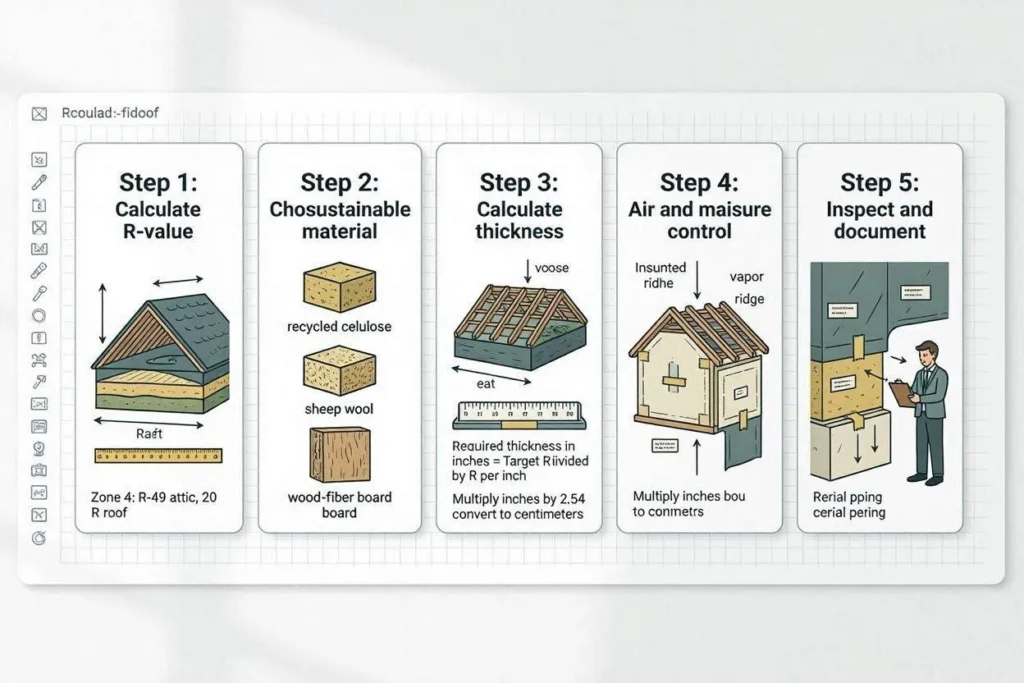
To install sustainable roof insulation correctly, follow these 5 steps in order to achieve full thermal performance and avoid moisture problems.
Step 1: Calculate R-value requirement. Check the IECC 2021 requirements for your climate zone. Zone 4 requires R-49 for attics and R-20 for roofs. Divide the target R-value by the material’s R-per-inch to get the required thickness in inches (then convert: multiply by 2.54 for centimeters).
Step 2: Install a vapor barrier. In Climate Zones 5–8, install a 6-mil polyethylene vapor retarder on the warm interior side before placing batt insulation. Skip the vapor barrier in Climate Zones 1–3, where walls need to dry inward.
Step 3: Place batt insulation between rafters. Friction-fit batts without compressing them — compression reduces R-value proportionally. A sheep wool batt compressed to 75% of its labeled thickness delivers only 75% of its rated R-value.
Step 4: Add a second layer perpendicular to the first. Cross-layering a second course of insulation eliminates thermal bridging through rafters. Rafters conduct heat 3–5 times faster than the insulation material, so a cross-layer increases whole-assembly R-value by 15–25%.
Step 5: Seal all penetrations. Air leakage through penetrations — electrical boxes, pipes, and vent stacks — accounts for up to 30% of heat loss in a poorly sealed attic. Apply low-expansion spray foam (such as Great Stuff Pro Gaps and Cracks) around every penetration before placing insulation.
How Do Sustainable Insulation Materials Affect Indoor Air Quality?
Sustainable insulation materials directly improve indoor air quality by eliminating the formaldehyde binders, VOCs, and loose glass fibers found in conventional fiberglass and spray polyurethane foam products.
Recycled denim insulation and hemp fiber insulation release zero VOCs after installation. Fiberglass batts release acrylates and endocrine-disrupting compounds for up to 2 years post-installation, according to indoor air studies published in the journal Building and Environment.
Sheep wool naturally absorbs and locks formaldehyde molecules through a chemical reaction with the wool protein keratin, reducing indoor formaldehyde levels by up to 23% compared to an uninsulated space. This makes sheep wool the best choice for homes where occupants have chemical sensitivities, asthma, or allergies.
Cork insulation contains suberin — a natural polymer in cork cell walls — which resists mold and bacteria growth without added biocides. Mold on insulation surfaces contributes to mycotoxin levels in indoor air, worsening respiratory health. Cork’s suberin content prevents mold colonization even at relative humidity levels above 80%.
Sustainable Insulation Materials: Cost vs. Long-Term Savings
Sustainable insulation materials cost 20–120% more upfront than fiberglass batts, but the long-term energy savings recover that premium within 3–7 years in most U.S. climate zones.
A standard 2,000 sq ft (186 sq m) attic floor requires approximately 2,000 sq ft of insulation. At $0.50 per sq ft installed, cellulose costs $1,000 total — comparable to fiberglass. Sheep wool at $1.50 per sq ft costs $3,000 but saves an estimated $400–$600 per year on heating and cooling, producing a full payback in 5–7 years.
Polyiso boards command the highest premium at $1.20–$2.50 per sq ft but deliver the highest R-value per inch. On commercial flat roofs where every inch of insulation thickness adds structural load, polyiso’s density advantage justifies the price. A 3-inch (7.6 cm) polyiso roof on a 10,000 sq ft (929 sq m) commercial building saves an estimated $8,000–$12,000 annually in HVAC costs.
Federal tax credits under the Inflation Reduction Act allow homeowners to claim 30% of insulation material costs up to $1,200 per year through the Energy Efficient Home Improvement Credit (25C). This credit applies to all 7 sustainable insulation materials listed in this guide when installed in a primary U.S. residence.
Conclusion
Selecting the right sustainable insulation material cuts your energy bills by 10–40%, reduces your home’s carbon footprint, and improves indoor air quality for every occupant. Cellulose suits budget-conscious retrofits, sheep wool excels in humid climates, polyiso delivers maximum R-value per inch on flat roofs, and recycled denim removes VOCs from your living environment.