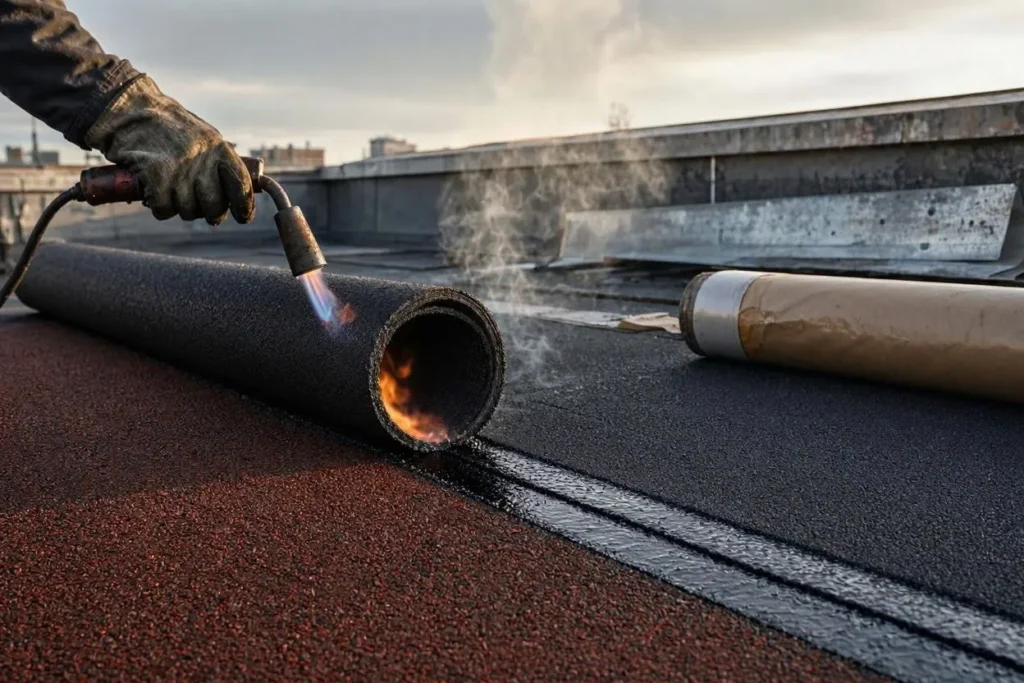
Torch down roofing material is modified bitumen, an asphalt sheet blended with either APP (atactic polypropylene) plastic or SBS (styrene-butadiene-styrene) rubber and reinforced with a polyester or fiberglass mat. Roofers heat each roll with a propane torch so it fuses to the layer below, forming a waterproof membrane for flat and low-slope roofs. Installed prices usually land between $3.50 and 7.00persqft(38 to $75 per m²), and a 3-ply system lasts 20 to 25 years with basic upkeep.
What Is Torch Down Roofing Material?
Torch down roofing material is a roll of polymer-modified asphalt that bonds to the roof when its underside is melted with an open flame. The same product family goes by 3 other names: torch-on roofing, modified bitumen (mod bit), and heat-welded membrane. Some homeowners call it “rubberoid,” though only the SBS version contains rubber.
A plain asphalt sheet cracks in cold weather and slumps in summer heat. Polymers fix that. Blending APP or SBS into the bitumen gives the sheet enough stretch to handle a January night in Minneapolis and a July afternoon in Phoenix without splitting.
What Is Torch Down Roofing Made Of?
Every roll of torch down roofing is built from 4 components:
- Bitumen: the asphalt base that blocks water.
- Polymer modifier: APP or SBS, mixed into the bitumen for flexibility.
- Reinforcing mat: polyester for stretch and puncture resistance, or fiberglass for dimensional stability.
- Surfacing: a smooth finish for base plies, or mineral granules on the cap sheet for UV (ultraviolet) protection, color, and fire rating.
A thin plastic film on the bottom burns off as the torch hits it. That film is how installers judge heat: when it shrinks and the bitumen starts to flow, the sheet is ready to roll into place.
What Layers Make Up a Torch Down Roof System?
A typical torch down roof stacks 5 layers from the deck up: insulation, a vapor barrier, a cover board, a base sheet, and a cap sheet. Three-ply systems add a smooth middle ply between the base and the cap. Flashing wraps every penetration, such as vent pipes, skylights, and HVAC (heating, ventilation, and air conditioning) curbs.
The cover board matters more than most homeowners realize. It gives the membrane a firm, flat surface, and a poorly set board is a common cause of ponding water years later.
APP vs SBS: Which Torch Down Roofing Material Fits Your Climate?
Pick SBS for cold or freeze-thaw climates and APP for hot, sunny regions with little freezing. SBS stays flexible well below freezing, while APP holds up better under intense UV and high surface temperatures.
| Factor | APP (atactic polypropylene) | SBS (styrene-butadiene-styrene) |
| Polymer type | Plastic | Synthetic rubber |
| Best climate | Hot, sunny (Southwest, Gulf Coast, Southern California) | Cold, freeze-thaw (Northeast, Midwest, Mountain West) |
| Cold flexibility | Stiffer below freezing | Stays pliable in cold |
| UV and heat resistance | Higher | Good with granulated cap |
| Application methods | Torch only | Torch, hot mop, cold adhesive, self-adhered |
| Relative price | Usually slightly cheaper | Usually slightly higher |
| Manufacturer guarantee range (GAF example) | Up to 15 to 20 years | Up to 20 to 30 years |
Hybrid systems are common. Many specs call for an SBS base ply for flexibility with an APP cap sheet on top for UV resistance, which blends the strengths of both.
How to Read a Torch Down Roofing Spec Sheet
Check 3 codes on any spec sheet: the ASTM (American Society for Testing and Materials) standard number, the Type, and the Grade. Those codes tell you the polymer, the reinforcement, and the surface finish before you ever see the roll.
| ASTM standard | Polymer | Reinforcement |
| D6222 | APP | Polyester |
| D6223 | APP | Polyester and glass fiber combined |
| D6509 | APP | Glass fiber (base sheet) |
| D6164 | SBS | Polyester |
| D6163 | SBS | Glass fiber |
| D6162 | SBS | Polyester and glass fiber combined |
| D6298 | SBS | Glass fiber with factory metal (foil) surface |
Type (I, II, or III) rates physical strength, and a higher number generally means more mass and better performance. Grade S marks a smooth surface; Grade G marks a granule surface. A cap sheet listed as “ASTM D6164, Type II, Grade G” is a heavy, polyester-reinforced SBS sheet with granules on top.
Two more lines are worth reading. Thickness is usually listed in mm or mils, with 4 mm (157 mils) common for torch-applied caps. The fire rating tells you whether the finished assembly reaches Class A under UL 790 or ASTM E108, the tests building codes reference.
How Much Does Torch Down Roofing Material Cost?
Torch down roofing material costs $100 to $200 per roll on its own and $3.50 to 7.00persqft(38 to $75 per m²) installed. Labor makes up roughly 60% of the total because torch work requires trained crews, specialized insurance, and fire-watch time.
What Does One Roll Cost?
A 100 sq ft (9.3 m²) roll of APP cap sheet sells for $109 to $129 at Home Depot as of September 2026. The GAF Tri-Ply rolls listed there measure about 39.6 in by 32.25 ft (1 m by 9.8 m) and weigh around 83 lb (38 kg), so a single roll needs 2 people or a hoist to get onto a roof.
Specialty sheets cost more. Fire-rated caps, reflective “cool roof” caps, and heavy Type II SBS sheets sit at the upper end of the $100 to $200 range.
What Does Installation Cost per Square Foot?
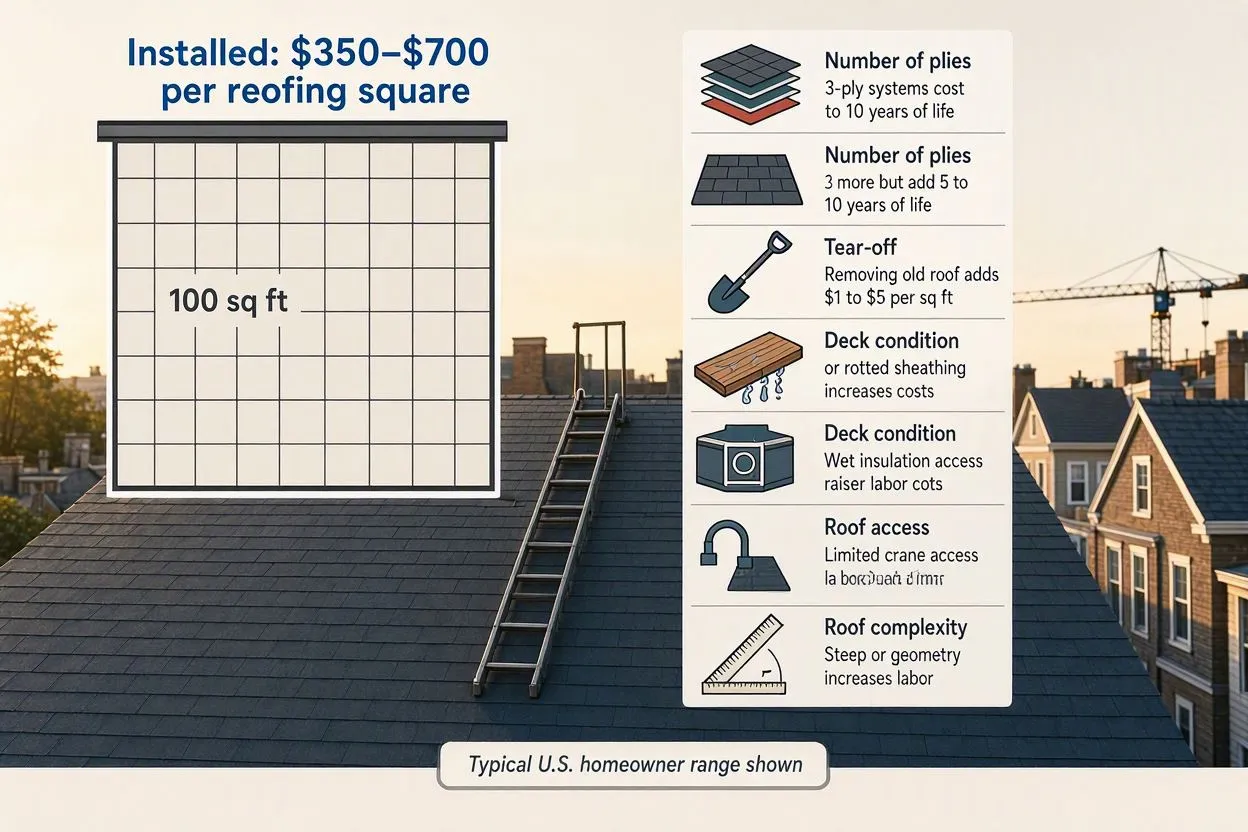
Most US homeowners pay $350 to $700 per roofing square (100 sq ft) installed. Your price moves with 5 factors:
- Number of plies: A 3-ply system costs more than 2-ply but adds 5 to 10 years of service life.
- Tear-off: Removing the old roof adds $1 to 5persqft(11 to $54 per m²).
- Deck condition: Wet insulation or rotted sheathing found during tear-off raises the bill.
- Roof access: A third-floor rowhouse roof with no crane access costs more than a single-story garage.
- Region: Labor rates in Boston or San Francisco run well above rates in rural Texas.
| Roof size | Approximate installed range ($3.50 to $7.00 per sq ft) |
| 500 sq ft (46 m²) porch or garage | $1,750 to $3,500 |
| 1,000 sq ft (93 m²) | $3,500 to $7,000 |
| 1,500 sq ft (139 m²) | $5,250 to $10,500 |
| 2,000 sq ft (186 m²) | $7,000 to $14,000 |
These figures exclude permits, which run $100 to $1,000 depending on the city. [YOUR DATA: add 2 or 3 real, anonymized invoices from your last 12 months with size, plies, and final price. This is the section competitors can’t match.]
How Many Rolls Does a Roof Need?
Plan on roughly 1.15 to 1.2 rolls per ply for every 100 sq ft of roof, since 2 in (51 mm) side laps and 6 in (152 mm) end laps eat into each roll’s coverage. Add 5% to 10% for waste at edges, curbs, and flashings.
Here’s a worked example. A 1,000 sq ft (93 m²) roof with a 2-ply system needs about 10 squares × 2 plies × 1.15 = 23 rolls, plus 1 or 2 extra for flashing. Your contractor’s measurement always overrides this rule of thumb.
How Long Does a Torch Down Roof Last?
A 2-ply torch down roof lasts about 15 years, and a 3-ply system lasts 20 to 25 years. Premium SBS assemblies installed under a manufacturer guarantee can carry coverage for up to 30 years.
Lifespan depends on 4 conditions more than the product label:
- Drainage: Water that sits longer than 48 hours after rain shortens membrane life.
- Installation quality: Cold seams and missed end laps fail first.
- Climate: Intense sun degrades unprotected bitumen faster than mild weather does.
- Maintenance: Clearing drains and checking flashings once or twice a year catches small problems early.
A roof that’s still dry underneath can often get 10 more years from a restoration coating. GAF recommends an asphalt bleed-blocking primer before any coating goes over a bitumen surface.
Where Does Torch Down Roofing Work Best?
Torch down roofing performs best on low-slope roofs between ¼:12 and 1:12 pitch (about 2% to 8%). IKO advises against it on dead-flat roofs, where water has nowhere to go.
Residential homeowners find it on 4 kinds of roofs:
- Rowhouse and townhome roofs in cities such as Baltimore, Philadelphia, and Washington, DC.
- Attached garages with a slight pitch toward the gutter.
- Porch and sunroom roofs tied into a steeper main roof.
- Modern homes with low-slope roof sections.
Commercial use is broader: strip malls, apartment buildings, and warehouses with concrete or steel decks. Snowy regions favor it too, because a well-sealed 3-ply membrane holds up under standing snow until it melts.
Is Torch Down Roofing Safe on a House?
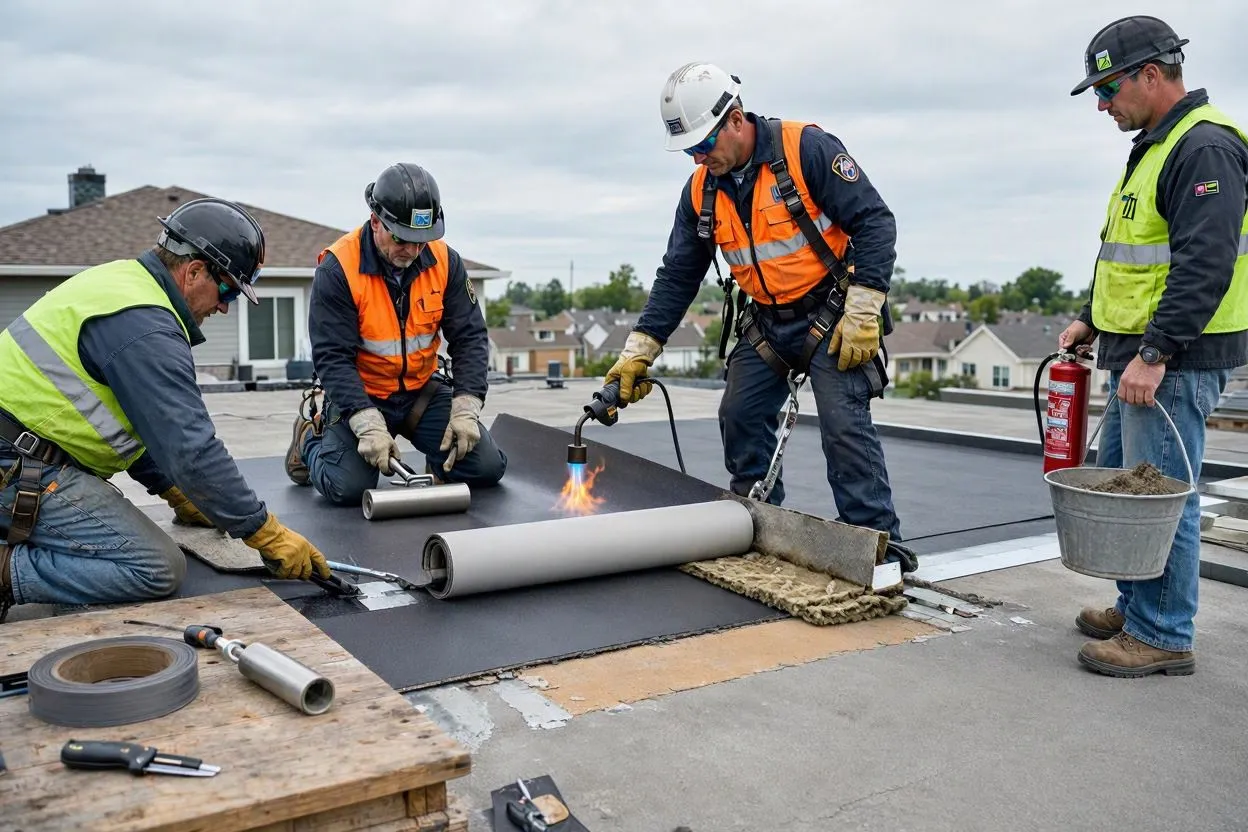
Yes, torch down roofing is safe on a house when a CERTA-trained crew installs it over a noncombustible surface. CERTA (Certified Roofing Torch Applicator) is the NRCA (National Roofing Contractors Association) safety program for roofers who use torches.
The main risk is fire. NRCA’s CERTA best practices say torch-applied products must not be applied directly to combustible decks such as plywood, OSB (oriented strand board), or wood planks. Most homes have exactly that kind of deck, so crews use 1 of 2 safe setups:
- Nail a base sheet to the wood deck, then torch only the upper plies to it.
- Install a thermal barrier first, such as ¾ in (19 mm) perlite, fiberglass, or mineral wool board, or ¼ in (6 mm) glass-faced gypsum board.
Concrete decks are different. A crew can torch directly to concrete, provided the deck has no voids or cracks that could carry flame. Many insurers and fire codes, including NFPA 51B (the National Fire Protection Association hot-work standard), require a fire watch to stay on the roof after torching ends, since smoldering insulation can ignite hours later.
What Are the Torch-Free Alternatives?
Self-adhered SBS and cold-applied SBS give you the same modified bitumen membrane without an open flame. Self-adhered rolls have a peel-off backing and stick under pressure. Cold-applied systems set the sheets in a solvent or water-based adhesive.
Choose torch-free when the deck is wood with no thermal barrier, the building stays occupied during work, or local rules ban hot work. Expect a slightly higher material cost, and note that self-adhered sheets need warm weather (typically above 40 °F / 4 °C) to bond well.
How Is Torch Down Roofing Installed?
To install a torch down roof, crews follow 6 steps:
- Prepare the deck. Remove old roofing, fix damaged sheathing, and make sure the surface is dry and clean.
- Install insulation and a cover board. Fasten or adhere the boards so the surface is flat and drains toward scuppers or gutters.
- Relax the rolls. Unroll each sheet and let it rest for about 30 minutes, which GAF recommends so the sheet returns to its true shape.
- Apply the base sheet. Torch, nail, or adhere it, depending on the deck type.
- Torch the cap sheet. Heat the underside until the bitumen flows, then roll it onto the base with 2 in (51 mm) side laps and 6 in (152 mm) end laps. Cut the corner of each end lap at an angle, called a dog-ear, to prevent water from getting in at the T-joints where 3 sheets meet.
- Flash and inspect. Wrap every edge and penetration, then walk the roof checking for lifted seams, wrinkles, and fishmouths.
A good seam shows a thin, even bead of melted bitumen, about ¼ in to ½ in (6 to 13 mm) wide, along the lap edge. No bead means the sheet was underheated. A wide, runny bead that burned the granules means it was overheated.
This is not a DIY job. The torch, the fire risk, and roughly 83 lb (38 kg) rolls make it a trade skill, and a failed seam voids most manufacturer warranties.
Torch Down vs TPO, EPDM, and PVC
Torch down costs less than metal roofing and usually more than TPO or EPDM, but it offers the most layers of protection among common flat-roof systems. Choose it when puncture resistance, redundancy, and easy patching matter more than the lowest bid.
| Feature | Torch down (mod bit) | TPO | EPDM | PVC |
| Material | Polymer-modified asphalt | Thermoplastic polyolefin | Synthetic rubber | Polyvinyl chloride |
| Seam method | Torch-fused bitumen | Hot-air welded | Tape or adhesive | Hot-air welded |
| Layers | 2 to 3 plies | Single ply | Single ply | Single ply |
| Puncture resistance | High (multi-ply) | Moderate | Moderate | Moderate to high |
| Repair method | Torch or adhere a patch | Weld a patch | Tape or glue a patch | Weld a patch |
| Open flame needed | Yes (torch-free versions exist) | No | No | No |
| Best fit | Foot traffic, rooftop decks, snowy climates | Reflective roofs in hot climates | Low budgets, simple roofs | Restaurants, chemical or grease exposure |
What Are the Signs a Torch Down Roof Is Failing?
Watch for 6 warning signs:
- Open seams: Laps that lift at the edge let water under the cap sheet.
- Blisters: Raised bubbles form when moisture or air gets trapped between plies.
- Alligatoring: A cracked, scaly surface means UV has dried out the bitumen.
- Granule loss: Bare black patches on a granulated cap expose the sheet to sun.
- Ponding water: Puddles that sit longer than 48 hours stress seams and point to a slope or drainage problem.
- Interior stains: Ceiling spots below the roof mean water has already passed through.
Repair the roof when damage covers less than about 25% of the surface and the insulation is dry; replace it when leaks are widespread or the insulation is soaked. Spot repairs typically run $2.50 to 10.00persqft(27 to $108 per m²), and an inspection costs $100 to $400. A moisture scan (infrared or core cuts) settles the question before you spend money.
How to Hire a Torch Down Roofing Contractor
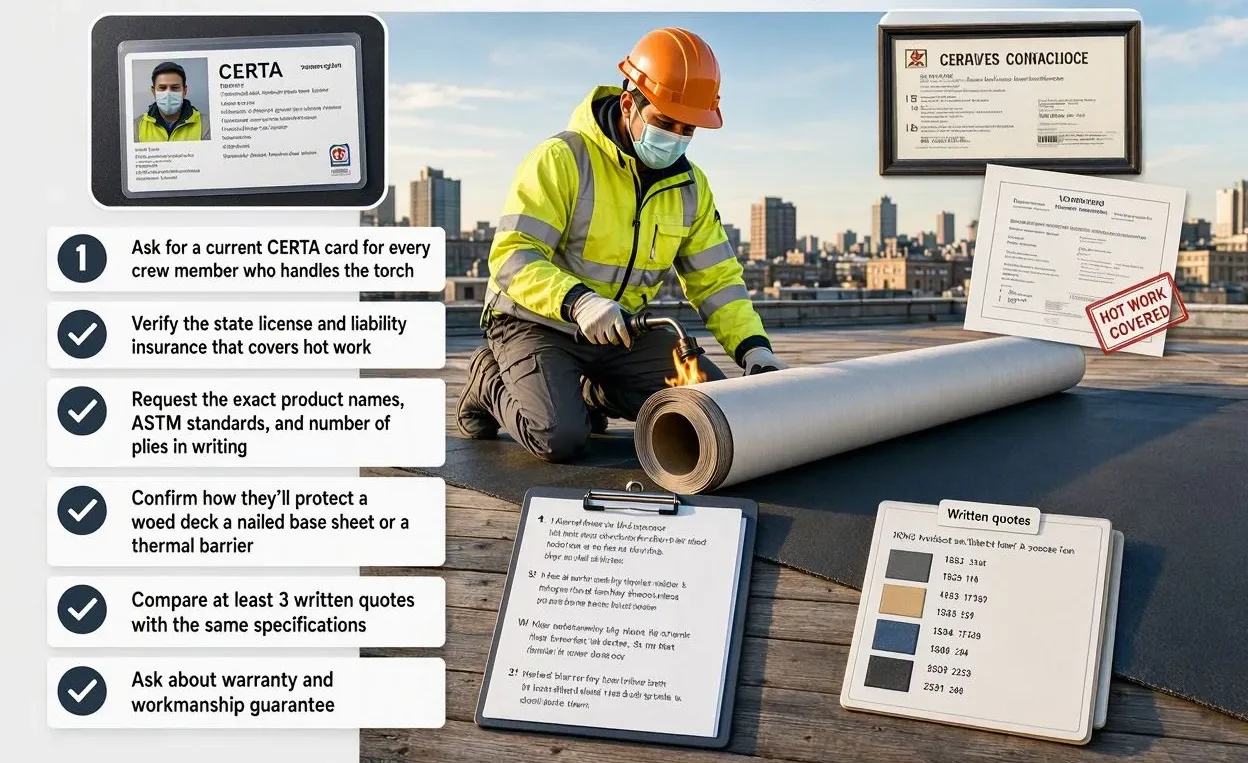
To hire a qualified torch down roofer, confirm these 6 items before you sign:
- Ask for a current CERTA card for every crew member who handles the torch.
- Verify the state license and liability insurance that covers hot work.
- Request the exact product names, ASTM standards, and number of plies in writing.
- Confirm how they’ll protect a wood deck (a nailed base sheet or a thermal barrier).
- Compare at least 3 written quotes with the same scope.
- Review the warranty terms, separating the manufacturer’s material coverage from the contractor’s labor warranty.
NRCA’s CERTA site lets you search for companies that employ CERTA-authorized applicators.
FAQs
Is torch down roofing better than rolled roofing?
Yes. Standard rolled roofing is a single, thin asphalt sheet that lasts 5 to 10 years, while a multi-ply torch down system is heavier, polymer-modified, and heat-fused for 15 to 25 years of service.
Can you walk on a torch down roof?
Yes. A granulated cap sheet handles light foot traffic for maintenance. Rooftop decks or frequent walking need walkway pads, which stop heel and furniture damage from wearing through the granules.
How many square feet does one roll cover?
One standard roll covers 100 sq ft (9.3 m²) of net area. Seam overlaps cut real coverage to about 85 to 87 sq ft (7.9 to 8.1 m²) per roll.
Can torch down be installed in winter?
Yes, with limits. SBS sheets handle cold better than APP, rolls must stay warm before use, and the deck must be dry and free of frost. Follow the manufacturer’s cold-weather instructions.
Does homeowners insurance cover torch down roof damage?
Coverage depends on the cause. Most policies pay for sudden storm or fire damage, but they exclude wear, poor installation, and slow leaks. Check your policy’s roof age limits and exclusions.
Conclusion
Choose SBS torch down roofing material for cold climates, APP for hot ones, and a 3-ply system whenever your budget allows it. Expect $3.50 to 7.00persqft(38 to $75 per m²) installed and 20 to 25 years of service from a well-built 3-ply roof. Safety comes down to the crew: hire CERTA-trained installers, insist on a nailed base sheet or thermal barrier over wood, and switch to a self-adhered or cold-applied system if the job can’t be torched safely. Get 3 written quotes that name the ASTM standard and ply count, and you’ll be able to compare bids line by line.