Roof cement is a thick, asphalt-based paste used to patch leaks, seal flashing, and reattach loose shingles on a roof. It’s sold in tubs, tubes, and caulk cartridges, and most homeowners reach for it the moment a ceiling stain shows up. Roofers use it too, though usually as a short-term fix rather than a permanent one. This guide covers what roof cement is made of, how it differs from sealant and flashing cement, which products actually hold up, and how to apply it without making the leak worse.
What Is Roof Cement?
Roof cement is an asphalt-based sealant designed to stop leaks and bond roofing materials together. Contractors sometimes call it asphalt roofing cement or plastic roof cement. It comes in a paste consistency, thick enough to fill a crack without running off a sloped surface. A five-gallon (18.9 L) bucket weighs roughly 44 lb (20 kg), so it’s heavy work even before you climb a ladder.
What Roof Cement Is Made Of
Roof cement contains asphalt, fiberglass or cellulose fibers, and mineral fillers, blended into a spreadable paste. The fibers give it body and prevent sagging on vertical surfaces like chimney walls. Mineral spirits or petroleum solvents keep it workable until it’s applied, then evaporate as it cures. Cleanup, unfortunately, still requires mineral spirits, since water alone won’t touch it.
Main Types of Roof Cement
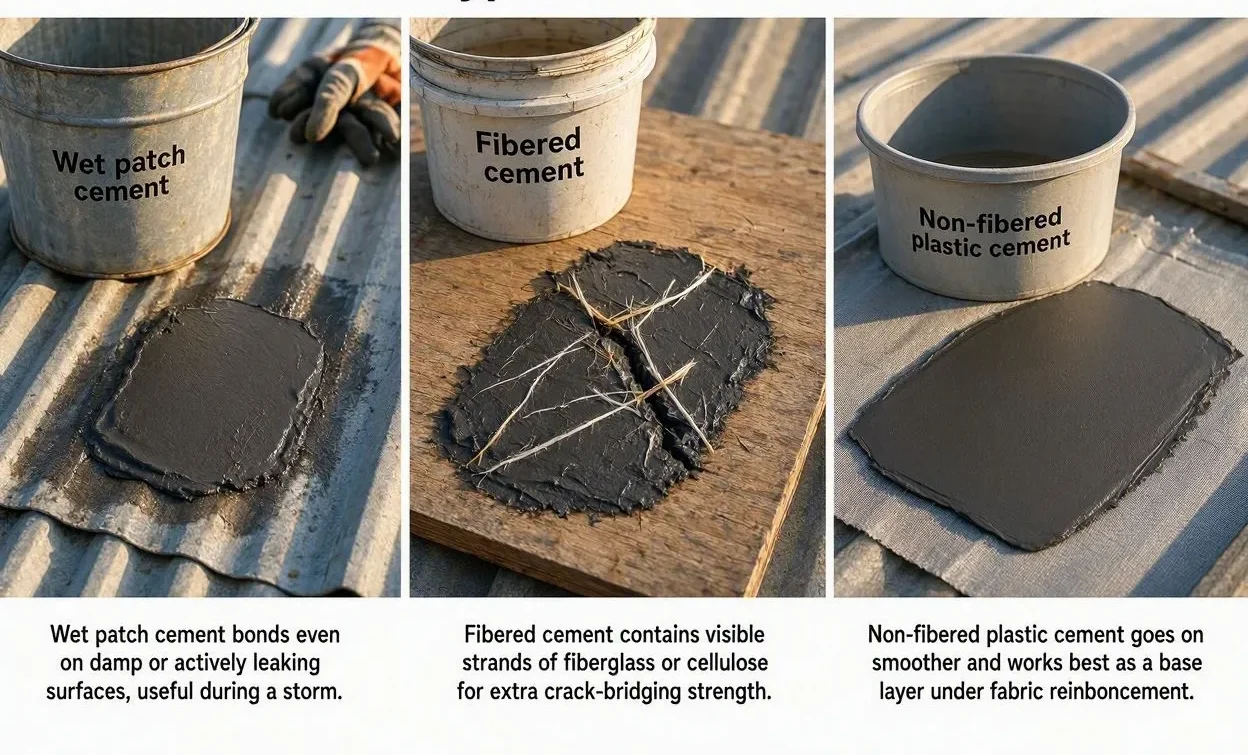
Manufacturers sell three main types, and each targets a different job.
- Wet patch cement bonds even on damp or actively leaking surfaces, useful during a storm.
- Fibered cement contains visible strands of fiberglass or cellulose for extra crack-bridging strength.
- Non-fibered plastic cement goes on smoother and works best as a base layer under fabric reinforcement.
Roofers choose the type based on weather conditions at the time, not personal preference. A wet patch, for instance, will bond underwater, which matters when a leak can’t wait for dry skies.
Roof Cement vs Roof Sealant: What’s the Difference?
Roof cement is thicker, more adhesive, and built for patching, while roof sealant is thinner, more flexible, and built for coating seams and larger surfaces. Cement grips asphalt shingles and rolled roofing with a strength sealant can’t match. Sealant, on the other hand, flexes with temperature swings and spreads easily across metal or EPDM roofing.
| Factor | Roof Cement | Roof Sealant |
| Base material | Asphalt, fibers, mineral fillers | Silicone, acrylic, polyurethane, or aluminum |
| Best for | Patches, flashing, cracks, shingle reattachment | Seams, large surface coatings, EPDM/metal roofs |
| Flexibility | Low, can crack with temperature shifts | High, resists cracking in cold |
| Application | Trowel or putty knife | Brush, roller, or caulk gun |
| Typical cost | Lower per unit, more product needed | Higher per gallon, covers more area |
| Cure environment | Works wet or dry, some types bond underwater | Needs a cleaner, often drier surface |
Picking the wrong one causes real damage. A roofing crew that coats flashing with sealant instead of cement, for example, may watch that seal peel back within a season once heavy rain hits. Cement holds detail areas together; sealant protects broader surfaces from UV exposure and general wear.
Roof Cement vs Flashing Cement: Same Product or Not?
Flashing cement is a specific, heavy-bodied version of roof cement, formulated to cling to vertical surfaces without sliding down. Both share an asphalt base. But flashing cement carries extra fiber reinforcement, giving it the non-sag property needed around chimneys, walls, and parapets.
Karnak’s 19 Flashing Cement, sold in 5-gallon (18.9 L) buckets, is marketed specifically for vertical application on shingles, concrete, metal, and masonry. Standard roof cement can technically be used in the same spots, though it may sag or thin out faster in heat. If a job involves a steep vertical seam, reach for flashing cement first.
When to Use Roof Cement for Shingles
Use roof cement for shingles when you need to reattach a lifted or loose shingle, patch a small crack, or seal an edge that’s curling up. It’s not meant to replace missing shingles entirely, and it won’t fix widespread wind damage across a whole slope.
Signs Your Roof Needs Cement, Not a Full Repair
Four conditions usually signal a cement job rather than a full repair:
- A single shingle corner has lifted, exposing the nail line underneath.
- A small crack or split has formed near a vent or pipe boot.
- Granule loss has left a bald patch smaller than a dinner plate.
- Flashing edges have separated slightly from the chimney or wall.
Once damage spreads past a few square feet, or multiple shingles show cracking, roof cement stops being a fix. At that point, a licensed roofer should assess whether a section replacement or a full re-roof makes more sense.
How to Apply Roof Cement
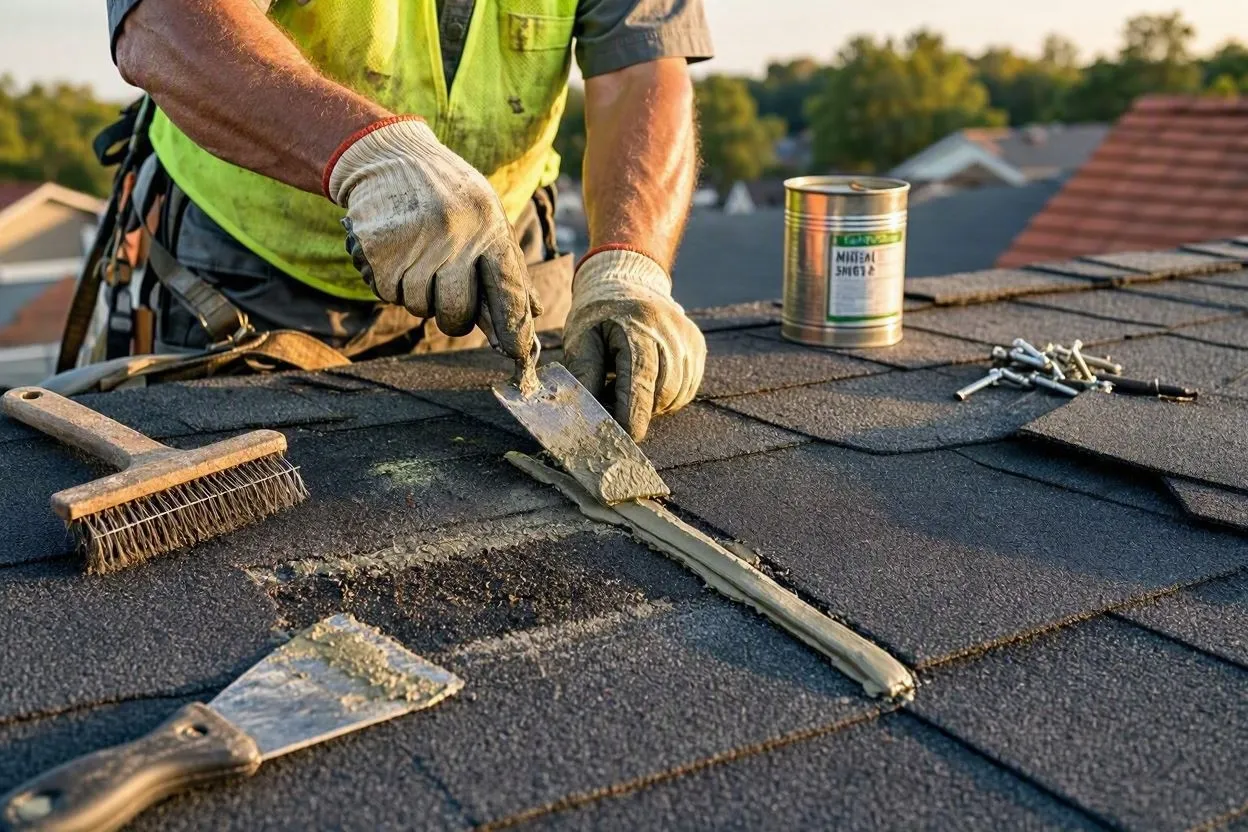
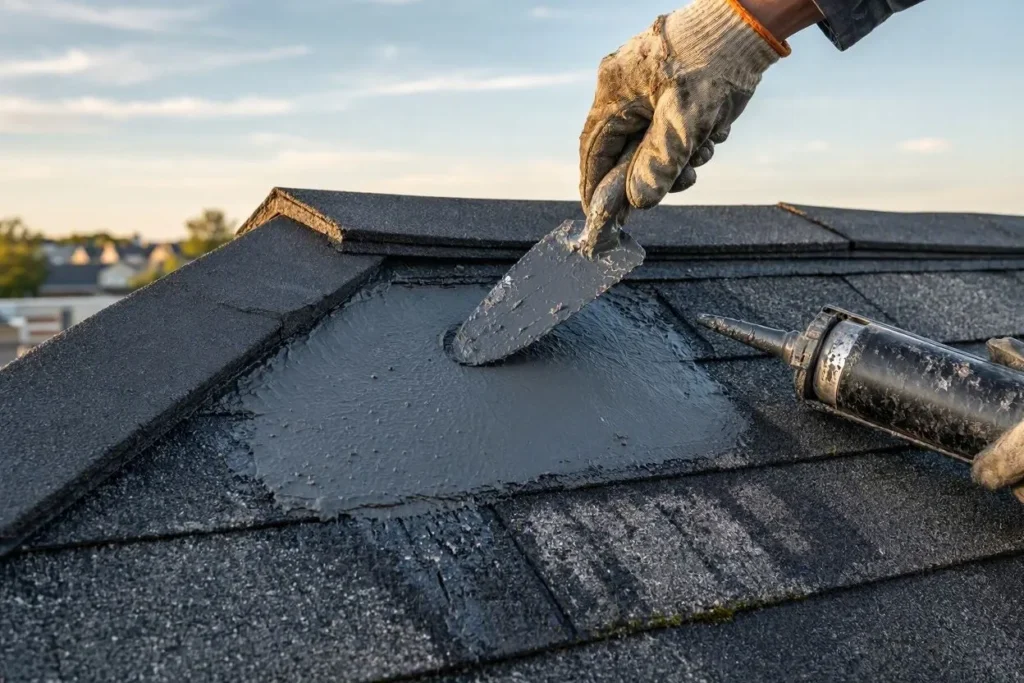
To apply roof cement, clean the damaged area, pack the cement into the crack or gap with a trowel, then smooth the edges so water sheds properly. Skipping the cleaning step is the single biggest reason patches fail within weeks.
Tools You’ll Need
- Putty knife or trowel
- Wire brush or scraper
- Mineral spirits for cleanup
- Roofing nails, if reattaching a shingle
- Safety harness and non-slip footwear
- Work gloves
Application Steps
- Clear the area. Remove debris, loose granules, and old sealant with a wire brush.
- Check the weather. Apply on a dry day if possible, unless you’re using a wet-patch formula rated for rain.
- Locate the damage. Trace the full edge of the crack or hole before you start applying anything.
- Pack the cement. Use a putty knife to press cement into the gap, working from the center outward.
- Feather the edges. Smooth the perimeter so the patch tapers instead of sitting as a raised lump.
- Reinforce large areas. For anything wider than a few inches, embed a strip of fiberglass fabric between two coats of cement.
- Nail and seal shingles. If a shingle came loose, nail it back down first, then dab cement over the nail heads to block water entry.
Cold weather changes everything about this process. Roof cement stiffens below roughly 40°F (4°C), making it harder to spread evenly, so many pros bring the container indoors overnight before a winter job. Skip that step, and you’ll fight a paste that behaves more like clay than a sealant.
Asphalt Roofing Cement: Standards and Certifications
Asphalt roofing cement sold for professional use typically meets ASTM D3409 and ASTM D4586 Type I standards, which govern asphalt roof coating and cement performance. These standards test for things like flow resistance, water resistance, and how well the product holds up under weathering.
Some products carry additional regional approval. APOC’s 109 Asphalt Roof Cement, for example, holds Miami-Dade County Product Control Approval, a certification tied to Florida’s strict wind and water-intrusion building codes. If a job falls under a jurisdiction with hurricane-rated code requirements, checking for that approval matters more than checking the price tag.
Weight and volume specs also vary by container size. A 1-gallon (3.8 L) tub weighs about 8.6 lb (3.9 kg), a 3-gallon (11.4 L) pail runs closer to 27 lb (12.2 kg), and a 5-gallon (18.9 L) bucket lands around 44 lb (20 kg). A 10.1 oz (298 ml) caulk tube, by contrast, weighs just 1 lb (0.45 kg), making it the right size for a single small patch rather than a full roof section.
Best Roof Cement Products and Prices
Roof cement prices range from about $3 for a small caulk tube to nearly $80 for a multi-gallon pail, depending on brand, formula, and container size. Pricing below reflects widely available retail listings as of 2026.
| Product | Size | Price |
| Roofers Choice 15 Plastic Black Roof Cement Caulk | 10.1 oz (298 ml) | $2.97 |
| Henry 208R Rubberized Wet Patch Caulk | 10.1 oz (298 ml) | $7.97 |
| Henry 209XR Extreme Rubberized Wet Patch Caulk | 10.1 oz (298 ml) | $10.97 |
| Roofers Choice 15 Plastic Black Roof Cement | 0.90 gal (3.4 L) | $9.97 |
| Lanco Siliconizer Crack Filler | 1 gal (3.8 L) | $19.98 |
| Henry 208R Rubberized Wet Patch | 0.90 gal (3.4 L) | $27.97 |
| Henry 209XR Extreme Rubberized Wet Patch | 0.90 gal (3.4 L) | $44.97 |
| Roofers Choice 15 Plastic Black Roof Cement | 4.75 gal (18 L) | $44.97 |
| Henry 208 Wet Patch | 3.3 gal (12.5 L) | $64.97 |
| Karnak 19 Flashing Roof Cement | 5 gal (18.9 L) | $74.97 |
| Henry 208R Rubberized Wet Patch | 3.3 gal (12.5 L) | $79.97 |
Henry, Karnak, and Roofers Choice dominate the shelf space at most large hardware retailers. Karnak’s flashing cement carries the strongest reputation for vertical, non-sag work, while Henry’s wet-patch line leads in reviews for rainy-day repairs. Roofers Choice tends to sit at the lower end of the price range without sacrificing basic patch performance.
Roof Cement Mistakes to Avoid
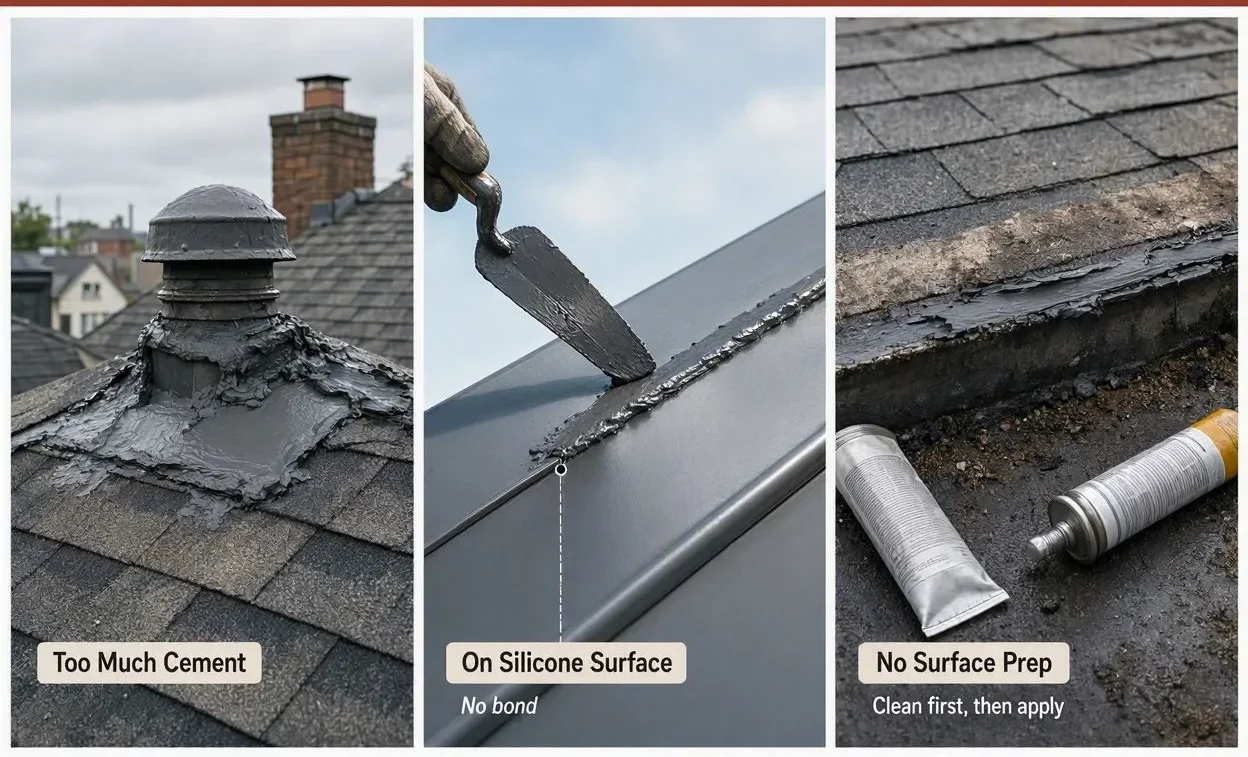
The most common roof cement mistake is applying too much of it, which traps water instead of shedding it. A thin, even layer works better than a thick mound, no matter how bad the leak looks.
Homeowners run into trouble in a few predictable ways:
- Overloading vents, chimneys, and shingle edges with cement, which blocks proper water runoff.
- Applying it over a silicone-coated surface, where it won’t bond at all.
- Skipping surface prep, then wondering why the patch peels within a month.
- Ignoring ventilation while working, since some formulas release fumes that shouldn’t be inhaled in an enclosed space.
A patch job done in a rush rarely holds. Two contractors, called back to the same skylight leak within a single season, discovered the previous fix had skipped surface cleaning entirely. Once they scraped it down and reapplied correctly, the leak didn’t return.
How to Store Roof Cement
Store roof cement in a cool, dry location, and bring it indoors overnight during freezing weather to keep it workable. Extreme cold thickens the paste to the point where spreading it evenly becomes nearly impossible.
Keep the lid sealed tightly between uses, since air exposure causes the surface layer to skin over and harden. Never store it near an open flame or while smoking nearby, given its solvent content. Most opened containers stay usable for six to twelve months if sealed properly, though performance can drop off toward the end of that window.
Is Roof Cement a Permanent Fix?
No, roof cement is not a permanent fix. It’s designed as a temporary or short-term patch, not a substitute for shingle replacement or a new roof.
It buys time, sometimes months, occasionally a year or two, depending on climate and how the patch was applied. Homeowners who lean on it repeatedly in the same spot are usually looking at a deeper problem underneath, whether that’s deteriorated flashing, a failing underlayment, or shingles past their service life. Scheduling a proper inspection after a cement patch, rather than waiting for the next leak, saves money over time.
Conclusion
Roof cement solves a specific problem: small leaks, loose shingles, and gaps around flashing that need a fast, dependable patch. It isn’t interchangeable with sealant, and it isn’t a substitute for a proper roof repair when damage spreads beyond a small area. Choosing the right type, whether that’s wet patch, fibered, or flashing-grade cement, and applying it with clean, prepped surfaces makes the difference between a patch that lasts a season and one that fails in the next storm. Treat it as a bridge to a permanent fix, not the fix itself, and it will do exactly the job it’s built for.