
12 main types of cement are used in modern construction — each designed for a specific structural need, climate condition, or chemical environment. Choosing the wrong type costs more in repairs than it saves at purchase.
This guide covers every major cement type with real specs, compressive strength data, setting times, and direct use cases — so you pick the right cement the first time.
Quick Answer: The 12 types of cement are Ordinary Portland Cement (OPC), Portland Pozzolana Cement (PPC), Portland Slag Cement (PSC), Rapid Hardening Cement (RHC), Extra Rapid Hardening Cement (ERHC), Low Heat Cement (LHC), Sulphate Resistant Cement (SRC), High Alumina Cement (HAC), White Cement, Colored Cement, Expansive Cement, and Hydrophobic Cement.
What Is Cement?
Cement is a fine gray powder that acts as a binding agent in concrete and mortar. When mixed with water, it undergoes a chemical process called hydration — forming calcium silicate hydrate (C-S-H) gel that binds aggregate particles into a hard, durable mass.
The primary raw material is limestone (CaCO3), which makes up 60–67% of the raw mix. Other ingredients include clay (silica + alumina), iron ore, and gypsum. The mix is heated in a rotary kiln at 2,640°F (1,450°C) to form clinker — the intermediate product ground into finished cement.
Initial setting time: 30 minutes minimum (IS 269). Final setting time: 600 minutes maximum. Specific gravity: 3.15. Fineness: minimum 225 m²/kg (Blaine method).
Cement has a shelf life of 3 months from manufacturing date. Store in dry conditions away from moisture — expired cement loses compressive strength and is unsafe for structural work.
Proper material selection is the first step. For professional installation on your roof, see our metal roofing installation services.
12 Types of Cement Used in Construction
1. Ordinary Portland Cement (OPC)
OPC is the most widely used cement worldwide — available in 3 grades: 33, 43, and 53. The number represents 28-day compressive strength in N/mm² (MPa).
- Grades: OPC 33, OPC 43, OPC 53
- 28-day strength: 33 / 43 / 53 N/mm² respectively
- Initial setting time: 30 minutes minimum
- Specific gravity: 3.15
- US Standard: ASTM C150 Type I/II/III
- IS Code: IS 269:2015
- Best for: RCC structures, beams, columns, bridges, precast
- Price (50 kg bag): $8–$14 USD / ₹340–₹460 INR
OPC 53 gains strength fastest — reaching 27 N/mm² at 7 days versus OPC 43’s 23 N/mm². Use OPC 53 when formwork removal speed matters: prestressed beams, precast panels, and industrial floors.
The trade-off is heat of hydration — OPC generates 80–90 cal/g during curing, which causes thermal cracking in mass concrete pours above 3 feet (900 mm) thickness.
2. Portland Pozzolana Cement (PPC)
PPC replaces 15–35% of OPC clinker with pozzolanic materials — fly ash, volcanic ash, or calcined clay. The pozzolanic reaction between silica in fly ash and calcium hydroxide (Ca(OH)₂) produces additional C-S-H gel, densifying the concrete matrix.
- Fly ash content: 15–35% by weight
- 28-day strength: 25–33 N/mm²
- Heat of hydration: 60–70 cal/g (25% lower than OPC)
- IS Code: IS 1489:2015 (Part 1)
- Best for: House construction, foundations, masonry, plastering
- Price (50 kg bag): $7–$12 USD / ₹320–₹420 INR
PPC is the recommended cement for most residential construction in humid and rainy climates. Lower heat of hydration reduces cracking in slabs and foundations. Enhanced sulphate resistance makes PPC suitable for soil with moderate sulphate content.
PPC gains strength slowly — 7-day strength is 65–70% of OPC at the same age. Do not use PPC where formwork must be removed before 14 days.
Roof substrate preparation requires proper cement selection. Our team handles roof repair services including parapet wall and roof deck work.
3. Portland Slag Cement (PSC)
PSC blends OPC clinker with 25–70% granulated blast furnace slag (GBFS) — a steel industry by-product with latent hydraulic properties. Slag reacts slowly with calcium hydroxide, producing a dense, low-permeability concrete matrix.
- Slag content: 25–70% by weight
- 28-day strength: 16 N/mm² minimum
- IS Code: IS 455:2015
- Best for: Marine structures, sewage plants, coastal buildings, mass concrete
- Price (50 kg bag): $8–$13 USD
PSC’s chloride diffusion coefficient is 60–70% lower than OPC — critical for reinforced concrete in marine environments where chloride-induced rebar corrosion is the primary failure mode. Bridges, jetties, offshore platforms, and coastal retaining walls specify PSC as standard.
PSC gains strength slowly in cold weather. Curing at below 50°F (10°C) significantly reduces 28-day strength development.
4. Rapid Hardening Cement (RHC)
RHC achieves in 3 days what OPC achieves in 28 days — through finer grinding (450 m²/kg vs 225 m²/kg for OPC) and higher C₃S (tricalcium silicate) content. The increased surface area accelerates hydration.
- 3-day strength: Equal to OPC 28-day strength
- Fineness: 450 m²/kg minimum
- IS Code: IS 8041:1990
- ASTM equivalent: Type III Portland Cement
- Best for: Road repairs, precast units, cold weather concreting, emergency repairs
- Price premium: 20–30% above OPC
RHC generates significantly more heat than OPC — avoid in mass pours. The primary application is road repair where traffic must resume within 24–48 hours. Precast factories use RHC to achieve faster mold turnover — removing forms at 16 hours instead of 24.
5. Extra Rapid Hardening Cement (ERHC)
ERHC contains calcium chloride (CaCl₂) added during grinding — typically 1–2% by weight. Calcium chloride accelerates hydration, producing 1-day strength equal to RHC’s 3-day strength.
- Calcium chloride content: 1–2% by weight
- 1-day strength: Equal to RHC 3-day strength
- Best for: Precast concrete, cold weather emergency repairs
- Critical warning: Never use in reinforced concrete — CaCl₂ corrodes steel rebar
ERHC is limited to plain concrete applications only. The chloride content attacks steel reinforcement within 2–5 years, causing expansion cracking and structural failure. Permitted only in unreinforced precast units, plain concrete paving, and non-structural applications.
6. Low Heat Cement (LHC)
LHC contains higher C₂S (dicalcium silicate) and lower C₃A (tricalcium aluminate) — reducing heat generation during hydration to 60 cal/g at 7 days versus OPC’s 89 cal/g.
- Heat of hydration: 60 cal/g at 7 days, 70 cal/g at 28 days
- C₂S content: 46% minimum
- C₃A content: 6% maximum
- IS Code: IS 12600:2015
- ASTM equivalent: Type IV Portland Cement
- Best for: Dams, mass foundations, thick retaining walls, bridge abutments
LHC was specified for Hoover Dam and similar large-volume concrete structures where internal temperature rise causes cracking. In a 10-foot (3 m) thick dam section, OPC concrete reaches 160°F (70°C) internally — sufficient to cause severe thermal cracking. LHC keeps the same section below 122°F (50°C).
7. Sulphate Resistant Cement (SRC)
SRC contains less than 3.5% C₃A — the compound most vulnerable to sulphate attack. When C₃A reacts with sulphate ions in soil or groundwater, it forms ettringite, which expands and destroys concrete from within.
- C₃A content: 3.5% maximum
- 28-day strength: 33 N/mm² minimum
- IS Code: IS 12330:2003
- ASTM equivalent: Type V Portland Cement
- Best for: Foundations in sulphate-bearing soil, sewage pipes, basement walls, coastal piles
Soil sulphate content above 0.2% (2,000 mg/kg) requires SRC. Groundwater sulphate above 300 mg/liter requires SRC. Use a water-cement ratio below 0.45 with SRC for maximum impermeability. Without SRC in aggressive sulphate conditions, concrete deteriorates within 5–10 years.
Roofing structures over sulphate-bearing soil need proper waterproofing. Our commercial roofing specialists handle flat roof systems including TPO and modified bitumen over concrete decks.
8. High Alumina Cement (HAC)
HAC contains 35–40% alumina (Al₂O₃) versus OPC’s 5–8%. The high alumina content produces calcium aluminate hydrates instead of calcium silicate hydrates, enabling extraordinary early strength and heat resistance.
- Alumina content: 35–40%
- 24-hour strength: 40 N/mm² (equal to OPC 28-day)
- Maximum service temperature: 1,832°F (1,000°C) for refractory use
- Best for: Refractory concrete, furnace linings, chemical plants, emergency repairs
- Price premium: 5–8x OPC price
HAC is not used for general structural concrete because of conversion — at high humidity and temperature, HAC undergoes a chemical change (conversion) that reduces strength by 50–60% over 5–10 years. HAC is limited to refractory applications, marine piling, and chemical resistance scenarios where high alumina resistance outweighs conversion risk.
9. White Cement
White cement is OPC manufactured with raw materials low in iron and manganese — the compounds responsible for gray color in standard cement. The result is a bright white powder that accepts pigments cleanly.
- Iron oxide content: Below 0.5% (vs 3–4% in gray OPC)
- 28-day strength: 33–53 N/mm²
- IS Code: IS 8042:1989
- Best for: Tile grouting, exterior plaster, decorative concrete, swimming pools, architectural features
- Price premium: 3–4x gray OPC price
White cement costs more because low-iron raw materials are scarce and kiln temperatures must be carefully controlled to prevent discoloration. The high reflectivity (albedo 0.7–0.8) makes white cement concrete a natural cool surface for roof applications. White cement plaster on parapet walls reduces heat absorption by 30–40% compared to gray cement.
White cement is commonly used on parapet walls and roof decks. For complete roof replacement using modern materials, see our roof replacement services.
10. Colored Cement
Colored cement is white or gray cement ground with mineral oxide pigments — 5–10% by weight. Pigments include iron oxide (red, yellow, brown, black), chromium oxide (green), cobalt blue, and titanium dioxide (bright white).
- Pigment content: 5–10% by weight
- IS Code: IS 8042:1989
- Best for: Decorative floors, architectural facades, swimming pools, terrazzo, footpaths
Mineral oxide pigments are chemically inert and UV-stable — they do not fade under sunlight. Organic pigments are cheaper but fade within 3–5 years. Specify mineral oxides (iron oxide, chromium oxide) for any outdoor or sun-exposed application.
11. Expansive Cement
Expansive cement expands 0.05–0.2% during and after setting — compensating for shrinkage that occurs in normal concrete. The expansion mechanism uses sulphoaluminate compounds that form ettringite in controlled quantities.
- Expansion range: 0.05–0.2% linear
- Best for: Grouting anchor bolts, post-tensioned tendon ducts, concrete repair, filling cracks
- Types: K-type, M-type, S-type (based on expansion compound)
Expansive cement used in grout ensures zero-shrinkage contact between anchor bolts and base plates in structural connections. In repair applications, expansive grout fills cracks completely without leaving voids — critical in structural repairs where partial contact causes stress concentrations.
12. Hydrophobic Cement
Hydrophobic cement has stearic acid or oleic acid added during grinding — forming a water-repellent film on each cement particle. This film prevents moisture absorption during storage without affecting concrete performance once mixed.
- Additive: Stearic acid or oleic acid (0.1–0.5%)
- IS Code: IS 8043:1991
- Best for: Long-term storage in humid conditions, monsoon regions, coastal storage
Standard OPC in a humid environment absorbs 1–2% moisture per month, reducing 28-day strength by 5–10% per month of improper storage. Hydrophobic cement resists moisture absorption for 6–12 months under the same conditions. The protective film breaks down during mixing — hydrophobic cement performs identically to OPC in concrete.
Cement Types Comparison Table
Use this table to match cement type to project requirements:
| Cement Type | 28-Day Strength | Best Use | Avoid When |
|---|---|---|---|
| OPC 53 | 53 N/mm² | RCC, precast, bridges | Mass pours (>3 ft thick) |
| PPC | 25–33 N/mm² | Houses, foundations, plastering | Fast formwork removal needed |
| PSC | 16+ N/mm² | Marine, coastal, sewage plants | Cold weather below 50°F |
| RHC | OPC 28-day in 3 days | Road repair, precast | Mass concrete (high heat) |
| LHC | 40+ N/mm² | Dams, mass foundations | Thin sections (slow strength) |
| SRC | 33+ N/mm² | Sulphate soil, basements | Normal soil (no benefit) |
| HAC | 40 N/mm² at 24 hrs | Refractory, chemical plants | General structural use |
| White | 33–53 N/mm² | Decorative, tile grout, pools | Budget projects (3–4x cost) |
| Hydrophobic | Same as OPC | Long-term humid storage | Unnecessary in dry climates |
How to Choose the Right Cement Type
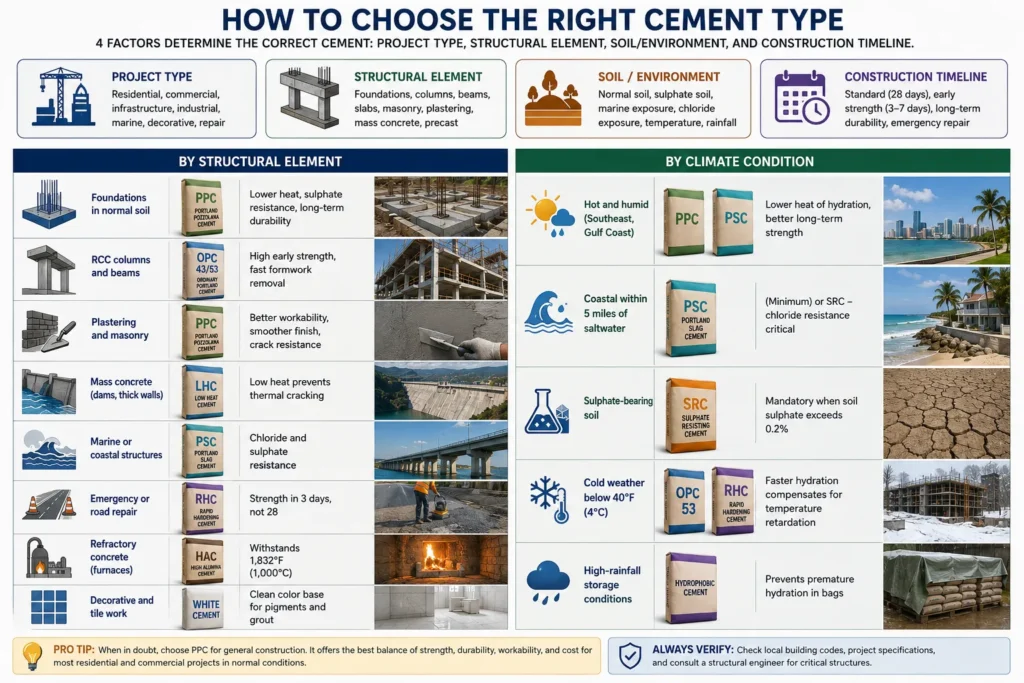
4 factors determine the correct cement: project type, structural element, soil/environment, and construction timeline.
By structural element
- Foundations in normal soil: PPC — lower heat, sulphate resistance, long-term durability
- RCC columns and beams: OPC 43 or OPC 53 — high early strength, fast formwork removal
- Plastering and masonry: PPC — better workability, smoother finish, crack resistance
- Mass concrete (dams, thick walls): LHC or PSC — low heat prevents thermal cracking
- Marine or coastal structures: PSC or SRC — chloride and sulphate resistance
- Emergency or road repair: RHC — strength in 3 days, not 28
- Refractory concrete (furnaces): HAC — withstands 1,832°F (1,000°C)
- Decorative and tile work: White cement — clean color base for pigments and grout
By climate condition
- Hot and humid (Southeast, Gulf Coast): PPC or PSC — lower heat of hydration, better long-term strength
- Coastal within 5 miles of saltwater: PSC (minimum) or SRC — chloride resistance critical
- Sulphate-bearing soil: SRC — mandatory when soil sulphate exceeds 0.2%
- Cold weather below 40°F (4°C): OPC 53 or RHC — faster hydration compensates for temperature retardation
- High-rainfall storage conditions: Hydrophobic cement — prevents premature hydration in bags
Roof deck concrete and parapet walls use cement-based substrates. For roofing over these substrates, our roof inspection services identify substrate failures before they compromise the roofing system.
OPC vs PPC Cement — Which Is Better for Your Project?
OPC and PPC are the 2 most commonly specified cement types. The correct choice depends on 3 variables: timeline, structure type, and environment.
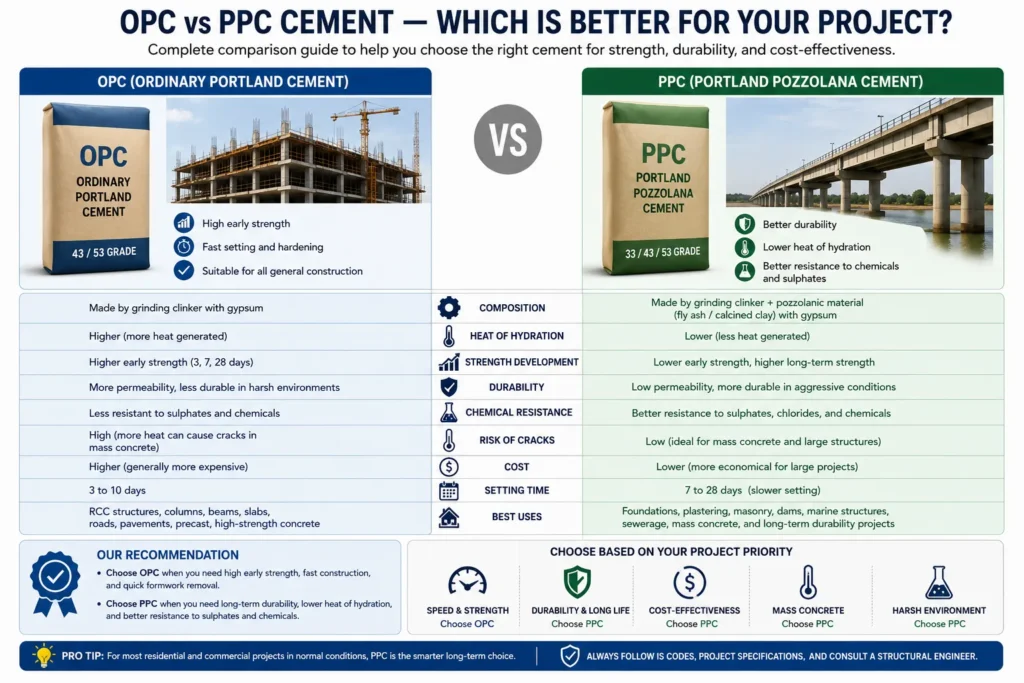
| Factor | OPC 43/53 | PPC |
|---|---|---|
| Early strength (7 days) | High (70–80% of 28-day) | Moderate (55–65% of 28-day) |
| 28-day strength | 43–53 N/mm² | 25–33 N/mm² |
| Heat of hydration | 80–90 cal/g | 60–70 cal/g |
| Sulphate resistance | Low | Moderate |
| Workability | Standard | Better (fly ash lubricates) |
| Cost (50 kg bag) | $8–$14 | $7–$12 |
| Best for | RCC structures, fast projects | Houses, foundations, plastering |
| Avoid when | Mass pours, humid long-term | Fast formwork removal needed |
Use OPC when: formwork must be removed within 3–7 days, the structure requires 40+ N/mm² early strength, or the project is in cold weather where slow-setting PPC loses too much strength.
Use PPC when: building a house, laying foundations, plastering walls, or constructing in a humid or coastal region. PPC’s 28-day and 90-day strength often exceeds OPC in normal moisture conditions due to the ongoing pozzolanic reaction.
Cement Types for Roofing Applications
Roofing structures use cement in 4 specific applications — each with a different requirement:
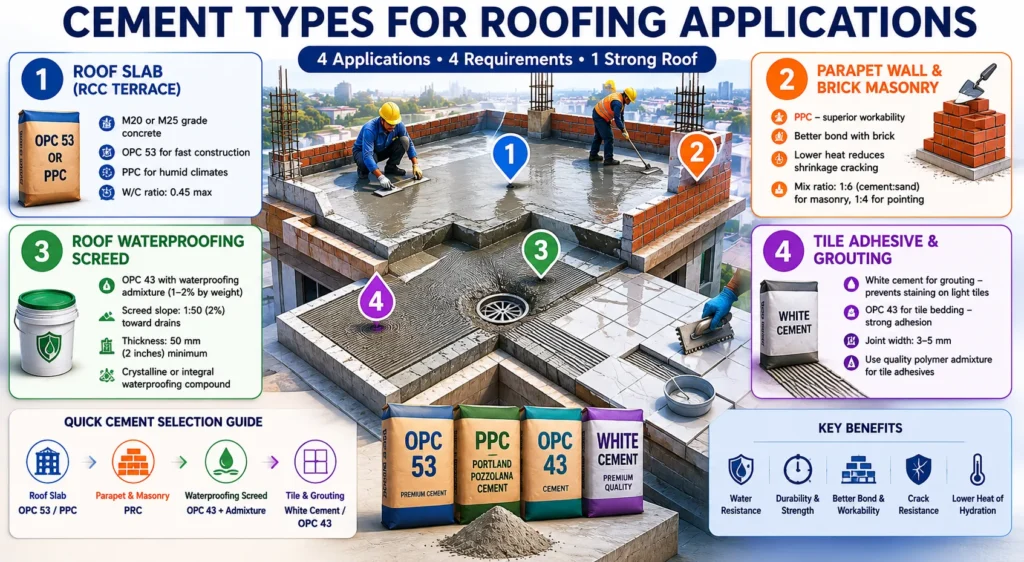
Roof slab (RCC terrace)
OPC 53 or PPC — M20 or M25 grade concrete. OPC 53 for fast construction timelines. PPC for humid climates where durability over speed is the priority. Water-cement ratio: 0.45 maximum for watertight terraces.
Parapet wall and brick masonry
PPC — superior workability produces better bond with brick. Lower heat of hydration reduces shrinkage cracking in thin parapet walls. Mix ratio: 1:6 (cement:sand) for masonry, 1:4 for pointing.
Roof waterproofing screed
OPC 43 with waterproofing admixture — crystalline or integral waterproofing compound added at 1–2% by weight of cement. Screed slope: minimum 1:50 (2%) toward drains. Thickness: 50 mm (2 inches) minimum.
Tile adhesive and grouting
White cement for grouting, OPC 43 for tile bedding — white cement grout prevents staining on light-colored tiles. Tile adhesive bed: 12–15 mm (0.5 inch) OPC mortar at 1:3 ratio.
Roof maintenance includes regular inspection of cement joints and parapet walls. Our roof maintenance services identify cement deterioration before water infiltration damages the structure.
Cement Grade Guide — Compressive Strength by Grade
| Grade | Min. 28-Day Strength | Best Application | ASTM Equivalent |
|---|---|---|---|
| OPC 33 | 33 N/mm² (4,786 psi) | Plastering, low-load masonry | Type I (low end) |
| OPC 43 | 43 N/mm² (6,236 psi) | General RCC, floors, foundations | Type I |
| OPC 53 | 53 N/mm² (7,687 psi) | High-strength RCC, precast, bridges | Type III |
| PPC | 25–33 N/mm² | Residential, masonry, humid climates | No direct equivalent |
| PSC | 16 N/mm² minimum | Marine, coastal, chemical exposure | Slag cement (ASTM C595) |
| SRC | 33 N/mm² minimum | Sulphate soil, sewage, basements | Type V |
Conclusion
The right cement type depends on 3 things: the structural element you are building, your local climate, and your construction timeline. For most residential projects, PPC delivers the best long-term durability at the lowest cost. For structural RCC work on tight timelines, OPC 53 is the correct choice. Marine and coastal structures need PSC or SRC regardless of cost.
Wrong cement selection causes cracking, corrosion, and early failure — problems that cost 10–20x the cement cost differential to repair. Specify the right type upfront.