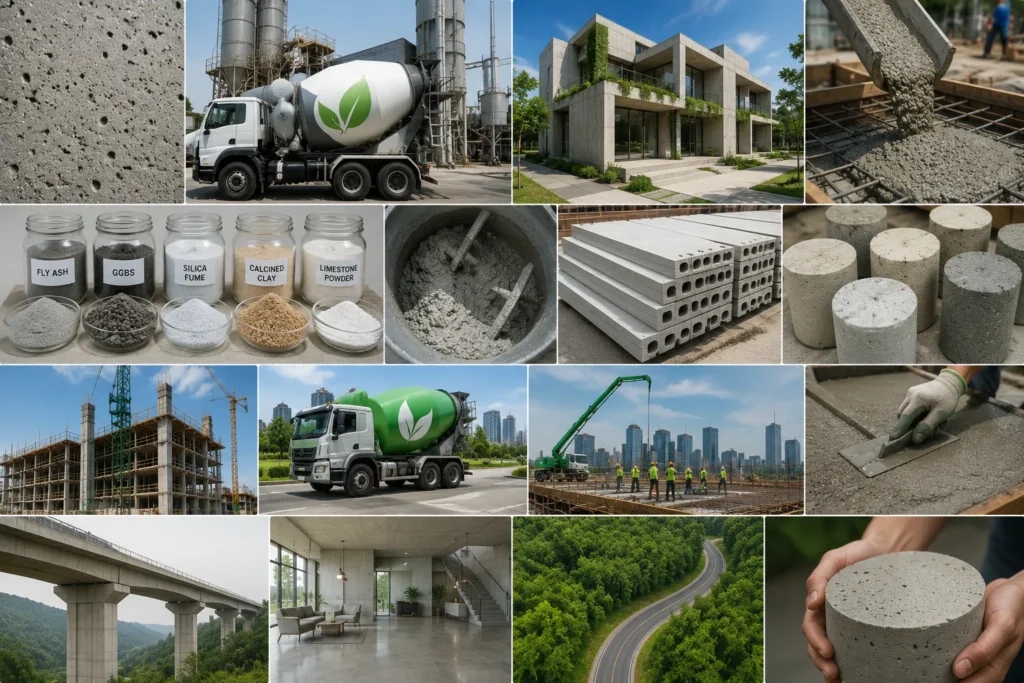
Low carbon concrete cuts CO2 emissions by 30% to 70% compared to standard concrete while matching its strength. Producers replace part of the Portland cement with materials like fly ash, slag, or captured CO2 — the structure performs the same, the carbon footprint drops.
Concrete is the second most consumed material on Earth after water. Cement production alone causes roughly 7% of global CO2 emissions. Builders, architects, and homeowners now ask for low carbon concrete by name, and 2026 supply has caught up with that demand. This guide covers what low carbon concrete is, how producers make it, what it costs, and how to specify it for your next project.
What Is Low Carbon Concrete?
Low carbon concrete is concrete made with a smaller carbon footprint than standard concrete, while delivering equal strength and durability. Producers reach this result 3 ways: switching fuel sources, replacing part of the cement with mineral by-products, or injecting captured CO2 directly into the mix.
The finished product looks and performs like ordinary concrete. A contractor pours it, finishes it, and cures it the same way. The difference sits in the mix design and the manufacturing process, not in the final slab.
Why Traditional Concrete Produces So Much Carbon
Traditional concrete produces high emissions because cement requires extreme heat to manufacture. Producers burn limestone in kilns at 2,300°F to 3,000°F (1,260°C to 1,650°C) to form clinker, the core ingredient in Portland cement.
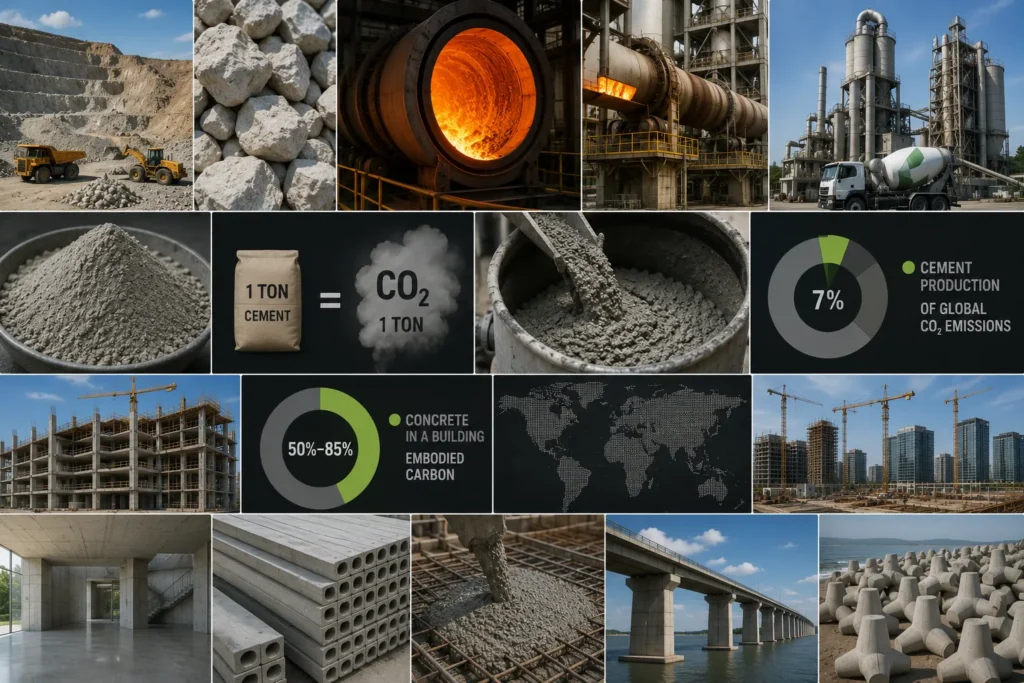
- 1 ton of Portland cement produces roughly 1 ton of CO2 emissions during manufacturing.
- Cement manufacturing causes an estimated 7% of global CO2 emissions — among the highest of any industrial process.
- Concrete production accounts for 50% to 85% of the embodied carbon in a typical building project.
- Global concrete consumption reaches 3 tons per person every year, making concrete the most manufactured material in the world after water.
These numbers explain why governments and certification bodies now require carbon disclosure on concrete used in public and commercial projects. A single mineral inside the cement mix drives much of this initial heat demand: alite (Ca3SiO5) cures within hours of pouring and gives concrete its early strength, but producing it requires the highest kiln temperatures in the entire process. Lowering the alite content, or replacing part of the clinker outright, is where most low carbon innovation starts.
The Building-Owner Cost of High-Carbon Concrete
Architects, contractors, and government agencies increasingly track embodied carbon as a line item, not an afterthought. Environmental Product Declarations (EPDs), green building certifications such as LEED, and state-level “Buy Clean” procurement policies now require carbon disclosure before a concrete order qualifies for certain public contracts. A building owner who ignores this shift risks losing bids on public infrastructure work and paying higher insurance or certification costs later in the project lifecycle.
How Manufacturers Make Low Carbon Concrete
Manufacturers make low carbon concrete through 3 proven methods: alternative fuels, cement replacement, and carbon capture technology. Each method reduces emissions at a different stage of production, and producers often combine all 3 in a single mix design.
Low Carbon Fuels
Cement plants cut emissions by switching kiln fuel from coal to lower-carbon alternatives — renewable natural gas, biomass, or waste-derived fuels such as non-recyclable tires and plastics. This change alone reduces manufacturing emissions without touching the concrete mix itself.
Supplementary Cementitious Materials (SCMs)
SCMs replace a portion of Portland cement with industrial by-products that still react chemically to build strength. 4 common SCMs:
- Fly ash — a by-product of coal-fired power plants.
- Ground granulated blast-furnace slag (GGBS) — a by-product of iron and steel production.
- Silica fume — a by-product of silicon and ferrosilicon manufacturing.
- Natural pozzolans — volcanic ash or calcined clay that reacts similarly to cement.
A 2026 strength study found that low-carbon gel concrete made with a 1:1 ratio of slag powder to fly ash reached 20% higher compressive strength than conventional concrete after 28 days of curing, while reducing carbonation depth by 30.77%. Researchers tested the mix at a water-cement ratio of 0.38 and confirmed the carbon savings did not come at the expense of flexural or tensile strength.
Carbon Capture, Utilization, and Storage (CCUS)
CCUS technology injects captured CO2 directly into fresh concrete during mixing. The CO2 reacts with calcium ions and mineralizes permanently into the concrete — it does not escape back into the atmosphere. One technology provider’s ready-mix partner produced over 182,000 truckloads of concrete using this method and prevented more than 17,000 metric tons of CO2 from entering the atmosphere, equal to the annual carbon capture of more than 20,000 acres (8,094 hectares) of forest.
How Much Does Low Carbon Concrete Cost in 2026?
Low carbon concrete costs 0% to 15% more than standard concrete per cubic yard, with most residential projects paying a 3% to 8% premium. The exact cost depends on the SCM percentage, regional material availability, and whether the producer uses CCUS technology.
- Standard ready-mix concrete: $125 to $175 per cubic yard (0.76 cubic meters).
- Low carbon mix with 20% to 30% SCM replacement: $130 to $185 per cubic yard — often at price parity once transportation and volume discounts apply.
- CCUS-enhanced concrete: $128 to $180 per cubic yard, since the technology adds minimal cost while replacing cement volume.
State that the price gap narrows every year. CalPortland’s blended cement product reduces embodied carbon by up to 25% without sacrificing strength, performance, or cost competitiveness against standard mixes.
Volume matters more than mix design when it comes to final cost. A homeowner ordering 5 cubic yards (3.8 cubic meters) for a driveway pays a higher per-unit premium than a commercial contractor ordering 500 cubic yards (382 cubic meters) for a parking structure, since SCM suppliers offer steeper discounts at scale. Ask your ready-mix producer for a price quote on both the standard mix and the low carbon alternative side by side — most producers in 2026 can generate both quotes within the same business day.
Low Carbon Concrete vs Standard Concrete: Quick-Reference Table
| Task | Timing | Method | Difficulty |
| Request an EPD from your supplier | Before bidding | Email or supplier portal | Low |
| Specify SCM percentage in mix design | Design phase | Written spec sheet | Medium |
| Order test cylinders for strength check | Day of pour | ASTM C39 compression test | Low |
| Cure low carbon mix properly | 7 to 28 days | Wet curing or curing compound | Medium |
| Verify carbon savings for green certification | After pour | EPD comparison report | Medium |
How to Specify Low Carbon Concrete for Your Project
To specify low carbon concrete, state the maximum embodied carbon target and required SCM percentage directly in your project documents. General contractors and architects who write vague language like “sustainable concrete preferred” get standard mix delivered by default.
- State a numeric embodied carbon limit, such as 250 kg CO2e per cubic meter, in the specification.
- Require an Environmental Product Declaration (EPD) from the supplier before the bid closes.
- Set a minimum SCM replacement rate — 20% is achievable in most US markets without a cost premium.
- Request 3 compressive strength test results from past projects using the same mix design.
- Confirm curing time, since some low carbon mixes gain strength more slowly than standard mixes in the first 7 days.
Architects who skip the numeric carbon target see the biggest gap between intent and delivery. A spec sheet that names a kg CO2e ceiling, names the required EPD, and names the SCM percentage leaves no room for a producer to default back to standard mix on a tight schedule.
Where Low Carbon Concrete Is Used in Roofing and Construction
Low carbon concrete works in every application standard concrete handles, including roofing-adjacent structures like parapet walls, chimney bases, and flat roof deck slabs. Contractors pour, finish, and cure it using the same techniques as standard concrete.
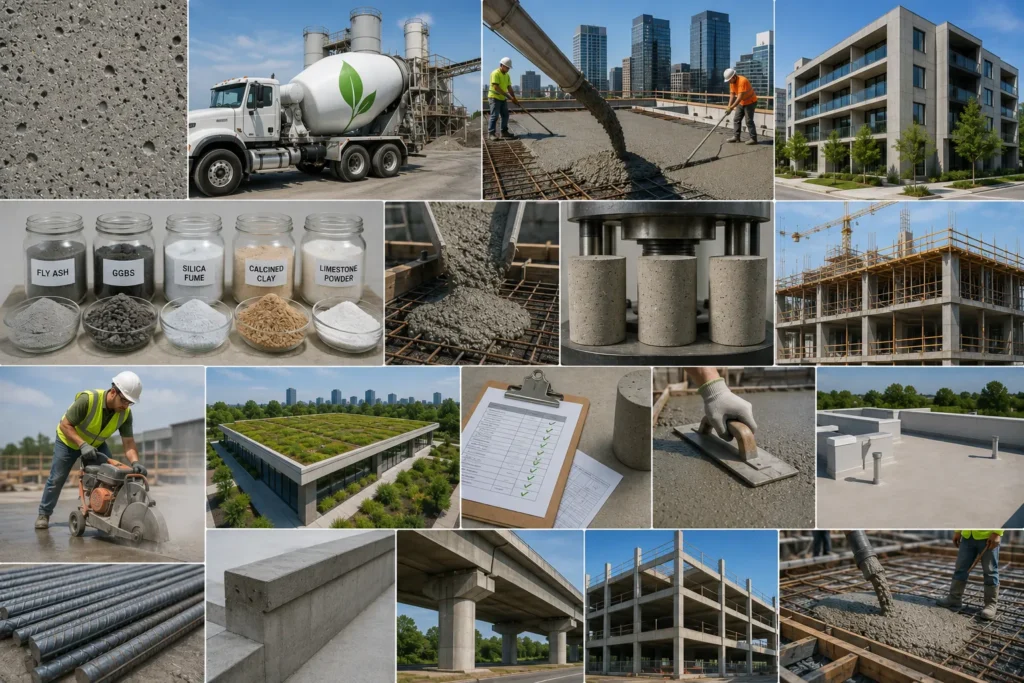
Flat roof systems built on concrete decks benefit directly from this material, since the deck represents a significant share of a building’s total concrete volume. Property owners who plan a deck repair, a parapet rebuild, or a new green roof installation can request low carbon concrete at the specification stage with no change to the construction timeline. Green roof decks in particular carry added structural weight from soil and vegetation, which means the concrete deck specification already gets close scrutiny from a structural engineer — adding a carbon target at that same review stage costs nothing extra in design time.
Concrete on or near a roofing system sometimes needs to be cut for pipe penetrations, drain installation, or parapet modification. Crews handling this work follow specific blade and safety requirements — see our guide on how to cut concrete for the tools, PSI ratings, and rebar considerations that apply to low carbon mixes as well.
Roofing materials and concrete decks often get specified together on the same sustainability scorecard. Property owners comparing total building emissions sometimes evaluate the roofing membrane alongside the structural deck — our breakdown of
rubber roofing cost covers EPDM, TPO, and PVC pricing for projects that pair a concrete deck with a membrane roof system.
How to Choose a Low Carbon Concrete Supplier
Choose a low carbon concrete supplier by checking 3 things: a published EPD, a track record of completed low carbon pours, and third-party strength verification. Suppliers who cannot produce an EPD on request are not equipped to deliver verified low carbon concrete.
- Ask for an EPD specific to the mix design you plan to order, not a generic company-wide document.
- Request 2 to 3 reference projects completed in the past 24 months using the same SCM blend.
- Confirm ASTM C150 or ASTM C595 compliance for the cement blend used in the mix.
- Compare delivered cost per cubic yard, not just the per-bag cement price, since SCM availability affects total project cost.
A supplier with all 4 qualifications still needs a logistics check. Confirm delivery radius, batch plant capacity for the SCM blend you specified, and lead time — some SCM blends require 48 to 72 hours of advance notice compared to same-day availability for standard mix. Building this lead time into your project schedule avoids pour delays on the day the crew shows up.
FAQs
Is low carbon concrete as strong as regular concrete?
Yes. Low carbon concrete matches or exceeds standard concrete strength when SCM ratios are correctly designed. Independent testing on slag-and-fly-ash blends showed 20% higher compressive strength after 28 days.
Does low carbon concrete cost more than standard concrete?
No, in most cases. A 0% to 8% premium applies in some markets, but volume discounts and SCM availability often bring the price to parity with standard mix.
How much CO2 does low carbon concrete actually save?
Low carbon concrete cuts embodied CO2 by 30% to 70%, depending on the SCM percentage and whether the producer uses carbon capture technology.
Can low carbon concrete be used for structural foundations?
Yes. Engineers approve low carbon mixes for foundations, slabs, and structural walls once compressive strength testing confirms the mix meets project specifications.
How do I find a low carbon concrete supplier near me?
Search supplier directories that list Environmental Product Declarations, contact 3 regional ready-mix producers directly, or ask your concrete contractor which suppliers stock SCM-blended mixes.
Conclusion
Low carbon concrete delivers the same strength, the same pour process, and the same finished result as standard concrete — at a carbon cost that runs 30% to 70% lower. The technology has moved past the pilot stage. Suppliers across the US stock SCM-blended mixes today, and CCUS-enhanced concrete now ships in volume from major ready-mix producers.
Planning a concrete pour near your roofline — a parapet, a deck, or a footing? Contact Rainy Roofers for a free assessment of how low carbon concrete fits your roofing project, and ask about coordinating the pour with your membrane or deck installation timeline.