
Cut concrete using 1 of 6 methods depending on job size: hammer and chisel for small breaks, circular saw for slabs up to 3 inches (7.6 cm) deep, angle grinder for detail cuts, walk-behind saw for large driveway sections, core drill for round holes, or wet-cutting saw for reinforced concrete. The right method depends on slab thickness, reinforcement type, and how clean the cut needs to be.
Concrete cutting is not complicated but 2 things cause most problems: using the wrong blade for the job, and skipping silica dust protection. This guide covers both in full, along with tool-by-tool instructions, a 2026 cost table for rental, and the 5 situations where you call a professional instead of renting a saw.
Rainy Roofers cuts concrete regularly on roof installation projects parapet walls, chimney bases, concrete tile sections, and flat roof deck edges. The same cutting principles apply whether you are opening a concrete wall for a new pipe penetration or trimming a paver for a backyard path.
Reviewed by a licensed masonry contractor with 14+ years of residential and commercial concrete work across the USA.
QUICK REFERENCE — Concrete Cutting by Project
| Project type | Best tool | Blade type | DIY or Pro? |
| Concrete pavers | Circular saw / chisel | Diamond / abrasive | DIY |
| Concrete walkway / patio | Circular saw | Diamond | DIY |
| Concrete driveway slab | Walk-behind saw | Diamond wet | DIY or rent |
| Concrete wall opening | Angle grinder + saw | Diamond | DIY (thin) / Pro |
| Reinforced foundation | Walk-behind + core drill | Diamond wet | Pro only |
| Control joints | Walk-behind or circular saw | Diamond | DIY or Pro |
Why Concrete Is Hard to Cut and What That Means for Your Tools
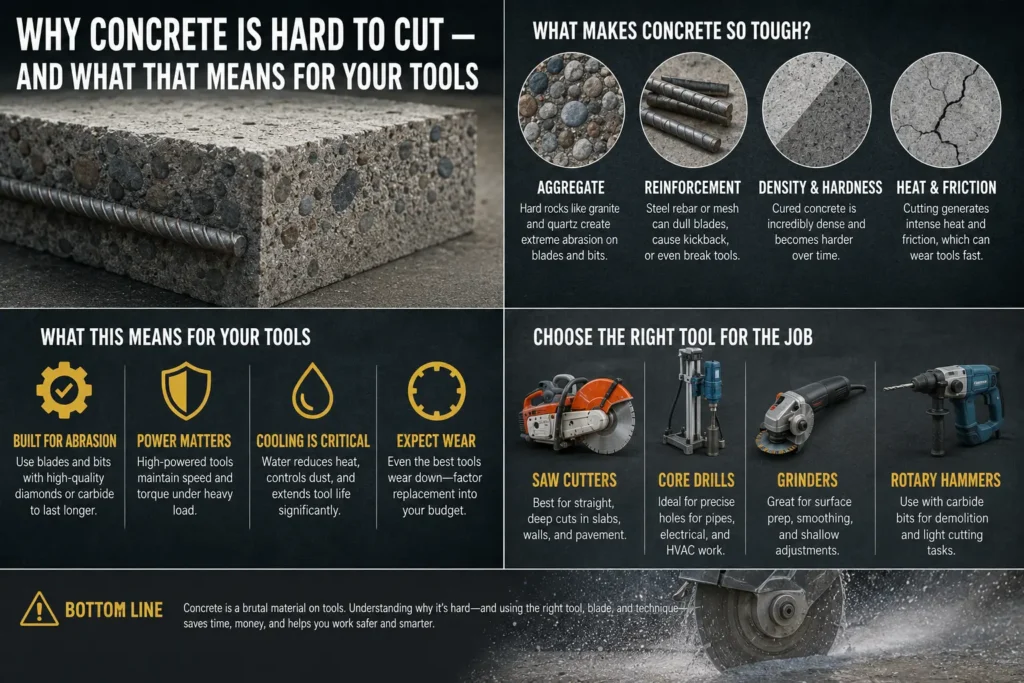
Concrete reaches 4,000 PSI (27.6 MPa) compressive strength at 28 days making it harder than most metals and almost impossible to cut without purpose-built tools. Standard wood-cutting blades overheat within seconds on concrete and shatter. The material also contains steel rebar (No. 3 to No. 5 bar, 3/8 to 5/8 inch / 9.5 – 15.9 mm diameter) in structural slabs — which destroys abrasive blades and requires a diamond-tipped blade to cut cleanly without kickback.
Concrete cutting creates 2 hazards that wood cutting does not: crystalline silica dust and blade kickback. Silica particles produced by dry concrete cutting measure 10 microns or smaller — invisible to the eye and capable of reaching deep lung tissue. OSHA’s respirable crystalline silica standard (29 CFR 1926.1153) limits silica exposure to 50 micrograms per cubic meter (µg/m³) over an 8-hour workday for construction workers. Homeowners are not covered by OSHA regulations, but the lung damage from silica is identical regardless of who is doing the cutting.
6 Methods to Cut Concrete Compared
Method 1: Hammer and Chisel, No Power Tools Required
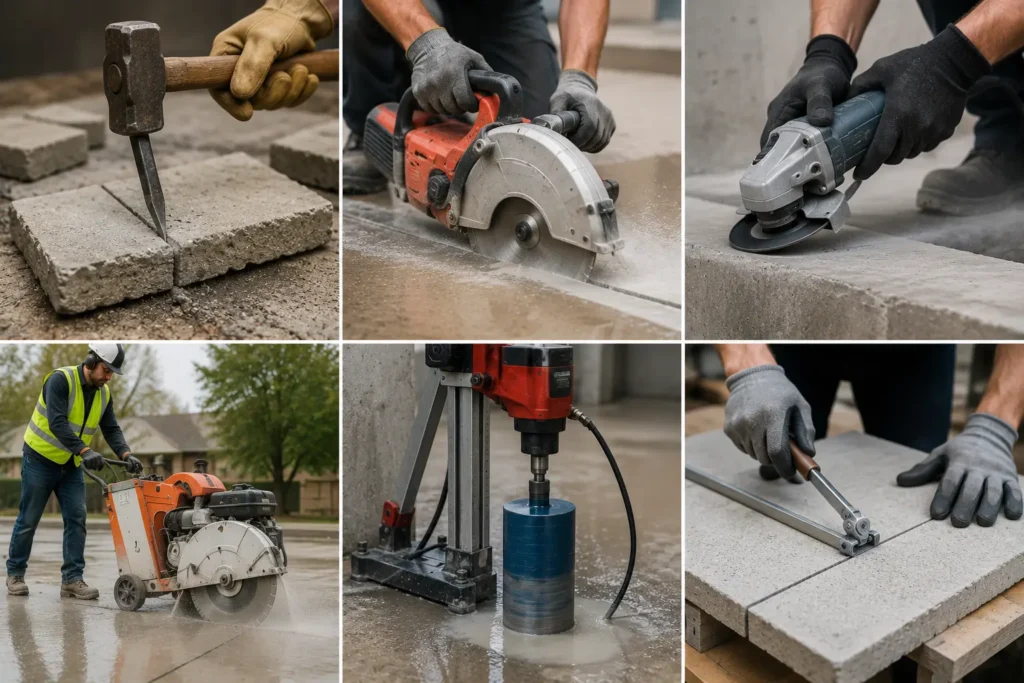
Use a hammer and cold chisel to cut concrete pavers, thin blocks, or small sections up to 2 inches (5 cm) thick. Score a line across the full width of the piece using the chisel and a steady hammer strike. Repeat the scoring pass 3 to 4 times to deepen the groove to 1/4 inch (6 mm). Place the chisel at the center of the scored line and strike firmly the concrete splits along the scored groove.
This method produces a rough edge, not a clean cut. Use it when edge appearance does not matter — such as pieces buried at the back of a garden border or hidden under a step. For visible cuts, use a saw.
- Best for: Pavers, thin blocks under 2 inches, small break-out work
- Cost: Under $20 for chisel if not already owned
- Dust level: Low no power tool involved
- Skill level: Beginner
Method 2: Circular Saw with Diamond Blade, Best for Slabs
A circular saw fitted with a 7-inch (17.8 cm) diamond blade cuts concrete slabs, driveways, patios, and pavers to depths of 2 to 2.5 inches (5 – 6.4 cm) per pass. For slabs thicker than 2.5 inches, use the step-cutting technique: set the blade to 0.5 inches (1.3 cm) depth for the first pass, then increase depth by 0.5 inches with each subsequent pass until reaching full depth. Step cutting reduces friction, prevents blade overheating, and eliminates the kickback risk that comes from plunging a blade to full depth in one pass.
Run the saw at maximum RPM along a chalk guide line. Move slowly rushing the blade creates heat, shortens blade life, and produces a ragged cut edge. Pull the saw out of the cut every 30 to 45 seconds during dry cutting to let the blade spin freely in the air and shed heat.
- Best for: Patios, driveways, slabs, walkways, pavers up to 4 inches thick
- Blade cost: $25 – $85 for a 7-inch diamond blade (2026 prices)
- Dust level: High (dry) / Low (wet attachment)
- Skill level: Intermediate
Method 3: Angle Grinder, Detail Cuts and Tight Spaces
An angle grinder with a 4 to 4.5-inch (10 – 11.4 cm) diamond disc cuts concrete in confined spaces, trims small sections, and cleans up saw cuts at corners. Maximum cutting depth on a 4.5-inch grinder is approximately 1.5 inches (3.8 cm) — not enough for full-depth slab cuts, but ideal for scoring, trimming, and opening joints. The process is identical to a circular saw: mark the line, make multiple shallow passes, and let the disc cool between passes.
Angle grinders produce more kickback risk than circular saws when the disc catches in the concrete. Keep both hands on the grinder at all times. Never use an angle grinder without the blade guard in position.
- Best for: Tight corners, wall openings, trimming blocks, control joint cleaning
- Disc cost: $15 – $45 for a 4.5-inch diamond disc
- Dust level: High — use outdoors or with HEPA extractor
- Skill level: Intermediate
Method 4: Walk-Behind Concrete Saw Large Slabs and Driveways
A walk-behind concrete saw (also called a flat saw or slab saw) cuts full-depth through concrete slabs up to 12 inches (30.5 cm) thick in a single pass. These machines weigh 150 to 400 lbs (68 – 181 kg) and use 14 to 20-inch (35.6 – 50.8 cm) diamond blades with continuous water feed for wet cutting. Walk-behind saws are the correct tool for cutting control joints in new concrete driveways, opening utility trenches in existing slabs, and removing large concrete sections.
Rental cost for a walk-behind concrete saw runs $180 to $350 per day in most US markets in 2026. Most home improvement stores and equipment rental companies carry them. Require a truck or trailer for transport — these machines do not fit in a standard SUV.
- Best for: Driveway sections, large patio removal, utility trenches, control joints
- Rental cost: $180 – $350/day (2026)
- Dust level: Low continuous water feed standard
- Skill level: Intermediate — read operator manual before use
Method 5: Core Drill Round Holes Only
A core drill cuts round holes from 1 inch to 36 inches (2.5 – 91.4 cm) in diameter through concrete walls, slabs, and footings. Core drills are used for plumbing penetrations, electrical conduit sleeves, HVAC ductwork openings, and anchor bolt installations. The cylindrical diamond bit removes a clean concrete plug without cracking the surrounding slab unlike hammer drilling, which causes radial cracking in reinforced concrete.
Core drilling is almost always a professional service for holes over 4 inches (10 cm). Rental units for smaller holes (1 – 4 inches) are available at $80 – $150 per day but require water supply and a stable drilling stand to maintain perpendicularity.
- Best for: Plumbing sleeves, electrical penetrations, anchor bolts, drainage holes
- Rental cost: $80 – $150/day for small units
- Dust level: Low — wet drilling standard
- Skill level: Intermediate to Advanced
Method 6: Score and Snap — Straight Breaks on Thin Pieces
Score concrete pavers or thin blocks halfway through with a circular saw or grinder, then snap along the score line using a straight pipe or wood block as a fulcrum. This produces a cleaner break than hammer-and-chisel and is faster than sawing fully through. Place the scored line directly over the fulcrum, apply firm downward pressure on both sides simultaneously, and the paver snaps cleanly. Works on pieces up to 2.5 inches (6.4 cm) thick.
- Best for: Concrete pavers, patio blocks, retaining wall blocks
- Cost: No additional tools beyond saw already in use
- Dust level: Low only a scoring pass required
- Skill level: Beginner
Diamond Blade vs Abrasive Blade Which One to Use
Use a diamond blade for any concrete cutting job that requires more than one cut. Diamond blades cost more upfront — $25 to $150 vs $8 to $25 for abrasive blades — but last 30 to 50 times longer. An abrasive blade cutting concrete loses 1/8 inch (3 mm) of diameter per cut and requires frequent replacement. Over a 20-foot driveway cut, a single abrasive blade may be consumed entirely. A diamond blade completes the same cut with minimal wear.
| Blade type | Cost (7-inch) | Lifespan | Best use |
| Abrasive (aluminum oxide) | $8 – $25 | 1–3 cuts | Single-cut trim work only |
| Diamond segmented (dry) | $25 – $65 | 100+ cuts | General concrete, pavers, block |
| Diamond continuous rim (wet) | $35 – $85 | 150+ cuts | Smooth cuts, pavers, tile |
| Diamond turbo rim | $30 – $75 | 120+ cuts | Fast cutting, rough edge OK |
| Diamond with rebar rating | $55 – $150 | 80+ cuts | Reinforced slabs, foundations |
For concrete containing steel rebar, use a blade specifically rated for rebar cutting. Standard diamond blades cut concrete cleanly but dull rapidly on steel — and can shatter if the rebar is struck at the wrong angle. Rebar-rated blades use a softer bond matrix that exposes fresh diamond crystals as the steel wears the blade, maintaining cutting speed through reinforced sections.
Wet Cutting vs Dry Cutting, The Real Difference
Wet cutting is safer, extends blade life by 30 to 50%, and produces a cleaner cut. Dry cutting is faster to set up and acceptable for short cuts outdoors. The choice is not about preference — it is about dust volume and cut length.
| Factor | Wet Cutting | Dry Cutting |
| Silica dust | Suppressed into slurry | High airborne — requires N95/P100 |
| Blade temperature | Kept cool — longer blade life | High — blade rests every 30–45 sec |
| Setup | Requires water supply | No water — faster setup |
| Cleanup | Concrete slurry — dispose correctly | Dust — easier cleanup |
| Best for | Cuts over 12 inches long, indoor cuts | Short outdoor cuts under 12 inches |
| Cut quality | Cleaner, smoother edge | Slightly rougher edge |
Concrete slurry produced by wet cutting is alkaline and harmful to storm drains. Do not wash slurry directly into street gutters or drain inlets. Let slurry dry completely on the work surface, sweep it into bags, and dispose as solid waste. Most US municipalities classify dried concrete slurry as inert construction debris — it goes in the regular trash, not hazardous waste.
Silica Dust Safety, What OSHA Requires and Why It Matters
Concrete cutting produces respirable crystalline silica a known carcinogen linked to silicosis, lung cancer, and chronic obstructive pulmonary disease (COPD). A single day of unprotected dry concrete cutting can deposit enough silica particles in lung tissue to cause permanent damage. Silicosis has no cure.
OSHA’s Table 1 for silica control (29 CFR 1926.1153) requires the following for concrete cutting with handheld saws:
- Dust control — Use a wet cutting method OR a vacuum dust collection system — not dry cutting without controls.
- Respirator — Wear a respirator rated minimum N95 for short tasks under 4 hours. Use P100 half-face respirator for extended cutting sessions or indoor work.
- Eye protection — Wear safety glasses or a full face shield. Concrete particles travel at high velocity and cause permanent eye damage.
- Hearing protection — Wear hearing protection. Walk-behind concrete saws operate at 95 to 110 decibels (dB) — above the 85 dB threshold for hearing damage over 8 hours.
- Hand and foot protection — Wear heavy-duty work gloves and steel-toed boots. Diamond blades spin at 5,000 to 9,000 RPM. A contact injury is severe.
Homeowners are not covered by OSHA but face identical health risks. A $25 N95 respirator and wet cutting attachment are the 2 most important investments before starting any concrete cutting project.
How to Cut Concrete — Step-by-Step Process
- Call 811 first — Call 811 before cutting into any slab outdoors. Underground utilities — gas, water, electrical, telecommunications — run beneath residential driveways, walkways, and patios. 811 is free and locates utilities within 2 to 3 business days.
- Mark the cut line — Mark the cut line with chalk and a straight edge or chalk snap line. For curved cuts, use a flexible guide rail or freehand with a grinder. Accuracy at marking determines accuracy of the final cut.
- Gear up fully — Put on full PPE before touching the saw — N95 or P100 respirator, safety glasses or face shield, hearing protection, gloves, steel-toed boots.
- Set blade depth shallow — Set blade depth to 0.5 inches (1.3 cm) for the first pass. Never plunge to full depth on the first pass this overheats the blade and increases kickback risk.
- Activate dust control — Turn on the water supply (wet cutting) or connect the dust extractor (dry cutting). Never start cutting without one or the other active.
- Step-cut to full depth —Start the saw at full RPM before the blade contacts concrete. A blade contacting concrete at low speed binds immediately. Hold the saw with both hands, keep the blade guard in position, and move steadily along the chalk line.
- Start at full speed — Complete the first shallow pass. Increase blade depth by 0.5 inches and make a second pass in the groove. Repeat until reaching full slab depth. During dry cutting, lift the blade free every 30 to 45 seconds to air-cool.
- Stop before lifting —Switch off the saw before lifting it from the cut. Never raise a spinning blade from a cut groove. The blade can catch on the concrete edge and cause kickback.
- Remove the cut section — Remove the cut section using a pry bar and sledgehammer if the piece has not broken free. Score both faces of a thick slab and meet in the middle if the blade does not reach full depth from one side.
- Clean up — Grind rough edges smooth with an angle grinder and diamond cup wheel. Sweep or vacuum all dust and slurry before leaving the work area.
Concrete Cutting Tool Rental Cost — USA 2026
| Tool | Daily rental (2026) | 4-hour rental | Best source |
| 7-in circular saw + diamond blade | Own it — $80–$150 purchase | — | Home Depot / Lowe’s |
| Angle grinder + diamond disc | Own it — $45–$120 purchase | — | Home Depot / Lowe’s |
| Walk-behind concrete saw (14-in) | $180 – $280/day | $110 – $160 | Equipment rental co. |
| Walk-behind concrete saw (20-in) | $280 – $350/day | $160 – $210 | Equipment rental co. |
| Core drill (small, 1–4 in) | $80 – $150/day | $55 – $90 | Home Depot Tool Rental |
| Plate compactor (post-cut prep) | $65 – $95/day | $40 – $60 | Home Depot Tool Rental |
| HEPA vacuum (dust control) | $55 – $80/day | $35 – $50 | Equipment rental co. |
Cutting Concrete Near Roofing Components — What to Know
Concrete and roofing intersect on 4 common project types: chimney base reconstruction, parapet wall cap replacement, concrete tile roof repair, and flat roof deck edge repair. Each requires concrete cutting before new roofing material is installed.
Cutting into a parapet wall or chimney base without first removing the adjacent roofing membrane risks slicing through the waterproofing layer. Rainy Roofers’ roof repair team always removes the membrane back 6 to 12 inches from the concrete cut line before any saw work begins — protecting the waterproofing from blade contact and concrete dust contamination.
Concrete tile roofing common in Florida, California, Texas, and the Southwest — requires cutting individual tiles to fit valleys, hips, and ridge lines. A 7-inch wet diamond saw produces the cleanest cuts through concrete tile without shattering. Cracked cuts from dry abrasive blades allow water to migrate beneath the tile, causing the exact leak patterns that roof maintenance inspections find most often on aging tile roofs.
Flat roof deck edges with damaged concrete curbs require grinding and cutting before new commercial roofing membrane is applied. The concrete must be cut back to sound material not just ground smooth to give the new membrane a clean, stable bonding surface.
5 Situations Where You Call a Pro Instead of Renting a Saw
Stop and hire a professional concrete cutter for these 5 specific situations.
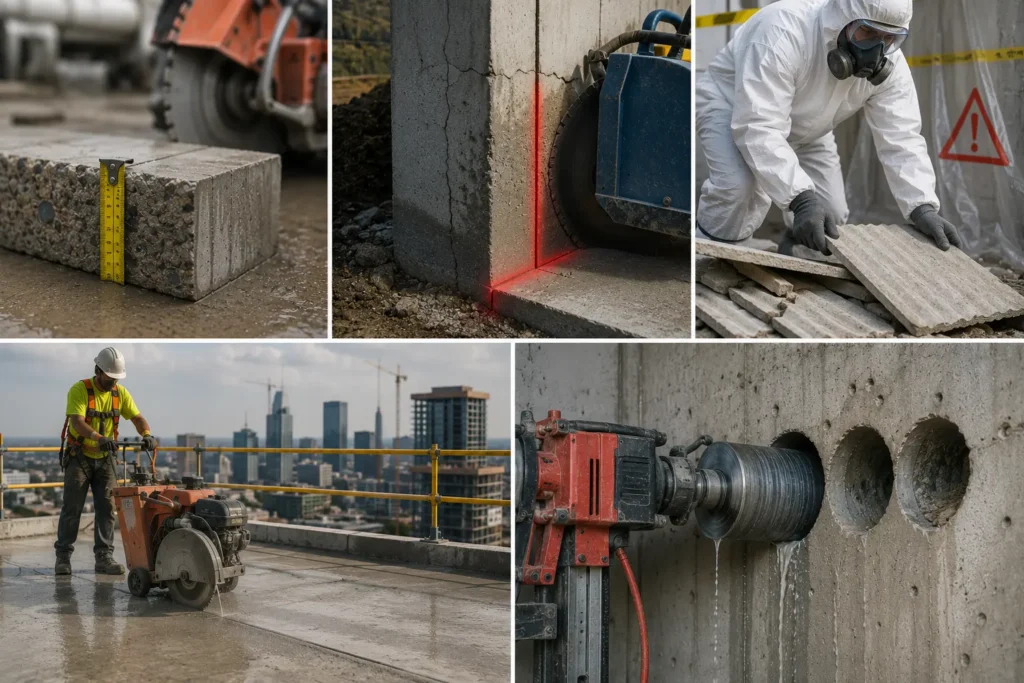
- Slab over 6 inches thick — Concrete over 6 inches (15.2 cm) thick — walk-behind saws at rental depth capacity risk jamming. Commercial-grade equipment with larger blades is required.
- Near foundation walls — Any cut within 12 inches (30.5 cm) of a structural foundation wall — cutting errors here cause structural damage that costs $10,000 to $50,000 to repair.
- Pre-1980 concrete — Concrete confirmed or suspected to contain asbestos — older slabs poured before 1980 may contain asbestos fiber reinforcement. Cutting releases airborne asbestos fibers, which require licensed abatement contractors to handle legally.
- Elevated cutting — Cuts requiring saw work above ground level — a walk-behind saw on a roof deck or elevated platform requires rigging, fall protection, and specialized equipment that rental units do not provide.
- Large-diameter core drilling — Core drilling over 4 inches diameter in structural concrete — large-diameter cores through load-bearing walls or post-tensioned slabs require engineering review before cutting begins.
Conclusion
Choose the right method for the job, use a diamond blade, control the dust, and cut in shallow passes. These 4 decisions determine whether a concrete cutting project is safe and clean or dangerous and damaging.
Hammer and chisel for small breaks. Circular saw for standard slabs. Walk-behind saw for large driveway sections. Core drill for round penetrations. Wet cutting whenever the cut runs more than 12 inches. And a P100 respirator every single time dry or wet, indoors or out.
For concrete cutting adjacent to roofing systems parapet caps, chimney bases, concrete tile, flat roof curbs the membrane must come off before the saw goes on. Contact Rainy Roofers for a free assessment of any concrete work affecting your roofing system. The right cut at the right time protects both the concrete and the roof above it.