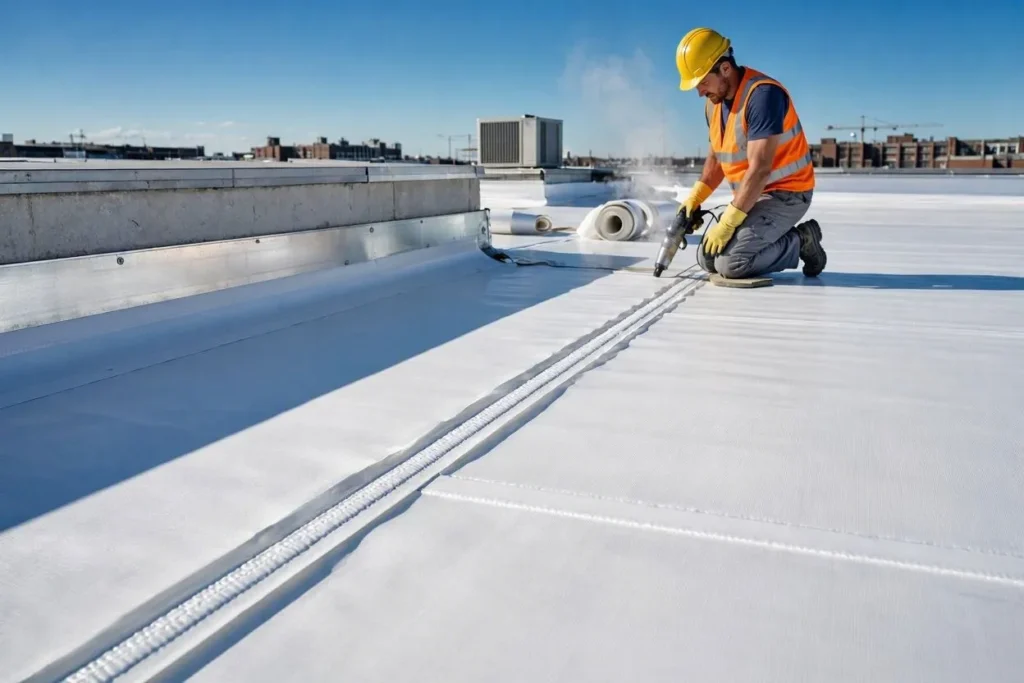
A facilities manager staring down a roof replacement quote usually has one question buried under the jargon: will this material actually last, and what’s it going to cost per square foot? PVC roofing keeps showing up on commercial bids for a reason. It’s been on U.S. rooftops since the 1960s, and manufacturers still back it with warranties that stretch past two decades. Here’s what the membrane is made of, how crews install it, where it beats TPO (thermoplastic polyolefin) and EPDM (ethylene propylene diene monomer), and what a realistic budget looks like before anyone shows up with a crew.
What Is PVC Roofing?
PVC roofing is a single-ply membrane system made from polyvinyl chloride, used to waterproof low-slope and flat commercial roofs. A polyester scrim sits between two layers of PVC, and crews heat-weld the sheets together at the seams, a bond that ends up stronger than the membrane itself. Contractors have been installing PVC systems on commercial, industrial, and institutional buildings since the 1960s, which makes it one of the most specified single-ply options in the country.
People often confuse PVC roofing with rigid PVC pipe from plumbing. Same chemistry, different job: roofing-grade PVC gets loaded with plasticizers that keep the sheet flexible enough to roll, weld, and flash around penetrations.
How Is PVC Roofing Made?
PVC roofing membrane comes from two base ingredients: chlorine, derived from common salt, and ethylene, derived from natural gas. Combine them and you get a resin manufacturers can formulate as rigid, semi-rigid, or flexible, depending on the additive package. Roofing-grade PVC falls into the flexible category, and that formulation flexibility is a big part of why PVC shows up in so many corners of construction.
Two layers of PVC compound get bonded to a polyester reinforcement layer during manufacturing. That gives the membrane enough tensile strength to resist wind uplift and puncture while staying thin enough to heat-weld on site. Sheet thickness ranges from 40 mil (0.04 inches / 1.0 mm) up to 90 mil (0.09 inches / 2.3 mm). Most commercial roofs land on 60 mil, 80 mil, or 90 mil.
What Types of PVC Roofing Membranes Are Available?
Three membrane types dominate the market: standard PVC, PVC with KEE (Ketone Ethylene Ester), and fleece-backed PVC. Each one solves a different installation or performance problem, and picking the wrong one can shave a decade off a roof’s service life.
| Membrane Type | Key Feature | Best For |
| Standard PVC | Two-layer sheet with polyester core; fastened or adhered | General commercial roofs, Energy Star reflectance |
| PVC with KEE | Polymer additive resists plasticizer evaporation and chemical exposure | Restaurants, industrial sites, roofs exposed to oils and fuels |
| Fleece-backed PVC | Fleece layer on the underside allows direct roll-on installation | Projects prioritizing faster labor and simpler substrate prep |
Take a restaurant with a rooftop grease trap. It should get a KEE membrane over standard PVC, because kitchen exhaust residue degrades unprotected PVC compounds within a few years.
How Is PVC Roofing Installed?
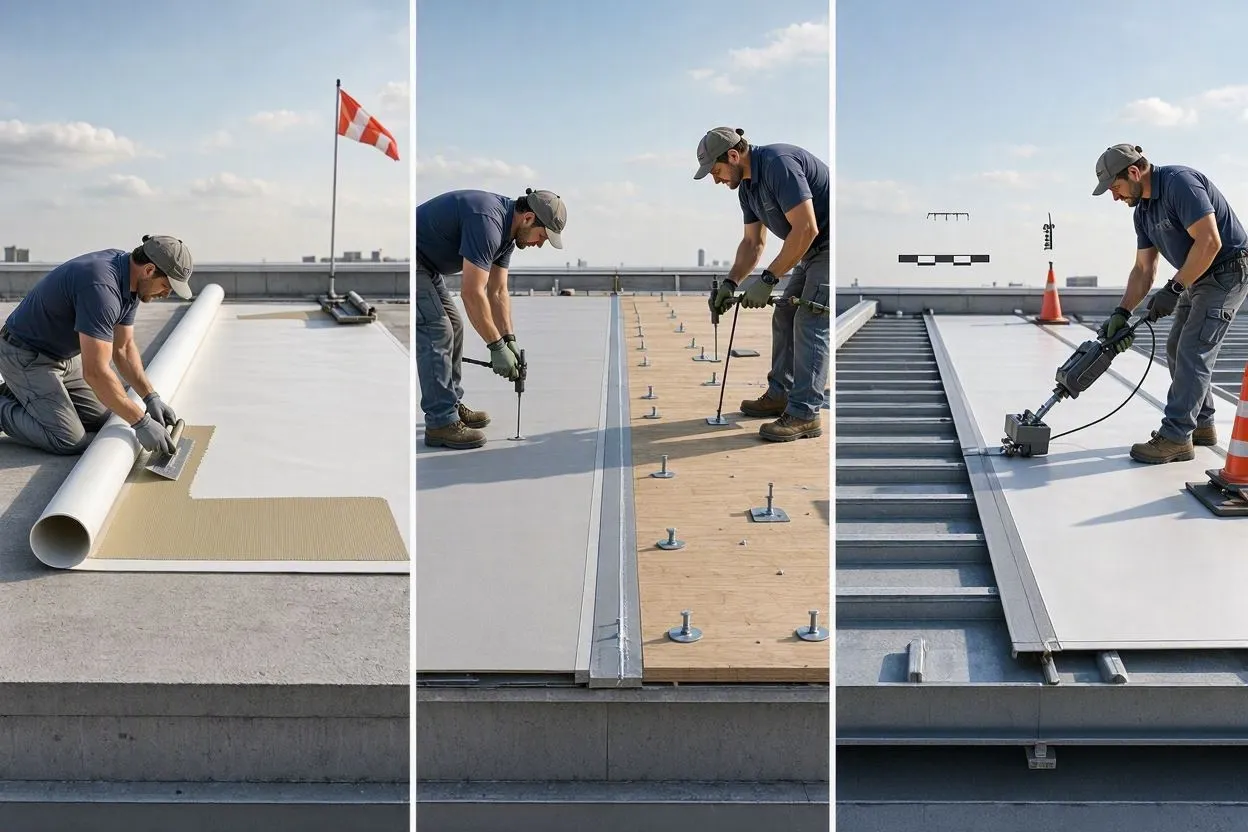
Crews install PVC roofing one of three ways: fully adhered, mechanically attached, or induction welded. Which one they choose comes down to the deck material, wind-load requirements, and how much deck penetration the building can tolerate.
Fully adhered means the membrane bonds directly to the substrate with a commercial-grade adhesive. Crews reach for this method on decks that can’t hold fasteners securely, or on projects that call for minimal deck penetration, like concrete decks and lightweight insulating concrete.
Mechanically attached uses screws and plates to secure the membrane at intervals spaced to the roof’s wind-uplift rating. Along the hurricane-prone Gulf Coast, builders favor this method for its resistance to sustained wind.
Induction welded installation uses a handheld tool that sends an electromagnetic pulse through coated metal plates beneath the membrane, bonding the plate to the underside of the PVC sheet. It uses fewer fasteners and speeds up labor on large commercial roofs.
All three methods still rely on heat-welded seams. That’s what separates PVC roofing from built-up or shingle systems, which depend on adhesives or overlapping layers alone.
PVC Roofing vs. TPO vs. EPDM: What’s the Difference?
PVC beats both TPO and EPDM on chemical resistance and seam strength. TPO costs less upfront, and EPDM is the cheapest of the three materials. All three are single-ply membranes, but their chemistry and long-term performance differ enough to change how you’d spec a project.
| Factor | PVC | TPO | EPDM |
| Base chemistry | Thermoplastic (polyvinyl chloride) | Thermoplastic (polyolefin blend) | Thermoset (synthetic rubber) |
| Seam method | Heat-welded | Heat-welded | Glued or taped |
| Chemical resistance | High | Moderate | Low |
| Track record | 60+ years | Reformulated multiple times since the 1990s | 50+ years |
| Typical membrane cost | Higher | Lower | Lowest |
| Flexibility in cold weather | High | Lower (stiffer sheets) | Moderate |
TPO manufacturers have revised their formulations several times since the material hit the U.S. market, chasing the kind of performance PVC has delivered consistently since the 1960s. EPDM, meanwhile, relies on glued or taped seams instead of welded ones, and those seams stay more vulnerable to failure over a 20-year service life than a heat-welded PVC seam.
How Long Does PVC Roofing Last?
PVC roofing lasts 20 to 30 years under normal conditions. Some third-party-verified installations have gone past 35. Three things determine where a given roof falls in that range: installation quality, regional climate, and membrane thickness.
A poorly flashed parapet wall can cut a roof’s service life in half, no matter how good the membrane is. Water intrusion at a single penetration point does more damage over a decade than years of UV exposure across the rest of the roof. Buildings in hail-prone regions, Texas or Colorado’s Front Range for example, also see shorter effective lifespans unless the spec calls for a thicker membrane (80 mil or 90 mil) rated for impact resistance. Roofs installed by manufacturer-certified contractors and kept on a documented inspection schedule tend to land at the upper end of that range.
How Much Does PVC Roofing Cost?
PVC roofing runs $6.50 to $12.00 per square foot installed, membrane, insulation, and labor included, though large commercial jobs can push the per-square-foot price down through volume. Membrane thickness, insulation R-value requirements, and installation method drive most of that spread.
A 50,000-square-foot warehouse roof using a 60-mil membrane with mechanical attachment sits toward the low end, since mechanical attachment takes less labor than a fully adhered install. A hospital or lab specifying 90-mil KEE membrane with a fully adhered system lands closer to the top, both because thicker membrane costs more per roll and because chemical-resistant formulations carry a manufacturing premium. Regional labor rates move these numbers too. Contractors in major metro markets typically charge 15% to 25% more per square foot than contractors in smaller regional markets.
| Project Type | Membrane | Installation Method | Estimated Cost (per sq ft) |
| Warehouse / large commercial | 60 mil, standard PVC | Mechanically attached | $6.50 – $8.00 |
| Mid-size commercial building | 80 mil, standard PVC | Fully adhered | $8.00 – $10.00 |
| Hospital / lab / chemical exposure | 90 mil, KEE | Fully adhered | $10.00 – $12.00 |
Estimates cover membrane, insulation, and labor. Regional labor rates can shift these figures 15% to 25% in either direction.
Is PVC Roofing Durable in Severe Weather?
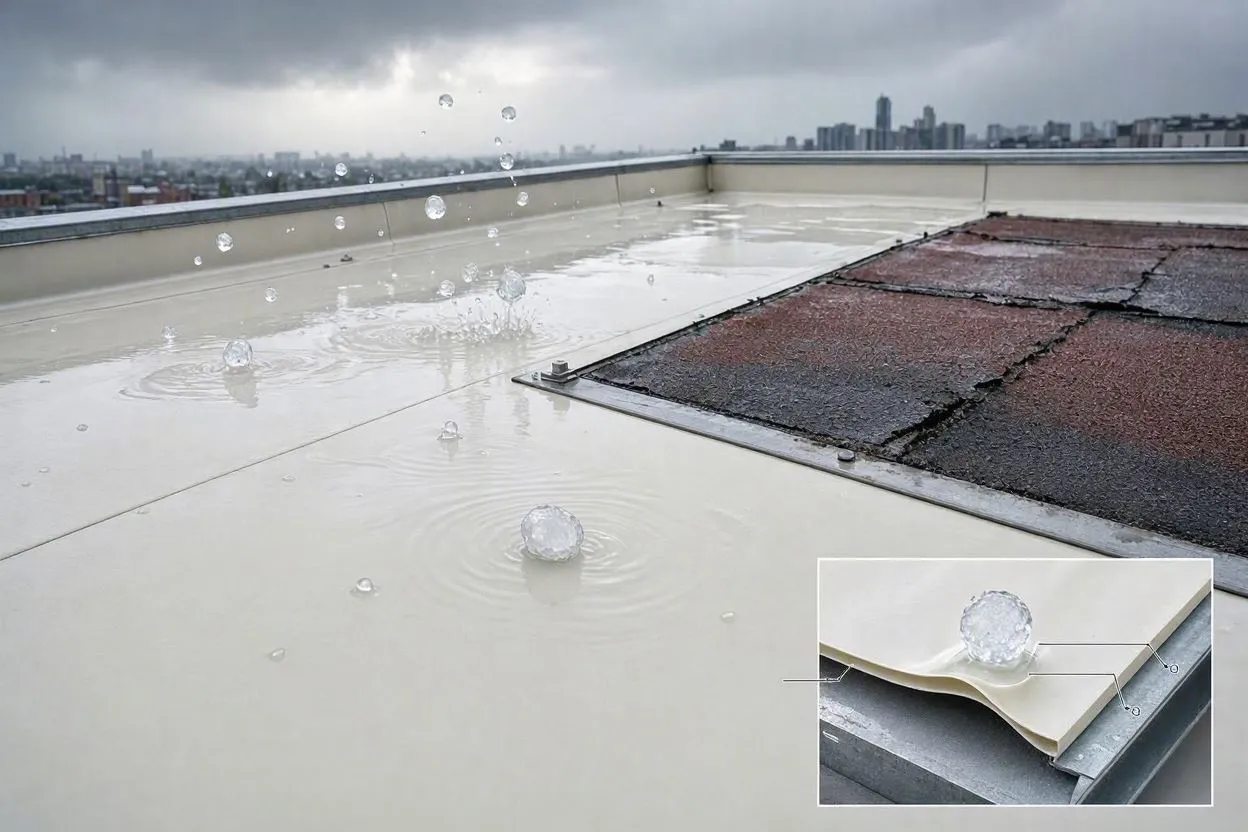
Yes. PVC roofing resists high winds, hail impact, and ponding water better than most single-ply alternatives, as long as the installation matches the region’s wind-uplift and impact-resistance requirements. Standing water doesn’t degrade PVC the way it degrades bitumen, so reflective white membrane handles ponding water without the breakdown that plagues asphalt-based systems.
Hail: resistance comes down to membrane thickness and cover-board specification. Some manufacturers rate PVC systems to UL 2218 Class 4, the highest impact classification, which affects insurance premiums in hail-prone states like Texas, Oklahoma, and Colorado.
Wind: mechanically attached systems use fastener spacing engineered to the building’s wind-uplift rating. Coastal hurricane zones typically need tighter fastener patterns than inland structures.
Is PVC Roofing Energy Efficient?
Yes. White and light-colored PVC membranes reflect solar radiation instead of absorbing it, which reduces cooling-system demand during peak summer months. Paired with properly specified insulation underneath, PVC roofing can cut a building’s air-conditioning load enough to lower total energy costs by up to 40% compared to a dark, non-reflective roof.
Insulation board thickness matters just as much as membrane color. Common insulation types, polyisocyanurate (polyiso) and expanded polystyrene (EPS), carry an R-value between R-4 and R-6 per inch, and stacking two layers of 2-inch polyiso board (roughly R-12 total) is standard on new commercial construction in colder U.S. climate zones. A distribution center in Phoenix gets more benefit from membrane reflectivity. A facility in Minneapolis gets more from insulation R-value. Same system, different payoff depending on climate.
Is PVC Roofing Recyclable?
Yes. PVC roofing membrane can be recycled at the end of its service life, and several manufacturers run take-back programs that reclaim old membrane for reprocessing into new roofing products. That recyclability, on top of a 20-to-30-year service life, gives PVC a lower lifecycle environmental footprint than materials that need replacing every 10 to 15 years.
Manufacturers can grind reclaimed PVC membrane, reprocess it, and blend it back into new sheet production without much loss of material performance, something EPDM can’t really claim since it’s far harder to recycle economically. Building owners chasing LEED or Green Globes certification can often claim credit for specifying a PVC system with documented recycled content or a verified take-back program.
How Often Does PVC Roofing Need Maintenance?
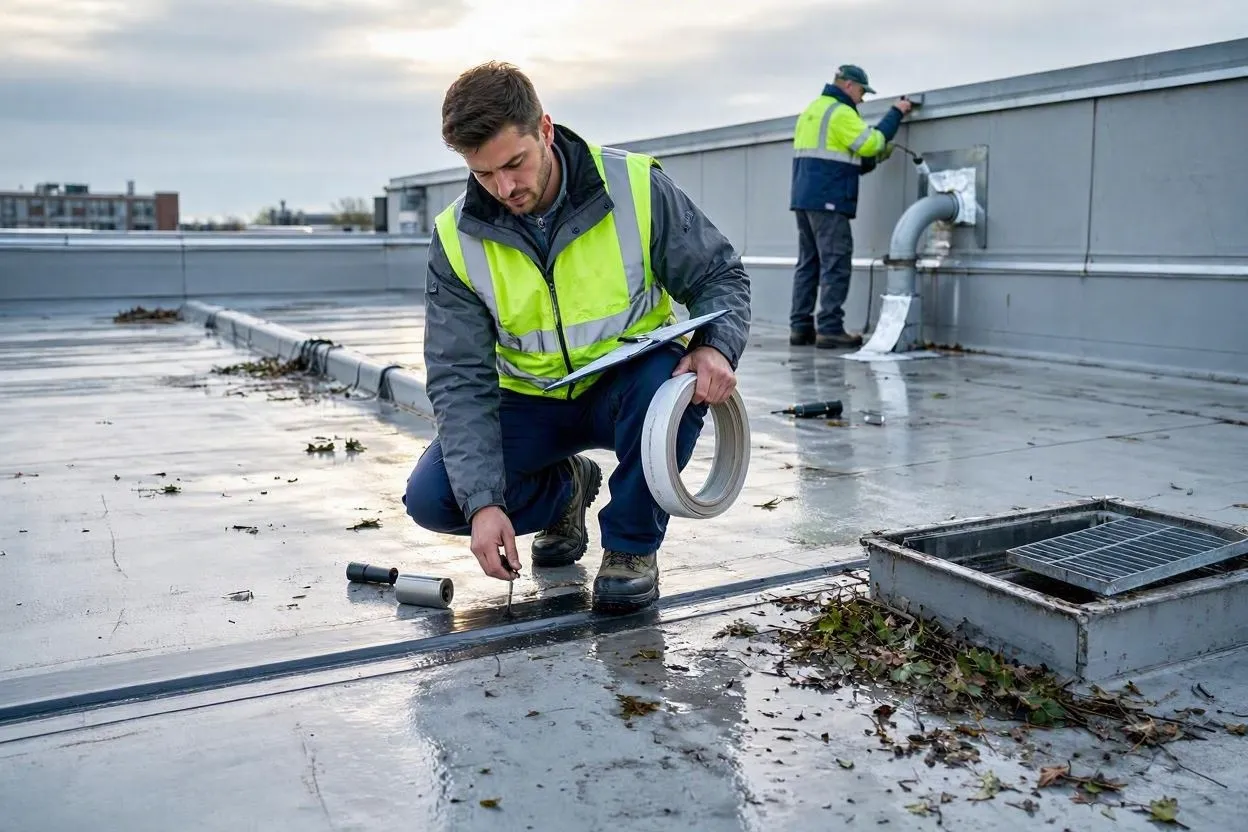
Twice a year, once in spring and once in fall, plus a walk-through after any severe weather event. Skip these and the roof won’t fail overnight, but small problems will quietly turn into expensive ones.
A typical maintenance visit checks seam integrity, flashing at penetrations, drain function, and any punctures from foot traffic or storm debris. Facilities teams should also clear debris from drains after major storms. Ponding water that can’t drain properly stresses seams over time, even though PVC itself shrugs off water damage. Owners who stick to a documented twice-a-year schedule usually catch small issues, a lifted seam edge, a cracked pipe boot, before they turn into full membrane failures that need section replacement.
How Do You Choose a PVC Roofing Contractor?
Look for manufacturer certification, active state licensing and insurance, and references from at least three completed commercial projects of similar scope. Manufacturer certification matters more here than with some other roofing materials, since welding seams correctly takes specific training on temperature control and overlap width.
Ask for proof of workers’ compensation coverage and general liability insurance before signing anything, and get actual certificate numbers rather than a verbal assurance. A contractor managing a 100,000-square-foot re-roof, for instance, should be able to walk you through how they’ll stage the tear-off and installation in sections to keep the building weathertight the whole time. If a contractor hesitates to hand over certification numbers or insurance documentation, cross them off the list.
Conclusion
PVC roofing is still the highest-performing single-ply option for commercial and flat roofs, backed by a track record that’s passed 35 years on some verified installations and heat-welded seams that hold up better than the glued or taped seams on EPDM. Building owners weighing PVC against TPO or EPDM should treat membrane thickness, insulation R-value, and installation method as the real specification decisions, not membrane color or brand name. A distribution center in a hail-prone state and a hospital in a coastal flood zone need completely different PVC specs, even though both technically fall under “commercial low-slope roof.” Get the thickness, the chemistry, and the fastening pattern right for the specific building, and a PVC roof installed today can still be watertight decades from now.