
There are 9 main types of roofing sheets metal, corrugated GI, polycarbonate, fiber cement, PVC, fiberglass, bitumen, color-coated steel, and galvalume. Each type of roofing sheet suits a different combination of climate, budget, and building structure.
You can choose the wrong sheet and spend twice once on installation and once on repairs. This guide gives you the material facts, U.S. cost ranges, lifespan figures, and climate data you need to buy right the first time.
Roofing Sheet Types at a Glance: Quick-Reference Table
The table below compares all 9 types of roofing sheets across 6 key performance factors.
| Sheet Type | Material Cost/Sq Ft | Lifespan (Years) | Min. Roof Pitch | Climate Fit | Install Difficulty |
| Corrugated GI Steel | $1.20–$2.50 | 25–40 | 3:12 | All climates | Easy |
| Color-Coated Steel | $1.80–$3.50 | 30–50 | 3:12 | All climates | Easy |
| Galvalume Steel | $2.00–$4.00 | 40–60 | 2:12 | Coastal/humid | Easy |
| Standing Seam Metal | $4.00–$8.00 | 40–70 | 1:12 | Snow, rain, coastal | Hard |
| Polycarbonate (PC) | $1.50–$5.00 | 15–25 | 5:12 | Temperate, dry | Easy |
| PVC / uPVC | $1.00–$3.00 | 20–30 | 5:12 | Warm, moderate rain | Easy |
| Fiberglass (FRP) | $1.50–$4.00 | 20–35 | 4:12 | All climates | Medium |
| Fiber Cement | $2.50–$5.00 | 30–50 | 4:12 | High-humidity, coastal | Medium |
| Bitumen / Asphalt | $0.80–$2.00 | 15–30 | 2:12 | Cold, freeze-thaw | Medium |
Min. Roof Pitch = minimum slope required for safe water runoff. GI = Galvanized Iron. FRP = Fiber-Reinforced Plastic. PC = Polycarbonate. All cost figures are 2026 U.S. national averages for material only, excluding labor and delivery.
Corrugated GI and Color-Coated Steel Sheets: Best for Budget Builds
Corrugated Galvanized Iron (GI) sheets are the most widely installed roofing sheets in the United States for agricultural, industrial, and budget residential buildings.
What Makes Corrugated Steel Sheets Strong
The wave profile — typically 76 mm (3 inches) pitch, 19 mm (0.75 inches) depth — distributes wind and snow loads across the sheet instead of concentrating stress at one point. A 26-gauge corrugated GI sheet holds up to 75 mph (121 km/h) wind loads without fastener pull-out when installed on purlins spaced 24 inches (61 cm) apart.
Corrugated GI sheets cost $1.20–$2.50 per square foot in materials. A standard 8-foot (2.4 m) sheet weighs 2.3–2.8 lb (1–1.3 kg). Zinc coating weight ranges from G60 (0.60 oz/sq ft) to G90 (0.90 oz/sq ft) — G90 lasts 8–12 years longer in humid or coastal environments.
Color-Coated Steel vs. Plain GI: Key Differences
Color-coated steel sheets add a primer coat and polyester or PVDF paint system over galvanized steel. The paint system prevents fading for 25–40 years and blocks surface oxidation that plain GI sheets develop within 10–15 years in wet climates.
- Plain GI sheets: $1.20–$2.50/sq ft. Best for barns, warehouses, agricultural sheds.
- Color-coated steel sheets: $1.80–$3.50/sq ft. Best for residential roofs, commercial facades, and any build where curb appeal matters.
You install color-coated sheets on purlins spaced 24–48 inches (61–122 cm) apart. Use hex-head self-drilling screws with EPDM rubber washers never plain steel screws, which rust and allow water ingress within 3–5 years.
For homes needing a full metal roof replacement, the team at Rainy Roofers handles metal roofing services for both residential and commercial properties across all 50 states.
Galvalume and Standing Seam Metal Sheets: Best for Longevity
Galvalume steel sheets use an aluminum-zinc alloy coating (55% aluminum, 43.4% zinc, 1.6% silicon by weight) instead of pure zinc. The aluminum component creates an oxide barrier that outperforms plain galvanized coatings by 2–4 times in salt-spray testing.
Galvalume Sheet Performance in Coastal Climates
Galvalume sheets last 40–60 years in humid and coastal climates compared to 25–35 years for G90 galvanized steel. The material cost runs $2.00–$4.00 per square foot. Galvalume carries an AZ50 or AZ55 coating designation (ASTM A792 standard) AZ55 provides 15–20% more corrosion resistance than AZ50.
Do not use Galvalume sheets in direct contact with concrete, copper piping, or treated lumber containing copper azole. Galvanic corrosion between dissimilar metals accelerates failure by 10–15 years.
How Standing Seam Metal Roofing Differs from Screwed Sheets
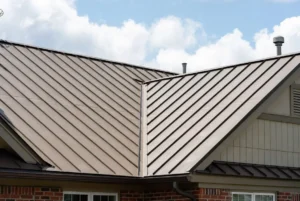
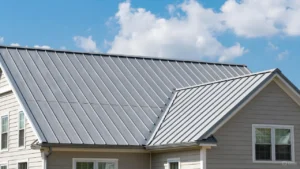
To install standing seam metal roofing, you clip panels to the roof deck with concealed fasteners. The panels interlock at raised seams 1.5–2 inches (38–51 mm) high. No exposed fasteners means zero screw-hole leaks — the leading failure point of corrugated and ribbed metal sheets.
Standing seam metal roofs cost $4.00–$8.00 per square foot installed. Lifespan reaches 40–70 years with no repainting required. Minimum roof pitch is 1:12 (1 inch of rise per 12 inches of run), making standing seam viable on near-flat commercial roofs where corrugated sheets need at least 3:12.
To get a same-day quote on a new standing seam or metal panel system, visit the roof installation guide on Rainy Roofers — the page covers residential and commercial project timelines.
Polycarbonate and PVC Roofing Sheets: Best for Light Transmission
Polycarbonate (PC) and uPVC [unplasticized Polyvinyl Chloride] sheets let natural light into garages, patios, greenhouses, and covered walkways. Both types weigh less than 1.5 lb per square foot (7.3 kg/m²) — less than half the weight of GI steel.
Polycarbonate Sheet Grades and UV Ratings
Polycarbonate sheets come in 3 grades: twin-wall (6 mm / 0.24 inch), triple-wall (10 mm / 0.39 inch), and solid flat sheet (2–12 mm / 0.08–0.47 inch). Twin-wall provides an R-value of 1.54; triple-wall reaches R-2.10.
UV-protected polycarbonate sheets block 99% of UV-B radiation and retain 80–90% of their light transmission after 10 years. Un-protected sheets yellow within 3–5 years and become brittle. Always specify sheets with a co-extruded UV layer, not a surface coating — surface UV coatings wear off within 5 years.
Minimum roof pitch for polycarbonate sheets is 5:12 (5 degrees). At lower pitches, water pools at overlaps and algae grow under the sheet within 2–3 seasons.
uPVC Sheets vs. Polycarbonate: Which to Choose
uPVC sheets cost $1.00–$3.00 per square foot and transmit 20–40% of natural light less than polycarbonate’s 60–80% transmission. uPVC resists chemical exposure and costs 30–50% less than equivalent polycarbonate panels.
- Choose polycarbonate: when you need high light transmission, impact resistance (polycarbonate withstands 250 times more impact than glass), or insulation.
- Choose uPVC: when you need low cost, chemical resistance, and partial light blocking — ideal for covered industrial walkways and utility sheds.
Fiberglass and Fiber Cement Sheets: Best for Industrial and Coastal Builds
Fiberglass reinforced plastic (FRP) sheets and fiber cement boards solve 2 different problems. FRP handles chemical environments and temperature swings. Fiber cement handles high humidity, salt air, and fire risk.
Fiberglass FRP Sheets: Performance in Chemical Environments
FRP sheets consist of glass fiber woven into a polyester or vinyl ester resin matrix. The glass content — typically 20–30% by weight — determines tensile strength. A standard 4-foot-wide (1.22 m) FRP sheet at 0.09 inches (2.3 mm) thick resists acids, alkalis, and salt spray that corrode steel within 5 years.
FRP sheets cost $1.50–$4.00 per square foot and last 20–35 years in industrial environments. Fire ratings range from Class C (standard polyester resin) to Class A (vinyl ester resin with flame-retardant additives) per ASTM E84 testing.
Fiber Cement Roofing Sheets: Performance in Coastal Zones
Fiber cement sheets combine Portland cement, cellulose fiber, and silica sand. The cement matrix prevents moisture absorption and gives fiber cement a Class A fire rating with no additional treatment.
Fiber cement sheets weigh 2.5–3.5 lb per square foot (12.2–17.1 kg/m²) — roughly 1.5 times heavier than corrugated GI steel. Verify your roof structure handles at least 15 lb per square foot (73.2 kg/m²) live load before specifying fiber cement. Cost runs $2.50–$5.00 per square foot.
Bitumen Roofing Sheets: Best for Freeze-Thaw Climates
Bitumen roofing sheets — also called asphalt corrugated sheets — consist of cellulose fiber or glass fiber mat saturated with modified bitumen and pressed into a corrugated profile.
Bitumen sheets cost $0.80–$2.00 per square foot — the lowest material cost of any sheet type. The corrugated profile sheds snow loads effectively, and the flexible bitumen layer expands and contracts through freeze-thaw cycles without cracking.
A standard bitumen sheet measures 6.7 feet (2.04 m) long by 2.6 feet (0.79 m) wide, with 75 mm (3-inch) corrugation pitch. Install bitumen sheets on solid decking — not open purlins — because the sheets flex under point loads without continuous support.
Lifespan runs 15–30 years. Bitumen sheets do not suit coastal salt environments: the fiber core absorbs moisture when cut edges are exposed and salt accelerates delamination within 8–10 years.
If storm damage or age has compromised your roof, request residential roof repair from Rainy Roofers. The repair team assesses sheet type, damage extent, and repair vs. replacement cost in one visit.
How to Choose the Right Type of Roofing Sheet for Your Project
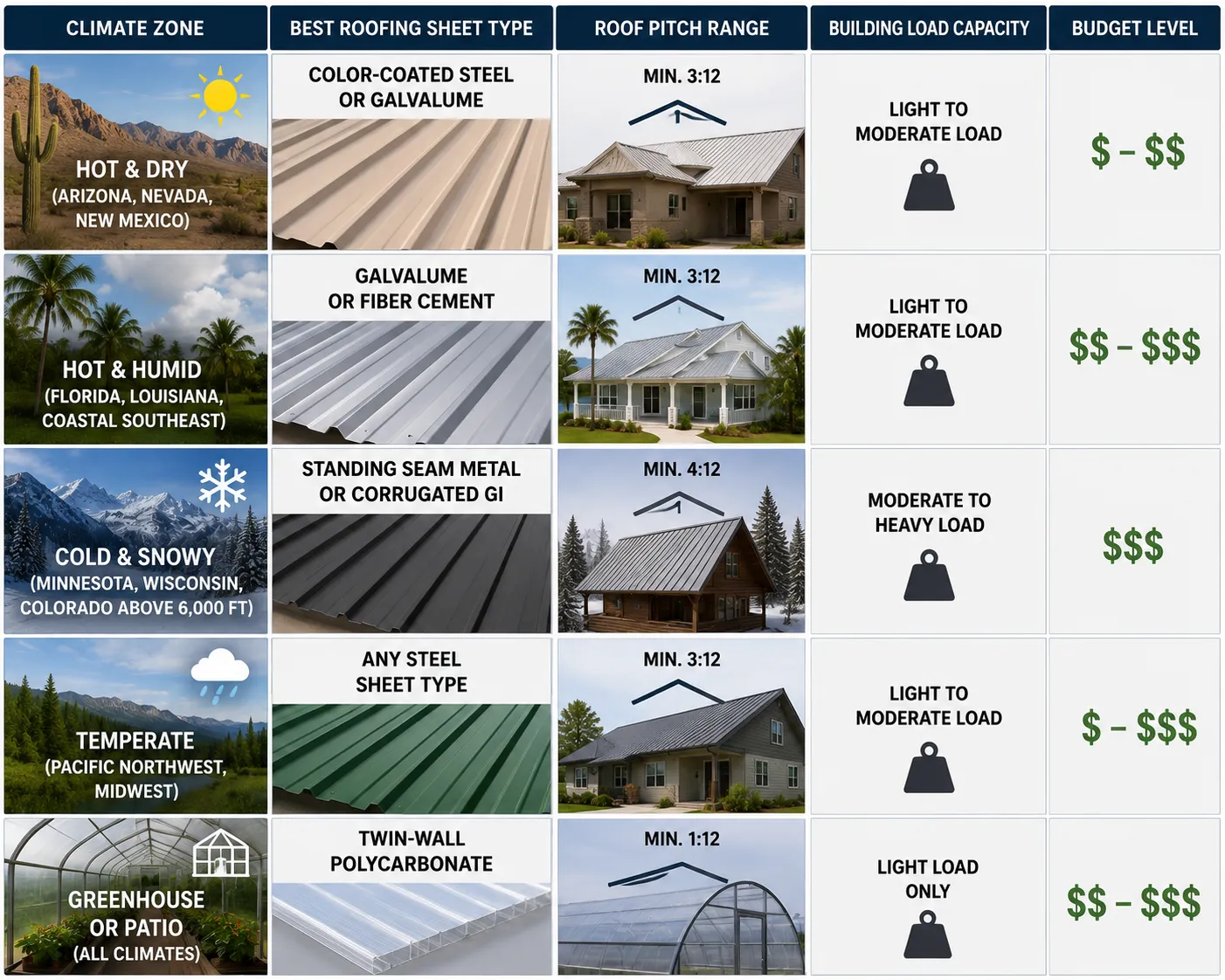
To choose the correct type of roofing sheet, match 4 factors: climate zone, roof pitch, building load capacity, and budget.
How Climate Zone Determines Your Roofing Sheet Type
To match roofing sheets to climate zones, use the 5 climate categories below:
- Hot and dry (Arizona, Nevada, New Mexico): Color-coated steel or Galvalume. Thermal expansion coefficient of steel (12 x 10⁻⁶ /°C) requires expansion screws on runs longer than 20 feet (6.1 m).
- Hot and humid (Florida, Louisiana, coastal Southeast): Galvalume or fiber cement. G90 galvanized steel corrodes 40% faster in salt air above 0.3 mg/m²/day chloride deposition.
- Cold and snowy (Minnesota, Wisconsin, Colorado above 6,000 ft): Standing seam metal or corrugated GI at minimum 26 gauge. Standing seam sheds snow loads; concealed fasteners do not loosen from freeze-thaw cycles.
- Temperate (Pacific Northwest, Midwest): Any steel sheet type. Moss growth on low-pitch roofs requires annual zinc strip installation or 5-year biocide treatment.
- Greenhouse or patio (all climates): Twin-wall polycarbonate at 8 mm (0.31 inch) minimum. Never use single-layer polycarbonate below 6 mm (0.24 inch) — hail impact causes cracking.
How Roof Pitch Limits Your Sheet Options
To select a roofing sheet based on pitch, check the minimum slope in the table above. A 2:12 pitch — 2 inches of rise per 12 inches (30.5 cm) of run limits you to Galvalume or bitumen sheets. At pitches below 2:12, only standing seam metal with sealant tape at every seam remains watertight.
3 Installation Rules That Apply to All Types of Roofing Sheets
All 9 types of roofing sheets share 3 universal installation requirements regardless of material.
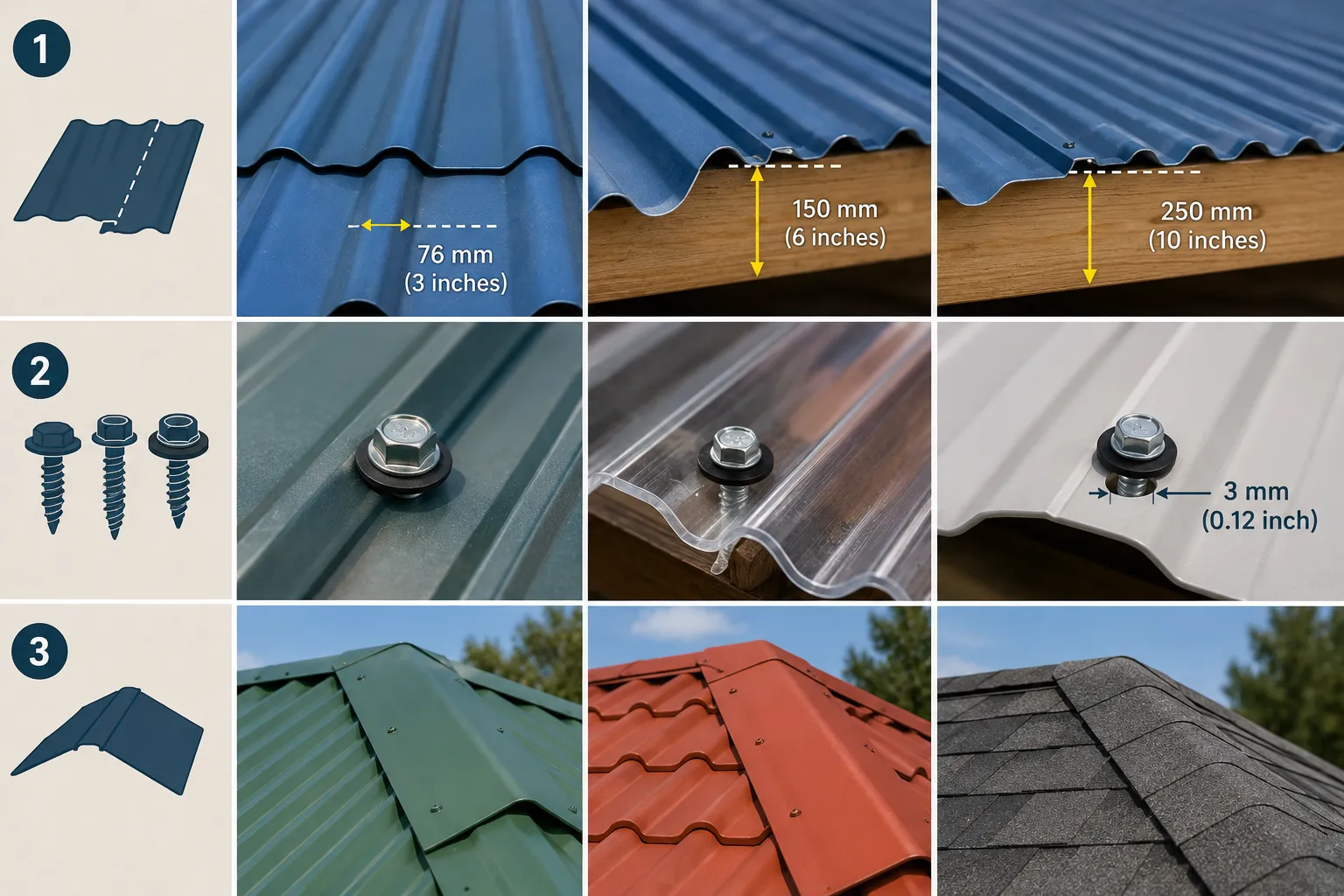
- Overlap correctly: Corrugated and ribbed sheets overlap by 1 full corrugation (76 mm / 3 inches) side-to-side and 150 mm (6 inches) end-to-end on pitches above 5:12. On pitches of 3:12–5:12, increase end overlap to 250 mm (10 inches) and apply a continuous bead of compatible sealant.
- Use matched fasteners: Steel sheets require Type 304 stainless steel or zinc-aluminum-coated hex-head screws. Polycarbonate and PVC sheets need neoprene-washer screws with pre-drilled oversized holes — 3 mm (0.12 inch) larger than the screw shank — to allow thermal movement.
- Install ridge caps: Every roofing sheet type requires a matching ridge cap at the peak. The ridge cap seals the gap that open ends create. On corrugated profiles, fill the corrugation voids with foam closure strips before setting the ridge cap — gaps allow birds, insects, and wind-driven rain to enter.
Full Cost Comparison: 9 Types of Roofing Sheets Installed
The table below shows installed cost — material plus standard labor for a 1,000 sq ft (93 m²) residential roof in 2026.
| Sheet Type | Material Cost | Labor Cost | Installed Total (1,000 sq ft) | Lifespan |
| Bitumen / Asphalt | $800–$2,000 | $1,500–$2,500 | $2,300–$4,500 | 15–30 yrs |
| PVC / uPVC | $1,000–$3,000 | $1,500–$2,500 | $2,500–$5,500 | 20–30 yrs |
| Corrugated GI Steel | $1,200–$2,500 | $1,500–$2,800 | $2,700–$5,300 | 25–40 yrs |
| Polycarbonate | $1,500–$5,000 | $1,800–$3,000 | $3,300–$8,000 | 15–25 yrs |
| Fiberglass FRP | $1,500–$4,000 | $2,000–$3,200 | $3,500–$7,200 | 20–35 yrs |
| Color-Coated Steel | $1,800–$3,500 | $1,500–$2,800 | $3,300–$6,300 | 30–50 yrs |
| Galvalume Steel | $2,000–$4,000 | $1,500–$2,800 | $3,500–$6,800 | 40–60 yrs |
| Fiber Cement | $2,500–$5,000 | $2,500–$4,000 | $5,000–$9,000 | 30–50 yrs |
| Standing Seam Metal | $4,000–$8,000 | $3,000–$5,000 | $7,000–$13,000 | 40–70 yrs |
Which Roofing Sheet Should You Choose?
The 9 types of roofing sheets each target a specific performance need. Corrugated GI steel and color-coated steel cover most residential and agricultural builds at $1.20–$3.50 per square foot. Galvalume and standing seam metal deliver the longest service life for homes in coastal, snowy, or high-wind zones. Polycarbonate and PVC work for patios, garages, and any space needing natural light. Fiber cement and FRP fiberglass protect against humidity, salt air, and chemical exposure. Bitumen sheets offer the lowest entry cost for cold-climate utility buildings.
Match your sheet to your roof pitch, climate zone, and structural load capacity before purchasing. A wrong match costs you the full replacement price within 10–15 years.
Conclusion
With nine roofing sheet types on the market, the right pick always comes down to matching climate, roof pitch, and structural load rather than chasing the lowest price tag. Corrugated and color-coated steel cover most budget residential builds, galvalume and standing seam handle coastal or snow-heavy regions, and polycarbonate or fiber cement solve more specific problems like light transmission or salt air exposure. Get the pitch and climate match right from the start, since a mismatched sheet often means paying for a full replacement within 10 to 15 years.