A homeowner in Ohio once called a supplier asking for “everything on a roofer’s truck” after a single missing shingle turned into a $40 repair bill for a $12 job. She’d bought a full pneumatic nailer setup for one nail. That’s the trap a bad roofing tools list sets: either too little for the job, or way too much for the budget.
A complete roofing tools list runs 30 to 40 items across six categories: hand tools, power tools, metal roofing tools, tile and slate tools, safety equipment, and measuring or business tools. Nobody needs all six groups at once. A single shingle repair calls for six items and a ladder. A commercial crew welding membrane roofing never touches a roofing hatchet. This guide breaks down what belongs on the list for each job, what it costs in 2026, and which categories the usual roofing tools list articles skip entirely.
Why a Roofing Tools List Looks Different for Every Job
The right roofing tools list depends on the roof type and the scope of work, not on how long someone’s been doing this. A 20-year roofer patching a single leak carries the same six hand tools as a first-time DIYer doing the same repair. Scope drives the list. Experience doesn’t change what’s in the bag, just how fast the bag gets used.
Rough budget by category, based on standard US retail and roofing-supply pricing:
- Hand tools: $245 to $650
- Power tools: $400 to $1,000+
- Metal roofing tools: $935 to $2,835
- Tile and slate tools: $200 to $900
- Safety equipment: $345 to $925
- Commercial equipment: $1,505 to $6,665
Add it all up and a full outfit tops $10,000. Almost nobody buys everything at once, and nobody should. A two-person residential crew starting from scratch typically spends $1,500 to $3,000 on a working kit, then layers in metal or commercial tools as the contract mix demands it.
Hand Tools Every Roofer Carries
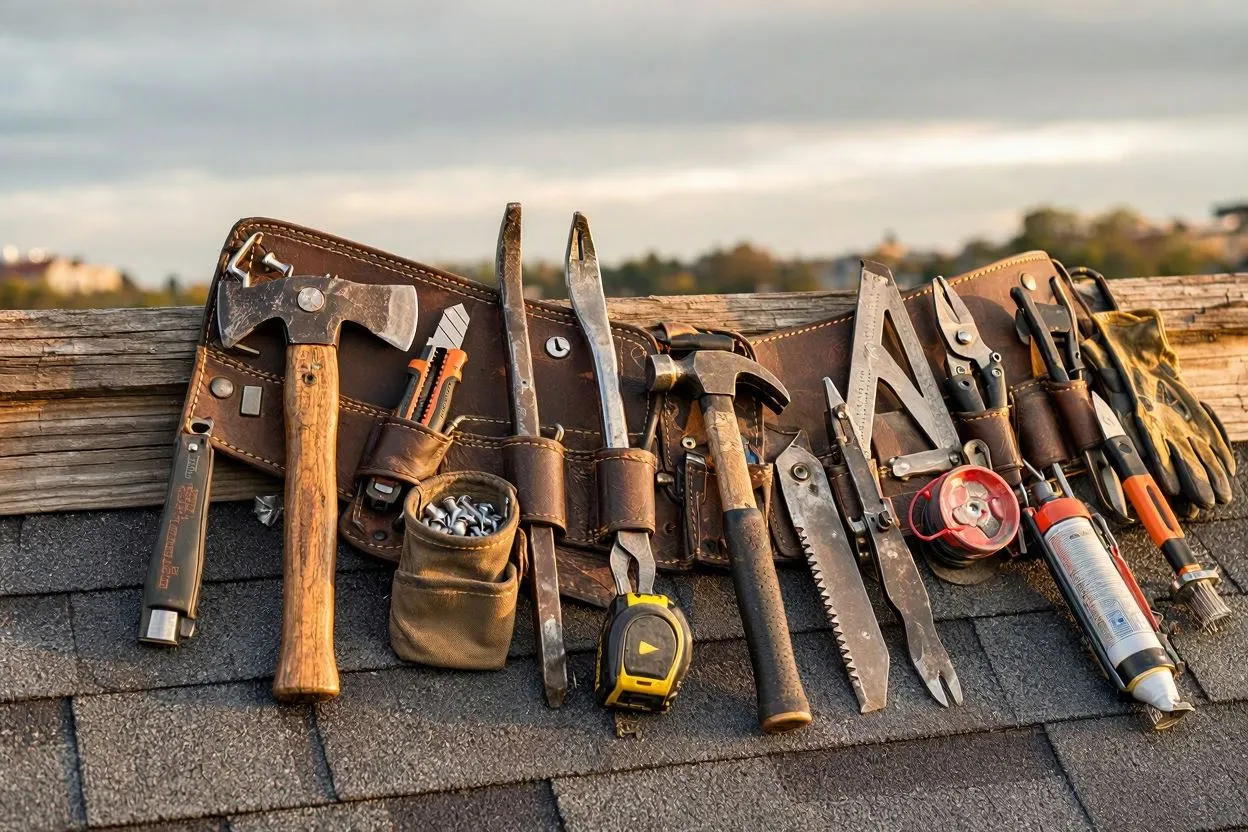
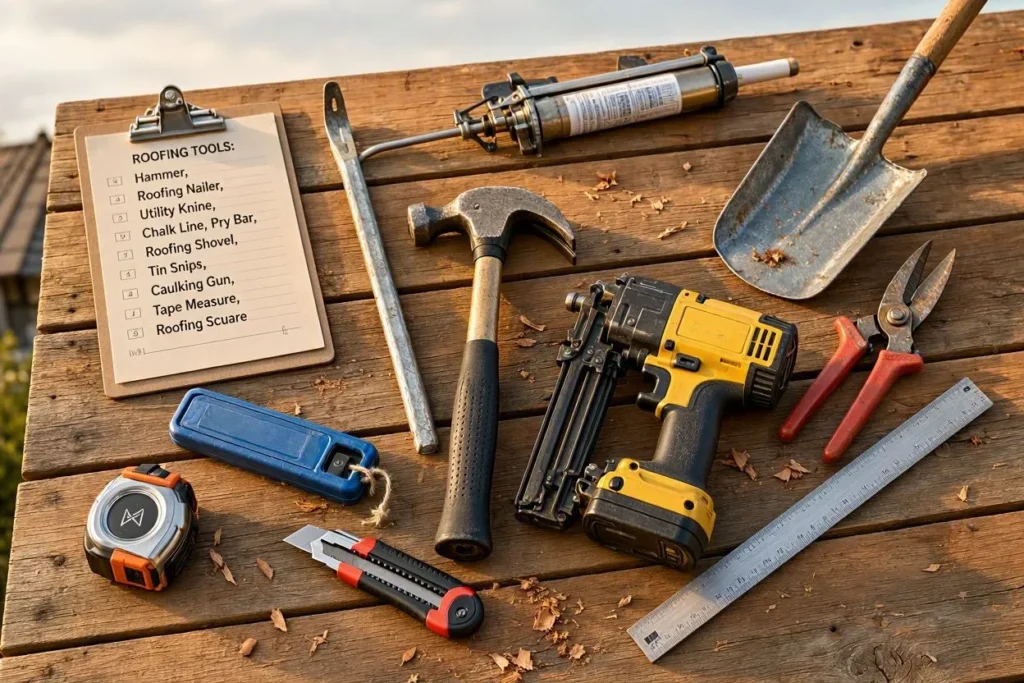
Fifteen hand tools cover nearly every asphalt shingle job, and they live on a belt, not in a truck bed. During a full tear-off, a roofer’s hand touches one of these every 30 seconds or less. Quality matters more here than almost anywhere else on the list, because these are the tools that get dropped, sat on, and left in the rain.
- Roofing hatchet ($20-50): Cuts shingles and drives nails, with a magnetized gauge for setting exposure.
- Utility knife with hook blades ($5-25): Cuts shingles, felt, and underlayment. Blades dull fast on granules; five spares per job isn’t excessive.
- Tin snips ($10-25): Left, right, and straight cuts for flashing and drip edge. Color-coded handles (red, green, yellow) mark which cut each pair makes.
- Pry bar or tear-off bar ($15-40): Rips old shingles and pulls nails in one motion.
- Roofing shovel ($30-55): Strips shingles and nails with a notched, serrated edge.
- Chalk line ($5-20): Snaps a straight reference line for shingle courses. Blue chalk washes off; red stains permanently.
- Tape measure ($5-20): A 25-foot steel tape covers most residential runs.
- Framing square ($10-25): Marks right angles and straight cuts.
- Hammer ($10-30): Reaches spots a nail gun can’t, mainly around vents and valleys.
- Felt or underlayment stapler ($30-45): Fastens synthetic or felt underlayment before shingles go down. Not the same tool as a general hammer stapler; roofing-rated staplers hold up to daily UV and moisture exposure that a hardware-store model won’t.
- Galvanized roofing nails ($5-50 per box): Zinc coating resists rust; these secure shingles and underlayment.
- Roofing cement tube ($5-15): Seals flashing, vent boots, and nail heads.
- Wheelbarrow ($50-120): Moves shingles and debris across the job site.
- Tool belt ($30-60): Keeps the core kit within reach without a trip down the ladder.
- Nail bags ($20-45): Separate compartments for nails, fasteners, and small tools, worn instead of pockets. Cheap ones rip out at the seam within a season; it’s one of the few items worth buying mid-range instead of bargain.
Buying all fifteen new costs $245 to $650. That homeowner in Ohio actually needed six items: hatchet, utility knife, pry bar, tape measure, chalk line, and a tube of roofing cement. Under $150 total.
Power Tools for Roofing Jobs
Five power tools speed up most roofing jobs, and a complete set runs $400 to $1,000 or more. Speed isn’t optional on production shingle work. A crew racing an incoming storm front cares about minutes the same way an ER doctor does.
- Pneumatic roofing nailer ($150-350): Drives coil nails at a consistent depth. Get the depth wrong and there are two failure modes: an overdriven nail cuts through the shingle mat and can void the manufacturer’s warranty, while an underdriven nail sits proud and keeps the sealant strip from bonding.
- Air compressor ($120-400): Supplies the nailer. Match its CFM output to the nailer’s demand or the gun starves mid-run.
- Cordless drill or impact driver ($80-300): Drives screws into metal roofing and sets structural fasteners.
- Battery-powered roofing nailer ($100-180): Skips the hose entirely, which matters on steep pitches or large roofs where hose length becomes its own hazard.
- Angle grinder ($25-105): Cuts through seized fasteners and old flashing, though a nibbler cuts metal panels cleaner.
- Battery-powered blower ($50-150): Clears debris and dust from the roof surface before inspection or coating work.
The Asphalt Roofing Manufacturers Association (ARMA) publishes nail-application guidance stating the entire nail head has to sit flush against the shingle: not sunk into the mat, not standing above it. Warm asphalt softens as the day heats up, so experienced crews re-check nailer depth around midday rather than trusting the morning’s settings to hold.
Metal Roofing Tools
Metal roofing needs six tools beyond the standard shingle kit, priced from $935 to $2,835 for a full set. Standing-seam and exposed-fastener panels demand precision that snips and a hammer can’t deliver alone.
- Hand seamers ($25-60): Bend and crimp panel edges by hand, for finishing work a power seamer can’t reach.
- Electric seam locker ($800-2,500): Crimps standing-seam panels together across long roof runs. Pays for itself once a crew handles multiple metal jobs a month.
- Standing seam clamps ($15-40 each): Attach to panel ribs without penetrating the metal, giving safety lines and solar mounts a secure anchor point.
- Nibbler attachment ($50-120): Chucks into a cordless drill and cuts clean, burr-free lines without the heat discoloration a grinder leaves behind.
- Metal roofing snips, left, right, and straight ($15-35 each): Aviation-style with color-coded handles for quick identification on the roof.
- Magnetic sweeper ($30-80): Collects metal shavings and screws that puncture tires and bare feet in the yard below.
Skip these on a metal job and oil-canning, burred panel edges, and voided coating warranties usually follow.
Tile and Slate Roofing Tools
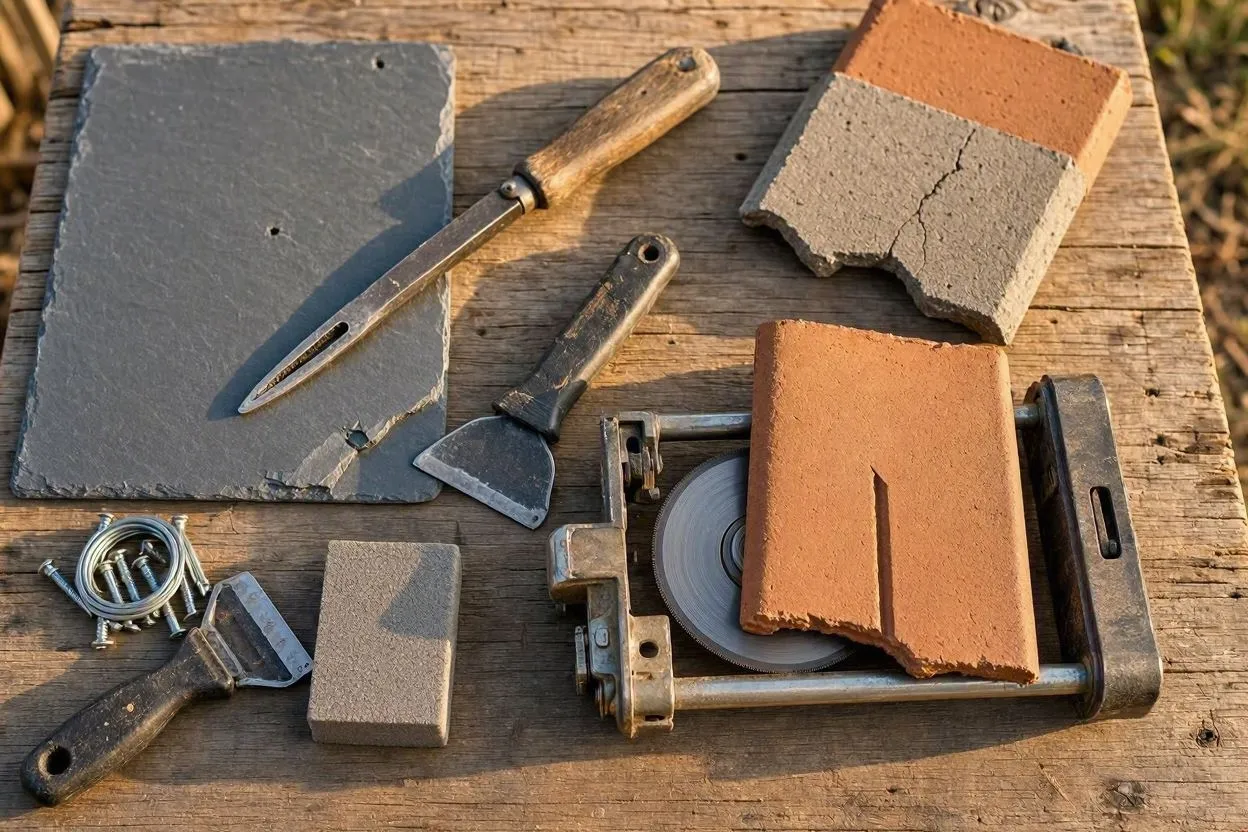
Tile and slate almost never make it onto a roofing tools list, which is odd, because a decent share of homes in the Southwest and parts of the South carry clay or concrete tile roofs, and older Northeast and Midwest homes still turn up slate. These materials crack under the wrong tool the way shingles never do.
- Tile cutter ($100-400): A wet or dry saw that scores and snaps clay or concrete tile without shattering it.
- Slate ripper ($20-40): A thin, hooked blade that slides under a broken slate tile and cuts the nail without disturbing the tiles around it.
- Tile hooks or tile battens ($5-15 each): Hang and lock tiles in place on the batten system many tile roofs use instead of a nailed deck.
- Roofing hole punch ($30-70): Punches clean holes in slate or tile for hangers and fasteners, since drilling tends to crack the material.
- Copper or stainless roofing nails ($10-30 per box): Standard galvanized nails corrode faster under tile, where moisture sits longer than it does under shingles.
This is a rental category for most residential crews. Unless tile or slate work is a regular part of the job mix, a tile cutter and a slate ripper for one job is a better call than owning tools that sit in a drawer the rest of the year.
Commercial Roofing Equipment
Commercial roofing equipment adds specialized tools for membrane and flat-roof work, running $1,505 to $6,665 for a complete outfit. Flat and low-slope commercial roofs use thermoplastic polyolefin (TPO), polyvinyl chloride (PVC), and modified bitumen, materials that shingle tools simply can’t process.
- Hot air welder ($200-1,000): Welds seams in TPO and PVC membranes for a watertight bond.
- Propane torch ($25-55): Heats and seals bitumen roofing materials.
- Roof seam roller ($30-60): Presses and smooths membrane seams after welding.
- Adhesive spray gun ($150-250): Applies roofing adhesive in a fine mist to bond material layers on large commercial roofs.
- Ladder hoist ($1,000-5,000): Lifts bundles and equipment to the roof deck. Electric and pneumatic models skip the fuel refills gas-powered hoists require.
- Metal cutter shear ($100-300): Cuts metal roofing materials with a cleaner line than an angle grinder manages.
Very few commercial crews buy every item here outright. Most rent the hoist and the welder until job volume justifies ownership.
Roofing Safety Equipment
A hard hat alone does not meet OSHA fall-protection requirements. No exceptions. The Occupational Safety and Health Administration requires a full personal fall arrest system under 29 CFR 1926.501 whenever a worker faces a fall of six feet or more on a construction site, and the International Residential Code (IRC) folds in similar fall-protection and safe-access expectations for residential work through its adopted state and local building codes. Falls to a lower level remain the leading cause of death among roofers according to federal injury data. Nothing in this category gets cut for budget reasons, ever.
- Full-body safety harness ($50-150): Distributes arrest forces across the body if a fall occurs. Webbing and D-rings need inspection before every use, not once a season.
- Roof anchor and lifeline ($40-150): The anchor ties into rafters or trusses, never into decking alone. The lifeline connects to the harness through a rope grab.
- Rope grab ($50-150): Allows vertical movement along the lifeline but locks instantly during a fall.
- Roof jacks ($10-50 each): Metal brackets nailed into the roof deck that hold planks for a stable standing platform, mainly on pitches above 6:12.
- Personal protective equipment ($85-275): Hard hat, cut-resistant gloves, safety glasses, and soft-sole, anti-slip boots.
- Extension ladder ($150-300): Set at roughly a 4:1 angle, meaning one foot of base offset for every four feet of height, or about 76 degrees from the ground.
Guardrails, safety nets, and a warning-line and safety-monitoring combination can substitute for a full harness system on low-slope commercial roofs, depending on which OSHA category the work falls under.
Measuring, Layout, and Business Tools
Measuring and business tools decide whether a roofing job gets priced and executed right, and they belong on this list just as much as a hammer does. None of these touch a shingle, but all six decide whether the business behind the shingle survives.
- Pitch and slope finder ($10-30): Determines roof pitch, which drives material selection and whether the surface can be walked safely.
- Moisture meter ($100-400): Finds saturated insulation on low-slope commercial roofs that look dry from the surface.
- Aerial or drone roof measurement tool: Measures square footage, pitch, and facets from satellite or drone imagery, cutting a rooftop measurement down to minutes without a site visit.
- Roofing estimate template: Converts measurements into a professional, itemized quote a homeowner or property manager can review and sign.
- Accounting software (starting at $38/month): QuickBooks Online is the default most small roofing shops end up on, for tracking client payments, contractor payments, and receipts.
- Roofing contractor software: Bundles quoting, scheduling, invoicing, and payment collection into one system, replacing spreadsheets and paper job forms. Jobber is a common pick here for crews that outgrew a notebook.
None of these show up in a photo of a roofer’s truck bed. They still determine whether a roofing business gets paid on time.
Minimum Roofing Tool Kit by Job Type
A roofing tools list changes size and cost based on the job, not the roofer’s experience level. This table maps four job types to their essential tools and a realistic starting budget.
| Job Type | Essential Tools | Skip For Now | Starting Budget |
| Homeowner small repair | Hatchet, hook knife, pry bar, tape measure, chalk line, ladder, gloves | Nailer, compressor, welders, seamers | $150-400 |
| DIY shingle replacement | Full hand tool set, pneumatic nailer, compressor, roof jacks, harness | Metal seamers, hot air welder, hoist | $700-1,300 |
| Residential pro crew | Complete hand and power sets, multiple harnesses, magnetic sweeper, estimating software | Membrane welders (unless doing flat work) | $1,500-3,000 |
| Commercial flat roof | Hot air welder, seam roller, membrane tools, metal shears, fall protection, hoist | Shingle-specific hand tools | $3,500-6,700 |
A homeowner replacing three broken shingles never needs a ladder hoist. A commercial crew welding TPO membrane never needs a roofing hatchet. Matching the tools to the job is what prevents both overspending and showing up unprepared.
Regional Notes: What Changes on the Gulf Coast and Plains
A roofing tools list built for the Gulf Coast looks a little different from one built for New England, and most guides skip this entirely. Crews working Monroe, Baton Rouge, Lafayette, and Shreveport in Louisiana, or Little Rock in Arkansas, deal with heat and humidity that shorten the useful life of plastic-bodied tools and soften asphalt earlier in the day than a nailer’s morning depth setting accounts for. Corrosion-resistant fasteners and a harness inspected more often than the manual suggests aren’t optional extras there; they’re standard practice.
Wichita and the rest of Kansas sit in hail alley, where impact-resistant shingle installs and post-storm tarping kits (heavy poly sheeting, cap nails, a staple gun with long-crown staples) turn into regular line items rather than emergency purchases. A crew doing frequent storm-response work in that part of the country often keeps a dedicated tarp kit packed separately from the main tool bag, ready to grab without digging through the rest of the truck.
Should You Buy, Rent, or Buy Used?
Buy the tools used on nearly every job. Rent the tools used only a handful of times a year. Hand tools, a nailer, and safety gear belong in the “buy” column since they’re inexpensive and get used daily. Ladder hoists, hot air welders, and specialty metal seamers belong in “rent” until job volume justifies the purchase price.
Rule of thumb: if rental costs exceed 30% of a tool’s purchase price over one year, buying pays off faster than continued rentals. A ladder hoist renting for $150 a day against a $1,500 purchase price crosses that 30% mark, $450, after roughly seven rental days across the year. Below that usage level, renting avoids storage costs and maintenance on equipment that sits idle most weeks anyway.
There’s a third option most roofing tools list guides never mention: buying used. Seam lockers, air compressors, and even hot air welders show up regularly on contractor auction sites and in local trade groups at 40 to 60% off retail, and metal doesn’t wear out the way a blade or a battery does. The exception is anything with a safety function. A used harness, rope grab, or lifeline is a hard no; there’s no way to verify what stress that webbing has already absorbed, and the whole point of a fall arrest system is trusting it completely in the one moment it matters.
Roofing Tools Not Worth the Money
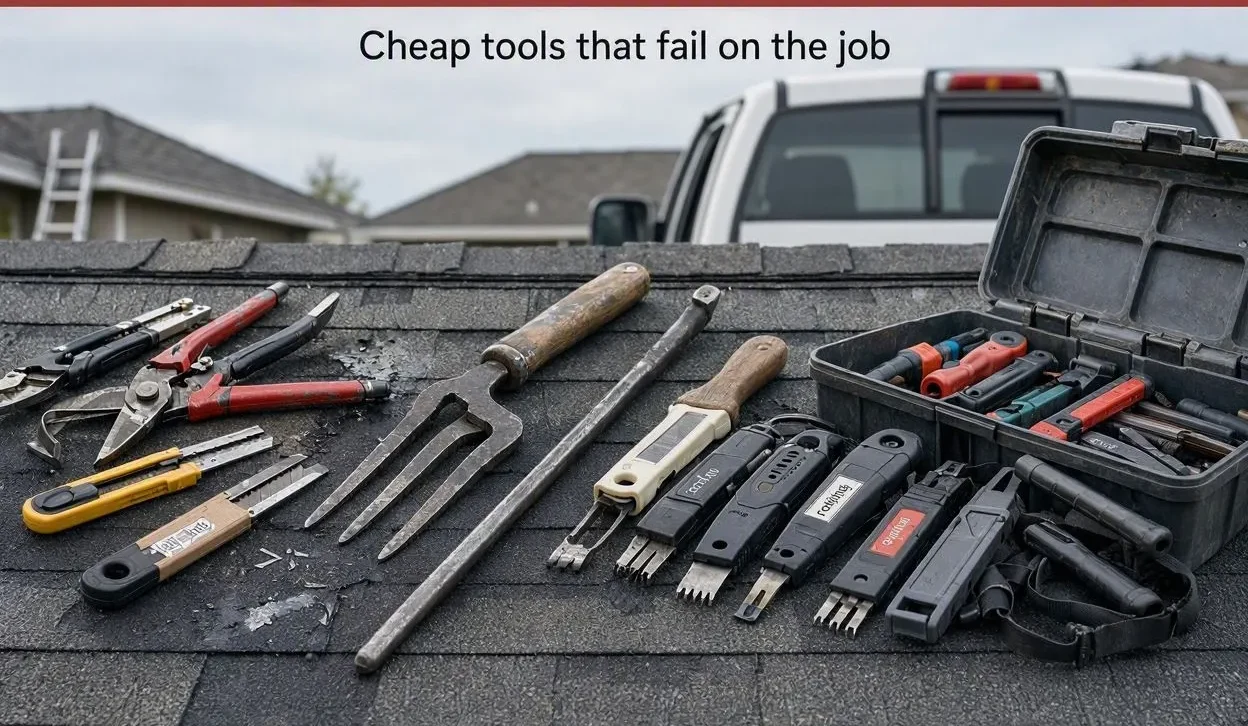
Four categories of roofing tools waste money for most crews and homeowners. A label that says “roofing” doesn’t guarantee a tool earns its spot on the truck.
- Bargain tin snips and utility knives: Cheap snips flex and leave ragged flashing edges. Cheap knife blades snap under load mid-cut.
- Gimmick shingle-removal gadgets: A tear-off fork and a standard pry bar outperform most infomercial-style tear-off tools.
- Plastic-bodied tools stored in a closed truck bed: Interior temperatures in a parked truck bed exceed 130°F (54°C) during summer months, and cheap plastic housings crack under that kind of heat, faster still in the Gulf Coast humidity mentioned above.
- Oversized laser layout tools for residential work: A chalk line and tape measure beat a laser system on most single-family roofs. Drop a laser from roof height once and the lesson sticks.
Spend money on the tools that touch a roofer’s hands every day, plus anything that prevents a fall. Everything else is a novelty until proven otherwise.
Conclusion
A working roofing tools list starts at $150 for a single repair and scales to $6,700 for a full commercial outfit. Matching the list to the actual job, not the job someone might land next year, is what separates a smart purchase from wasted money. Buy the hand tools and the safety gear outright. Rent the ladder hoist and the hot air welder until the job volume says otherwise, and don’t rule out buying some of the bigger equipment used. Skip the gadgets with “roofing” printed on the box but nothing behind the name.