
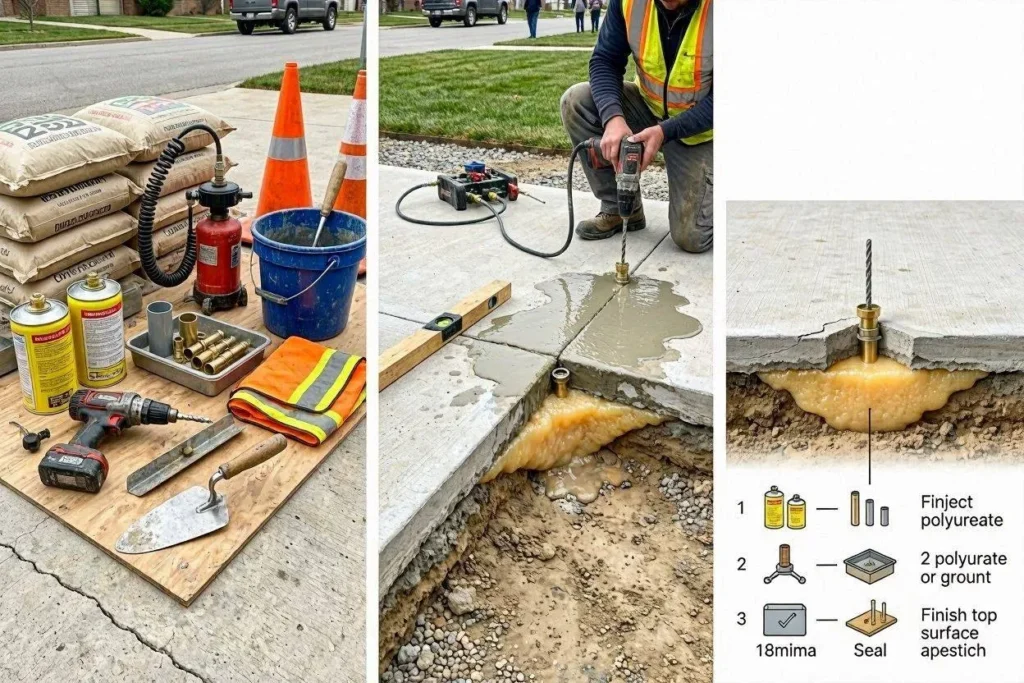
Concrete leveling is a construction repair process that restores a settled slab to grade by injecting an engineered material beneath it. A contractor drills access holes through the concrete substrate, pumps foam, cementitious grout, or slurry into the void underneath under controlled pressure, and patches the holes once the slab returns to the correct elevation.
This guide covers the injection materials, drilling specifications, cure chemistry, equipment, and compressive-strength data for every method used in the concrete leveling industry.
Concrete leveling restores settled slabs by injecting foam, cementitious grout, or slurry through small drilled access holes to fill the substrate void and re-establish load-bearing support. Material selection determines drill diameter, cure time, and service life. Polyurethane foam cures fastest and lasts longest; mudjacking costs the least per square foot; stone slurry grout balances the two.
What Is Concrete Leveling?
Concrete leveling is a slab repair method that restores structural elevation without removing the existing concrete. The construction industry also uses the terms concrete lifting, slabjacking, and mudjacking, each referring to a specific injection material rather than a different process. The drilling, injection, and patching sequence stays the same across all three; only the material and equipment specification changes.
A concrete slab settles when the soil substrate beneath it loses volume. Erosion, compaction failure, or moisture loss creates a void, and the slab drops into the empty space. Leveling fills that void with an engineered material sized and mixed for the specific substrate condition.
The Concrete Leveling Process
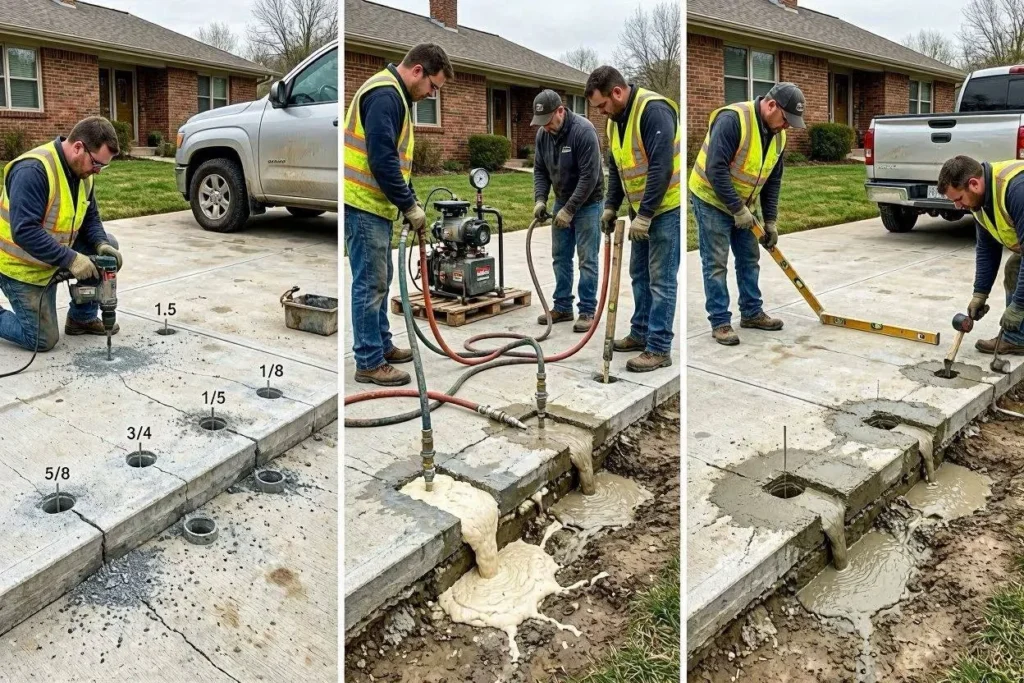
The injection sequence follows three steps across all material types.
- Access drilling. A technician drills holes through the slab at a diameter matched to the specified material — 5/8 inch for polyurethane foam, up to 1.5 inches for mudjacking slurry, and 3/4 to 1 inch for stone slurry grout.
- Material injection. The crew pumps the specified material through the access holes under controlled pressure. The material spreads through the substrate void and lifts the slab to target elevation as it fills.
- Hole patching. Once the slab reaches correct grade, the crew seals each access hole with a matching cementitious patch compound and finishes the surface.
A standard residential slab takes two to four hours from drilling to patch completion.
Concrete Leveling Materials Compared
Three injection materials are specified across the concrete leveling industry, each with distinct drilling, curing, service-life, and cost characteristics.
| Material | Composition | Drill Diameter | Cure Time | Service Life | Density | Cost/Sq Ft |
| Mudjacking slurry | Soil, sand, and cement mixed with water | 1-1.5 in | Hours to days | 5-10 years | ~120 lbs/cubic ft | $3-$8 |
| Polyurethane foam | Two-part expanding polymer | 5/8 in | Under 1 hour | 15-25+ years | ~4 lbs/cubic ft | $6-$15 |
| Stone slurry grout | Pulverized limestone aggregate + water | 3/4-1 in | Same day | 10-20 years | ~110 lbs/cubic ft | $5-$10 |
Polyurethane foam weighs roughly 96% less than mudjacking slurry, which means the injected material adds minimal dead load to the substrate and reduces the risk of accelerated future settlement. Mudjacking slurry, because it is cementitious, can crack and erode over time using the same mechanism that affects the original concrete pour. Stone slurry grout uses a finer aggregate than mudjacking, which produces a denser fill and a longer service life at a moderate material cost.
Material Specification Guide
- Specify polyurethane foam for: slabs near a foundation wall, high-moisture substrate zones, interior floors, and projects requiring maximum service life.
- Specify mudjacking for: large low-traffic slabs such as rural driveways where material cost per square foot is the primary constraint.
- Specify stone slurry grout for: mid-size residential and commercial slabs needing a balance between material cost and long-term durability.
Equipment Used in Concrete Leveling

Contractors use hydraulic drilling equipment to bore access holes at the specified diameter, followed by a pump system rated for the chosen material’s viscosity. Polyurethane foam requires a heated two-component pump system that mixes the resin and catalyst at the injection point. Mudjacking and slurry grout use a piston or auger-style pump capable of moving thicker, aggregate-based mixtures through a hose line at consistent pressure. Pressure gauges at the injection point let the technician monitor lift in real time and stop material flow once the slab reaches target elevation.
Compressive Strength by Material
| Material | Compressive Strength | Expansion Ratio | Set Time |
| Mudjacking slurry | 150-300 PSI | None (pumped to volume) | 2-24 hours |
| Polyurethane foam | 4,000-6,000 PSI | 15-25x liquid volume | 15-20 minutes |
| Stone slurry grout | 200-400 PSI | None (pumped to volume) | 4-12 hours |
Polyurethane foam’s compressive strength exceeds cementitious slurry by a wide margin because the cured polymer distributes load across a closed-cell structure rather than relying on aggregate bonding.
Material Cost Scaling by Void Depth
Material and labor pricing scales with substrate void depth more than with surface square footage, since a deeper void requires a greater fill volume regardless of the slab’s dimensions. A 200-square-foot driveway with a shallow 1-inch void can require less material than a 100-square-foot patio settled 3 inches, which is why contractors confirm void depth with a probe or inspection before finalizing a material quantity. Small jobs typically carry a flat minimum charge, since mobilization and equipment setup cost the same whether the crew injects one hole or twenty.
Concrete Leveling vs. Slab Replacement
Concrete leveling uses a fraction of the material volume required for full slab replacement, since the process fills an existing void rather than pouring an entirely new slab. Replacement requires demolition equipment, debris removal, new concrete material, and a 7- to 28-day structural cure period before the slab bears full load. Leveling eliminates the cure-time delay entirely, since injected foam sets in under an hour and slurry-based materials reach working strength the same day.
Slab Conditions That Rule Out Leveling
Leveling is not specified when a slab shows:
- Multiple structural cracks separating the slab into distinct sections.
- Crumbling or spalling concrete at the edges or surface.
- Root intrusion that has displaced the slab upward rather than settled it downward.
- Total displacement exceeding 3 to 4 inches in a localized area, which indicates a substrate condition beyond what injection material can correct.
Concrete Leveling Material Myths, Corrected
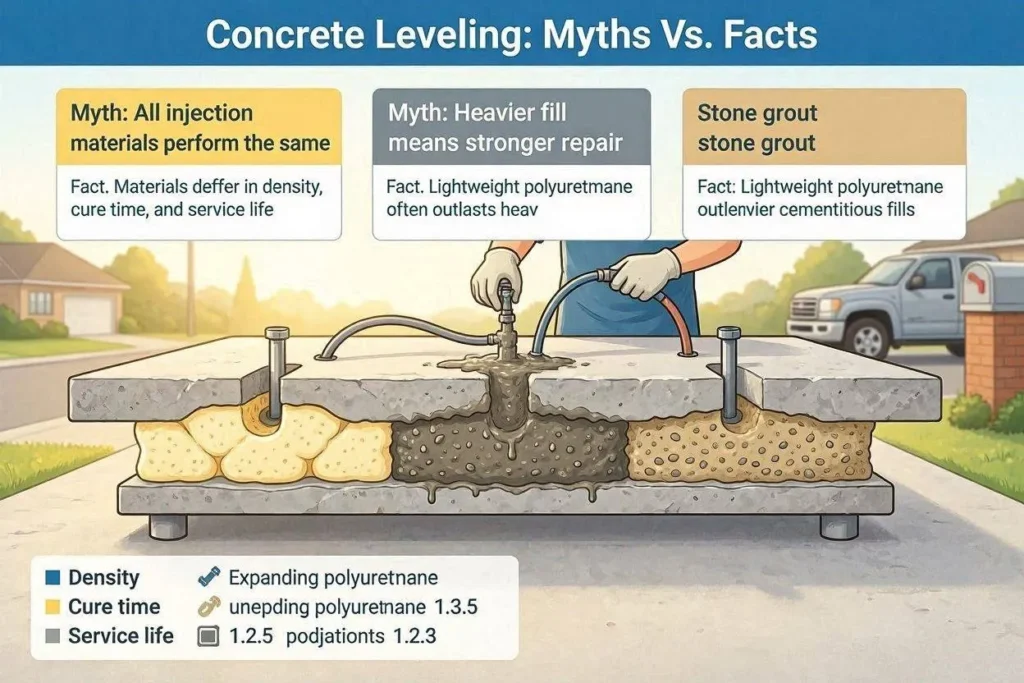
Myth: All injection materials perform the same. Fact: Polyurethane foam, mudjacking slurry, and stone slurry grout differ in density, cure time, and service life; material selection changes the outcome significantly.
Myth: Heavier fill material means a stronger repair. Fact: Polyurethane foam weighs a fraction of cementitious slurry and still delivers a longer service life, since added slab weight from heavier material can accelerate future substrate settlement.
Myth: Patched access holes remain visible long-term. Fact: Access holes measure 5/8 inch to 2 inches in diameter and get sealed with a matching cementitious patch compound that weathers in with the surrounding slab within weeks.
Myth: Consumer-grade leveling compounds match professional injection material. Fact: DIY compounds are formulated for minor interior surface leveling, not for filling a substrate void under pressure at the volume required to lift an exterior slab.
Material Cure Chemistry by Temperature
Polyurethane foam cures through a two-component polymer reaction that doesn’t depend on ambient moisture, giving it consistent cure performance across temperature ranges. Cementitious materials — mudjacking slurry and stone slurry grout — rely on water content to hydrate and set, so low-temperature conditions slow the hydration reaction and extend cure time. Contractors adjust the water-to-material mix ratio for cementitious products to maintain consistent cure strength across seasonal temperature variation.
Conclusion
Material selection is the single biggest factor in a concrete leveling project’s structural outcome. Polyurethane foam delivers the highest compressive strength and the longest service life, mudjacking uses the lowest-cost cementitious material, and stone slurry grout balances aggregate density against material cost. Drill diameter, cure chemistry, and pump equipment all change based on the material specification, so the correct choice depends on substrate condition, void depth, and slab load requirements. A qualified contractor evaluates these material variables on-site before specifying a product, rather than defaulting to one material for every slab.