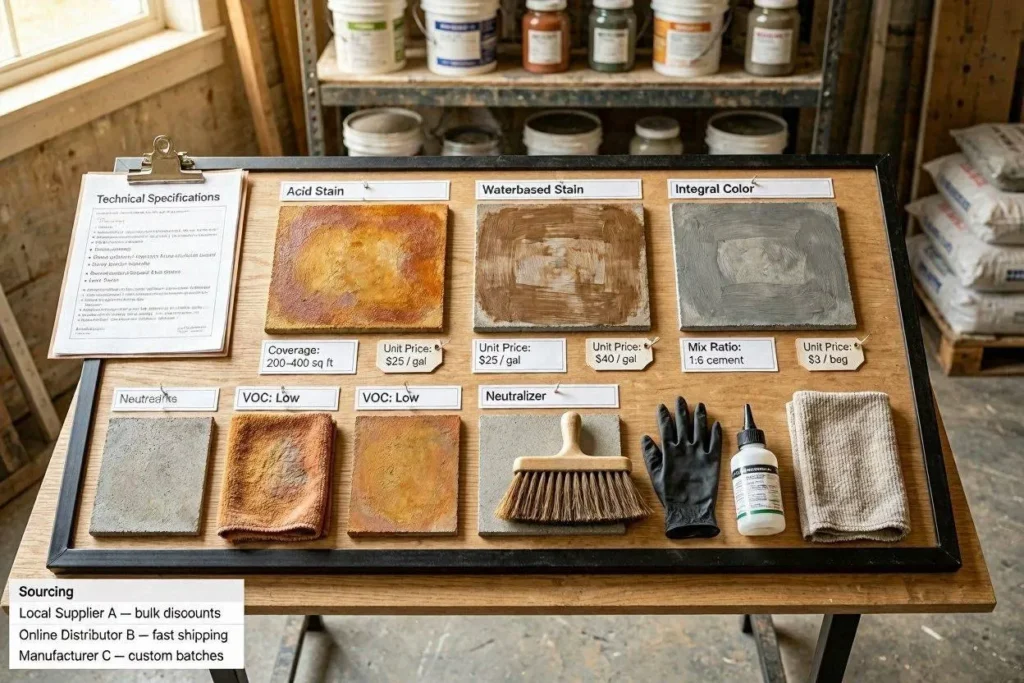
Concrete staining is a decorative concrete finishing category built on three distinct material classes: acid-reactive chemical stains, water-based pigment stains, and solvent- or water-carried dyes. Each class is a different chemical product with its own composition, packaging, distribution channel, and applicable industry standard not simply a different color option within one product.
The finished surface holds up better than paint and outlasts most flooring alternatives, provided the correct material class is specified for the substrate and the correct sealer system is applied over it.
This guide covers the three material categories, their chemical composition and specifications, what each costs and how it’s sourced in 2026, the application standards that govern proper installation, and the classification these products fall under in construction materials supply.
What Is Concrete Staining?
Concrete staining penetrates the surface and colors the material from within. Paint sits on top and eventually peels. Stain goes into the concrete it becomes part of the slab.
Concrete staining falls under CSI MasterFormat Division 09 Finishes, specifically decorative concrete finishing, while the underlying slab work falls under Division 03 Concrete. Contractors bidding commercial projects reference these divisions when specifying materials in project documents.
The finish stays translucent. You can still see the texture, the natural veining, and the small imperfections that give concrete its character. That’s the whole point. Every floor ends up looking slightly different, which is why contractors and designers keep coming back to the process.
Staining works on garage floors, patios, driveways, basements, sunrooms, pool decks, and interior living spaces. Any concrete surface that’s structurally sound and properly prepped can be stained.
3 Types of Concrete Stain — And How to Choose
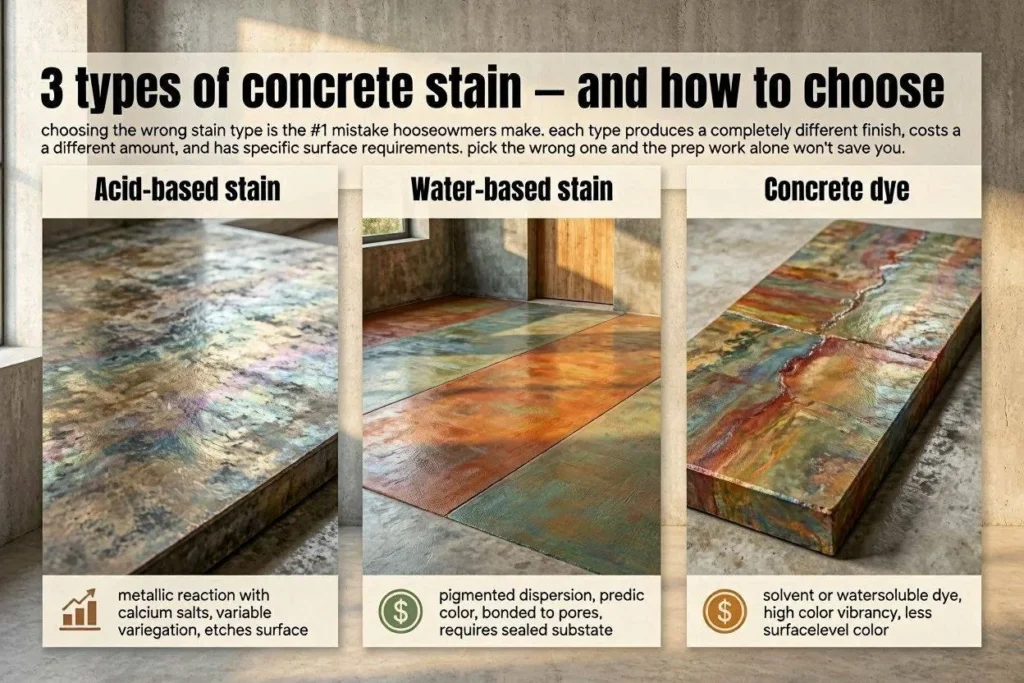
Choosing the wrong stain type is the #1 mistake homeowners make. Each type produces a completely different finish, costs a different amount, and has specific surface requirements. Pick the wrong one and the prep work alone won’t save you.
1. Acid-Based Stain
Acid stain is the real thing. A hydrochloric acid solution containing metallic salts reacts with the calcium compounds inside the concrete. Acid stain’s metallic salts most commonly include iron, copper, and cobalt compounds, each producing a different reaction color with the calcium hydroxide in cured concrete. The result is earthy, rich color walnut browns, terracotta reds, deep blues, sage greens. No two sections of floor react identically, so the finish looks mottled, marbled, and organic rather than painted.
The color is permanent. Acid stain doesn’t sit on the surface it chemically bonds inside the concrete. UV rays won’t fade it. Physical wear hits the sealer on top, not the stain underneath. Properly sealed acid-stained floors last 10 to 20 years. Some last 30+.
The catch: acid stain needs bare, porous concrete to work. Sealed slabs, painted surfaces, and floors with adhesive residue block the chemical reaction completely. New concrete needs 21 to 28 days minimum to cure before it will accept acid stain.
- Best for: Patios, driveways, interior floors, any area where longevity matters most
- Color options: 8–15 earth tones
- Application requirement: Neutralization step required after application
- Lifespan: 10–20 years with proper sealing
2. Water-Based Stain
Water-based stain skips the chemical reaction. Inorganic pigment particles penetrate the concrete’s pores and bond mechanically. The color is more consistent and predictable than acid stain, with less mottling and more uniform coverage across the floor.
The color range is far wider, with over 50 options including cool grays, bright whites, deep greens, and custom mixes that acid formulations can’t produce. The product is low-odor and non-corrosive, classified separately from acid-reactive stains for shipping and storage purposes.
Water-based stain needs an open concrete surface to absorb properly. Sealed or painted concrete requires mechanical grinding or acid etching before the pigment will penetrate.
- Best for: Indoor spaces with limited ventilation, jobs requiring specific colors, low-VOC specification projects
- Color options: 50+
- Application requirement: No neutralization needed
- Lifespan: 3–7 years before recoating depending on traffic and sealer quality
3. Concrete Dye
Concrete dye uses ultra-fine pigment particles in an acetone or water carrier. The particles are small enough to enter dense, low-porosity concrete that resists both acid stain and water-based products. Application is fast, drying in minutes rather than hours.
The colors are vivid in a way the other types can’t match. Electric blues, deep purples, saturated reds that look almost backlit on a polished floor. Retail showrooms, art studios, and high-end residential interiors use dye specifically because of this intensity.
The limitation is UV stability. Sunlight breaks down dye pigment within 1–3 years outdoors. One summer on a patio and the color will fade visibly. Concrete dye is strictly for indoor use.
- Best for: Polished interior floors, retail spaces, residential living areas without direct sun
- Color options: Unlimited
- Application requirement: No neutralization needed; fast-dry carrier
- Lifespan: 1–3 years indoors; not suitable for outdoor use
Product Classification Comparison
| Acid Stain | Water-Based Stain | Concrete Dye | |
| Product class | Reactive chemical stain | Pigment-dispersion stain | Fine-particle dye, solvent or water carrier |
| How it works | Chemical reaction | Pigment absorption | Physical penetration |
| Color range | 8–15 earth tones | 50+ any color | Unlimited, vibrant |
| UV stability | Excellent | Good | Poor — indoor only |
| Lifespan | 10–20 years | 3–7 years | 1–3 years |
| Hazmat shipping class | Corrosive (acid) | Non-hazardous | Flammable (acetone carrier) or non-hazardous (water carrier) |
| Needs neutralizing | Yes | No | No |
| Outdoor use | Yes | Yes | No |
Concrete Staining Materials: Pricing, Packaging, and Supply Costs in 2026
Professional concrete staining runs $2–$4 per square foot (0.09 m²). DIY materials cost $0.50–$1.50 per square foot. On a 400 sq ft (37 m²) garage floor, that’s $200–$600 in materials versus $800–$1,600 for a contractor.
Project Cost Estimates
| Project | Size | DIY Cost | Pro Cost |
| Small patio | 100 sq ft (9.3 m²) | $50–$150 | $200–$400 |
| Garage floor | 400 sq ft (37 m²) | $200–$600 | $800–$1,600 |
| Full basement | 800 sq ft (74 m²) | $400–$1,200 | $1,600–$3,200 |
| Large driveway | 1,000 sq ft (93 m²) | $500–$1,500 | $2,000–$4,000 |
What Pushes the Price Up
The stain itself — Acid stains cost $30–$80 per gallon (3.78 L) and cover 200–400 sq ft (18.6–37 m²). Water-based stains run $20–$60 per gallon. Dyes are $40–$100 per gallon but stretch further at 400–600 sq ft (37–55 m²) per gallon.
Surface condition — Neglected concrete with heavy contamination, deep cracks, or old sealer adds $0.50–$1.50 per sq ft to professional jobs. DIY homeowners can rent a floor grinder for $80–$120 per day and handle most prep work themselves.
Sealer choice — Basic acrylic sealer costs $0.10–$0.30 per sq ft. Polyurethane sealers run $0.30–$0.60 per sq ft. On a high-traffic floor, the polyurethane is worth the extra cost it lasts 3–5 years versus 1–2 years for acrylic.
Where to Buy Concrete Stain, Sealer, and Prep Materials
Concrete stain, sealer, and surface-prep products move through three distribution channels: big-box retailers, specialty concrete supply distributors, and manufacturer direct sales.
Big-box retailers stock acrylic sealers and basic water-based stains in single-gallon and 5-gallon container sizes. Selection is limited to consumer-grade formulations — commercial-grade acid stains and industrial degreasers typically aren’t shelf items.
Specialty concrete supply distributors carry the full product range: acid stains, dyes, densifiers, epoxy and polyurethane coating systems, and anti-slip additives. These suppliers also stock the application equipment — diamond grinding pads, pump sprayers rated for acidic solutions, and floor buffers — and typically provide technical data sheets (TDS) and safety data sheets (SDS) for every product line.
Manufacturer direct purchasing applies mainly to large commercial or industrial projects, where bulk pricing and extended warranty programs make direct sourcing worthwhile.
Before purchasing, confirm the product’s VOC (volatile organic compound) rating against local building code. Many states cap VOC content for interior coatings, and non-compliant sealers can’t legally be applied indoors in regulated jurisdictions.
Concrete stain and sealer products are typically sold in 1-gallon, 5-gallon pail, and 55-gallon drum quantities, with drum pricing reserved for contractor and commercial accounts. Distributors classify acid stains, water-based stains, and dyes under decorative concrete chemicals, a subcategory of concrete finishing materials that also includes densifiers, hardeners, and curing compounds. Densifiers — typically lithium silicate or sodium silicate based — are often bundled with staining projects on polished concrete to increase surface hardness before dye application.
Building materials suppliers typically stock these products alongside related concrete and masonry supply lines — patching compounds, joint fillers, and surface repair materials — under a single materials account, allowing contractors to consolidate purchase orders and freight shipments across multiple product categories rather than sourcing each line separately. Suppliers assign each product a distinct SKU by container size and formulation, and pricing is generally tiered by order volume, with per-unit cost dropping at pallet and truckload quantities.
Commercial-grade sealer manufacturers commonly back coating systems with 5- to 10-year material warranties when applied by a certified applicator following the manufacturer’s specified surface-preparation protocol. Warranty claims typically require documentation of surface porosity testing and adherence to recoat windows specified on the product’s technical data sheet.
Concrete degreasers and acid-etching solutions fall under OSHA hazard communication requirements, and commercial applicators must maintain SDS documentation on-site during application. Shipping of acid-based stain products is regulated under DOT hazardous materials guidelines when transported in bulk quantities.
Materials Storage and Packaging Reference
| Material Category | Common Packaging | Typical Shelf Life | Storage Requirement |
| Acid stain | 1-gal, 5-gal pail | 2–3 years unopened | Above 40°F (4°C), sealed |
| Water-based stain | 1-gal, 5-gal pail | 1–2 years unopened | Avoid freezing |
| Concrete dye | Quart, 1-gal | 1 year unopened | Sealed, away from heat |
| Acrylic sealer | 1-gal, 5-gal pail | 1–2 years unopened | Avoid freezing |
| Epoxy sealer (2-part) | Kit (resin + hardener) | 1 year unopened, components separate | Room temperature |
| Polyurethane sealer | 1-gal, 5-gal pail | 1–2 years unopened | Sealed, cool/dry |
Surface Preparation Requirements
Surface preparation determines whether a stain product can perform to its material specification. Acid stain is translucent and does not mask surface defects — contamination, adhesive residue, and prior coatings all telegraph through the finished color as uneven patches.
Manufacturers specify surface preparation as a precondition for warranty coverage. The required sequence: clear and mask the work area; degrease with a commercial concrete degreaser (heavy contamination requires 2–3 treatment cycles, since residual oil creates a barrier that blocks acid reaction); open the surface profile mechanically with a diamond-pad floor grinder or chemically via acid etching (1 part acid to 10 parts water, per manufacturer dilution guidance); verify surface porosity with a water-absorption test — absorption within 30 seconds confirms an open profile, while beading indicates further prep is required; and allow a full 24-hour dry period before material application, since residual moisture dilutes stain concentration and produces inconsistent color development.
Rental-grade floor grinders run $80–$120 per day; commercial applicators typically own dedicated equipment rated for continuous use.
Application Specifications by Material Class
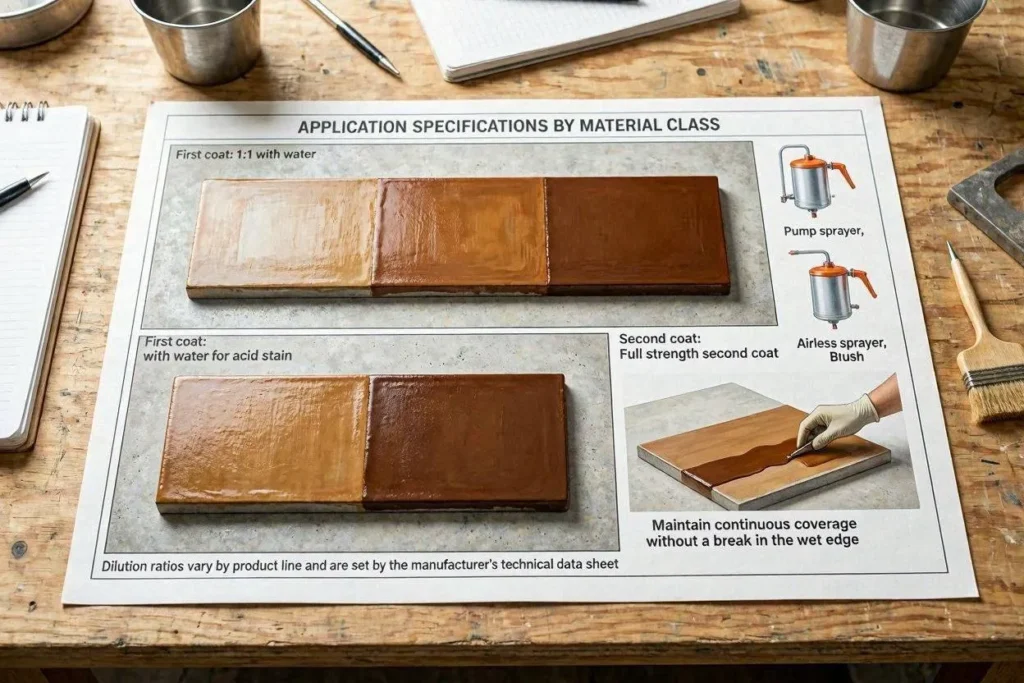
Application and dilution — Manufacturer specifications typically call for a diluted first coat (commonly 1:1 with water for acid stain) and a full-strength second coat; dilution ratios vary by product line and are set by the manufacturer’s technical data sheet, not by general practice. Application equipment — pump sprayer, airless sprayer, or brush must maintain continuous coverage across a section without a break in the wet edge; a dried edge before the adjoining pass produces a visible color-density line, since overlapping acid stain onto a dried edge roughly doubles reaction time in that zone. At 70°F (21°C), acid stain reaches touch-dry in 15–20 minutes with full cure at 24 hours.
Coat buildup — Color depth is a function of coat count: one coat produces light, translucent color; two coats produce medium depth; three coats produce full saturation. Manufacturer guidance typically specifies a 2–4 hour interval between coats and alternating application direction (lengthwise, then widthwise) to prevent overlap banding. Water-based stain follows the same coat-buildup principle, typically reaching target color within two to three coats.
Neutralization (acid stain only) — Acid stain leaves a surface residue after the reaction completes that must be neutralized before sealer application; unneutralized residue prevents sealer adhesion and causes bubbling or delamination within weeks. Standard neutralizing agents include baking soda (1 tablespoon per gallon / 3.78 L of water), TSP (trisodium phosphate, per manufacturer dilution), and ammonia (1 cup per gallon). The surface is scrubbed, rinsed, and re-rinsed until runoff is clear, then extracted with a wet vacuum. Water-based stain does not require this step — a clean-water rinse is sufficient.
Sealer application — Sealer is applied within 24 hours of stain cure as part of standard building-materials installation sequencing. Acrylic, epoxy, and polyurethane sealers are distinct product lines within the broader concrete finishing materials category, each carrying its own unit cost, packaging, and specification sheet. Two coats is standard specification across all three product lines, with the first coat applied thin and the second applied after a manufacturer-specified cure interval.
Sealer product comparison:
- Acrylic sealer ($15–$25 per gallon) — lowest material cost, suited to light-traffic specifications. Recoat interval: 1–2 years.
- Epoxy sealer — higher material and labor cost, longer service life, standard specification for garage and commercial-floor installations.
- Polyurethane sealer — highest-performance specification for high-traffic floors, available in matte, satin, or gloss finish.
Exterior installations require a sealer product rated for outdoor exposure; interior-rated sealer products are not specified for exterior use.
Environmental and Application-Rating Specifications
Material behavior differs by installation environment, and product specifications account for this directly.
Temperature specification — Application is specified between 50°F (10°C) and 90°F (32°C). Below the minimum, the acid-stain chemical reaction slows or stops; above the maximum, the product dries before it can be spread evenly, producing lap marks. Manufacturers publish this range on the technical data sheet for each product line.
UV exposure rating — Products specified for exterior use must carry UV-stable formulation and be paired with an exterior-rated sealer containing UV inhibitors. Interior-rated sealer products degrade under sustained UV exposure and are not specified for freeze-thaw environments.
Freeze-thaw rating — Sealer systems specified for exterior installations in cold climates must carry a freeze-thaw durability rating; interior-only sealer formulations are not rated for this exposure and will fail prematurely outdoors.
Slip-resistance specification — Exterior walking surfaces — pool decks, patios, exterior steps — require a sealer formulated or additized for slip resistance. Fine silica sand or aluminum oxide additive ($5–$15 per lb) is blended into the sealer coat to meet this specification without altering surface appearance.
Material Service Life and Warranty Terms
Acid stain carries a 10–20 year service life under proper sealer maintenance, with some professionally installed systems exceeding 30 years. Color permanence is a property of the chemical bond itself — service-life limitations come from the sealer coat, not the underlying stain.
Water-based stain carries a 3–7 year service life before recoating, varying with traffic load and sealer specification.
Concrete dye carries a 1–3 year indoor service life; UV exposure degrades dye pigment rapidly and the product is not warrantied for exterior application.
Sealer systems govern replacement cycles. A polyurethane sealer specified for a 2–5 year recoat interval determines the maintenance schedule regardless of the underlying stain class. Manufacturer warranty terms typically require documented adherence to the recoat interval to remain valid.
Indicators that a sealer coat has reached end-of-service-life: loss of water-beading (absorption resumes), surface haze or cloudiness, reduced abrasion resistance, and visible color dulling relative to the original installed finish.
Common Specification Deviations and Their Effects
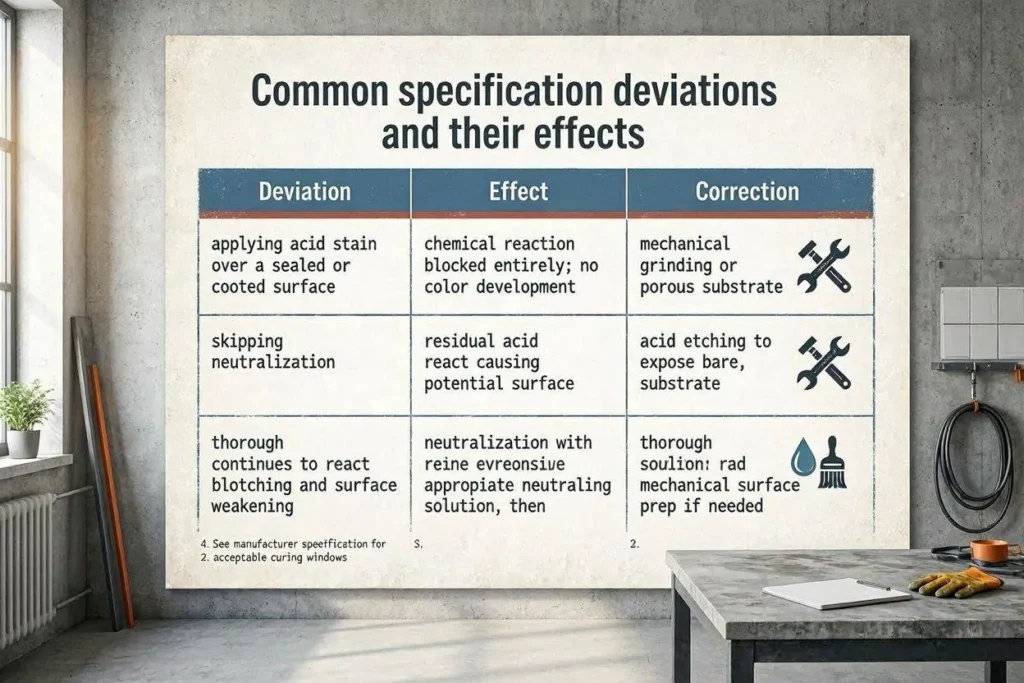
Most stained-concrete performance failures trace back to a deviation from manufacturer specification rather than a product defect. The table below maps common deviations to their cause and effect.
| Deviation | Effect | Correction |
| Applying acid stain over a sealed or coated surface | Chemical reaction blocked entirely; no color development | Mechanical grinding or acid etching to expose bare, porous substrate |
| Skipping neutralization after acid stain | Sealer fails to bond; bubbles and delaminates within weeks | Neutralize with baking soda or TSP solution, rinse to clear runoff |
| Applying water-based stain over existing stain | Uneven absorption produces patchy, inconsistent color | Strip existing stain before reapplication |
| Staining concrete before full cure (under 21–28 days) | Weak, inconsistent color from incomplete calcium compound formation | Confirm cure date before scheduling application |
| Breaking the wet edge during application | Visible density line at the overlap point | Complete each work section without interruption |
| Applying outside the 50–90°F (10–32°C) window or in direct sun | Reaction slows/stops below range; dries too fast above range, causing lap marks | Schedule application within manufacturer temperature specification |
| Specifying solid-color stain for a decorative/translucent finish | Opaque, paint-like result instead of marbled, translucent finish | Confirm “semi-transparent” or “acid stain” designation on product label before purchase |
Industry Classification and Specification Reference
Decorative concrete stains, dyes, and sealers fall within the broader building materials category of concrete finishing products, alongside aggregate additives, densifiers, hardeners, curing compounds, and joint sealants. Distributors and materials suppliers group these products by packaging format, unit pricing, and regulatory shipping classification for inventory and procurement purposes.
Product classification for procurement — Acid stains are classified as corrosive materials for shipping and storage. Water-based stains and most sealers fall under non-hazardous or low-VOC classifications. Dyes carried in acetone are classified as flammable liquids; water-carried dyes are not. These classifications determine freight handling, storage requirements, and required shipment documentation.
Regulatory reference — VOC content limits are set by state and regional air-quality regulations rather than a single federal standard, so compliant product selection varies by jurisdiction. Project specifications for commercial decorative concrete work typically list these products under construction materials procurement documentation alongside other finishing and building supply line items.
Procurement considerations — Bulk purchasing (drums versus pails) affects unit cost and freight surcharges, since corrosive and flammable material classes carry additional shipping fees. Distributors typically require a signed safety documentation acknowledgment for corrosive or flammable product categories before shipment.
A project that combines multiple material classes — for example, acid stain on one zone and water-based stain on an adjacent zone — should be documented as separate line items in procurement records, since each class carries distinct storage, handling, and disposal requirements under standard building materials supply practice.
Conclusion
Concrete staining materials deliver a lower installed cost per square foot than most flooring alternatives, with a service life that depends far more on material selection and sealer specification than on the finished color itself.
Confirm the substrate condition, the required chemical class, and the applicable VOC and hazmat regulations for the project’s jurisdiction before purchasing. Specialty concrete supply distributors can confirm current TDS and SDS documentation, packaging sizes, and lead times for acid stains, water-based stains, dyes, and the sealer systems that protect them.
For commercial or large-scale projects, request material specification sheets and manufacturer warranty terms from at least two suppliers before finalizing an order — coating warranties and adhesion standards vary meaningfully between manufacturers.