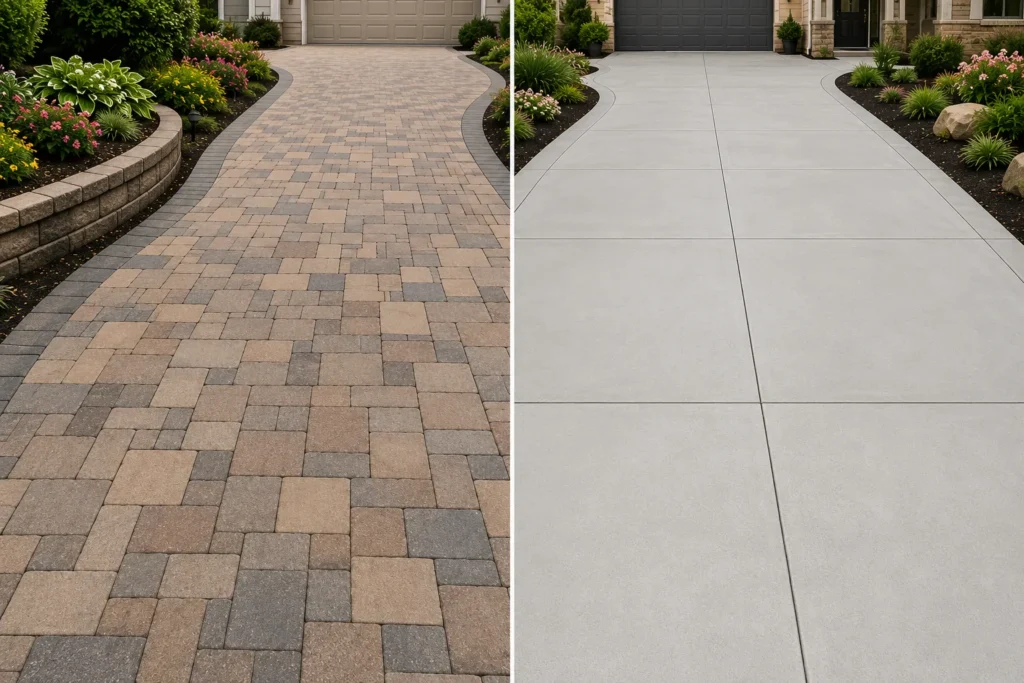
Pavers cost more upfront but last longer, resist cracking, and cost less to repair over time. Concrete costs less to install but cracks under ground movement, requires patching within 10–15 years, and resurfacing costs $3–$7 per sq ft (0.09 m²).
A 500 sq ft (46.5 m²) concrete patio runs $2,000–$7,500 to install. The same area in pavers runs $5,000–$15,000. Over 25 years, concrete’s repair and resurfacing costs close that gap or exceed it.
This guide covers every factor: upfront cost, 25-year cost, strength, lifespan, drainage, appearance, and which surface fits each application. Roofing and exterior contractors — including the team at Rainy Roofers — understand that surface water management around a structure starts at the ground level, and material choice directly affects drainage near foundations and exterior walls.
Pavers vs Concrete: Quick Comparison
- Installation cost: Concrete $4–$15/sq ft | Pavers $10–$30/sq ft
- Compressive strength: Concrete 3,500–4,000 psi (24–27.6 MPa) | Pavers 8,000–12,000 psi (55–82.7 MPa)
- Lifespan: Concrete 25–50 years | Pavers 25–75+ years
- Crack resistance: Concrete — cracks under ground shift | Pavers — flex individually, no crack propagation
- Repair cost: Concrete $300–$5,000+ per section | Pavers $50–$200 per damaged unit
- Reseal frequency: Concrete every 2–3 years | Pavers every 3–5 years
- Drainage: Concrete — impermeable (runoff) | Pavers — joints allow drainage; permeable pavers reduce runoff by 50–93%
- Curb appeal: Concrete — limited colors and patterns | Pavers — hundreds of colors, patterns, and textures
- Installation time: Concrete 1–2 days pour + 7-day cure | Pavers 2–5 days installation, usable immediately
Pavers vs Concrete Cost: Full Breakdown
Cost comparison splits into 3 categories: installation, maintenance, and 25-year total. Both numbers matter — installation-only comparisons favor concrete unfairly.
Installation Cost per Square Foot
Concrete: $4–$15/sq ft ($43–$161/m²) installed. Plain concrete slabs run $4–$8. Stamped or colored concrete runs $8–$15. Labor adds $3–$5/sq ft. A 500 sq ft (46.5 m²) plain driveway costs $2,000–$5,500 total.
Pavers: $10–$30/sq ft ($108–$323/m²) installed. Concrete pavers cost $10–$18/sq ft. Brick pavers run $12–$20/sq ft. Natural stone (travertine, flagstone, slate) runs $18–$30+/sq ft. Labor adds $7–$13/sq ft because each unit is placed individually. A 500 sq ft paver driveway costs $5,000–$15,000 total.
Stamped concrete narrows the gap. A stamped concrete patio at $12/sq ft costs close to basic concrete pavers at $10–$14/sq ft. Homeowners comparing aesthetics should use stamped concrete as the benchmark, not plain slabs.
Maintenance Cost Over 25 Years
Concrete maintenance over 25 years on a 576 sq ft (53.5 m²) driveway:
- Years 5–10: Minor crack filling — $200–$600
- Years 10–15: Major crack repair — $500–$1,500
- Years 15–20: Partial resurfacing — $1,500–$4,000
- Resealing every 2–3 years x 10 applications — $400–$800
- Total 25-year maintenance: $2,600–$6,900
Paver maintenance over 25 years on the same 576 sq ft surface:
- Resealing every 3–5 years x 6 applications — $1,200–$2,400 ($200/1,000 sq ft per seal)
- Joint sand replacement x 2 — $200–$500
- Individual paver replacement (occasional) — $100–$400
- Total 25-year maintenance: $1,500–$3,300
Pavers save $1,100–$3,600 in maintenance costs over 25 years on a standard driveway. Combined with longer lifespan, total cost of ownership often favors pavers on projects expected to last 25+ years.
Strength and Durability: Pavers vs Concrete
Pavers reach 8,000–12,000 psi (55–82.7 MPa) compressive strength. Poured concrete reaches 3,500–4,000 psi (24–27.6 MPa). Pavers are 3–4x stronger under direct compression.
That strength difference matters most in 2 scenarios:
- Heavy vehicle traffic — Forklift and truck loads test compressive limits. Pavers handle heavy commercial traffic without cracking. Standard concrete slabs crack under repeated heavy loads within 10–15 years.
- Freeze-thaw cycles — Ground freezes and expands, then thaws and contracts. Rigid concrete slabs crack when the ground beneath shifts. Individual paver units flex independently — no crack propagates across the surface. In climates with 50+ freeze-thaw cycles per year, pavers outlast concrete by 15–25 years.
One important distinction: concrete pavers (manufactured blocks) reach 8,000–12,000 psi. Natural stone pavers range from 5,000–20,000 psi depending on stone type. Poured concrete slabs max at 4,000–5,000 psi for residential mixes. The structural advantage of pavers over poured concrete is consistent across all paver materials.
Why Concrete Cracks and Pavers Don’t
Poured concrete is one rigid slab. Any ground movement — soil settling, tree roots, frost heave, or subgrade erosion — stresses the entire slab. Concrete has low tensile strength (roughly 10% of its compressive strength). Tension cracks appear quickly and spread.
Pavers are individual units set on a flexible base. When the ground moves, individual pavers shift slightly rather than fracturing. Reset a section of sunken pavers in 2–3 hours without replacing the entire surface. Concrete repairs require cutting, removing, and re-pouring — leaving visible patch lines.
Poor drainage under concrete accelerates cracking. Water that pools against a foundation and saturates the base erodes subgrade material, causing slab voids and sudden failures. This same drainage issue affects roof drainage systems — water management at grade level connects directly to how water moves at and above the roofline.
Lifespan: How Long Do Pavers and Concrete Last?
Concrete driveways last 25–50 years with proper maintenance. Concrete patios last 20–40 years. Accelerated cracking from freeze-thaw damage, tree roots, or poor drainage cuts lifespan to 15–20 years in harsh conditions.
Pavers last 25–75+ years. Concrete pavers last 30–50 years. Brick pavers last 50–100 years. Natural stone pavers (granite, travertine, bluestone) last 75–100+ years. Permeable pavers last 20–60 years depending on maintenance of the drainage aggregate beneath.
The key variable is base preparation. A paver installation on 4 inches (100 mm) of compacted base material suits pedestrian patios. A paver driveway requires 9–12 inches (228–305 mm) of compacted base to handle vehicle loads and prevent settling. Skimping on base depth cuts paver lifespan by 50%.
Drainage: Pavers vs Concrete
Standard concrete is impermeable — all water runs off the surface. On driveways and patios, this concentrates runoff toward foundations, landscaping, and storm drains. Many municipalities now restrict impermeable surface area in residential construction due to stormwater regulations.
Standard pavers allow some drainage through joints filled with polymeric sand. Permeable pavers — designed with larger joints filled with crushed stone — allow 80–100% of surface water to infiltrate directly into the ground. Permeable pavers reduce surface runoff by 50–93% compared to concrete.
Permeable paver systems cost $18–$28/sq ft ($194–$301/m²) — more than standard pavers — but eliminate the need for separate drainage infrastructure, saving $2,000–$6,500 on drainage systems. In areas with strict pervious surface requirements, permeable pavers allow larger patio and driveway footprints that standard concrete would prohibit.
Proper drainage at grade level protects building foundations and walls. Water that pools at the base of a structure works upward through masonry, causing efflorescence, spalling, and long-term structural damage that escalates into costly roof repair work when moisture migrates through walls and into roofing assemblies.
Appearance and Design Flexibility
Concrete offers 3 finish options: plain, stamped, and colored. Plain concrete is grey and utilitarian. Stamped concrete mimics stone, brick, or wood patterns and costs $8–$15/sq ft. Integral color adds $3–$5/sq ft to any finish. Over time, stamped concrete fades and requires resealing every 2–3 years to maintain color.
Pavers offer hundreds of combinations. Materials include concrete pavers, brick, clay, travertine, flagstone, bluestone, granite, slate, and porcelain. Patterns include herringbone, running bond, basketweave, circular, fan, and custom designs. Colors range from earth tones to charcoal to terracotta to pure white.
Pavers maintain appearance longer than stamped concrete. Paver color is integral through the full unit — fade affects only the surface mm, and individual units replace without color mismatch. Stamped concrete surface sealer wears unevenly, creating patchy color loss that requires full resurfacing to correct.
Resale Value Impact
Pavers increase home resale value more than concrete. A well-installed paver driveway or patio improves curb appeal visibly and signals quality to buyers. Real estate professionals consistently cite pavers as higher-value hardscaping. Concrete improves value over no paving but shows wear more visibly over time.
Matching paver style to the home’s architecture matters. Travertine and natural stone suit Mediterranean and luxury homes. Brick pavers complement traditional and colonial styles. Concrete pavers in neutral tones work with modern and contemporary architecture.
Installation Process: How Each Surface Gets Built
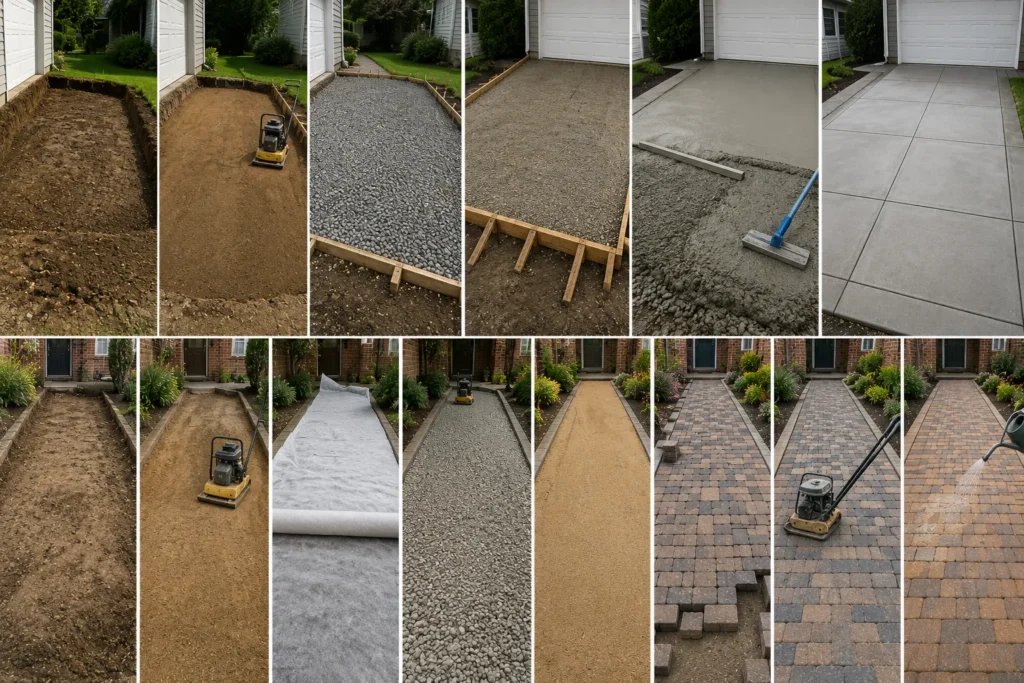
Concrete Installation
6 steps to install a concrete driveway or patio:
- Excavate — Remove 4–8 inches (100–200 mm) of soil. Driveways need deeper excavation than patios.
- Grade and compact subgrade — Level and compact the soil base to prevent settling.
- Place gravel base — Spread 4–6 inches (100–150 mm) of compacted gravel for drainage and load distribution.
- Set forms — Install wooden or metal forms that define slab edges and control thickness.
- Pour and finish — Pour concrete, screed level, and apply finish (broom, trowel, or stamp). Takes 1–2 days.
- Cure — Concrete needs 7 days minimum curing before light foot traffic, 28 days before vehicle use.
Cut control joints every 8–12 ft (2.4–3.7 m) in the slab to direct cracking. Without control joints, cracks form randomly and spread uncontrolled.
Paver Installation
7 steps to install a paver driveway or patio:
- Excavate — Remove 6–14 inches (150–355 mm) of soil. Driveways need 9–12 inches of base depth.
- Grade subgrade — Compact subgrade to 95% Proctor density for stable load distribution.
- Lay geotextile fabric — Prevents base aggregate from migrating into subgrade soil.
- Compact base aggregate — Install and compact 6–10 inches (150–255 mm) of crushed stone in 3-inch (75 mm) lifts.
- Set bedding sand — Spread 1 inch (25 mm) of coarse sand. Screed level as a setting bed.
- Place pavers — Lay pavers in the chosen pattern. Use edge restraints to prevent lateral spreading.
- Compact and fill joints — Compact pavers into the sand bed with a plate compactor. Fill joints with polymeric sand, compact again, and mist with water to activate sand binders.
Pavers are walkable immediately after polymeric sand sets (24–48 hours). No curing period required.
Repairs: Which Is Easier to Fix?
Paver repairs take 2–3 hours and cost $50–$200 per damaged section. Remove the affected pavers, re-level the base, reset the units, and refill joints with polymeric sand. No visible repair lines. No color mismatch if replacement pavers are from the same batch. Always save leftover pavers from the original installation for future repairs.
Concrete repairs are visible and expensive. Small crack filling costs $200–$600. Large crack repairs cost $500–$1,500. Partial resurfacing costs $1,500–$4,000. Full replacement costs $4–$15/sq ft. Every patch leaves a visible line. Concrete that matches original color exactly is nearly impossible to source years after installation.
Utility access is another differentiator. Running a new irrigation line, electrical conduit, or drain under a paver surface requires removing and resetting pavers — no damage. The same work under a concrete slab requires breaking the slab with a concrete saw and patching afterward.
On commercial properties, utility access issues compound. Slab demolition for underground work adds $2–$6/sq ft in removal costs before any utility work begins. Failed commercial roof drainage systems often link to undersized surface drainage — and retrofitting drainage under a concrete apron around a commercial building costs significantly more than the same work under pavers.
Pavers vs Concrete: Which Should You Choose?
The right choice depends on 5 specific factors:
Choose Concrete When:
- Budget is the primary constraint — $2,000–$7,500 installs a 500 sq ft concrete patio vs. $5,000–$15,000 for pavers. If cash flow limits the project, concrete delivers a functional surface at lower immediate cost.
- Large flat areas need fast coverage — Driveways over 1,000 sq ft (92.9 m²) or expansive patios install faster with concrete. Paver labor scales linearly with area — the larger the surface, the bigger the cost gap.
- Soil is stable, climate is mild — In warm climates with stable sandy or clay soils and minimal freeze-thaw cycling, concrete performs well long-term. Central and Southern US locations with minimal frost see concrete driveways last 40–50 years.
- Project is temporary or interim — Concrete works as a permanent-but-replaceable surface if the long-term plan includes renovation.
Choose Pavers When:
- Freeze-thaw climate — In the Northern US, Canada, and high-altitude regions with 50+ freeze-thaw cycles per year, pavers outperform concrete by 15–25 years in lifespan.
- Tree roots are present — Pavers lift, reset, and return to full function after root intervention. Concrete cracks and requires full panel replacement.
- Drainage is a concern — Permeable pavers eliminate surface runoff, protect foundations, and satisfy stormwater management requirements that poured concrete cannot meet.
- Utility access is likely — Properties with aging irrigation, electrical, or drainage infrastructure benefit from paver surfaces that lift and reset without demolition costs.
- Curb appeal and resale value matter — Pavers consistently deliver higher visual impact and better buyer perception than concrete in residential markets.
- Long-term ownership is planned — 25-year total cost of ownership (installation + maintenance) for pavers is often equal to or lower than concrete on the same surface.
How Paving Material Affects Your Roof and Foundation
Surface paving choice connects to structural health in 3 direct ways:
Foundation moisture — Impermeable concrete concentrates surface runoff against foundations. Persistent moisture causes foundation wall cracking, efflorescence, and interior water intrusion. Permeable pavers distribute water evenly away from the structure.
Parapet and flashing performance — Commercial properties with concrete aprons around the building perimeter trap water at the base of parapet walls. This moisture wicks upward through masonry, deteriorating the mortar that holds roof flashing systems in place. Paver aprons with proper drainage gaps maintain drier wall bases.
Roof replacement access — Material delivery and equipment staging during roof replacement projects involves heavy equipment on driveways and aprons. Paver surfaces handle equipment loads without cracking. Concrete aprons crack under crane outrigger and loader wheel loads, requiring patching after the roofing project completes.
Conclusion
Concrete wins on upfront cost. Pavers win on strength, lifespan, repairability, drainage, and long-term value.
Pick concrete when budget is tight, the climate is mild, and the surface covers a large flat area quickly. Pick pavers when the project is in a freeze-thaw climate, drainage matters, curb appeal is a priority, or the property will see utility work under the surface in the future.
For commercial properties, the calculation shifts further toward pavers. Concrete aprons around buildings concentrate water at foundations, limit drainage design, and crack under equipment loads. Paver aprons drain freely, handle heavy loads, and reset without demolition costs during commercial roofing work.
Define your priority first: budget, lifespan, drainage, or aesthetics. One priority makes the choice clear. Homeowners who skip that step consistently regret the decision at year 10 when a cracked concrete slab requires $3,000 in repairs that a paver surface would have absorbed with a $150 unit replacement.