A TPO roof lasts 15 to 25 years under normal conditions, with premium 80-mil to 90-mil systems in mild climates stretching to 30. Climate, membrane thickness, installation quality, and maintenance can each swing that number by a decade in either direction. Install identical TPO membranes on a building in Phoenix and one in Portland on the same day, and the Phoenix roof will often need replacing a full 10 years before the Portland roof does.
This guide breaks down why that range is so wide, then covers warranty tiers, replacement costs, and the warning signs that mean a roof is on its way out.
How Many Years Does a TPO Roof Last?
There isn’t really one answer. TPO membranes hit the market commercially in the early 1990s, so the oldest installations are only now reaching the far end of their projected service life, and manufacturers like Carlisle SynTec, GAF, Johns Manville, Firestone (now marketed as Elevate), and Versico all publish warranted lifespans somewhere in the 15-to-30-year window. Which end of that window a given roof lands on comes down to mil thickness and attachment method more than age alone.
A 45-mil membrane on a warehouse in Phoenix might need replacing at year 15. A 90-mil membrane with a cover board, inspected twice a year, can push past year 28 without a full tear-off. Thickness, weld quality, and drainage design carry more weight than the calendar.
What Factors Shorten or Extend TPO Roof Lifespan?
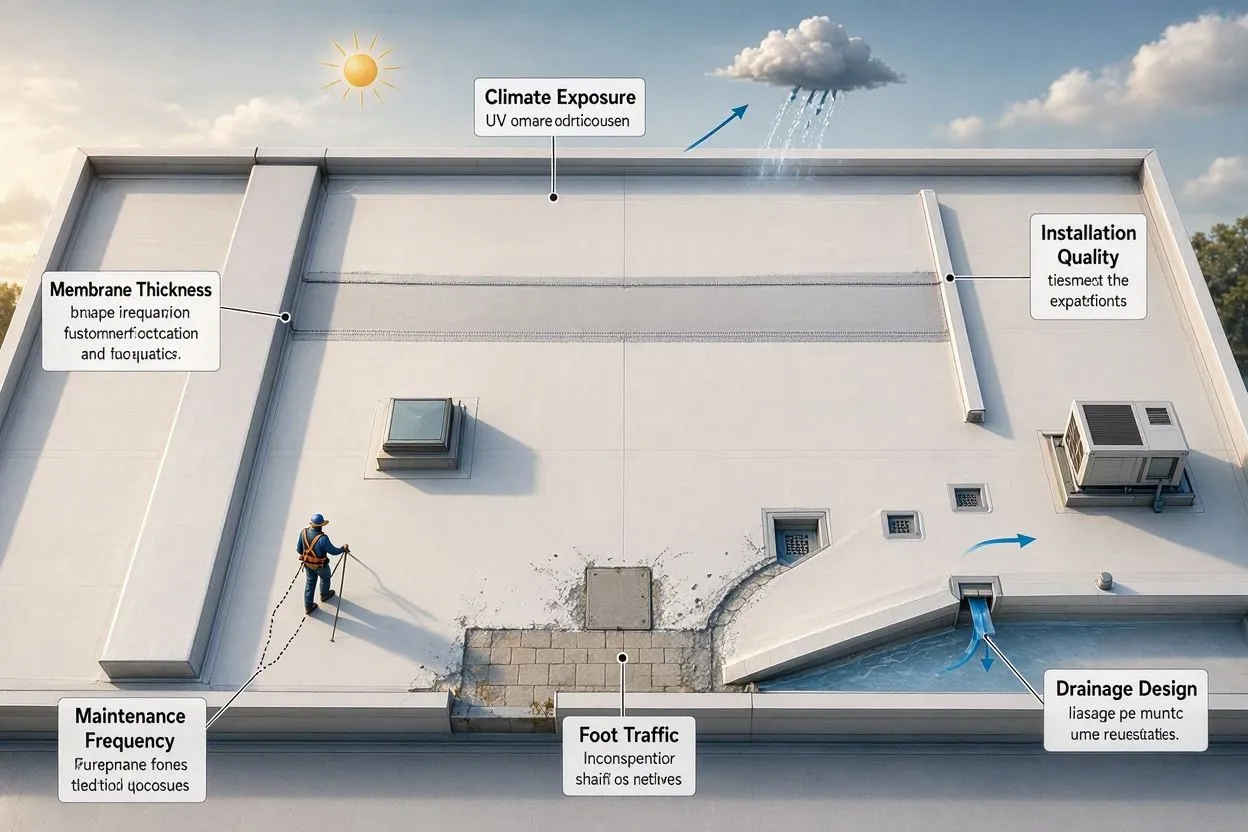
Six things determine where a TPO roof lands in that range: installation quality, membrane thickness, climate exposure, maintenance frequency, foot traffic, and drainage design.
Installation Quality
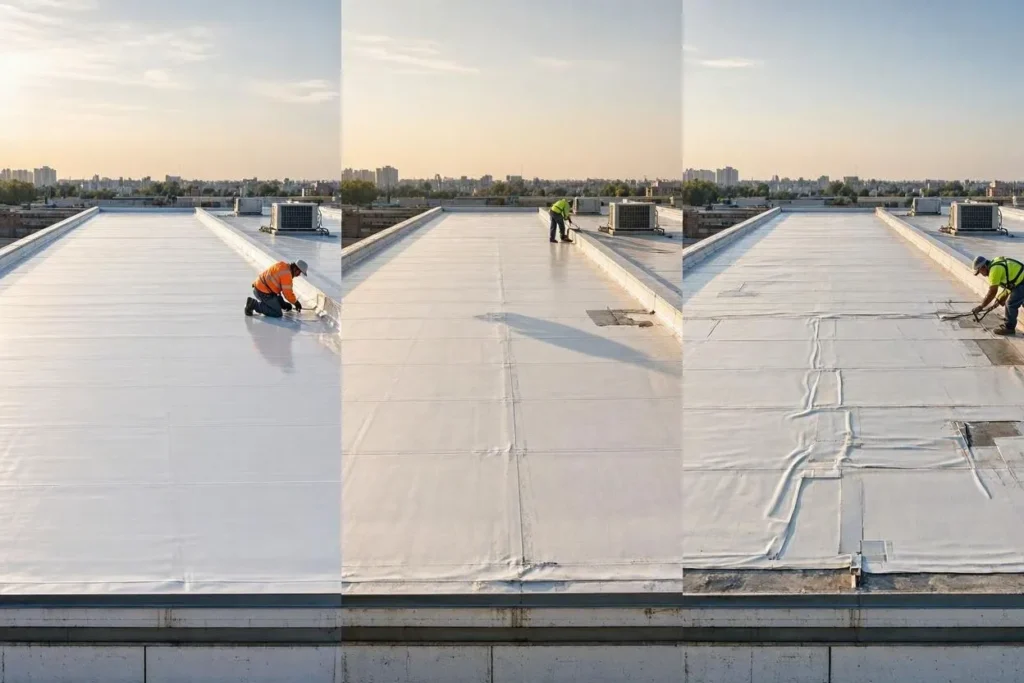
Poor seam welding can cut 5 to 10 years off a roof’s life compared to a properly heat-welded job. TPO sheets rely on hot-air welding to fuse seams into one waterproof layer, and seams separate years early if a contractor rushes the weld or skips probe testing. Certified installers run peel tests on sample welds and check for hidden gaps with infrared scans before signing off. Roofs installed without those checks have shown seam failure as early as year 8 in industry case reviews.
Membrane Thickness
Thicker membranes hold up better against punctures and UV, though the thickness above the reinforcing scrim layer matters more than the mil rating printed on the roll. TPO comes in four common thicknesses (45, 60, 80, and 90 mil), with over-scrim thickness ranging from about 15 mils on entry-level product to 36 mils on premium grades. A 45-mil sheet typically lasts 15 to 20 years; an 80-mil sheet with strong over-scrim coverage can push past 25. If you’re comparing quotes, ask for the over-scrim spec, not just the total mil count.
Climate and Sun Exposure
UV radiation and sustained heat wear a membrane down faster, while cooler, less sun-exposed climates slow that process. Roofs in Arizona and Texas commonly top out at 12 to 15 years, even with white reflective membrane. The Pacific Northwest regularly sees 20 to 25 years from the exact same product line. Freeze-thaw cycling adds its own stress in colder regions too, though PVC and EPDM both outperform TPO in sustained sub-freezing temperatures.
Maintenance Frequency
Roofs inspected twice a year outlast roofs checked once every few years, because small tears and clogged drains compound into major failures when nobody catches them. A single unnoticed puncture near an HVAC curb can saturate the insulation underneath and force a full tear-off years ahead of schedule if it sits unpatched through two rainy seasons.
Foot Traffic
Repeated foot traffic near HVAC units, solar arrays, and service walkways wears the membrane faster than weather alone. Data centers, hospitals, and buildings with rooftop mechanical rooms see the most traffic-related wear. Heat-welded walk pads, usually 150 to 180 mils thick, cut down on that wear by giving techs a protected path to the equipment.
Drainage and Ponding Water
Water sitting for more than 48 hours stresses seams, promotes algae growth, and adds structural load, even though TPO itself resists water penetration fine. Tapered insulation that moves water to drains within hours rarely develops ponding-related failures. Flat decks with undersized drains often show degradation around low points 5 to 8 years before the rest of the roof shows comparable wear.
How Does TPO Roof Lifespan Vary by Climate Zone?
| Climate Zone | Expected TPO Lifespan | Representative States |
| Hot and sunny | 12–15 years | Arizona, Florida, Texas |
| Mixed or temperate | 15–20 years | Midwest, Mid-Atlantic |
| Cool and moderate | 20–25 years | Pacific Northwest, northern states |
Building codes widen that gap in hurricane-prone areas. Florida’s building code and Miami-Dade County’s Notice of Acceptance program call for wind-uplift and impact testing beyond baseline ASTM standards, which pushes coastal buildings toward thicker membranes and fully adhered attachment regardless of climate-driven UV wear. Worth confirming current code requirements with a local contractor before specifying a system, since these standards get revised.
How Long Does TPO Roofing Last Compared to PVC and EPDM?
TPO runs 15 to 25 years, slightly behind PVC and EPDM, both of which commonly hit 20 to 30. But raw lifespan isn’t the whole story, and the right pick depends on what the building is used for.
- TPO: heat-welded seams, high reflectivity, moderate chemical resistance. Good fit for retail, schools, warehouses, and light industrial buildings in sunny climates.
- PVC: heat-welded seams, high reflectivity, excellent chemical and grease resistance. The default choice for restaurants, food plants, breweries, and hospitals.
- EPDM: taped or primed seams, low reflectivity unless white membrane is specified, strong cold-weather flexibility. Common on cold-region warehouses and budget-focused jobs.
PVC handles grease and chemical exposure far better than TPO, which is why restaurants and food-processing facilities often pay more for it. EPDM’s rubber composition stays flexible in freezing weather where TPO’s thermoplastic blend doesn’t, giving it an edge in northern warehouse work where budget matters more than solar reflectance.
What Warranty Coverage Should You Expect on a TPO Roof?
Manufacturers typically warranty TPO roofs for 10, 15, or 20 years, tied directly to membrane thickness and installation spec.
| Warranty Tier | Typical System | Common Manufacturers |
| 10 years | ~45-mil membrane, standard fastening | GAF, Carlisle, Versico, Mule-Hide |
| 15 years | ~60-mil membrane, cover board included | GAF, Johns Manville, Firestone (Elevate) |
| 20 years | ~80-mil+ membrane, enhanced fastening, manufacturer inspection | Firestone (Elevate), Carlisle, Johns Manville, GAF, Versico |
Ask specifically about No Dollar Limit (NDL) coverage: it pays full repair or replacement cost within the warranty period, with no declining reimbursement schedule. Standard warranties often reduce that payout percentage as the roof ages, so a 20-year NDL warranty on an 80-mil system is worth meaningfully more than a 20-year standard warranty on paper, even though both list the same term length.
Warranty validity also depends on documented maintenance. Skip a required annual inspection, use a non-approved sealant, or let someone install unauthorized rooftop equipment, and coverage can be voided entirely, regardless of how many years are left on the term. Which raises the obvious next question: how do you know if a roof needs attention before the warranty question even comes up?
What Are the Signs a TPO Roof Needs Repair or Replacement?
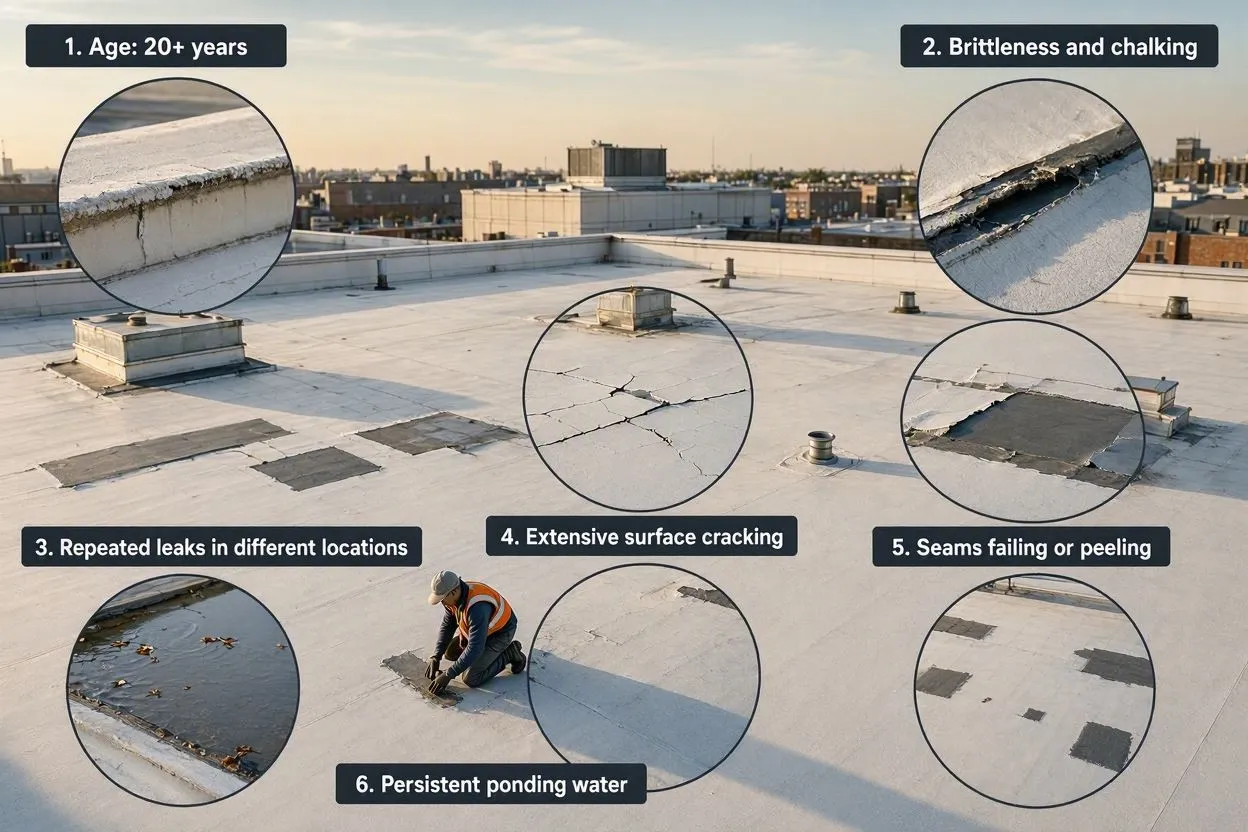
A TPO roof shows measurable warning signs well before a leak reaches the building’s interior. Six show up consistently across aging systems:
- Age approaching 20 to 25 years. A roof nearing its warranted service life deserves a close look even without visible damage, since materials go brittle from the inside before cracking shows on the surface.
- Repeated leaks in different locations. One patch job is normal maintenance. Leaks in three or more separate spots within a year signal broader membrane deterioration.
- Alligatored or cracked surface texture. A membrane that looks like cracked alligator skin has lost the flexibility it needs to handle thermal expansion and contraction.
- Ponding water lasting beyond 48 hours. Standing water that won’t drain within two days points to a drainage problem, a structural sag, or both.
- Rising energy bills with no other explanation. A TPO roof’s reflective surface degrades over time, and cooling costs climbing year over year often trace back to a roof that’s no longer reflecting UV efficiently.
- Expired warranty plus visible wear. A roof past its warranty term showing any of the above five signs belongs at the top of the capital-improvement list, not on a wait-and-see basis.
Damage under about 25% of the total roof area can usually be repaired rather than replaced, though most manufacturers and local codes require a full tear-off beyond that threshold. Document warning signs with dated photos either way. It strengthens any insurance claim tied to storm damage, since adjusters weigh pre-storm condition heavily when deciding whether damage came from a single weather event or from gradual wear.
How Can You Extend the Life of a TPO Roof?
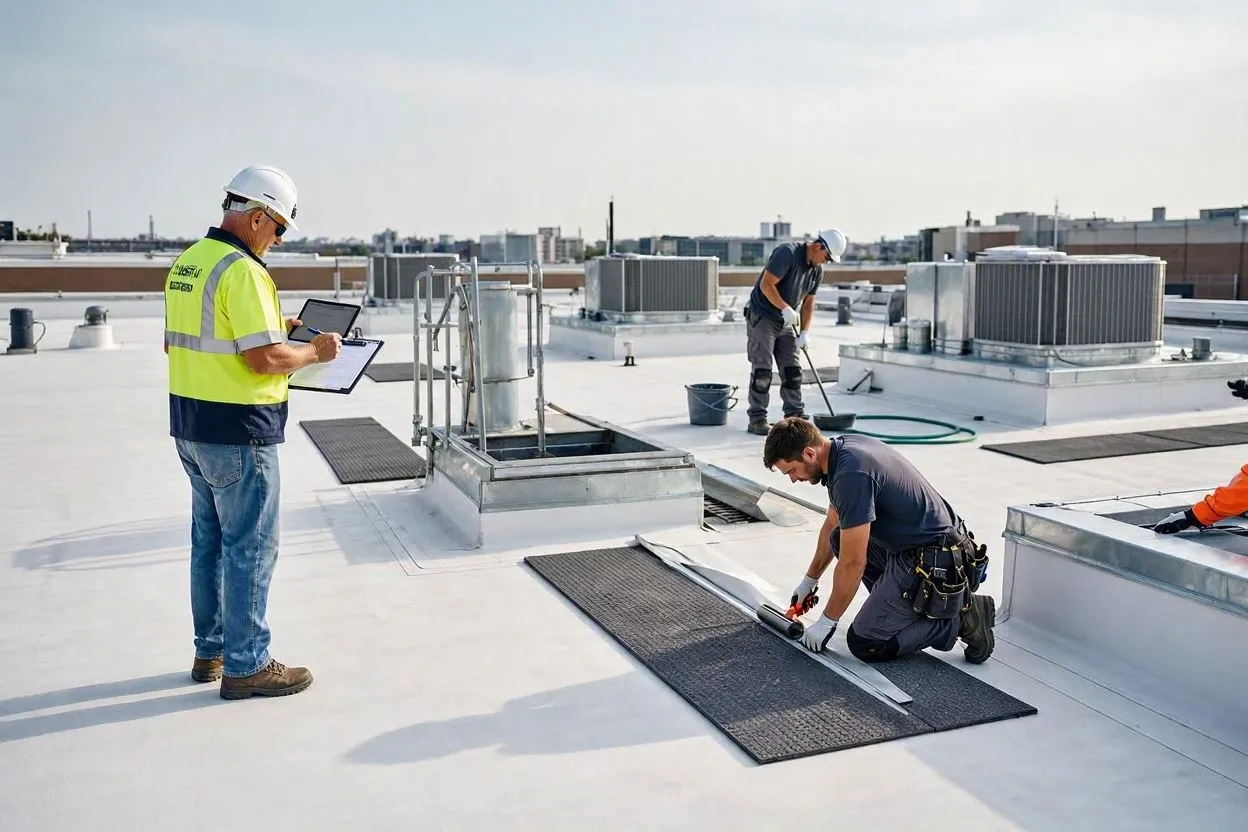
Scheduled inspections, prompt repairs, and controlled rooftop access can add 5 to 10 years beyond the manufacturer’s baseline warranty term. A few things apply across every climate zone:
- Get a professional inspection twice a year, spring and fall.
- Clear drains, gutters, and scuppers after every major storm.
- Check seams and flashing for lifting at least once a year.
- Install walk pads in high-traffic zones near HVAC curbs and access points.
- Repair small punctures or seam separations within 30 days of finding them.
- Keep a written maintenance log with dated photos, for warranty compliance.
- Skip pressure washing above 2,000 psi. It strips the reflective top layer.
A commercial property in Chicago that sticks to this schedule can reasonably reach 22 to 24 years on a 60-mil system rated for a 20-year warranty. That’s four extra years earned through maintenance, not material upgrades.
How Much Does TPO Roof Replacement Cost?
TPO replacement runs $6 to $15 per square foot including materials and labor, putting a 10,000-square-foot commercial roof somewhere between $60,000 and $150,000.
| System Tier | Membrane Thickness | Installation Method | Cost per Sq Ft | 10,000 Sq Ft Project Cost |
| Standard | 45 mil | Mechanically attached | $6–$8 | $60,000–$80,000 |
| Mid-grade | 60 mil | Mechanically attached or induction-welded (RhinoBond) | $8–$11 | $80,000–$110,000 |
| Premium | 80–90 mil | Fully adhered with cover board | $11–$15 | $110,000–$150,000 |
Membrane thickness, insulation type, attachment method, and local labor rates push a project toward the low or high end of that range. A recover project (new membrane over sound, dry insulation, no full tear-off) usually costs 20% to 30% less, since it skips deck-level demolition and disposal entirely.
Energy savings offset part of the upfront cost too. A reflective TPO membrane cuts cooling costs compared to a dark, non-reflective roof, which is worth factoring into the total cost of ownership rather than judging the system on installation price alone. Get an actual estimate from an energy auditor or contractor for your building’s specific numbers rather than relying on rule-of-thumb percentages.
Conclusion
Warranty tier, membrane thickness, and maintenance discipline move a TPO roof’s lifespan more than any single factor covered here, and a documented twice-yearly inspection schedule remains the least expensive way to add years to a roof that’s already on the building.