
TPO roofing thermoplastic polyolefin (TPO) is a single-ply membrane installed on flat and low-slope roofs. It accounts for over 40% of the North American commercial roofing market and costs $5 to $12 per sq ft ($53.82 to $129.17 per sq m) installed depending on membrane thickness, installation method, and roof complexity.
A white TPO membrane reflects 70 to 90% of solar radiation, reducing cooling costs by 10 to 30% versus dark roofing materials. 3 installation methods exist — mechanically attached, fully adhered, and ballasted — and 3 membrane thicknesses apply: 45 mil, 60 mil, and 80 mil. Each combination carries different costs, wind uplift ratings, and warranty eligibility.
What TPO Roofing Is and How It Works
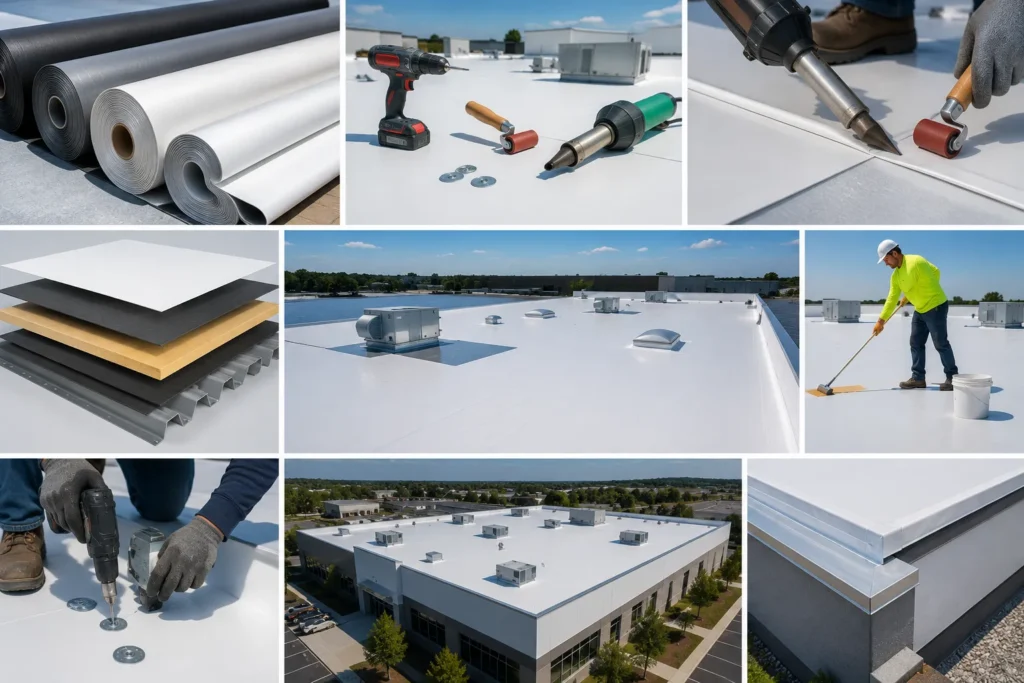
TPO roofing is a thermoplastic polyolefin membrane made from a blend of polypropylene and ethylene-propylene rubber. The membrane consists of 3 layers: a TPO polymer base that bonds to the roof system, a polyester-reinforced scrim in the middle for puncture and tear resistance, and a TPO compounded top layer that provides UV resistance and the reflective white surface.
TPO rolls come in widths of 6, 8, 10, and 12 feet (1.8, 2.4, 3.0, and 3.7 m) and lengths up to 100 feet (30.5 m). Installers roll out the membrane across the roof deck and heat-weld every seam at 900 to 1,100°F (482 to 593°C) using a hot-air welding machine. The welded seam fuses both layers of TPO into a single bond that is stronger than the membrane itself — eliminating the seam-failure risk that affects adhesive-seamed systems like EPDM.
TPO was introduced in the early 1990s as an alternative to EPDM (ethylene propylene diene monomer) rubber and PVC (polyvinyl chloride). Early formulations failed faster than expected due to UV degradation and seam shrinkage. Modern TPO formulations from manufacturers including Firestone Building Products, Carlisle SynTec, and GAF have corrected those issues with improved polymer blends and UV stabilizers, extending expected service life to 20 to 30 years on 60 mil and 80 mil products.
The 3-Layer TPO Membrane Structure
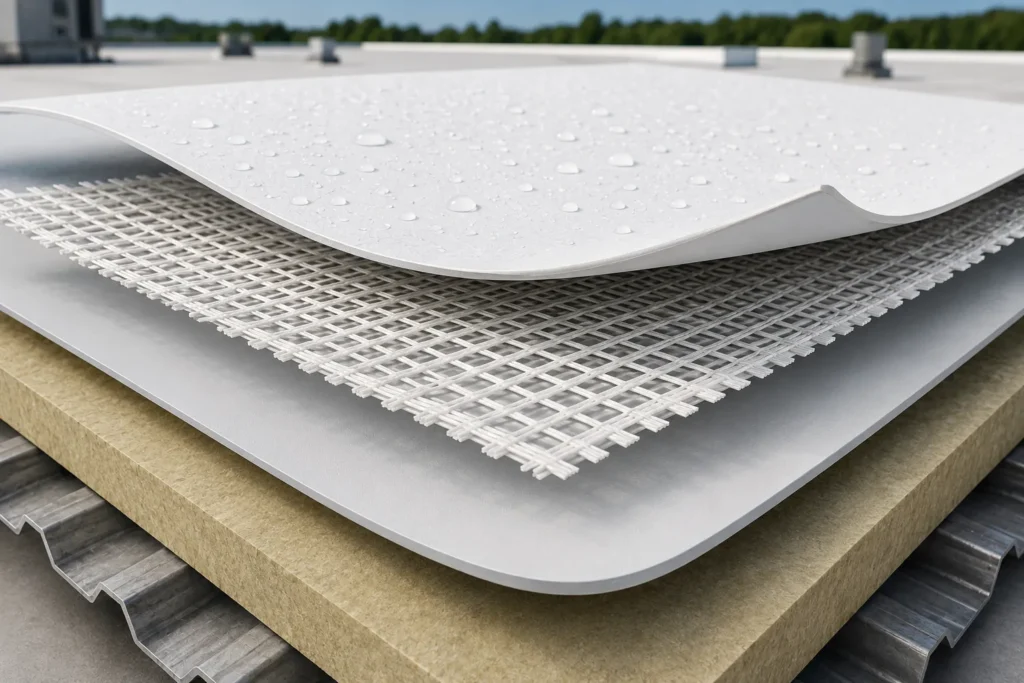
- TPO polymer base: Bonds to the roof deck, insulation, or coverboard. Provides the membrane’s flexibility in temperature swings from -40°F (-40°C) to 200°F (93.3°C) without cracking.
- Polyester-reinforced scrim: The middle fabric layer adds dimensional stability, puncture resistance, and prevents the membrane from stretching under foot traffic or hail impact.
- TPO compounded top ply: The weathering surface. White TPO achieves a Solar Reflective Index (SRI) of 104 to 107, qualifying for ENERGY STAR certification and contributing to LEED (Leadership in Energy and Environmental Design) credits.
TPO Roofing Cost Breakdown for 2026
TPO roofing costs $5 to $12 per sq ft ($53.82 to $129.17 per sq m) installed in 2026. Membrane thickness is the single largest variable: 45 mil, 60 mil, and 80 mil products carry material prices of $0.80, $1.10, and $1.50 per sq ft respectively. Labor represents 40 to 55% of total installed cost, depending on installation method and roof complexity.
Cost by Installation Method
- Mechanically attached TPO: $5 to $8 per sq ft ($53.82 to $86.11 per sq m) Screws and metal stress plates fasten the membrane edge through insulation into the deck. The next sheet covers each fastened edge. Fastest method, lowest labor cost, most common on commercial roofs.
- Fully adhered TPO: $6 to $10 per sq ft ($64.58 to $107.64 per sq m) Adhesive bonds the entire membrane surface to the coverboard or insulation. No exposed fasteners. Best wind uplift rating. Required for high-wind zones above 130 mph (209 km/h) design wind speed.
- Ballasted TPO: $4 to $7 per sq ft ($43.06 to $75.35 per sq m) Loose-laid membrane weighted down with 10 to 12 lbs per sq ft (48.8 to 58.6 kg per sq m) of river-washed gravel or pavers. Lowest material and labor cost but requires structural support for the added weight. Rarely specified on new builds after 2018.
Cost by Membrane Thickness: 45 mil vs 60 mil vs 80 mil
Membrane thickness — measured in mils, where 1 mil equals one-thousandth of an inch — directly controls puncture resistance, lifespan, and warranty tier. 60 mil is the NRCA-recommended minimum for commercial applications. The $500 to $1,500 upcharge from 45 mil to 60 mil on a standard roof buys 5 to 10 years of added service life.
- 45 mil: Material cost $0.80 to $1.20 per sq ft. Lifespan 15 to 20 years. Minimum acceptable for residential garages and low-traffic roofs. Qualifies for 10-year manufacturer warranties only.
- 60 mil: Material cost $1.10 to $1.60 per sq ft. Lifespan 20 to 25 years. Standard commercial specification. Qualifies for 15- to 20-year manufacturer warranties from Firestone, Carlisle, and GAF.
- 80 mil: Material cost $1.50 to $2.20 per sq ft. Lifespan 25 to 30 years. Specified for high-traffic roofs, rooftop gardens, and roofs with frequent maintenance foot traffic. Qualifies for up to 20-year NDL (No Dollar Limit) warranties.
Additional Cost Factors
- Tear-off and disposal: Add $1.00 to $2.50 per sq ft ($10.76 to $26.91 per sq m) to remove and dispose of existing membrane and wet insulation.
- Polyiso insulation: Add $2.00 to $4.00 per sq ft ($21.53 to $43.06 per sq m) for 2-layer polyisocyanurate (polyiso) insulation achieving R-30 or higher.
- Coverboard: Add $0.50 to $1.50 per sq ft ($5.38 to $16.15 per sq m) for a half-inch gypsum or high-density polyiso coverboard that protects insulation and provides a smooth membrane surface.
- Building permits: $150 to $500 depending on municipality and project scope.
TPO Roofing Quick-Reference: Specs vs EPDM and PVC
The table compares TPO at all 3 thickness grades against 60 mil EPDM and 60 mil PVC — the 2 most common alternative single-ply membranes. Use installed cost figures for contractor quote comparison.
| Specification | 45 mil TPO | 60 mil TPO | 80 mil TPO | EPDM (60 mil) | PVC (60 mil) |
| Material cost/sq ft | $0.80–$1.20 | $1.10–$1.60 | $1.50–$2.20 | $0.70–$1.10 | $1.20–$2.00 |
| Installed cost/sq ft | $5.00–$7.00 | $6.00–$9.00 | $7.50–$12.00 | $4.00–$7.00 | $6.00–$10.00 |
| Lifespan | 15–20 years | 20–25 years | 25–30 years | 25–30+ years | 25–30 years |
| Solar reflectance | 70–80% | 70–80% | 70–80% | 5–15% (black) | 80–90% |
| Seam method | Heat weld | Heat weld | Heat weld | Tape/adhesive | Heat weld |
| Chemical resistance | Moderate | Moderate | Moderate | Moderate | High |
| Best climate | Hot/mixed | Hot/mixed | All climates | Cold climates | All climates |
| Min roof slope | 1/4:12 | 1/4:12 | 1/4:12 | 1/4:12 | 1/4:12 |
For a full side-by-side cost analysis of EPDM and PVC alongside TPO, see the rubber roofing cost guide at Rainy Roofers.
How to Install TPO Roofing: 3 Methods Step by Step
To install TPO roofing, the crew follows the same 5 preparation steps regardless of attachment method. The membrane application step differs across the 3 methods: mechanically attached, fully adhered, and ballasted.
Step 1 — Deck Preparation (All 3 Methods)
- Inspect the deck: Remove all existing membrane, debris, and damaged fasteners. Replace any rotted plywood or OSB. The deck must be dry, clean, and structurally sound before insulation goes down.
- Evaluate drainage: Identify low spots where water pools. Flat roofs require a minimum 1/4:12 slope (2% gradient) to drain within 48 hours of rainfall. Install tapered insulation to correct inadequate slope.
- Calculate wind uplift: The structural engineer or contractor calculates fastener spacing based on local design wind speed. In Wind Zone III coastal areas rated at 150 mph (241 km/h), corners receive fasteners spaced 3 to 4 inches (7.6 to 10.2 cm) apart. Field areas receive 6 to 12 inches (15.2 to 30.5 cm) spacing.
- Install polyiso insulation: Lay 2 layers of polyisocyanurate boards with staggered and offset joints to eliminate thermal bridging. Achieve minimum R-30 for most commercial applications. Mechanically fasten the first layer; adhere the second layer to the first.
- Install coverboard: Set a 1/2-inch (12.7 mm) high-density polyiso or gypsum board over the insulation. The coverboard protects insulation from membrane indentation and provides a smooth, consistent substrate.
Step 2A — Mechanically Attached TPO
To install mechanically attached TPO, unroll the first membrane sheet along one roof edge. Allow the membrane to relax flat for 30 minutes to release roll memory before fastening. Drive screws with 2-inch (5.1 cm) metal stress plates through the membrane’s edge, the coverboard, and the insulation into the structural deck at the wind-uplift-calculated spacing. Overlap the next sheet 6 inches (15.2 cm) over the fastened edge, completely covering every screw and plate. Heat-weld the 6-inch lap seam at 900 to 1,100°F (482 to 593°C) using an automatic hot-air welder. The welder’s roller presses both TPO layers together as the seam cools, forming a continuous watertight bond.
Step 2B — Fully Adhered TPO
To install fully adhered TPO, apply TPO bonding adhesive to both the coverboard surface and the underside of the membrane using a stiff-bristle brush or roller. Allow the adhesive to flash off for 1 to 3 minutes until it becomes tacky — do not allow the adhesive to dry fully, as full drying eliminates bond strength. Roll the membrane onto the adhesive surface starting at one edge and pressing firmly outward to eliminate air bubbles and wrinkles. Overlap all seams 6 inches (15.2 cm) and heat-weld seams identically to the mechanically attached method. Fully adhered systems provide the highest wind uplift resistance and qualify for the highest warranty tiers, including NDL warranties from Firestone UltraPly TPO, Carlisle Sure-Weld, and GAF EverGuard.
Step 2C — Ballasted TPO
To install ballasted TPO, loose-lay the membrane across the entire roof surface with no mechanical fasteners and no adhesive in the field area. Mechanically fasten membrane only at perimeters and penetrations. Spread 10 to 12 lbs per sq ft (48.8 to 58.6 kg per sq m) of 1.5 to 2.5 inch (3.8 to 6.4 cm) diameter river-washed gravel uniformly over the membrane. Confirm the structural deck can carry the ballast weight — most concrete and steel decks handle it; lightweight wood-frame structures typically cannot. Ballasted systems are rarely specified after 2018 because they trap moisture, make leak detection difficult, and complicate future re-roofing.
Step 3 — Edge Termination and Penetrations (All Methods)
Terminate the membrane at all roof edges using metal termination bars secured every 6 to 9 inches (15.2 to 22.9 cm) into the parapet or edge substrate. Apply sealant above the termination bar. At every pipe vent, HVAC curb, skylight, and drain, cut the membrane to fit and weld a prefabricated TPO boot or flashing piece directly to the membrane surface. Install walkway pads — 1/4-inch (6.4 mm) thick TPO or rubber strips — in all high-traffic paths to protect the membrane surface from foot traffic indentation.
TPO Roofing Energy Efficiency and ROI
White TPO reflects 70 to 90% of solar radiation — compared to 5 to 15% for standard black EPDM. The SRI of 104 to 107 for white TPO exceeds ENERGY STAR’s minimum threshold of 82 for low-slope roofs. A 20,000 sq ft (1,858.1 sq m) warehouse switching from black EPDM to white TPO saves $3,000 to $6,000 annually in cooling costs in hot climates. At $6,000 annual savings on a $140,000 TPO installation, energy savings recover the cost premium over EPDM within 5 to 8 years.
In cold climates, the reflective surface of white TPO reduces passive solar heat gain in winter, which can increase heating costs. Cold-climate building owners in climates with heating degree days above 6,000 should evaluate whether the cooling savings offset the heating cost increase before specifying white TPO over black EPDM.
TPO qualifies for LEED credits under the Sustainable Sites category for heat island reduction — cool roofs with SRI above 78 for low-slope applications earn 1 LEED point. TPO is 100% recyclable at end of life and contains no chlorine, unlike PVC which releases dioxins if incinerated.
TPO Roofing vs EPDM vs PVC: Which System Fits Your Building
TPO, EPDM (ethylene propylene diene monomer), and PVC (polyvinyl chloride) are the 3 standard single-ply membrane systems for flat and low-slope roofs. All 3 require professional installation to achieve rated lifespan and warranty coverage. Each system fits different building types, climates, and budget ranges.
Choose TPO When Energy Efficiency Drives the Decision
TPO performs best on commercial buildings in warm and mixed climates where cooling costs represent a major operating expense. Office buildings, retail spaces, warehouses, and schools in the Sun Belt states consistently recover the TPO cost premium through energy savings within 5 to 8 years. TPO’s heat-welded seams outperform EPDM’s adhesive seams — seam failure is the primary cause of flat roof leaks, and welded seams eliminate that failure mode. A standing seam metal roof on a low-slope section is an alternative for pitched areas; TPO remains the correct system for flat roof sections below 3:12 pitch.
Choose EPDM When Cold-Weather Flexibility Matters Most
EPDM is a thermoset synthetic rubber that remains flexible at temperatures as low as -40°F (-40°C). TPO and PVC are thermoplastics that can become brittle in extreme cold if the membrane flexes at penetrations or parapets. EPDM has a 60-year commercial track record — longer than TPO, which has been in use only since the early 1990s. EPDM costs $4 to $8 per sq ft ($43.06 to $86.11 per sq m) installed — $1 to $2 per sq ft less than comparable TPO — making it the budget choice for cold-climate roofs where energy reflectance is less important.
Choose PVC When Chemical Resistance Is the Priority
PVC roofing is the correct specification for restaurants, food processing facilities, airports, and industrial buildings with rooftop exhaust carrying grease, oils, or chemical discharge. PVC resists grease and chemical degradation that dissolves TPO’s top layer over time in those environments. PVC costs $6 to $10 per sq ft ($64.58 to $107.64 per sq m) installed — 20 to 40% more than TPO. PVC also achieves a Class A fire rating without additional coatings, meeting stricter fire code requirements in some jurisdictions. For buildings without chemical exposure, the PVC cost premium is difficult to justify over 60 mil TPO.
TPO Roofing Maintenance and Common Failure Modes
A properly installed TPO roof requires 2 inspections per year — one in spring and one in fall — to identify seam issues, membrane punctures, and drainage blockages before they cause interior water damage. Annual maintenance cost runs $0.05 to $0.15 per sq ft ($0.54 to $1.61 per sq m), or $500 to $1,500 for a 10,000 sq ft (929.0 sq m) commercial roof.
4 Common TPO Failure Modes and How to Identify Them
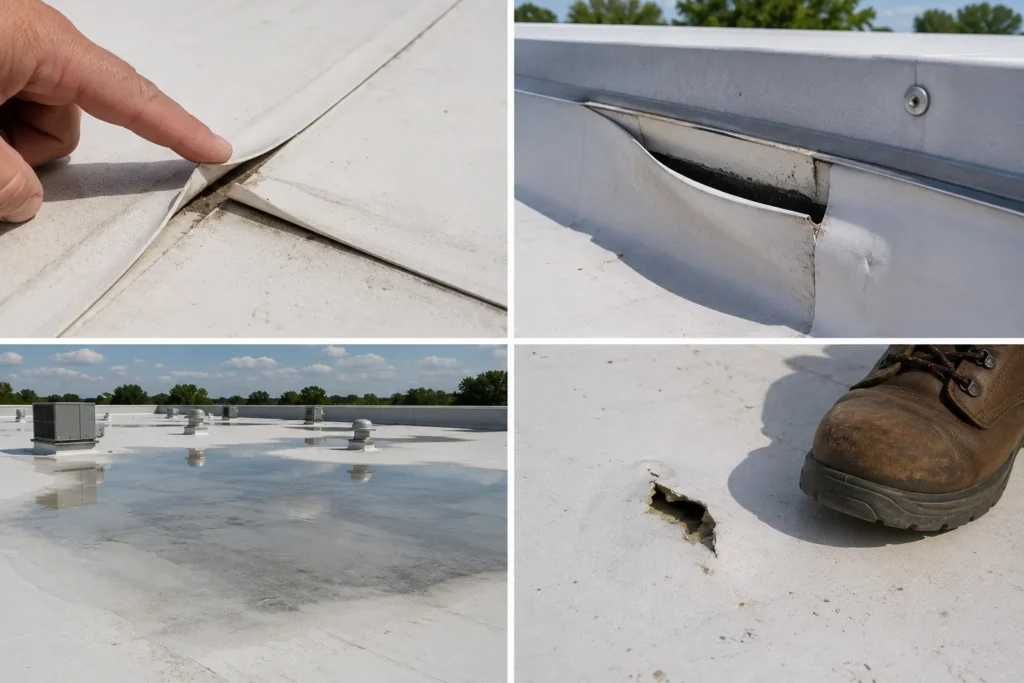
- Seam delamination: Seams exposed to improper welder temperature or wet membrane surfaces during installation peel apart. Identify by pressing the seam edge — delaminated seams lift without resistance. Repair by cutting out the failed seam, cleaning, and welding new TPO tape over the joint.
- Membrane shrinkage: Early-generation TPO (pre-2005) formulations shrink over time, pulling membrane away from edge terminations and penetration flashings. Identify by gaps at termination bars or lifted flashing edges. Modern formulations have significantly reduced shrinkage, but inspect all pre-2010 TPO installations annually.
- Ponding water damage: Standing water that remains on the roof for more than 48 hours after rainfall accelerates membrane degradation, compresses insulation, and deflects the deck. Add tapered insulation or install drainage crickets to eliminate ponding areas.
- Membrane punctures: Foot traffic from HVAC maintenance without walkway pads, dropped tools, and hail impact puncture the membrane surface. Small punctures under 1 inch (2.54 cm) in diameter repair with TPO patch material and a hand welder in under 30 minutes.
Recover vs Tear-Off: When to Choose Each
A TPO recover installs the new membrane over the existing roof without tear-off, saving $1.00 to $2.50 per sq ft ($10.76 to $26.91 per sq m) in removal and disposal costs. A recover is valid when: the existing roof has only 1 membrane layer, the insulation is dry (confirmed by infrared scan or core cuts), and the deck is structurally sound.
Tear-off is required when: moisture infrared scanning reveals wet insulation, the roof already has 2 membrane layers (most codes prohibit a third), structural deck damage exists, or the local building department mandates full tear-off. Wet insulation under a new membrane traps moisture, accelerates deck rot, and voids the new membrane warranty within 2 to 3 years.
Calculate Your TPO Roofing Cost Before Accepting Any Quote
TPO roofing is the dominant commercial flat roof membrane in North America for 3 reasons: heat-welded seams that outperform adhesive alternatives, white reflective surfaces that reduce cooling costs 10 to 30%, and installed costs 10 to 20% below PVC with comparable seam performance. 60 mil fully adhered TPO from a manufacturer such as Firestone UltraPly TPO, Carlisle Sure-Weld, or GAF EverGuard delivers a 20-year NDL warranty and 20 to 25 years of service life at $6 to $10 per sq ft installed.
Specify 60 mil over 45 mil — the $500 to $1,500 premium pays back through 5 to 10 years of added roof life. Choose fully adhered over mechanically attached if your building is in a high-wind zone or requires the highest warranty tier. Confirm insulation is dry with an infrared scan before accepting a recover proposal — wet insulation under new TPO voids the warranty and causes hidden deck damage within 3 years.
Compare TPO quotes against EPDM and PVC using the rubber roofing cost guide at Rainy Roofers. Contact the Rainy Roofers team for a free flat roof assessment and itemized TPO installation quote for your building.