
A concrete retaining wall costs $25 to $95 per square foot installed in 2026, lasts 50 to 100 years, and holds back soil on any slope a timber wall cannot handle. Whether you choose precast concrete blocks, poured cement with steel rebar, or mortared masonry units, the materials you pick change the math on every project. This guide breaks down all of it: real 2026 prices for each building material, the 4 main wall types, permit rules, and the 5 warning signs that your current wall needs repair.
We pulled data from national contractor surveys, National Concrete Masonry Association (NCMA) design standards, and our own installation records to keep every number here accurate.
What Is a Concrete Retaining Wall?
A concrete retaining wall is a rigid masonry structure that holds back soil where the ground changes elevation. Contractors build these walls from 3 core materials Portland cement, crushed stone aggregate, and steel rebar — either poured on site or assembled from precast concrete blocks. Homeowners use them to stop soil erosion, flatten sloped yards, protect foundations, and create usable terraces for gardens, driveways, and patios.
The wall works by resisting lateral earth pressure the sideways push of soil and water behind it. A 4-foot (1.2-meter) wall holding average soil resists roughly 2,000 pounds (907 kg) of pressure per linear foot. Double the height and that pressure quadruples. This single fact explains most wall failures: people build tall walls with short-wall methods.
How Much Does a Concrete Retaining Wall Cost in 2026?
A concrete retaining wall costs $25 to $95 per square foot installed in 2026, or $3,500 to $12,000 for a typical residential project. Materials alone run $10 to $40 per square foot that covers concrete blocks or ready-mix cement, rebar, gravel base aggregate, drainage pipe, and cap units. Labor covers the rest.
Here is the full 2026 price breakdown by wall type:
| Wall Type | Cost per Sq Ft (Installed) | Typical 30-ft Wall (4 ft tall) |
| Concrete block (CMU) | $25 – $45 | $3,000 – $5,400 |
| Segmental retaining wall (SRW) | $30 – $50 | $3,600 – $6,000 |
| Poured concrete | $40 – $75 | $4,800 – $9,000 |
| Poured with stone veneer | $60 – $95 | $7,200 – $11,400 |
Three factors push your quote toward the high end: wall height above 4 feet (1.2 m), poor site access for equipment, and clay soil that demands extra drainage work. Get 3 written quotes before you sign anything — pricing between contractors in the same city varies by up to 40%.
4 Types of Concrete Retaining Walls
Every concrete retaining wall falls into 1 of 4 categories:
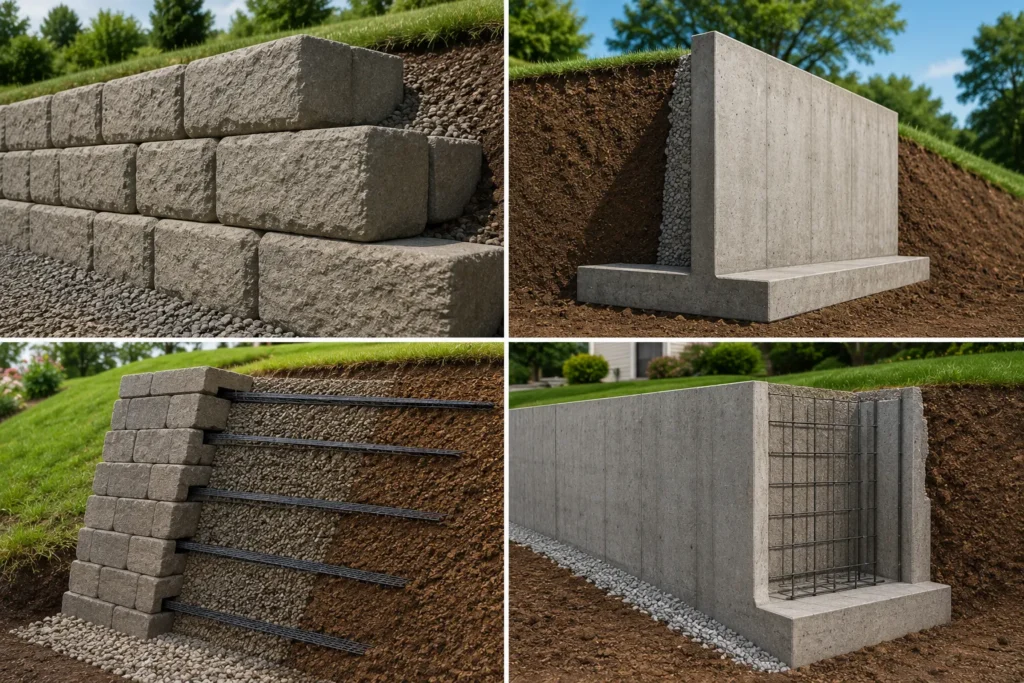
- Gravity walls rely on their own weight to resist soil pressure. Large interlocking blocks — some weighing 2,200 pounds (998 kg) each — stack without mortar. Gravity walls work best under 4 feet.
- Cantilever walls use a poured L-shaped footing buried under the soil they retain. The soil’s own weight presses down on the footing and locks the wall in place. Cantilever designs handle heights up to 25 feet (7.6 m).
- Segmental retaining walls (SRW) stack dry-cast concrete blocks with a slight backward lean called batter. Geogrid mesh layers tie tall SRWs into the soil behind them. SRWs dominate residential projects because installation is fast and repairs are simple.
- Poured concrete walls form one solid, steel-reinforced slab. Rebar runs through the entire pour, so the finished wall has no joints and no weak points. Poured walls carry the heaviest loads but cost the most to fix if they crack.
Poured Concrete vs Block Retaining Wall: Which One Wins?
Block walls win for most homeowners; poured concrete wins for height and heavy loads. The right choice depends on your budget, wall height, and repair tolerance.
| Factor | Poured Concrete | Concrete Block (SRW/CMU) |
| Cost per sq ft | $40 – $75 | $25 – $50 |
| Max practical height | 25+ ft with engineering | 4 ft without geogrid, 20 ft with |
| Install time (30-ft wall) | 5 – 7 days (curing included) | 2 – 3 days |
| Repair difficulty | Hard — cracks need injection or rebuild | Easy — swap individual blocks |
| Design options | Needs veneer or stamping for looks | 20+ colors and textures built in |
| Lifespan | 50 – 100 years | 40 – 75 years |
Pick poured concrete if your wall supports a driveway, pool, or structure — engineers call that a surcharge load. Pick block if you want lower cost, faster installation, and easy future repairs.
Do You Need a Permit for a Concrete Retaining Wall?
Yes, most US cities require a permit for any retaining wall over 4 feet (1.2 m) tall, measured from the bottom of the footing. Some jurisdictions including parts of California and Washington drop that limit to 3 feet.
Walls above the permit threshold also need stamped drawings from a licensed structural engineer. Expect $500 to $2,000 for engineering plus $50 to $450 for the permit itself. Skip the permit and you risk 3 problems: fines, forced demolition, and a failed home sale inspection years later. Call your local building department before any digging starts — the call costs nothing.
How to Build a Concrete Retaining Wall in 7 Steps
To build a concrete retaining wall that lasts, follow this sequence:
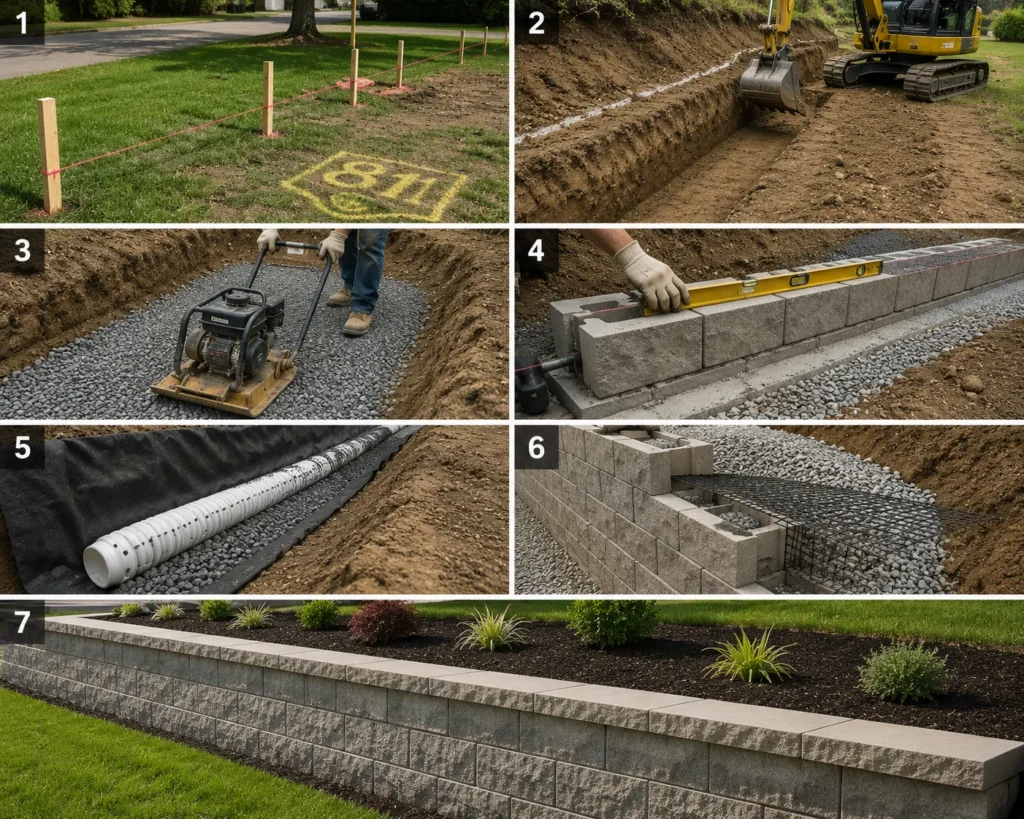
- Mark the layout with stakes and string, then call 811 to locate buried utilities. The service is free everywhere in the US.
- Excavate the trench to a depth of the wall height’s one-tenth plus 6 inches (15 cm) of base room. A 4-foot wall needs roughly a 12-inch (30-cm) deep trench.
- Compact 6 inches of crushed stone as the base course. Skip the compactor and the wall settles unevenly within 2 winters.
- Set and level the first row of blocks — or pour a 3,500 PSI concrete mix footing for poured walls. This row determines whether every row above it sits straight.
- Install the perforated drain pipe behind the first course, wrapped in filter fabric, sloped 1 inch per 8 feet toward a daylight exit.
- Stack remaining courses with proper batter, adding geogrid every 2 to 3 rows on walls over 4 feet. Backfill with clean gravel as you go, not soil.
- Cap the wall and grade the surface so rainwater flows away from the wall, never toward it.
Hire a contractor for any wall above 4 feet. The engineering, equipment, and liability past that height put the job outside weekend-project territory.
Concrete Retaining Wall Materials Checklist
Every wall project uses these 8 building materials, listed with 2026 supply prices:
- Concrete blocks or ready-mix concrete — $2 to $15 per block, or $125 to $165 per cubic yard for ready-mix
- Crushed stone aggregate (¾-inch minus) — $35 to $55 per ton for the compacted base course
- Drainage gravel (clean ¾-inch) — $40 to $60 per ton for backfill behind the wall
- Steel rebar (#4, half-inch) — $8 to $12 per 20-foot stick for poured walls
- Perforated drain pipe (4-inch) — $1 to $3 per linear foot
- Non-woven filter fabric — $0.50 to $1 per square foot
- Geogrid reinforcement mesh — $2 to $4 per square foot, needed on walls over 4 feet
- Masonry adhesive and cap units — $8 to $15 per tube plus $5 to $20 per cap block
Buy 10% extra blocks and aggregate. Suppliers accept returns on full pallets, and running short mid-project costs you a day.
Why Drainage Decides If Your Wall Survives
Poor drainage causes over 80% of retaining wall failures not weak concrete. Water trapped behind a wall creates hydrostatic pressure, and saturated soil pushes 2 to 3 times harder than dry soil.
A working drainage system needs 3 parts: 12 inches (30 cm) of gravel backfill directly behind the wall, a perforated drain pipe at the base that exits to daylight, and weep holes every 6 to 8 feet on solid poured walls. Filter fabric between gravel and native soil stops clay from clogging the system over time. Cheap insurance the full drainage package adds only $500 to $1,500 to a typical project and doubles the wall’s working life.
5 Signs Your Retaining Wall Is Failing
Inspect your wall each spring for these 5 warning signs:
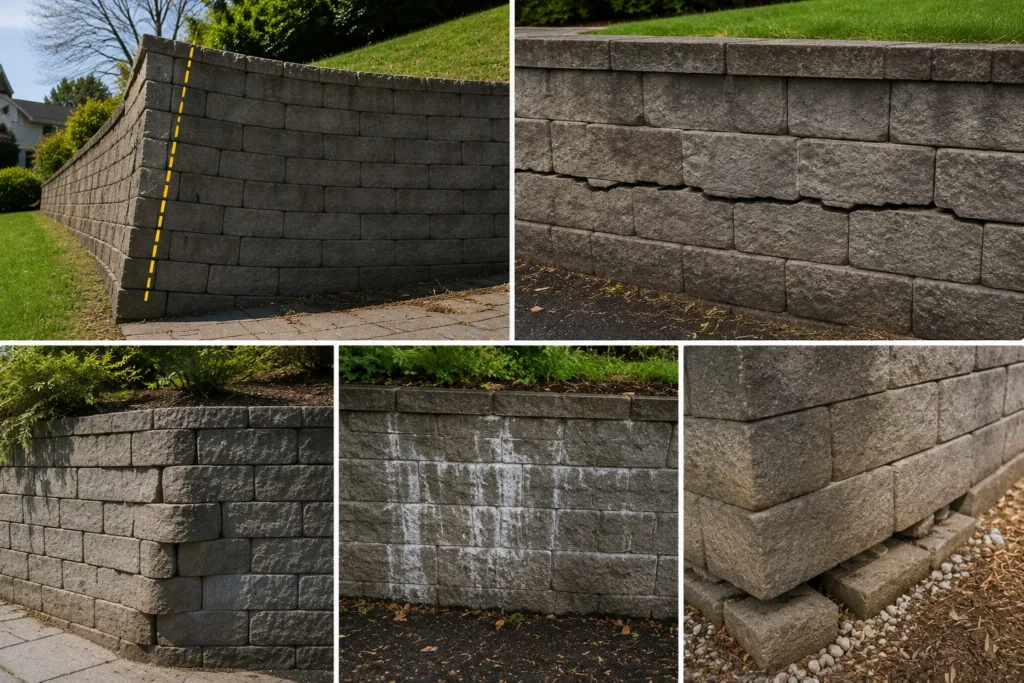
- Leaning or tilting more than 1 inch per 4 feet of height the most urgent sign, because leaning accelerates.
- Horizontal cracks across the face, which signal pressure the wall can no longer resist. Vertical hairline cracks matter less.
- Bulging sections where blocks push outward in one spot, usually from a clogged drain behind that area.
- Water stains or efflorescence — white mineral deposits that prove water sits inside the wall instead of draining.
- Sinking or separating blocks at the base, which point to a washed-out or poorly compacted foundation.
Repair costs run $250 to $1,000 for drainage fixes and minor resets. Full replacement of a leaning 30-foot wall runs $4,000 to $10,000. Catch problems at stage 1 and you pay 10 times less than at stage 5.
How Long Does a Concrete Retaining Wall Last?
A concrete retaining wall lasts 50 to 100 years with correct drainage, and as little as 15 years without it. Poured walls sit at the top of that range; block walls average 40 to 75 years.
Three habits stretch a wall’s life: keep drain outlets clear of leaves and soil, apply a penetrating silane-siloxane concrete sealer every 5 to 10 years in freeze-thaw states, and never pile new soil or heavy loads above the wall without checking its rated capacity. Walls in northern states face freeze-thaw cycles that crack unsealed concrete, so sealing matters most from Minnesota to Maine.
Which Wall Works Best for Your Soil Type?
Your soil decides your design before you pick a single block:
- Clay soil holds water and swells, so it demands the full drainage package plus wider gravel backfill — 18 inches (46 cm) instead of the standard 12.
- Sandy soil drains well but shifts, so it needs a deeper compacted base and often a wider footing.
- Sloped or terraced sites work better with 2 short tiered walls than 1 tall wall. Two 3-foot walls skip the permit threshold and cut engineering costs, if local code allows the setback between them.
A $300 soil test before construction beats a $5,000 rebuild after failure. Any geotechnical firm completes one in under a week.
Conclusion
A concrete retaining wall succeeds or fails on 3 material decisions: the concrete itself, the aggregate under it, and the drainage components behind it. Choose precast concrete blocks for walls under 4 feet, pour 3,500 PSI concrete with steel rebar for taller structures, and never cut the gravel backfill, filter fabric, or perforated drain pipe from your supply list those 3 items separate a 15-year wall from a 75-year wall.
Budget $25 to $95 per square foot installed, order 10% extra blocks and crushed stone aggregate from your supplier, and pull a permit for anything over 4 feet. Concrete outlasts timber by 40+ years and outmuscles every other retaining wall material on the market. Buy quality masonry supplies, compact the base course properly, and the wall you build in 2026 will still hold its slope in 2076.